

Recently, scammers have been running ads on social media promoting Circle750.com, a website claiming to provide free $750 gift cards to popular retailers. However, this is a scam site that uses deceptive promises of free gift cards to trick users into participating in online surveys, contests, and offers that only benefit the scammers.
This article will take an in-depth look at how the Circle750.com scam works, what happens when you attempt to claim the supposed gift cards, and most importantly, how to protect yourself from falling victim to this fraudulent scheme.
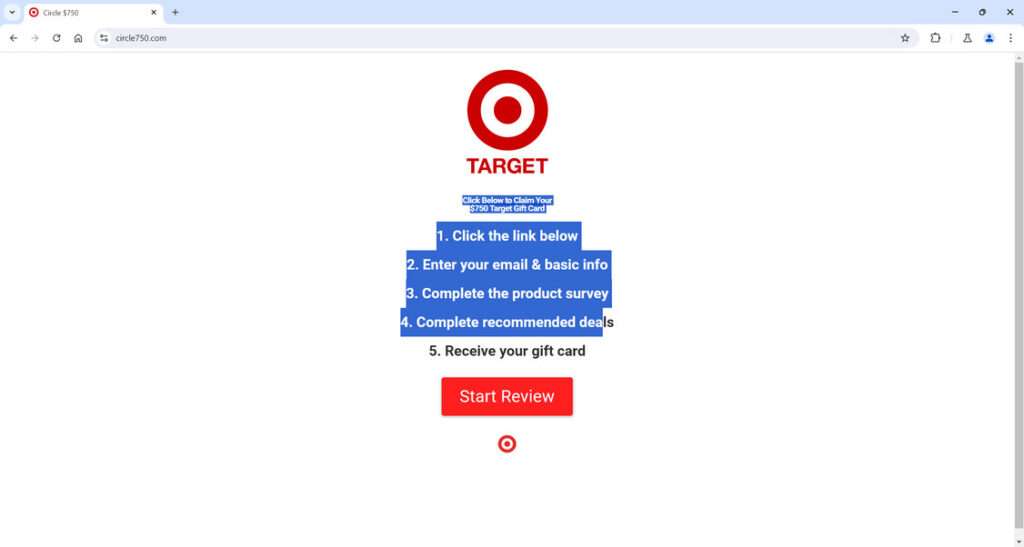
Overview of the Circle750.com Scam
The ads for Circle750.com are designed to entice users by advertising free $750 gift cards to retailers like Target, Walmart, Amazon, Zara, H&M, and more. The ads use language like “Answer a quick survey to claim your free $750 Target gift card!” and “Get a $750 Walmart gift card instantly!”
If users click the ad, they are taken to the Circle750.com website, which has a layout similar to a gift card rewards site. You are prompted to select your “free” gift card from major brands and then answer some basic questions to “verify eligibility.”
After entering your personal information, you are redirected to a third-party site and informed you must complete a few “mandatory tasks” to earn enough points to claim your gift card. These tasks include:
- Taking paid surveys
- Playing games
- Applying for offers
- Subscribing to trials
- Completing profile information
- Referring friends
The more tasks you complete, the more points you can supposedly earn towards redeeming the $750 gift card. However, this is a scam tactic to get users to complete as many paid offers as possible, which earns money for scammers through commissions and affiliate fees.
In reality, there is no free gift card. The Circle750.com site is a fraudulent front simply trying to profit off users through dubious tasks and offers. No matter how many points you “earn,” you will never receive a gift card reward.
Explanation of the Circle750.com Scam Process
Now let’s break down exactly how the Circle750 scam unfolds:
Step 1: You See a Social Media Ad for Circle750.com
While scrolling through your social feeds, you come across an ad promoting Circle750.com gift cards. The ad displays gift cards from major retailers like Target, Amazon, Nike, Sephora and claims you can get a $750 card for free.
The bright imagery showing the gift cards catches your eye. The promise of earning a $750 card without spending money seems enticing.
Step 2: The Site Asks You to “Verify Eligibility”
If you click the link in the ads, you are taken to the Circle750.com website. On the site, you are prompted to select which $750 gift card you want and then asked some basic questions to “verify eligibility” for the card.
The questions require you to enter personal details like your name, address, phone number, birthday, interests, and more. You are told this information is needed to claim your “free” gift card.
Step 3: You Are Redirected to Complete “Tasks”
After entering your personal information, you are redirected to a third-party website. Here you are informed that to get enough points for the $750 gift card, you must complete some “mandatory tasks.”
These tasks involve signing up for paid surveys, trials, subscriptions, applying for credit cards, downloading apps, playing games, watching videos, referrals, and more.
The site claims the more tasks you complete, the more points you’ll earn towards your gift card. A progress bar shows you supposedly getting closer to earning the card with each completed task.
Step 4: Scammers Profit, You Get Nothing
In reality, these tasks are designed solely to make money for the scammers, while costing users time and money. The scammers earn money through commissions, fees, selling data, and referrals.
There is no $750 gift card you can earn. The points and progress bars are fabricated to trick you into completing more and more scam offers. You will never receive any reward.
Meanwhile, you may have signed up for unwanted paid subscriptions, trials, and offers. You may have also downloaded malware or given up sensitive personal data. The scammers disappear with profits in hand, while users get nothing.
What to Do If You Fell for the Circle750.com Scam
If you completed any dubious tasks, offers, or gave your information on the Circle750.com site, here are the steps to take right away:
- Cancel any subscriptions, trials or services you registered for to avoid being charged. Monitor bank statements for any unauthorized payments as well.
- Run anti-virus software to check your device for any malware that may have been downloaded. Delete any suspicious programs.
- Change passwords on any accounts you may have entered on the site or tasks. Enable two-factor authentication where possible.
- Beware of potential follow-up scams from “Circle750 support” claiming they can provide the gift card for a fee. Cease communication.
- Watch for any misuse of personal information provided, like suspicious logins or ID theft attempts.
- Report details about the scam to the FTC, IC3, SEC, BBB, social networks, and other authorities to get the site shut down.
How to Avoid Gift Card Scams Like Circle750.com
Here are some tips to avoid falling prey to gift card scams in the future:
- Be skeptical of unsolicited social media ads promising free gift cards. If it seems too good to be true, it probably is.
- Research websites separately from the ads before providing any personal information or completing offers. Look for reviews and complaints.
- Exercise caution when entering sensitive information like your SSN, bank details, etc. Verify legitimacy first.
- Do not trust claims you need to complete tasks, offers, surveys or other steps to claim a promised reward. This is a red flag for scams.
- Use secure unique passwords on all accounts, and turn on two-factor authentication for an added layer of security.
- Routinely monitor your financial statements for any suspicious charges or activity. Report unauthorized charges ASAP.
- Avoid clicking directly on links in ads or messages. Type out site URLs manually or use trusted search engines to find sites.
The safest option is to ignore and report social media ads promoting free gift cards or rewards. If an offer looks suspicious, it’s best to trust your instincts and steer clear. Protect yourself from potential scams by being an informed consumer online.
Here is a detailed, SEO optimized FAQ about the Circle750.com gift card scam:
FAQ: The Circle750.com Free Gift Card Scam
1. What is Circle750.com?
Circle750.com is a scam website that falsely claims to provide free $750 gift cards to major retailers. The site uses deceptive ads and offers to trick users into providing personal information and completing dubious tasks.
2. How does the Circle750.com scam work?
The scam starts with social media ads promoting $750 gift cards from top brands. Users are taken to Circle750.com, asked to verify info, then redirected to complete “tasks” to earn points for the card. But it’s a fraud to get users completing offers that earn scammers money through commissions and selling data.
3. What happens when you try to get a gift card on Circle750.com?
When you attempt to claim a gift card, you have to provide personal information and complete tasks like surveys, subscriptions,downloads, referrals, games, and more. You never earn enough points to claim the promised gift card. There is no actual reward.
4. What are some red flags of the Circle750.com scam?
Red flags include promises of free gift cards, pressure to complete tasks, credit card/sensitive info requests, redirects to third-party sites, progress bars towards fake rewards, and unsupported claims about earning points/gift cards.
5. What should I do if I provided information to Circle750.com?
If you provided any personal or financial information, you should cancel any subscriptions/trials, scan your device for malware, change compromised passwords, watch for misuse of details provided, and report the scam to authorities.
6. How can I avoid the Circle750.com gift card scam?
Avoid clicking links in ads, research offers thoroughly, use secure passwords, don’t provide info easily, monitor statements, and be skeptical of free gift card offers. Report suspicious ads or sites.
7. Can I get scammed by gift card offers on legitimate websites?
Yes, gift card scams can appear even on legitimate sites through compromised ads. Still apply caution before providing info or completing offers with promises of free gift cards.
8. Where can I report the Circle750.com scam?
You can report this scam to the FTC, SEC, IC3, BBB, social networks, your bank, and other authorities. Reporting helps get scam sites shut down to prevent more victims.
The Bottom Line on the Circle750.com Scam
The supposed gift cards offered by Circle750.com are a fraudulent ploy to get users completing bogus offers, surveys, downloads, and referrals that generate illicit profits for scammers. There are no real rewards.
Be vigilant against too-good-to-be-true offers, exercise caution online, and report any scam attempts to disrupt these criminal operations. Avoid the financial losses and risks associated with gift card scams by recognizing the deceitful tactics used to lure unsuspecting consumers.








