

A big gift card. A store everyone knows. A few quick steps to claim it. Claimperks.store lines these up neatly, and on a budget, that looks like a lucky find.
Notice how little the page says about the steps, and how loudly the button shouts. Once you follow it, the offer on screen and the real deal split apart.
Overview
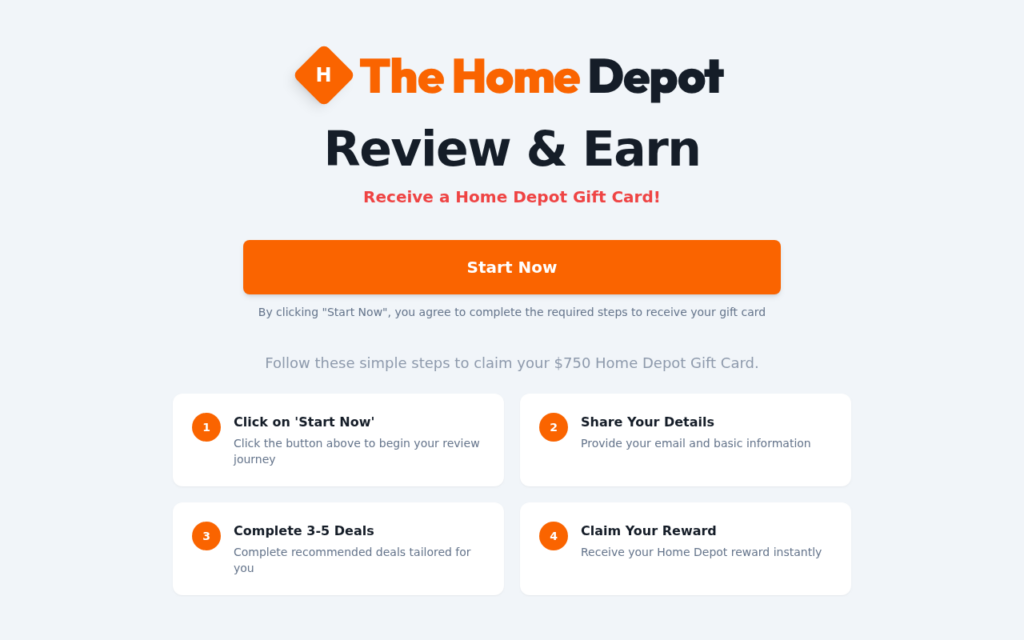
What you’re told on Claimperks.store
Claimperks.store hooks you with a big gift card headline and claim button, and similar pages usually add a famous retailer’s logo plus numbered steps toward “claim your card.”
Pages like this make the path sound tiny. Enter an email, answer a few questions, complete a few “recommended deals.” The details of those deals stay fuzzy until you’re in.
This offer doesn’t come from the store
The store named here has no hand in running this offer, never approved it and won’t send the card. Its name is borrowed for trust the site can’t earn.
The claim button opens a tracking link from an affiliate network, not the retailer. And the domain you’re on isn’t the retailer’s website to begin with.
The truth behind the “steps”
Behind the gift card bait sits a lead-generation funnel. This is what buttons like this one typically lead to:
- A tracking link that earns the operator money each time a visitor signs up.
- Sign-up forms that want your email, phone number, address and birth date.
- Offers paid for by sponsors, such as trials that cost money, subscriptions, app downloads and credit applications.
- Conditions that never stay put, so there’s always one more deal between you and the card.
- No company named to take responsibility for delivering the reward.
Claimperks.store is a gift card scam, plain and simple. Don’t give it your details. Don’t start the deals. And whatever the page promises, don’t expect a card at the end.
What We Found on Claimperks.store
Here’s what we noticed when we looked at Claimperks.store:
- The page’s title reads "Home Depot Review & Earn | Claim Your Gift Card".
- Its claim button opens a tracking link on giftclick.org, an affiliate network domain, not the website of the store it names.
How the Claimperks.store Gift Card Scam Works
Reward funnels like Claimperks.store are built from a single script. What shifts between pages is small: a new store name, a new amount and a new domain.
Step 1: The message that says you were chosen
You’ve been “selected,” says the text message, email or social media ad that brings most visitors in. The prize is a reward from a famous store, or products to test.
First the amount catches your eye, since it’s large enough to stop the scroll. Then the store’s name steps in with trust an unknown website could never earn alone.
A personal touch shows up in some messages, like your first name or a recent order. That information can come from an earlier data leak instead of the store.
Step 2: On the landing page, it all looks quick
On pages like Claimperks.store, the usual setup is a short list of numbered steps and a bright button to claim. “Complete a few deals” sounds brief and finite.
A countdown timer, an “only a few cards left” banner, a counter of people who “already claimed”: many of these pages add them. None of those numbers can be checked.
Step 3: An affiliate network sits behind the button
Press “Claim” or “Start now” and the next stop is a tracking link, not the store. That link files away the operator’s affiliate ID and the offer you clicked.
Affiliate links are standard stuff. What they show in this case is simple. You aren’t a winner being rewarded; you’re a lead being sold, right from the first click.
Step 4: The site turns your details into a product
First the pages want your email. After that come your name, phone number, home address and date of birth, and “survey” questions about income and shopping habits often follow.
Every answer you give makes you a more valuable lead to marketers. Quit halfway and those details can still drive emails, texts and calls for months.
Watch the checkboxes, too: some are ticked in advance. One “Continue” click with them left on can share your details with dozens of “marketing partners.”
Step 5: The sponsored deals come with real costs
Before the card is yours, the page says, you must finish sponsored deals. Think free trials, streaming plans, insurance quotes, credit applications, and mobile games played to a target level.
Here’s where the costs come in. Many need a payment card, an uncanceled trial can switch to full price, and a credit application can leave a hard inquiry.
Step 6: You wait, but the card never lands
Do a few deals and the page moves the goalposts. Suddenly you need more, a deal “didn’t track,” or your claim sits “pending review.”
By then, the operator has been paid for each sign-up you completed. The card was never the product, which is why there’s no one to contact about it.
Red Flags of Offers Like Claimperks.store
The same signs appear on almost every reward funnel. You only need the first one to be sure.
The card depends on completing “deals”
When a store gives away its own gift cards, it never makes you sign up for paid trials or credit. “Complete a few deals” signals an affiliate funnel.
A giant reward for barely lifting a finger
A form in exchange for a card worth hundreds? Stores don’t work that way, even when they run real giveaways. The size of the prize is part of the hook.
The domain belongs to someone other than the store
A big store’s name inside a strange address means an advertiser is using the brand. The store isn’t behind it. Check the address bar before you read further.
One click and you’re off the site
If you’re on a computer, hover before you click. The claim button on these pages points to a tracking domain, not to the retailer whose name it uses.
Nobody is accountable for the card
No company, no address and no support contact will send you the card or answer for it. A tiny footer line saying “not affiliated” doesn’t make up for that.
A message that came out of nowhere
If an unknown sender texts or emails to say you’ve “won” or been “selected,” that’s the funnel starting, not proof of a prize.
Countdown clocks and claims that cards are running out
All that urgency has one job: keeping you from checking. A genuine store promotion will still be there, unchanged, after you spend a day looking into it.
Why the Store’s Name Isn’t Proof
Scammers reach for famous stores because a familiar name persuades on its own. Costco, Target, Walmart and Amazon gift cards are common, and any trusted brand will work.
If you check, you’ll find big retailers regularly warning about fake surveys and reward messages carrying their name. They tell customers not to enter details through links they didn’t expect.
In 2013, operators of “free gift card” text campaigns that pushed people into paid offers were sued by the US Federal Trade Commission. The script has hardly changed since.
A store’s name in a headline is something to verify, not a guarantee. When the retailer’s own website says nothing about the offer, the offer doesn’t belong to that retailer.
What a Real Store Promotion Looks Like
Real retailers do offer gift cards, so a quick look at a genuine promotion helps. Put it beside a fake and the differences stand out right away.
- It shows up on channels the store controls: its website, its app or its verified social accounts.
- Its official rules name the company in charge, the prize and the date it ends.
- Taking part doesn’t depend on starting trials, installing apps or applying for credit.
- Surveys tied to a purchase use the address on your receipt. Loyalty rewards stay in your account with the store or in its app.
- You’ll be contacted through the account or channel you entered with if you win. A random text doesn’t count.
A “claim” button hiding the conditions is not how real promotions work. If an offer fails even one of these, treat the gift card as bait.
What the “Deals” Can Cost You
You won’t get the card, yet chasing it still comes with real costs. The usual ones look like this:
- Recurring charges. Full-price renewals on free trials and discounted plans when the cancellation window goes by unnoticed.
- Credit checks. A loan or credit card application isn’t harmless paperwork: it can leave a hard inquiry on your credit file.
- Spam and robocalls. Expect your email, phone number and address to travel to marketing partners you never picked.
- Follow-up scams. Expect more phishing and fake delivery texts: people who answered one “you won” offer make a valuable list for the next scammer.
- Apps that stick around. A mobile game installed to “unlock” the reward can keep tracking you or serving ads even after you’ve stopped playing.
- Lost time. Hours of surveys, games and offers, all for a reward that was never coming.
Even with no card in sight, these costs are genuine. The operator cashes in on every sign-up, leaving the visitor to cover the bills.
Same Funnel, New Domain
A page like Claimperks.store takes little money to build, often with an off-the-shelf website builder. Many near-identical ones exist, and they usually vanish within days of being reported.
Check the claim links and you’ll often see one affiliate ID repeated across several domains. That points to one operator running many pages at the same time.
The same fingerprints run through the pages when you line them up:
- A big gift card amount paired with a famous store name in the headline
- Three or four quick numbered steps that finish on “claim your card”
- A line saying you must “complete a few deals” to qualify
- The claim button, which opens an affiliate tracking link
- Counters or timers with nothing to back them up
The address changes, the store name changes, the amount changes. If the pattern is there, the funnel underneath is exactly the same.
How to Check a Gift Card Offer Before You Click
Real offers have nothing to hide from a two-minute check. Reward funnels fall apart under it.
- Check the source: open the store’s official site or app yourself, not through the link, and look for the promotion.
- On a computer, check where the claim button really goes by hovering before you click. A tracking domain instead of the store’s address answers it.
- Look up the site’s name alongside “scam” or “review.” Often a new funnel has no history at all, and that silence is a warning on its own.
- Search the fine print for “participation requirements,” “deals” or “offers.” Even one of them means the card comes with strings attached.
A single failed check settles it: close the page. Nothing there earns your email address, much less your card details.
What to Do If You Have Fallen Victim to This Scam
Here’s the good news if you entered details or started deals through Claimperks.store: most of the damage can be limited. You just need to act before the trial periods end.
- Shut down every trial and subscription. Work through each deal you signed up for, cancel it before the trial runs out, and save each confirmation of cancellation.
- Check your statements. Don’t recognize a small test charge or a recurring payment? Dispute it with your bank or card issuer.
- Get a fresh card number. If any page in this funnel received your card details, ask your bank to replace the card with a new number.
- Review your credit. New inquiries and unfamiliar accounts are what to look for on your credit report if you completed a loan or credit card application.
- Get ready for follow-up messages. Texts or emails about “your reward” or “a problem with your claim” are scams too. Don’t click the links inside them.
- Fix your browser and device. Pull any notification permissions these pages got, then run Malwarebytes Free if you installed anything. AdGuard stops many ads that lead there.
- Reset reused logins. If your account on the site shares a password with other accounts, give those other accounts a new password.
- Block and unsubscribe. Block the numbers that start calling or texting. For email, unsubscribe only from companies you recognize and mark the rest as spam.
- Report it. In the US, file at ReportFraud.ftc.gov; elsewhere, use your national fraud service. Also report the ad or message and tell the retailer whose name was used.
If the charge or subscription just won’t cancel, contact your bank or card issuer, which can usually dispute it. Most give you a few months, so act now.
Frequently Asked Questions
Is the Claimperks.store gift card real?
No. Think of Claimperks.store as an affiliate funnel wearing a gift card costume. It’s a scam that collects your details and pushes paid deals, and the card never comes.
Is Claimperks.store connected to the store it names?
No. The offer is built to look official by borrowing the store’s name and often its logo. If the retailer really offered this, its own website would show the promotion.
How does Claimperks.store make money?
Through affiliate commissions. The operator keeps a share of what advertisers pay for every email address, survey answer and completed deal.
I completed some deals. Will I get the gift card?
No. The best move now is to stop: no more deals. Cancel the trials and subscriptions you started, watch your statements closely, and skip any “pending” reward messages.
Why do I keep seeing the same offer on new websites?
Once a page is reported, starting over is easy for the operators, because the pages cost little. They move the same funnel to a fresh domain and rename the store.
What should I do if I get one of these offers by text?
Leave the link untouched, forward the text to 7726 (SPAM) if you’re in the US or the UK, and delete it. That forward helps your carrier block similar messages.
The Bottom Line
Claimperks.store isn’t about the gift card at all. It’s about paid affiliate deals, and it uses a famous store’s name and a big card as bait to get you there.
Never enter your details or start the deals. Completing offers to claim a free gift card is the trap, so close the page as soon as you see that request.
Those trials will renew unless you cancel them, so if you already took part, cancel every one. Check your statements and treat reward messages as the next scam.

Reviews & discussion
0 commentsShare a firsthand experience, or ask a question.
Community reviews
claimperks.store
Moderated reader experiences, not an editorial verdict.
Reviews
Be the first to review
Approved reviews for this site or product will appear here.