

Livesearchnow redirect is a computer virus, which will redirect your web browser when clicking on Google or other search results through click.livesearchnow.com to random landing pages, sponsored search results or simply web pages filled with ads.
![[Image: Click Livesearchnow redirect virus]](https://malwaretips.com/blogs/wp-content/uploads/mwt-media/a9/a9df0cfb677c441198fe03187c7f512bb0dfe7b75be37a44ddfafd189bb7e7fd/f522bed6cdfaa7721b3fa8660ba27b245c00c230e753dd16bd498b835448333d-623.webp "Livesearchnow redirect virus")
Livesearchnow redirect happens regardless of a web browser or search engine, and if you get sent to click.livesearchnow.com and then to random web pages, then your computer may be infected with Pihar, Tracur, ZeroAccess/Sirefef rootkit, DNS changing malware or potentially unwanted programs.
This infection is designed specifically to make money. It generates web traffic, collects sales leads for other dubious sites, and can display advertisements and sponsored links within your web browser.
Click.Livesearchnow.com virus is distributed through several means. Malicious websites, or legitimate websites that have been compromised, may drop this trojan onto a compromised computer. This drive-by-download often happens surreptitiously. Another method used to propagate this type of malware is spam email containing infected attachments or links to malicious websites. The threat may also be downloaded manually by tricking the user into thinking they are installing a useful piece of software.
Livesearchnow redirect virus is also prevalent on peer-to-peer file sharing websites and is often packaged with pirated or illegally acquired software.
Once install on a computer, the Livesearchnow virus will randomly redirect your web browser through click.livesearchnow.com to random landing pages, sponsored search results or simply web pages filled with ads. These landing pages are rarely the same, and in some particular cases may lead to additional malware being downloaded onto your computer.
Depending on what is causing the click.livesearchnow.com redirect, the malware removal process can be different for each particular case, however using the below guide, you should be able to remove this infection from your computer.
Click.Livesearchnow.com Redirect – Virus Removal Guide
STEP 1: Remove Livesearchnow infection with Kaspersky TDSSKiller
As part of its self defense mechanism, Click.Livesearchnow.com will install a ZeroAccess rootkit on the infected computer.In this first step, we will run a system scan with Kaspersky TDSSKiller to remove this rookit.
- Please download the latest official version of Kaspersky TDSSKiller.
Download TDSSKillerYour download starts right away. - Before you can run Kaspersky TDSSKiller, you first need to rename it so that
you can get it to run. To do this, right-click on the TDSSKiller.exe icon and select Rename.
Edit the name of the file from TDSSKiller.exe to iexplore.exe, and then double-click on it to launch. - Kaspersky TDSSKiller will now start and display the welcome screen and we will need to click on Change Parameters.
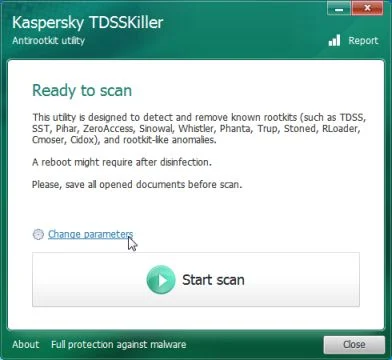
- In the new open window,we will need to enable Detect TDLFS file system, then click on OK.
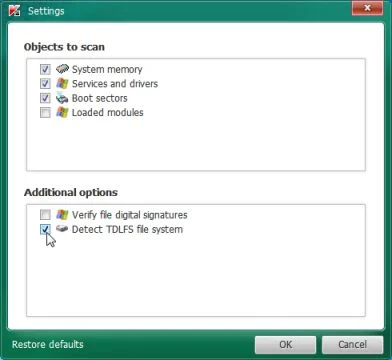
- Next,we will need to start a scan with Kaspersky, so you’ll need to press the Start Scan button.
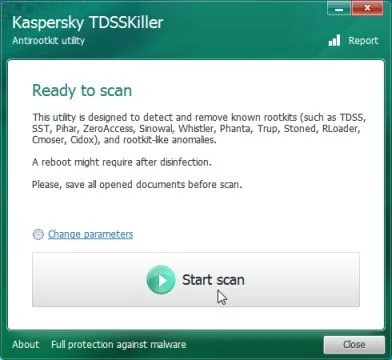
- Kaspersky TDSSKiller will now scan your computer for Click.Livesearchnow.com virus.
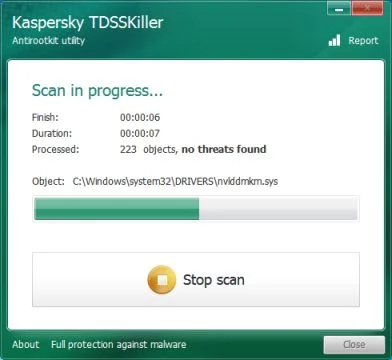
- When the scan has finished it will display a result screen stating whether or not the infection was found on your computer. If it was found it will display a screen similar to the one below.
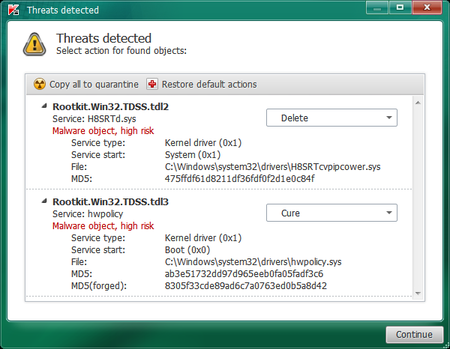
- To remove the infection simply click on the Continue button and TDSSKiller will attempt to clean the infection.A reboot will be require to completely remove any infection from your system.
STEP 2: Remove Livesearchnow malicious files with Malwarebytes Anti-Malware FREE
Malwarebytes Anti-Malware is a powerfull on-demand scanner which will remove Livesearchnow malicious files from your computer.
- You can download Malwarebytes Anti-Malware Free from the below link, then double click on it to install this program.
Download MalwarebytesFree official installer. Your download starts right away. - When the installation begins, keep following the prompts in order to continue with the setup process. DO NOT make any changes to default settings and when the program has finished installing, make sure you leave both the Update Malwarebytes’ Anti-Malware and Launch Malwarebytes’ Anti-Malware checked,then click on the Finish button.
![[Image: Malwarebytes Anti-Malware final installation screen]](https://malwaretips.com/blogs/wp-content/uploads/mwt-media/47/471448d4dd5aa1d55ea545effccf0ac9c8ccb5a29622da4e38ac677b5d8c37b5/9f473303c15a00262451cc5a56b904de929157b59e19e3cfb2c03ec88f643390-402.webp "Malwarebytes Anti-Malware final installation screen")
- On the Scanner tab,select Perform quick scan and then click on the Scan button to start scanning your computer.
![[Image: Malwarebytes Anti-Malware Quick Scan]](https://malwaretips.com/blogs/wp-content/uploads/mwt-media/1e/1eb209597ca2f06e596fd060345ac7e3100355f1ec8fc8ea2d9dec7abbb05ea0/3afba9b0b97b56945ffc33817ac48f7433c799241a22e422966180b76473a906-521.webp "Run a Quick Scan with Malwarebytes Anti-Malware")
- Malwarebytes’ Anti-Malware will now start scanning your computer for Livesearchnow malicious files as shown below.
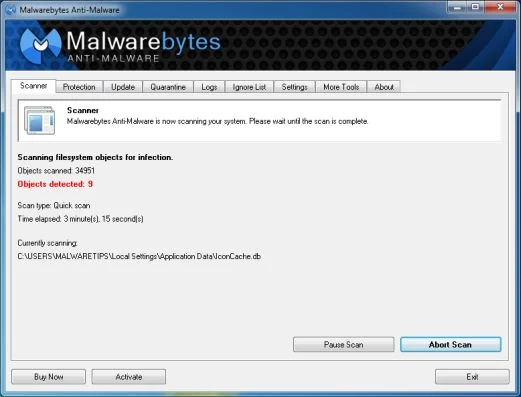
- When the Malwarebytes scan will be completed,click on Show Result.
![[Image: Malwarebytes Anti-Malware scan results]](https://malwaretips.com/blogs/wp-content/uploads/mwt-media/84/84c62dd46289424dbc686abc53672cb0810111920c8c0bbd69e973844d0a9ab0/a4c04aa700e641f47afec9965f79ff346740668e5952955ccbe5b4c3658b5897-521.webp "Malwarebytes when the system scan has completed")
- You will now be presented with a screen showing you the malware infections that Malwarebytes’ Anti-Malware has detected.Please note that the infections found may be different than what is shown in the image.Make sure that everything is Checked (ticked) and click on the Remove Selected button.
![[Image:Malwarebytes removing virus]](https://malwaretips.com/blogs/wp-content/uploads/mwt-media/d8/d86b6a8bac0e4ece9fd2d259a83db71487943f6b04b567edb0e9adcc3200f492/4eb94651b0e34cc99689c56dc71cd0a49444498ed05c5803ea55fda1cfee1b1f-521.webp "Click on Remove Selected to get rid of")
- After your computer restarts, open Malwarebytes Anti-Malware and perform a full system scan to verify that there are no remaining threats.
STEP 3: Remove Livesearchnow redirect rootkit with HitmanPro
In some cases,Livesearchnow will also install a rootkit on victims computer. To remove this rootkit we will use HitmanPro.
- Download HitmanPro from the below link,then double click on it to start this program.
Download HitmanProOfficial Sophos download. Free scan, free 30-day trial to remove threats.
IF you are experiencing problems while trying to start HitmanPro, you can use the Force Breach mode.To start HitmanPro in Force Breach mode, hold down the left CTRL-key when you start HitmanPro and all non-essential processes are terminated, including the malware process. (How to start HitmanPro in Force Breach mode – Video) - HitmanPro will start and you’ll need to follow the prompts (by clicking on the Next button) to start a system scan with this program.
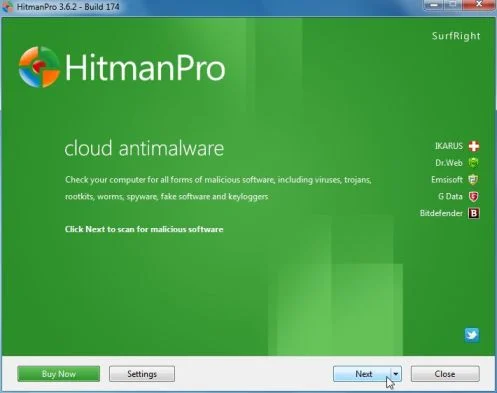
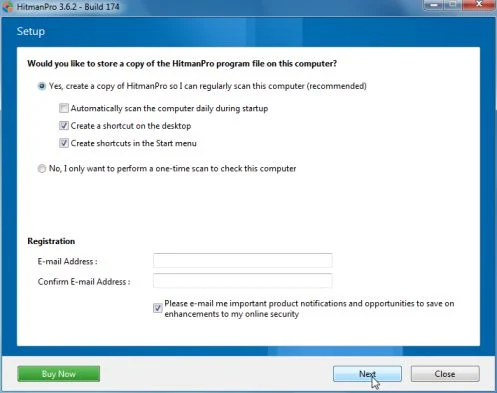
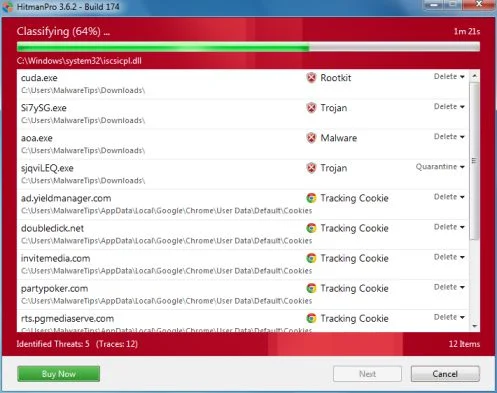
- HitmanPro will start scanning your computer for Livesearchnow malicious files as seen in the image below.
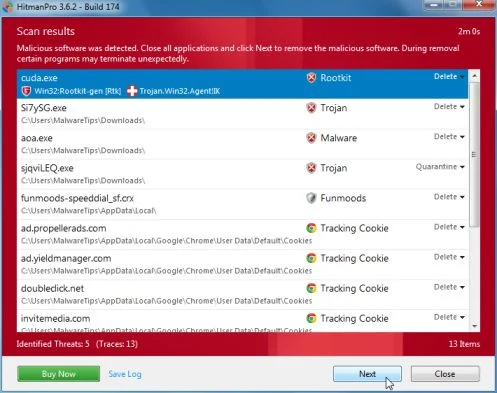
- Once the scan is complete,you’ll see a screen which will display all the infected files that this utility has detected, and you’ll need to click on Next to remove this malicious files.
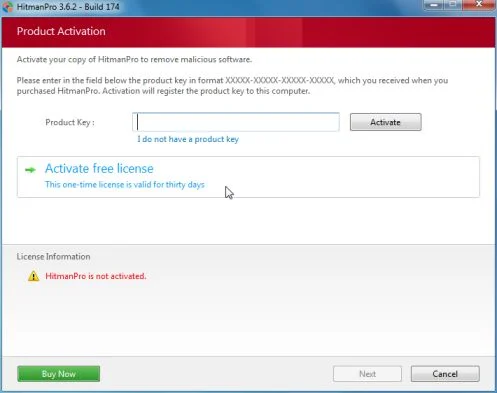
- Click Activate free license to start the free 30 days trial and remove all the malicious files from your computer.
STEP 4: Remove Livesearchnow malicious registry keys with RogueKiller
- Please download the latest official version of RogueKiller.
Download RogueKillerOpens the download page in a new tab. - Double click on RogueKiller.exe to start this utility and then wait for the Prescan to complete.This should take only a few seconds and then you can click the Start button to perform a system scan.
![[Image: RogueKiller scanning for Livesearchnow virus]](https://malwaretips.com/blogs/wp-content/uploads/mwt-media/a0/a0d25d880942dfa26618376c62dfb6122db4dce6da1f98af88226492d891c726/3b18c4b4589830dce38a71c95707969fb78876e99bee478a38dc5859de121469-600.webp "Click on the Start button to perform a system scan")
- After the scan has completed, press the Delete button to remove any malicious registry keys.
![[Image: Remove Livesearchnow virus with RogueKiler]](https://malwaretips.com/blogs/wp-content/uploads/mwt-media/9f/9f4f19530cf788dadd63ca5cb2b699db64b2c458570562cf64119031399aa734/977a2f35e7391111faf80a98edc26af95eb5f7edac47e879725c2d4fde16a6b2-600.webp "Press Delete to remove the malicious registry keys")
STEP 5: Remove Livesearchnow redirect from Internet Explorer, Firefox and Google Chrome
Remove Livesearchnow redirect from Internet Explorer
- Open Internet Explorer, click on the gear icon
![[Image: icongear.jpg]](//malwaretips.com/images/removalguide/icongear.jpg "Remove Click.Livesearchnow.com virus (Removal Guide) 1") (Tools for Windows XP users) at the top (far right), then click again on Internet Options.
(Tools for Windows XP users) at the top (far right), then click again on Internet Options.
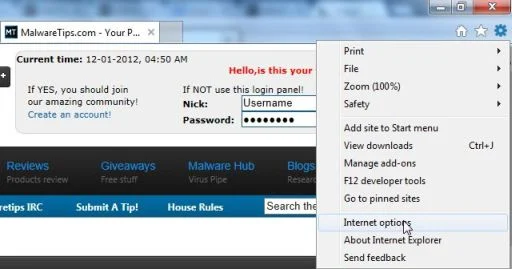
- In the Internet Options dialog box, click on the Advanced tab, then click on the Reset button.
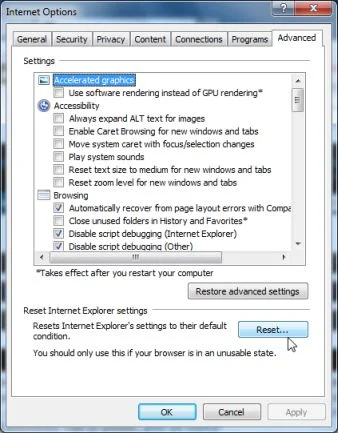
- In the Reset Internet Explorer settings section, check the Delete personal settings box, then click on Reset.
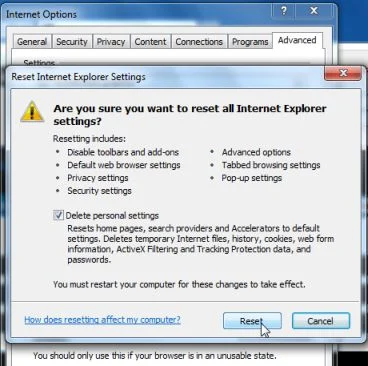
- When Internet Explorer finishes resetting, click Close in the confirmation dialogue box and then click OK.
- Close and open Internet Explorer.
![[Image: icongear.jpg]](http://malwaretips.com/images/removalguide/icongear.jpg "Remove Click.Livesearchnow.com virus (Removal Guide) 1") (Tools for Windows XP users) at the top (far right), then click again on Internet Options.
(Tools for Windows XP users) at the top (far right), then click again on Internet Options.Remove Livesearchnow redirect from Mozilla Firefox
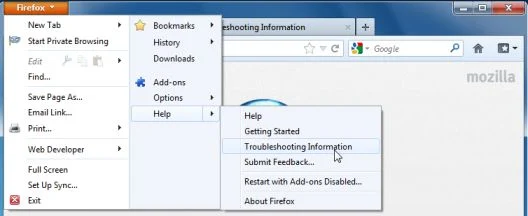
- At the top of the Firefox window, click the Firefox button, go over to the Help sub-menu (on Windows XP, click the Help menu at the top of the Firefox window), and select Troubleshooting Information.
- Click the Reset Firefox button in the upper-right corner of the Troubleshooting Information page.
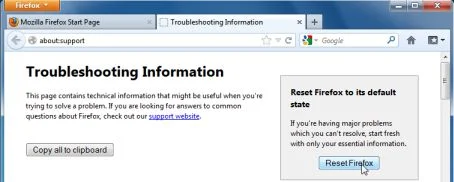
- To continue, click Reset Firefox in the confirmation window that opens.
- Firefox will close and be reset. When it’s done, a window will list the information that was imported. Click Finish
Remove Livesearchnow redirect from Google Chrome
- Click the Chrome menu
 button on the browser toolbar, select Tools and then click on Extensions.
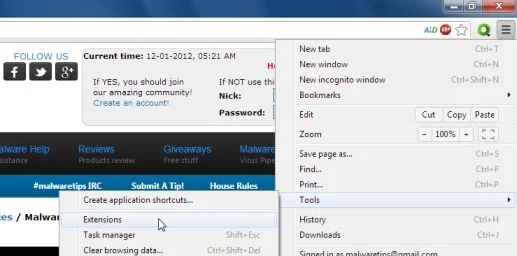
- In the Extensions tab, remove (by clicking on the Recycle Bin button) Printer Helper and any other unknown or unwanted extensions from Google Chroome.
STEP 6: Remove Livesearchnow residual damage from your browser with AdwCleaner
- You can download AdwCleaner from the below link.
Download AdwCleanerFree official download. Nothing to install. - Before starting this utility, close all open programs and internet browsers.
- Double click on adwcleaner.exe to run the tool.
- Click on Delete, then confirm each time with Ok.
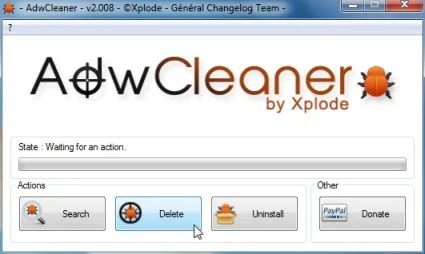
- Your computer will be rebooted automatically. A text file will open after the restart.
- NEXT, double click on adwcleaner.exe to run the tool.
- Click on Uninstall, then confirm with yes to remove this utility from your computer.

Join the discussion
0 commentsShare your experience or ask a question about this article.
Your progress
Did these steps help?
Let us know how the guide worked for you.
Describe what you see and the step you reached. Keep passwords and other private information out.
Discussion
Start the conversation
Have a question or something useful to share? Add the first comment.