

CoBIO pillow reviews can mean more than deciding whether a contour pillow feels comfortable. Sometimes you are trying to understand an order that has become difficult to follow.
Before sending another message or accepting another promise, look at the record behind the name and the options attached to your own payment.
Overview
A serious unanswered-complaint record
The BBB profile for Cobio Sleep gives the business an F rating and cites failure to respond to thirty-two complaints.
That is a concrete reason for caution, not merely one anonymous negative review. It does not prove that every pillow purchase failed or every item was defective.
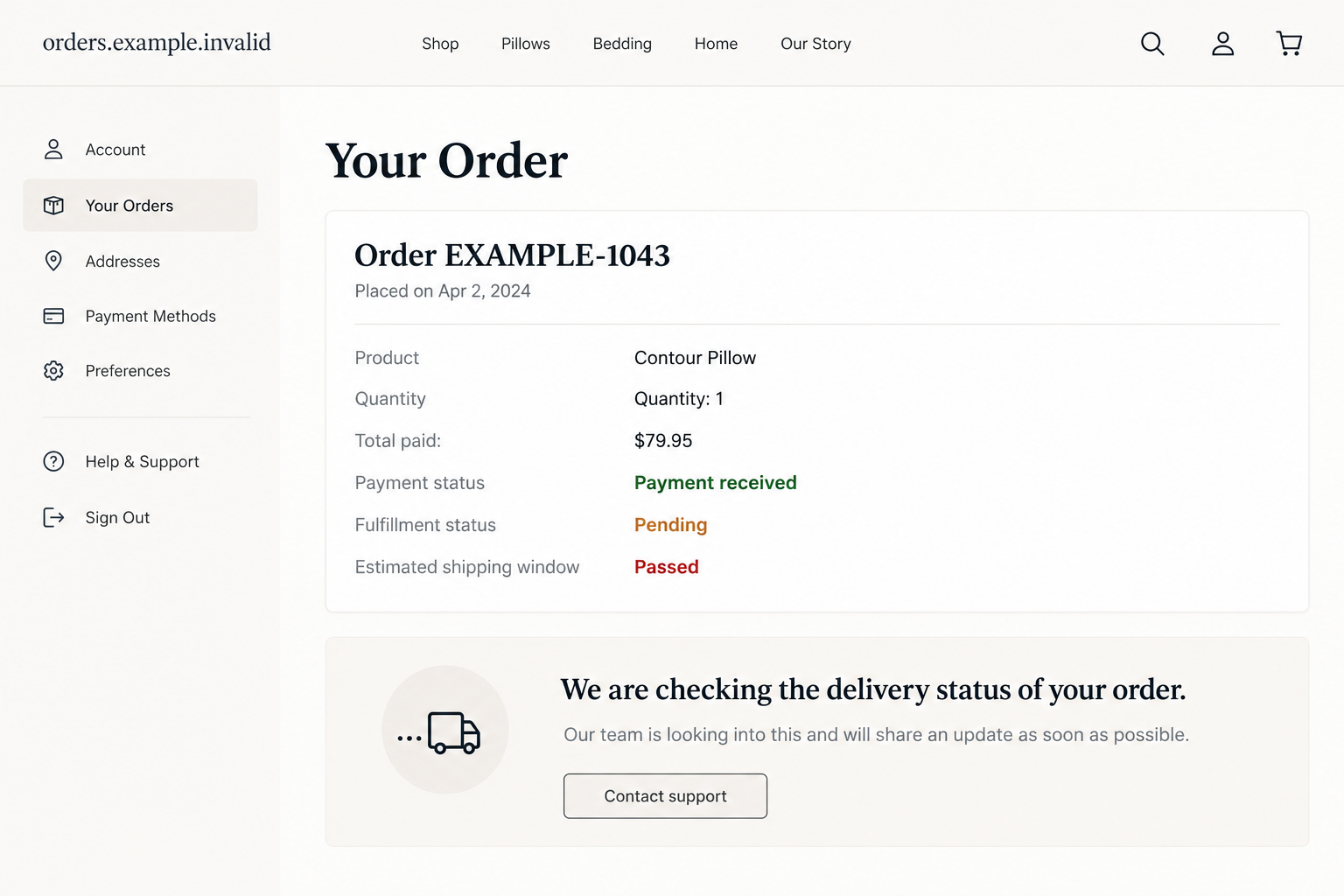
The article’s interfaces are fictional illustrations of order and refund checks. Our evidence comes from published records, not a customer’s private account or a test purchase.
The documented accounts concern older orders
The complaints reviewed include 2025 accounts concerning orders placed in late 2024. They describe missing merchandise, refund delays, and repeated support exchanges.
We reviewed the record on October 8, 2026. That does not turn the historical complaints into a newly verified wave of 2026 transactions.
- Match the business and domain on your original receipt.
- Separate non-delivery from dissatisfaction with a delivered pillow.
- Distinguish a refund request from a completed credit.
- Keep the original purchase, delivery, and contact dates.
- Ask the provider about deadlines instead of assuming a support queue pauses them.
Do not place more weight on a promise than a completed remedy
Our assessment is a serious delivery-and-refund risk warning. We did not authenticate every customer’s evidence or establish a court finding of fraud.
We also could not inspect the linked retailer’s current offer. Do not assume another store selling a similarly named pillow is the same operator.
Before a new purchase, verify the current merchant and purchase protection. For an unresolved old order, act through your records and provider rather than waiting without a plan.
What CoBIO Pillow Reviews Reveal About the Waiting Cycle
There is an important difference between a delayed package and a transaction that remains unresolved through repeated delivery and refund promises.
A delay can happen at a legitimate business. It becomes harder to assess when each message changes the explanation without producing merchandise or repayment.
The published accounts describe that kind of extended uncertainty. One customer says a December 2024 order was still unresolved after months of correspondence in 2025.
We did not verify the private exchanges. The value of the public record is that it identifies questions worth asking, not that it resolves every disputed fact.
If your own case feels similar, compare specific events. When was payment taken, when was delivery promised, and when did you first ask for a refund?
Then identify the latest completed action. An apology, an escalation, a queue position, and a promise to reship are not the same as receiving the remedy.
That simple distinction can make an exhausting email thread easier to understand. You are looking for an outcome, not just another reassuring message.
A clear timeline also helps a provider evaluate the purchase without relying on a broad accusation or a collection of unrelated reviews.
How the Reported CoBIO Order Problems Unfolded
Step 1: A pillow purchase creates an expectation
The published record concerns consumers who ordered pillows online. We did not independently recover every original advertisement or the purchase conditions shown to each buyer.
For your own case, start with the actual representation: the item, quantity, condition, delivery promise, and any trial or refund agreement.
A review of comfort cannot establish those conditions. Neither can a policy currently displayed by an unconnected retailer with a similar product name.
Save the exact receipt and storefront address. Those records connect the expectation to a specific payment and seller.
Step 2: Payment leaves the account before fulfillment is settled
A paid order and a shipped order are different events. Record the charge separately from any label, tracking email, or carrier scan.
One complaint reports a $127.78 order placed in December 2024. The customer describes subsequent months of refund requests without reimbursement.
That amount is a reported transaction, not a price we independently verified or a universal CoBIO pillow cost.
For a disputed order, match every charged amount against your confirmation. Include separate delivery or protection fees rather than considering only the pillow’s advertised price.
Step 3: Shipping explanations prolong uncertainty
Some accounts describe unusual tracking or explanations that an order had been delayed or lost. We did not independently examine those shipments.
For your own parcel, check the carrier record through an independently located service. Ask what events actually show acceptance, movement, or delivery.
A store’s status update can be useful, but it should not substitute for information that connects a shipment to your order.
If a replacement is offered, ask for a concrete dispatch date and whether accepting it changes the refund request. Keep that agreement in writing.
Step 4: The buyer enters a refund or escalation queue
Several published complaints describe continued correspondence after a refund was requested. Some say the response repeatedly referred to processing or escalation without an actual credit.
A queue may be part of an ordinary support operation. Its existence is not a guarantee that the payment has been reversed.
Ask whether the refund was approved, what amount was submitted, when processing occurred, and which payment reference confirms it.
If only a future promise is available, record it as a promise. Do not mark the case resolved until the relevant remedy is completed.
Step 5: Waiting can consume the time available for other action
The risk is not only frustration. Continued waiting may affect available payment-dispute procedures, especially for an order placed long ago.
Contact the provider while the matter is unresolved. Ask what deadline applies and what documentation is needed; do not assume merchant correspondence suspends that deadline.
If you already missed a standard period, explain the complete history without assuming recovery remains guaranteed. Different payment methods and circumstances may produce different options.
A realistic answer from the provider is more useful than another month spent waiting for a case status that never changes.
A Refund Queue Is Not a Completed Credit
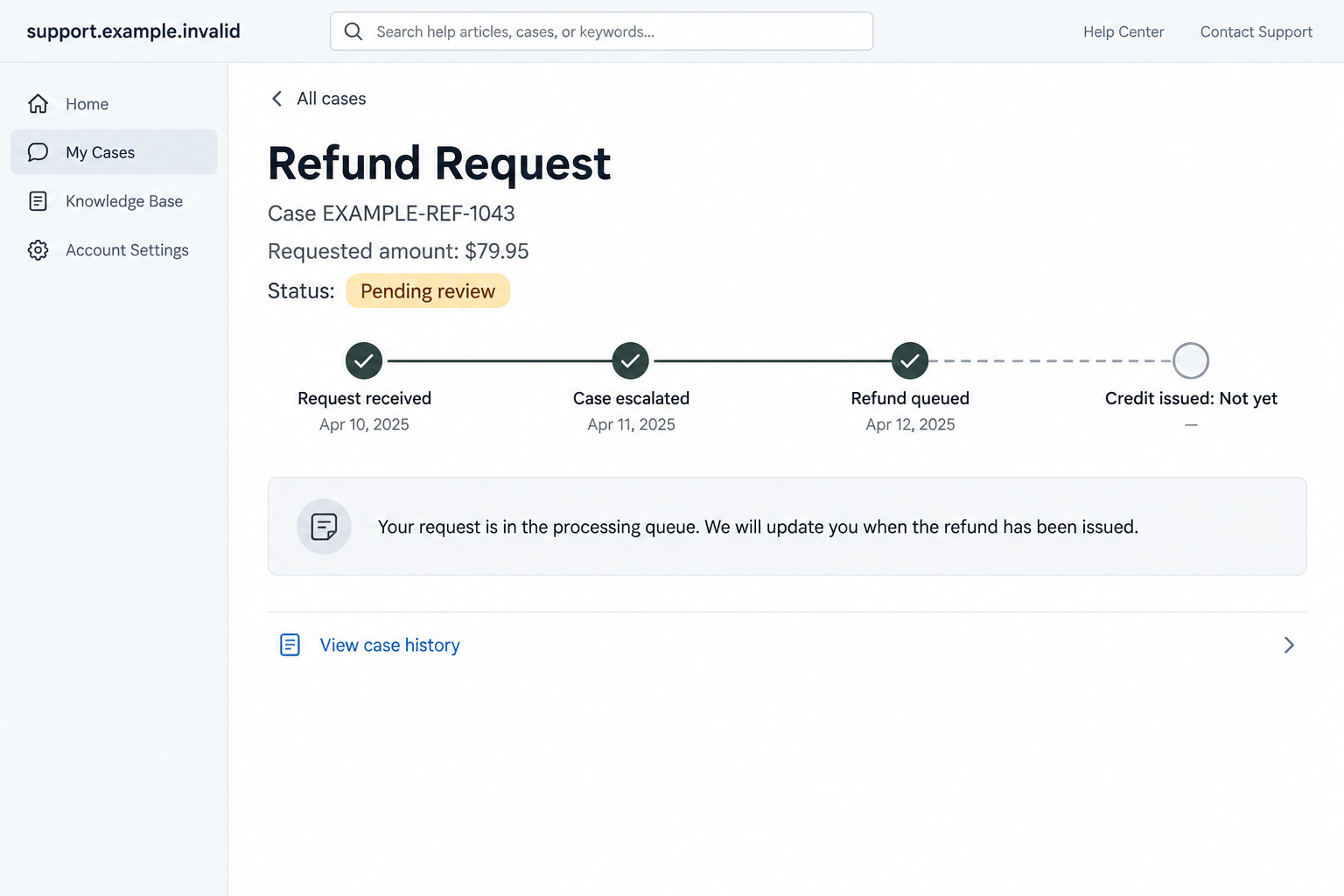
The fictional interface below illustrates the difference between a request progressing through support and money actually being returned.
It is not a capture from CoBIO’s account system or evidence of a particular customer’s refund. The reported experiences are documented separately in the public complaint record.
Use the same distinction with your own paperwork: request received, review completed, refund authorized, and credit posted are separate events.
A provider may need processing information to trace an alleged refund. Ask the seller for the relevant payment confirmation instead of another general status update.
If a partial refund arrives, record it accurately. A partial amount does not settle a larger claim unless that is the agreement you knowingly accepted.
Company, Address, and Fulfillment Checks
Identify Cobio Sleep through your receipt, not a similar name
The BBB record is for Cobio Sleep and lists cobiosleep.com. That does not establish a connection to every business using CoBIO, Cobio, or another related spelling.
We did not independently establish the full legal corporate chain. Check the seller and payment descriptor on the order you actually placed.
If a different domain appears, preserve it and ask the provider about the connection. A similar pillow photograph is not sufficient identification.
A Boulder city listing does not prove a factory location
The profile lists Boulder, Colorado 80302. We did not verify a factory, warehouse, office, or authorized return depot there.
Do not assume a city-level business listing identifies where your pillow was made or where an unwanted item should be sent.
If a return is proposed, get a complete receiving address and reference. Verify the instructions against the merchant attached to your receipt.
The listed phone was not tested in this investigation
BBB publishes (325) 246-9013 for the record reviewed. We did not call it or establish its current response behavior.
Customer accounts describing unanswered messages remain reports, not our own support test. Likewise, a listed number is not evidence that a refund inquiry will succeed.
Use known order contacts and provider information carefully. Do not disclose account passwords or pay a new verification fee to someone claiming to resolve an old purchase.
The actual pillow and supply chain remain separate questions
We did not test the foam, examine a delivered pillow, or establish the manufacturing country. Missing merchandise does not support a conclusion about every pillow’s materials.
For an item you received, document its condition, labeling, packaging, and differences from the saved description. Keep the product identifiable.
Do not replace a documented delivery or refund issue with an unsupported allegation of contamination, counterfeit contents, or unsafe manufacture.
Do Not Let Support Messages Replace Payment Deadlines
The FTC’s US guidance describes credit-card billing-error disputes within sixty days after the first statement containing the error was sent.
That is not a universal deadline for every remedy worldwide. Debit cards, payment services, particular dispute categories, and local laws can involve different procedures.
Ask your own provider what applies. Do not confuse a seller’s trial period with the provider’s reporting period.
For the historical orders discussed here, substantial time has passed. We cannot promise a standard dispute remains available for a transaction from 2024.
Contact the provider anyway to obtain a transaction-specific answer. Explain any existing dispute, refund promise, return, or repayment accurately.
Do not alter dates to make the claim seem newer. A truthful chronology is essential even when the outcome may be disappointing.
What to Do If You Ordered a CoBIO Pillow
- Build one complete purchase timeline.
Record the order date, merchant, total, delivery estimate, charge, tracking events, and first complaint. Add each promised remedy and its deadline.
Keep messages in order so the provider can see what happened without reconstructing a long collection of disconnected screenshots.
If you cannot locate a receipt, note which account and payment method you checked. That helps identify the remaining gap.
- Classify the actual problem.
Separate never-received merchandise, a delivered item that differs from its description, dissatisfaction with comfort, and an approved refund that did not arrive.
These issues can require different evidence. Do not describe a purchase you authorized as card theft merely because the seller disappointed you.
- Ask for a concrete final remedy.
If contacting the merchant remains possible, state whether you want delivery, a return, or reimbursement. Request the exact amount and completion date.
A replacement offer should be evaluated separately. Do not accept another unspecified shipment if your goal is to end the transaction.
- Check a claimed refund against the account.
Ask whether it was actually processed and request the relevant confirmation. Review the original payment method for the credit.
Record partial amounts and dates honestly. An email saying the refund is queued is not proof that money has been returned.
- Consult the provider promptly, even for an older order.
Ask about the applicable deadline and remaining options. Supply the timeline, receipt, communication record, and any evidence of return.
Be realistic about a long-past purchase. A provider can assess the situation, but this article cannot guarantee that a closed period can be reopened.
- Preserve the pillow if condition is disputed.
Keep packaging and clear photographs of a supplied item. Obtain authorized return instructions before mailing it to an address found online.
If a carrier returns the parcel, retain that evidence and inform the provider. Do not repeatedly pay postage without clarification.
- Report the facts and avoid a second loss.
Provide a factual account to an appropriate consumer agency when suspected deception remains unresolved. Include the exact domain and payment name.
Reject strangers offering guaranteed recovery for an advance payment. They do not become trustworthy because they know which pillow you bought.
Frequently Asked Questions
What did BBB say about Cobio Sleep?
The profile reviewed listed an F rating and failure to respond to thirty-two complaints. That is a serious public record, not a court judgment about every order.
Are these newly verified 2026 complaints?
No. Many published accounts date from 2025 and describe late-2024 orders. Our review date does not change when the reported purchases occurred.
Does a closed complaint mean the customer received a refund?
Not automatically. Administrative closure and a completed reimbursement are different matters. Look for the recorded outcome instead of inferring repayment from the word closed.
Are the illustrated interfaces actual customer records?
No. They contain fictional data and explain order-status and refund concepts. The evidence cited in this article comes from the public BBB record.
Can I still dispute an order from 2024?
Ask your payment provider. Significant time has passed, so standard periods may have expired. We cannot promise a refund or a particular remaining remedy.
Should I treat any similarly named pillow store as the same company?
No. Match the domain, legal seller, and payment descriptor to your receipt. Similar names or photographs do not establish common ownership.
The Bottom Line
CoBIO pillow reviews reveal a serious historical delivery-and-refund complaint record. Repeated assurances should not replace a verified outcome or attention to payment deadlines.
For a new purchase, verify the current merchant first. For an unresolved order, organize the evidence, contact the provider, and do not spend more chasing a promised remedy.








