

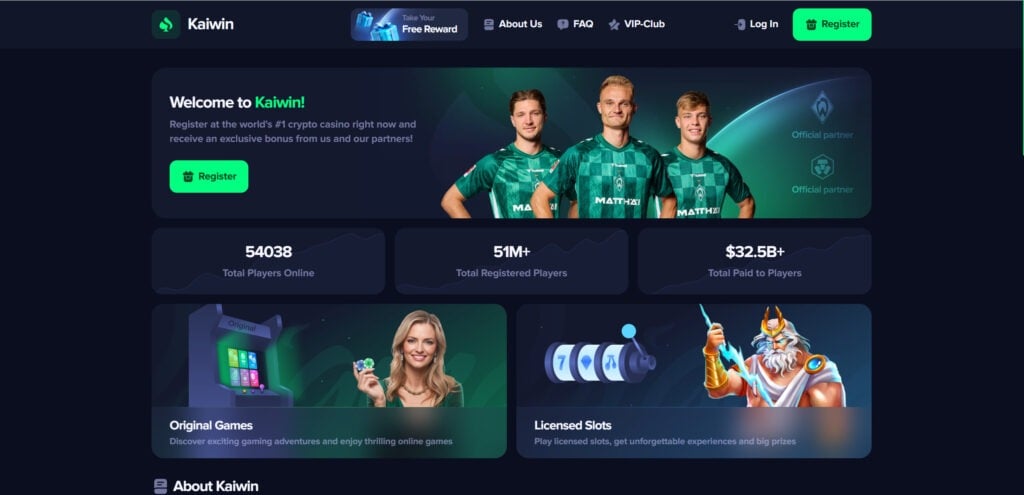
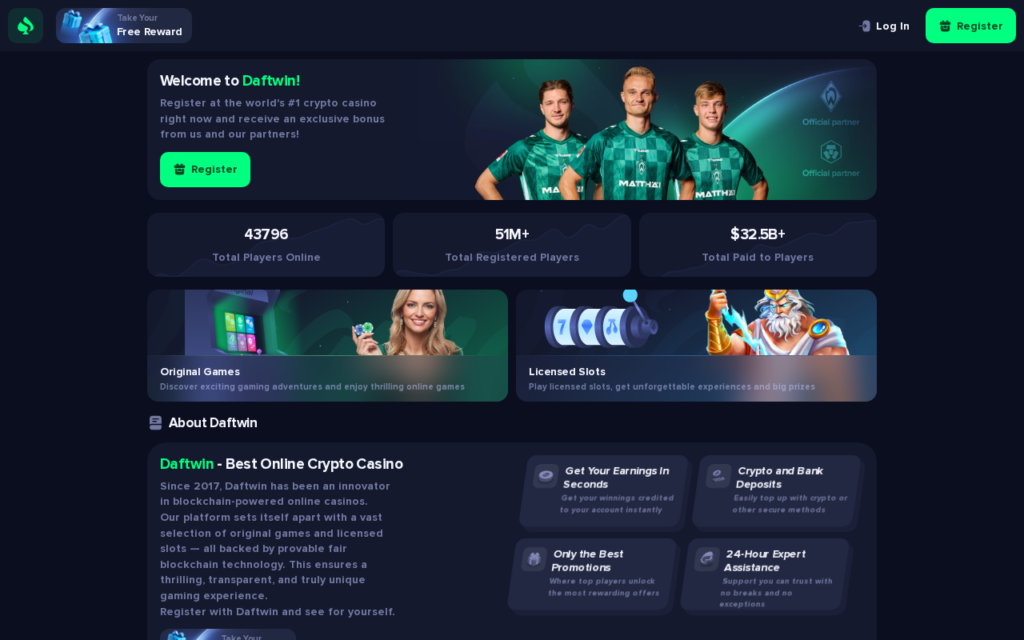
Land on Daftwin.com and it looks like a modern crypto casino: a slick lobby, the usual games and a promo code that adds a big bonus at signup.
Generous, right? Only until you try to withdraw. That’s the point where Daftwin.com shows what it was really built for.


Overview
Trust is the first thing this crypto casino sells
The pitch from Daftwin.com is that it’s a decentralized gaming platform. To sell that image, it leans on the signs people trust in a real crypto casino:
- A self-awarded “#1” ranking that no source ever backs up.
- Crypto jargon, including “blockchain,” “decentralized” and “provably fair.”
- A slick lobby styled after well-known crypto casinos.
- A game list packed with familiar titles like Crash, Plinko, Mines and slots.
- A hefty bonus that shows up immediately after registration.
- A constant stream of “recent wins” and “withdrawals” in live feeds.
It’s built to look busy, modern and well funded on your first visit. Give it the test you’d give any place holding your money, though, and the holes appear.
Name-dropping without evidence
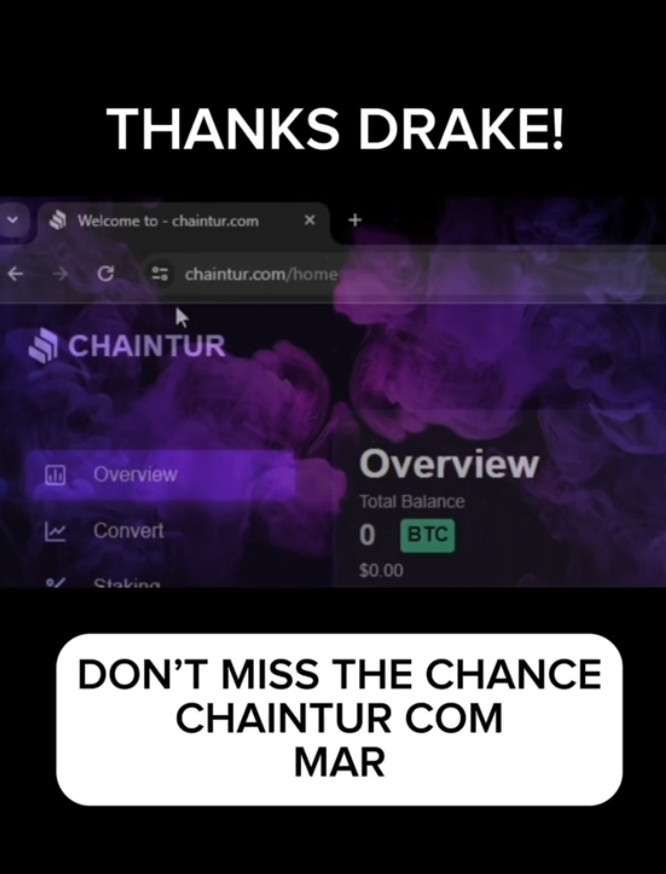
Elon Musk, MrBeast, Drake, Jeff Bezos, Bill Gates: these names often appear as the supposed money behind sites like this. Some pick Cristiano Ronaldo or Taylor Swift.
You won’t find credible evidence that any of them has a role in these casinos. The names are meant to stop questions in their tracks.

On social media, people move fast and rarely stop to check, which is why fake endorsements work so well there. These casinos tend to advertise on those platforms.
A promo code in a comment is not how a celebrity launches a casino. That kind of launch would be front-page news. Their official accounts will tell you the truth.
The point where the money stops moving
Sign-up is smooth and the games run fine. The snag comes with the first withdrawal, when the site suddenly asks for a new crypto deposit to “verify” your account.
The scam is the deposit. If you pay, you’ll be asked for more. If you don’t, the balance you see stays exactly as it is.
You’ll usually see the demand presented under an official-sounding label:
- Verification deposit
- Activation fee
- Network fee
- Security deposit
- Wallet validation
The labels rotate, but the logic never does. You’re asked to pay extra just to touch money you supposedly already have.

Daftwin.com is a fake crypto casino. Whether the charge is called “verification” or “activation,” don’t pay it to unlock a withdrawal, and don’t deposit.
How the Daftwin.com Scam Works
No matter which site runs this scam, the funnel is the same. Step by step, it steers you to your first withdrawal, where the real ask begins.
Step 1: Ads and chat groups seed the promo codes
Daftwin.com and sites like it are rarely found through search. They’re pushed through TikTok clips and YouTube ads, Facebook and Instagram posts, or messages in Discord and Telegram groups.
The message always follows a familiar shape: here’s a promo code, here’s a bonus worth thousands, hurry because it’s “limited time”, and look at these huge balances or payouts.
Speed beats caution on these channels. You watch a clip for seconds, see a code that looks exclusive, and scroll past comments full of people claiming they’ve been paid.




Step 2: Opening an account takes seconds
There’s very little to fill in. No one verifies who you are or where you live, and often the site doesn’t even confirm your email.
The speed is the point. Spend less time on the site before playing, and you’re less likely to search for reviews and warnings.
Some sites prompt you to connect a crypto wallet instead. Never click approve on wallet permissions here; one approval can let the site drain your wallet.
Step 3: A playable bonus balance shows up
The promo code is worth a large bonus, often $2,000 to $10,000. You play with it from the start, even though it was never really yours.
Wins in the first rounds are common. Each one grows the balance and your confidence, until cashing out feels like a formality.
Every game runs smoothly, Crash, Plinko, Mines, dice and slots alike. That polish doesn’t prove a thing; it’s there so you believe a withdrawal will work.

Step 4: The first attempt to cash out is blocked
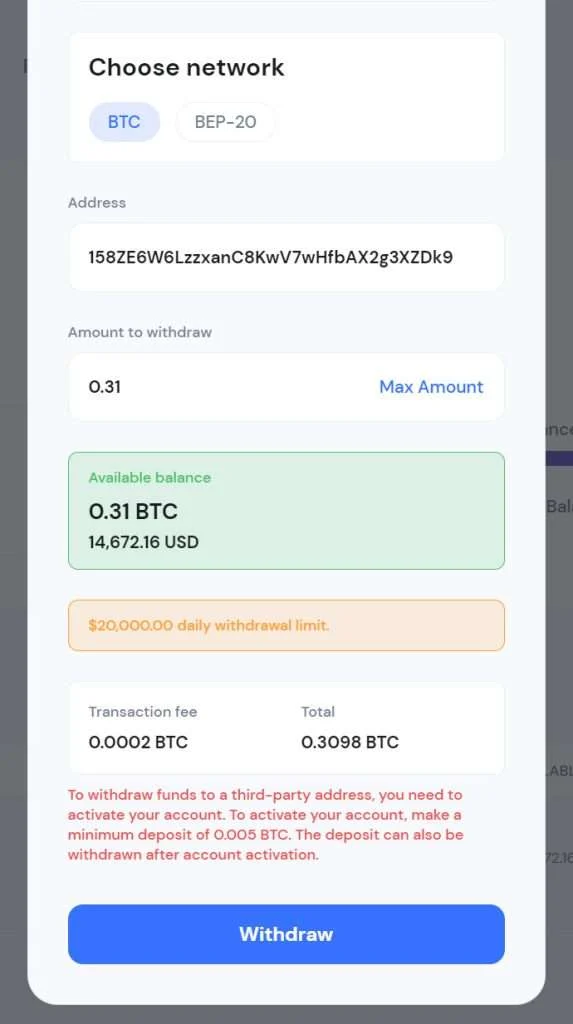
Request a payout and you get something else entirely: a message about verification, a locked wallet or a minimum deposit. The wording looks like this:
- “Withdrawals are locked until verification is complete”
- “Minimum deposit required to withdraw”
- “You must verify your wallet before payout”
- “Security check in progress”
Read them again and you won’t find a refusal. Each one promises a withdrawal right after one more step, keeping your hope alive.
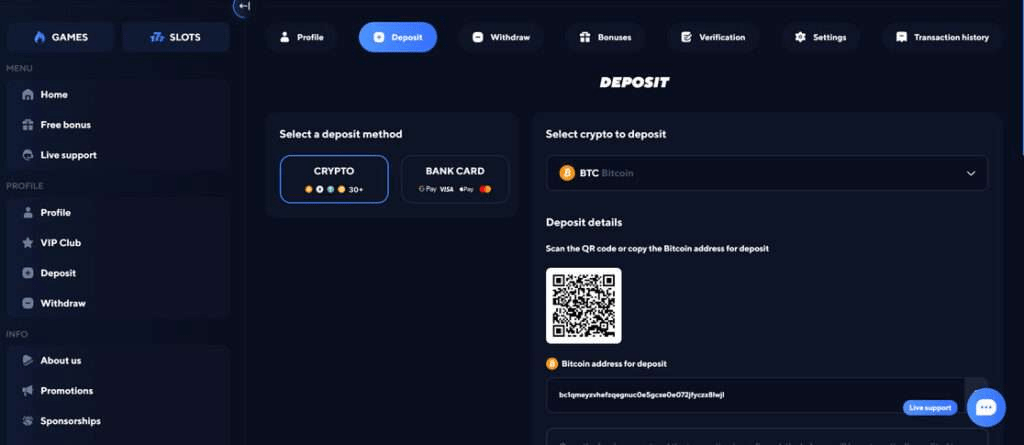
Step 5: Asked to pay a “verification deposit”
Extraction happens now. The site, or someone in its support chat, asks you for a fresh crypto deposit, commonly $100 to $500, to “activate” withdrawals.
Some sites turn up the pressure with a ticking countdown or a “pending” payout. It’s theater: the withdrawal never lands, whatever amount you send.
Step 6: Every payment brings another fee, then silence
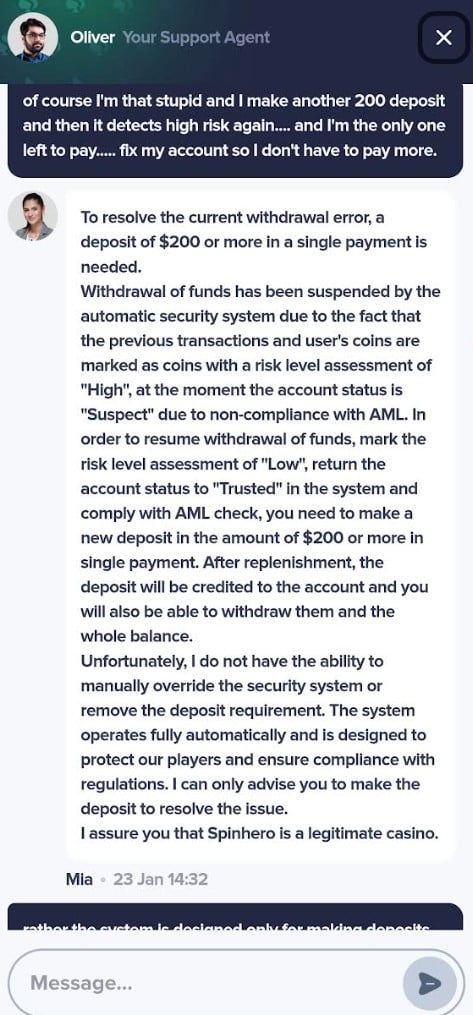
You pay, and right away there’s a new hurdle in the form of a higher verification tier, a VIP upgrade, a tax on your winnings or a larger deposit.
Alongside the fees, stalling replies are common: “your withdrawal is pending,” “try again later,” “you chose the wrong network.”
While money keeps arriving, the chat stays friendly. Once you refuse to send more, the replies thin out, get vague and finally stop.
Red Flags at Daftwin.com
The first sign is enough on its own. Most of the others can turn up separately, but stacked together they point to the crypto casino scam kit behind Daftwin.com.
The cashout that needs a fresh deposit
Nothing else on this list is as decisive. Being told to deposit again before a balance you supposedly won can be released means no payout is coming.
If there were truly a fee, the site would take it from the money you’re withdrawing. Sending a separate “unlock” payment only makes sense for the scammer.
A bonus too large to be real
No-strings money in the thousands isn’t how casino promotions work. Real operators put clear limits and wagering rules on welcome offers, so a bonus like this is bait.
Read whatever bonus terms you can find. Sites like this usually skip them, word them vaguely or copy them, and they never explain a real way to withdraw the bonus.
Activity feeds that run nonstop
The counters keep moving: more players online, more wins, more withdrawals. On sites like this, real activity isn’t usually what drives them. A scripted animation is.
Notice anything familiar after a few reloads? The same usernames and amounts tend to return, a sign the feed is running on a loop, not live data.
Operator, license and disputes: none of it checks out
Any real gambling site lists three things: its operator, its license and a dispute route. Fake casinos such as Daftwin.com usually omit them entirely or invent them.
Treat the site as unlicensed if it gives no license number or the number doesn’t match the regulator’s own register. Search there directly.
Easy registration, impossible payouts
Getting in is a seconds-long sign-up with no checks. Getting out suddenly needs “verification.” The trap is built around that reversal.
Identity checks at a genuine casino mean uploading documents, at sign-up or ahead of your first cashout. Paying crypto is never part of the process.
Support that only wants to talk about deposits
No matter how directly you ask about your withdrawal, support brings it back to paying. Genuine help explains a delay; it doesn’t treat another payment as the fix.
A payment page that only takes crypto
Sites like this limit deposits to crypto, because once crypto is sent, reversing the payment is almost impossible.
Same Scam Playbook, Different Domains
The setup you see on Daftwin.com turns up again and again: identical layout, games, bonus pitch and withdrawal message, spread across a long list of domains that come and go.
Place the sites side by side and these fingerprints repeat:
- The same headline style, like “Decentralized Crypto Gaming Platform #1”
- Identical layouts with a matching game carousel and game list
- The same supersized bonus pitch
- Usually Elon Musk or MrBeast, often in the very same celebrity story
- An identical request to pay a deposit before any withdrawal
These lookalike domains come from the same kit:
- Bunodex.com
- TryGamb.cc
- Olympus-games.net
- KaiWin.cc
- Betaras.com
- Bezhope.bet
- Acegam.com
- 8BitWin.com
- 7Spiny.com
- Nexusball.com
- Germibet.cc
- Telaxplay.com
- EnyBex.com
- Roarax.com
- Siodex.com
- RuseWin.cc
- Epicdrops.life
Don’t let a new lobby name fool you. From domain to domain, the withdrawal message is always what gives the game away.
These fingerprints mean one thing: don’t pay the site anything to prove it’s honest. For a casino you’re unsure about, run the free test below.
Why the same casino keeps showing up under new names
Switching domains pays off for the operators in several ways:
- Bad reviews and complaints get left behind with the old domain.
- A new, “clean” address lets the ads keep running.
- A search for the new domain doesn’t bring up any warnings yet.
- Many sites, one funnel: that’s how the same trick gets in front of a bigger crowd.
Names come and go, so judge the behavior instead. Every new domain still ends at that same withdrawal wall.
The Withdrawal Wall Test
You don’t have to guess about a crypto casino. Run this quick test first, before you deposit anything.
The test that takes two minutes
- Go straight to the withdrawal page after signing up with a throwaway email and a fresh password used nowhere else.
- Put in for a modest withdrawal from the bonus balance, even $10.
- Pay close attention to what the message says.
- Watch for a deposit, a fee, a wallet connection or a “wallet verification” transfer. If any of them comes up at any point, that’s the wall, so don’t deposit.
Learning this before you deposit costs you nothing. Learning it afterward can cost you every cent you sent.
Lines that give the game away
This kind of wording is the giveaway that you’re looking at the same playbook:
- “Verification deposit required to withdraw”
- “Activate withdrawals by making a deposit”
- “Pay the network fee to process your withdrawal”
- “One final step to unlock your funds”
How one question exposes the trap
Ask support to deduct the fee from your withdrawal. If nothing ever lands in your wallet, don’t pay. Save the chat and walk away.
What to Do If You Have Fallen Victim to This Scam
Already deposited? Now the job is to stop the losses, lock down your accounts and hold on to the evidence investigators will need.
- Stop paying. Don’t send another verification deposit, activation fee or network fee. Every payment just triggers the next demand.
- Gather your proof. Every transaction hash matters, so note each one alongside the deposit addresses and the promo code. Screenshot your balance, the withdrawal messages and support chats as well.
- Talk to your exchange. Sent the payment from an exchange account? Then report the date, amount, transaction hash and recipient address, since they may flag the wallet.
- Protect your logins. Your email and exchange accounts need new passwords and two-factor authentication. Also revoke any wallet permissions you granted on the site.
- Clean your device. Uninstall any casino app or extension you set up, then run Malwarebytes Free to scan.
- Watch for recovery scams. If someone offers to retrieve your crypto for an upfront fee, you’re looking at a second scam. The FBI specifically warns about it.
- Report the scam. Americans should file at ReportFraud.ftc.gov and with the FBI’s Internet Crime Complaint Center (IC3). Everyone else can reach their national cybercrime unit or local police.
- Flag the ads. On the platform where you saw the promotion, report the ad itself, the account behind it and the promo code.
- Block the ads. Ads and fake posts are how these casinos find new players. AdGuard stops many malicious ads and pop-ups in your browser, so fewer slip through.
- Warn other players. Keep it short and factual: the bonus you saw, the deposit you were asked for and the wallet address. That helps others spot the trap.
If you take one thing from this list, make it speed. Crypto transfers are hard to reverse, so get the details to the exchange and the authorities fast.
Frequently Asked Questions
Is Daftwin.com a legitimate crypto casino?
No. Behind the games, Daftwin.com is a fake crypto casino. It lets you play with bonus funds, and any withdrawal you request triggers a demand for yet another deposit.
Many other domains reuse the same layout and withdrawal trap. A site doesn’t become safe just because its name is new and nobody has posted warnings online.
Is the sign-up bonus real money?
No. You’re looking at a number on the screen, not money. It exists to get you playing, and no deposit will ever turn it into a payout.
Can I withdraw my winnings from Daftwin.com?
No. The payout never arrives. Withdrawals sit behind a “verification” deposit, and each payment you make only opens the door to another demand.
Why does Daftwin.com want a deposit to verify my account?
The deposit is the scam. Real platforms verify identity by checking documents, not by collecting a crypto payment.
“Verification” sounds like a normal step, and that’s the point. The payment is really an advance fee: more money from you to unlock a balance that isn’t real.
I already paid the verification deposit. Should I pay again?
No. Sending more only leads to the next requirement, and your money stays out of reach. Stop the payments, preserve your evidence and report the transactions to your exchange.
Can someone recover my crypto for a fee?
Be very wary. People who just lost funds are a favorite target for a second scam: a recovery offer that asks you to pay first.
There’s a specific FBI IC3 warning about recovery services that charge fees upfront. Rather than paying one, report your losses to the authorities at no cost.
The Bottom Line
Every road on Daftwin.com leads to the same demand. The bonus, the busy lobby, any celebrity story: request a withdrawal and you’re asked to deposit. It’s a fake crypto casino.
Send nothing to Daftwin.com, and treat any payment to unlock a withdrawal as a hard no. For crypto gambling, look for a licensed platform that tells you who operates it.
Money already gone? Don’t add to it. Save every transaction hash and screenshot you have, and report the wallet addresses to your exchange and the authorities today.

Reviews & discussion
0 commentsShare a firsthand experience, or ask a question.
Community reviews
daftwin.com
Moderated reader experiences, not an editorial verdict.
Reviews
Be the first to review
Approved reviews for this site or product will appear here.