


Finmexo says an AI bot can earn 2% to 4% a day on crypto deposits starting at $10, then return the deposit in full when the term ends.
We read its pages, legal documents and Ontario registration, then checked regulator lists, domain records and customer reports to see how much of the pitch holds up.

Overview
What Finmexo offers
The site, finmexo.net, presents itself as an AI-powered cryptocurrency trading platform, and its home page headline reads Automate Your Crypto Trading with AI.
A badge promises Up to 120% Monthly, and the AI Bot page lists one plan: 2% to 4% daily, $10 to $100,000, 15 to 90 days, 100% deposit return.
A referral program pays partners up to 29% of the deposits made by the people they bring in, spread across five levels.
What we found behind the pitch
The About page offers a Canadian business name certificate as proof of legality, but it records only a registered name and a broad finance code, never trading, securities or crypto.
The Terms name a company called Finmexo Pte. Ltd., which does not appear in the Ontario registry, while the certificate names a numbered company, 1000924408 Ontario Ltd.
The Canadian Securities Administrators list of crypto platforms authorized to do business with Canadians, updated November 4, 2026, does not include Finmexo or that numbered company.
Four one-star reviews and a French scam report describe one sequence: profits appear on screen, then a withdrawal request ends in a lost login and removal from Telegram.
What we could and could not verify
Here is where the evidence stands after our checks:
- Verified by us: the advertised rates and limits, the referral table, the registration certificate, the Ontario registry entries, the domain dates and the contradictions between the pages.
- Not found: any trading record, audit, exchange partnership, license number or regulator entry for Finmexo, anywhere we looked.
- Not verified: who controls the company, where deposits go, whether the team members exist and whether any user has withdrawn real profit.
Our advice is not to deposit, and to read the response section below if you already have.
What the AI Bot Page Promises
The AI Bot page is built around a card titled AI Bot Tariff, with the subtitle One powerful plan with everything you need.
The card lists daily profit of 2% to 4%, a $10 minimum, a $100,000 maximum, a term of 15 to 90 days and a 100% deposit return.
A green Activate AI Bot button sits underneath, and a five-step strip below it names market analysis, signal detection, auto execution, risk control and daily profits.
The FAQ adds that terms run 15, 30, 50 or 90 days, and that at the end the initial deposit returns in full with accumulated profits.
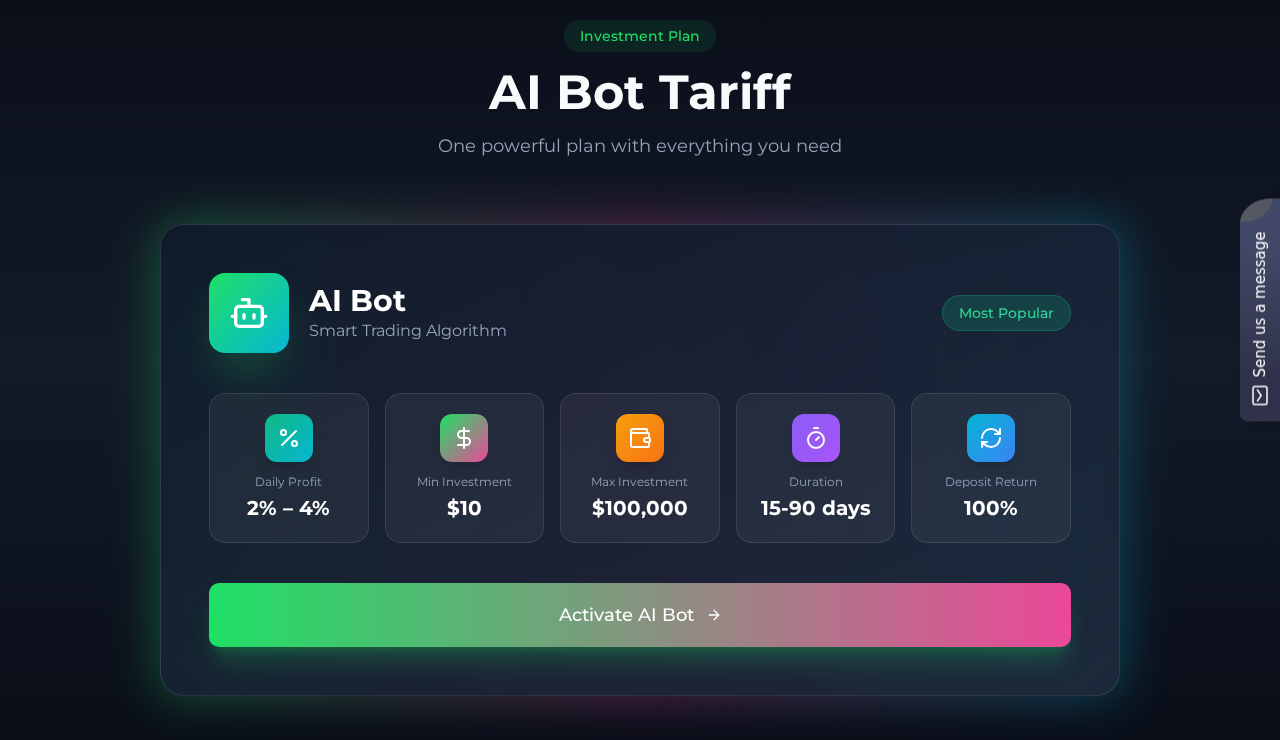
Notice what the card leaves out: there is no trading record, no auditor, no named custodian, no exchange account and no statement of who absorbs a loss.
Instead it offers a 100% deposit return, which works like a principal guarantee and sits awkwardly beside the site’s own risk language, covered next.
The only explanation the public pages give for the profit is that the bot spots micro-opportunities across crypto markets and executes high-frequency trades around the clock.
Further down, according to the page text we read in the site’s script file, the AI Bot page contrasts the service with fake platforms that promise guaranteed returns.
Risk Language That Contradicts the Offer
The Disclaimer, last updated April 25, 2026, says projected returns are estimates and not guarantees, and that market volatility can lead to significant and rapid losses.
The Terms go further and state that the company does not guarantee any specific returns or profits from using its trading bots.
Yet the tariff card shows a return range, the FAQ says the bot generates daily returns of 2% to 4%, and the deposit is promised back in full.
A product that can lose money in a volatile market cannot also hand every deposit back, which is why regulators treat guaranteed returns as a standard warning sign.
The joint SEC and CFTC alert on fraudulent crypto trading websites names high guaranteed returns with little or no risk as its first red flag.
The Disclaimer also says the company does not act as a financial advisor, broker-dealer or investment manager, although the Terms say its bots execute trades for you.
The FAQ asks whether Finmexo is a regulated platform and answers only that it operates in compliance with applicable regulations in the jurisdictions it serves.
That answer names no regulator, no license and no jurisdiction, so a reader leaves the page without learning whether any authority oversees the service.
What 2% to 4% a Day Adds Up To
A daily rate sounds small until you multiply it, which is what the home page badge does: 4% a day for 30 days becomes the 120% monthly figure.
Without compounding, 2% to 4% a day means 30% to 60% over the shortest 15-day term and 180% to 360% over the longest 90-day term.
A $1,000 deposit would therefore show $1,800 to $3,600 of profit after 90 days, while a $100,000 deposit would earn $2,000 to $4,000 daily.
The site also invites users to reinvest profits, and if they did so daily, 2% a day for 90 days would multiply a deposit almost six times.
At 4% a day, the same 90 days of reinvestment would multiply a deposit more than 34 times, and a full year would multiply it about 1.65 million times.
Those numbers are arithmetic, not predictions, but they show how far the promise sits from ordinary market returns and why the pages should explain where the profit comes from.
They never do, which leaves a plain question: if a bot really earned 2% to 4% every day, why would it need deposits from strangers starting at $10?
Referral Pay Tied to Deposits
The Referral page offers an affiliate program that gives partners up to 29% of the income from deposits made by users at all levels of their network.
Commissions run five levels deep, with up to 15% for direct referrals, 5% for the second level, 4% for the third, 3% for the fourth and 2% for the fifth.
Your rank, and your rate, rises with first-line turnover, which the page defines in bands from $0 to $1,000 up to $100,001 and above.
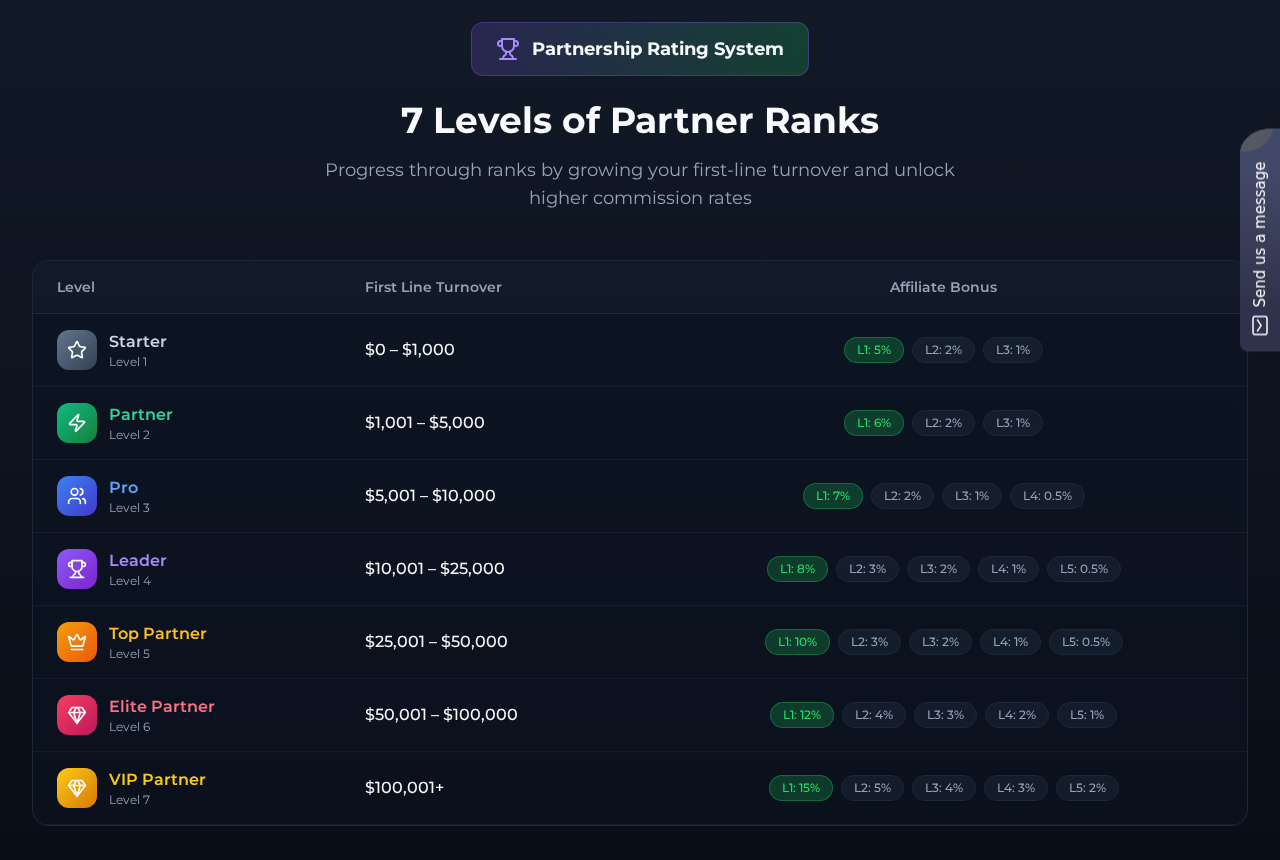
The Starter rank pays 5%, 2% and 1% on three levels, while the VIP Partner rank pays 15%, 5%, 4%, 3% and 2%, which adds up to the headline 29%.
The FAQ says commissions are credited instantly when a referral makes a deposit, and the page lists Access Without Investment among the benefits of joining.
Pay is therefore tied to new deposits, not to trading profit or to any product the recruits buy, and a partner can earn without investing a cent.
When a recruit deposits $1,000, up to $290 in commissions would move up the five-level chain on the day it arrives, before that recruit has earned anything.
The FTC explains in its guide to multi-level marketing and pyramid schemes that a legitimate business pays mainly for sales to real customers, while a scheme pays mainly for recruiting.
Finmexo’s public pages show pay on deposits and no retail product, so the structure leans toward recruiting, which is our inference and not a finding about the company.
A Team Page of Portraits and Big Names
The About page introduces six leaders with portraits and one-line résumés, among them a CTO with an MIT PhD and a head of security described as ex-NSA.
It also lists a CEO, a head of trading, a lead developer and a head of customer success, and no profile links to anything a visitor could check.
The six portraits share the same grey-lavender studio backdrop, the same head-and-shoulders framing and nearly identical dark business wear, which is unusual for people said to come from different employers.
Uniform styling proves nothing by itself, and we make no claim about how the images were produced.
The site’s script file, which also feeds a members-only Team page, lists the same names with different details, so the CTO’s former employer changes from Google to Renaissance Technologies.
In that version the head of trading becomes head of risk management, and four advisors appear with ties to Stanford, Deutsche Bank, the Ethereum Foundation and Baker McKenzie.
We read those entries in the published script and did not see them rendered, because that page sits behind a login we did not use.
Big institutions lend weight to a profile, which is exactly why a visitor should be able to check them, so search any name together with its employer before trusting it.
We are not naming the individuals, because we could not confirm that any of them exists or works for the company.
Legal Documents That Disagree
The Terms of Service, which the site also offers as a PDF, say the agreement is with Finmexo Pte. Ltd., a company registered in Canada.
The suffix Pte. Ltd. is most associated with Singapore, and the Ontario registry search for FINMEXO returns only a business name registration, not a corporation with that name.
The Terms say the bots execute trades using your connected exchange accounts, while the FAQ describes crypto deposits credited to a Finmexo account and withdrawals sent to your wallet.
Whether you keep your coins on your own exchange or send them to the platform matters, because only one of those lets the company control your money.
Section 5 says the service charges no fee for features and that commissions are included, then lists variable trading fees, withdrawal fees and premium features billed monthly or annually.
The liability clause caps the company’s total liability at the fees you paid in the previous 12 months, which on that wording could amount to little or nothing.
The company may suspend or terminate an account at any time for any reason at its sole discretion, and outstanding balances are handled under its own withdrawal procedures.
Disputes are to be resolved through the Ontario Department of Government and Business Services, labeled BNA, the same abbreviation the certificate uses for its filing type.
That points users to a government business-services office rather than a court or an arbitration service, which leaves no clear route for a customer who is owed money.
The Privacy Policy says security audits are done by third-party firms and adds the words CertiK certified, a claim we did not check against CertiK’s own records.
How the Finmexo Pitch Works
Step 1: A free account and a $10 start
The home page urges visitors to register in two minutes with an email address and says no verification is required, then invites them to deposit from $10.
A low entry price makes the first deposit feel like a trial, and the Get Started Free button removes the sense of commitment.
Step 2: A crypto deposit
The FAQ lists Bitcoin, Ethereum, Tether, BNB and Solana among accepted deposits, credited after one to three blockchain confirmations, usually within 10 to 30 minutes.
Deposits carry no fee, and the minimum withdrawal runs from $30 for Bitcoin and $20 for several Tether networks down to $0.10 for smaller coins.
Step 3: A term and a daily rate
The user picks 15, 30, 50 or 90 days, and the site says profit of 2% to 4% is credited to the balance every day of the term.
The screen balance therefore climbs daily, which is the evidence a user sees first and the number that later makes a withdrawal feel urgent.
Step 4: Commissions on every recruit
The referral program pays instantly on each new deposit, so a user who brings in friends sees extra income long before the first term ends.
That gives users a reason to share their link and a reason to defend the platform, since their own commissions depend on it.
Step 5: A withdrawal request
The FAQ promises that withdrawals are processed within 24 hours and that the initial deposit returns in full at the end of the term.
This is the step where customers report trouble, as the next section describes, and it is the only step that proves whether the balance on screen is real money.
What Customers Report
Trustpilot’s page for finmexo.net shows 13 reviews, a 2.1 TrustScore labeled Poor and a banner saying the company may be associated with high-risk investments.
Of those reviews, 84% are one star, 8% are two stars and 8% are five stars, and the profile shows no history of the company asking customers for reviews.
Four one-star reviews, posted between September 7 and October 20, 2026, describe a similar sequence: strong early numbers, a withdrawal request, then removal from the public Telegram group.
Three of the four add that the login stopped working, and one says emails to support went unanswered after a 30-day term ended without a payout.
One of the four also carries an unrelated line praising a different company, which is a reason to read any review page with caution.
The single five-star review, dated August 25, 2026, says withdrawals arrived in about three hours and that the writer was in a third 90-day contract.
An early payout and a later block are not contradictory, so one positive review does not settle how later withdrawals went for other users.
A report on the French site Signal-Arnaques, dated September 27, 2026, says its author put $1,000 into two bots, one for 50 days and one for 90.
The author says one bot ended on September 25 with $2,424.50 of displayed profit, and that a withdrawal request led to a block the next day.
The author also says they were removed from the Telegram group, which matches the pattern in the Trustpilot reviews, although we cannot verify the amounts or dates.
Those are personal accounts, not findings, and they come from a handful of people, but the same sequence on two separate sites is a pattern worth taking seriously.
Who Runs Finmexo?
The company named in the documents
The Terms name Finmexo Pte. Ltd., while the registration certificate on the About page names the registrant of the business name as 1000924408 Ontario Ltd.
The free Ontario Business Registry search shows that numbered company as active, an Ontario business corporation incorporated June 14, 2024, with a Mississauga address.
It shows FINMEXO, number 1001469742, as a business name registered January 13, 2026, with that company as registrant, and no other entity carrying the name.
A paid corporation profile report would list directors and officers, which we did not order, so we cannot say who owns or runs the numbered company.
Where the address and registration lead
The certificate, Terms, Privacy Policy and Contact page all give the same address in Mississauga, Ontario, and the Contact page embeds a map pinned to one unit there.
A unit number suggests a suite or an apartment, and web searches for the street mostly return apartment rental listings, which we could not open and treat as a lead.
We leave the street address out of this article because it may be a private residence, and the Ontario registry record is the proper place to look it up.
The certificate lists the business activity as classification code 52, finance and insurance, which describes the business but is not a license to run an investment service.
The certificate carries an effective date of January 13, 2026 and an expiry of January 12, 2031, so it covers the name for five years and no more.
The CSA list of authorized crypto platforms, updated November 4, 2026, and its separate list of banned platforms, updated October 23, 2025, contain no entry for Finmexo.
A missing entry is not a ruling, because other regulators exist, but it means the site’s claim of compliance with regional regulations has no visible backing in Canada.
The domains, the platform and the mail addresses
The domain finmexo.net was registered on February 15, 2026 through NICENIC International Group for three years, sits behind Cloudflare name servers and authorizes Mailgun to send its email.
The site is a single-page app that loads its text from a script file, which is why a plain page fetch shows only a title.
The Terms and Privacy Policy give legal and privacy mailboxes on finmexo.com, a different domain registered on December 25, 2025, while the Contact page lists support@finmexo.net.
The domain finmexo.com hosts an unrelated WordPress site selling AI bookkeeping software, and nothing we read ties the two sites together, so a shared name is not shared ownership.
It does mean the policy mailboxes of a crypto platform sit on a domain advertising accounting software, so a user’s message to them may not reach the platform.
What we could not confirm
We did not register, deposit, connect a wallet or open the members area, so we cannot describe the dashboard, the withdrawal form or any limits behind the login.
The certificate section of the About page sits below the part we could capture, so we read it from the page text and the PDF the site links.
We did not check other countries’ regulators or Canada’s money services business registry, and we could not read a BehindMLM review that a commenter on the French report cites.
No page names who holds the deposited coins or which exchanges the bot uses, and we found no trading record, audit, license number or independent confirmation of any profit.
What to Do If You Deposited or Plan To
-
Stop sending money. Do not add funds or reinvest profits, even when the dashboard shows rising balances.
-
Do not pay to withdraw. A demand for a fee or tax before a withdrawal is a known fraud step.
-
Save the evidence. Keep screenshots of balances, your wallet addresses, transaction IDs, Telegram messages and the dates of every deposit and request.
-
Ask once, in writing. Request your withdrawal through the dashboard and email support@finmexo.net, then keep every reply and every silence with its date.
-
Contact your exchange. Tell the exchange or wallet you sent from what happened, because crypto transfers are rarely reversible but their records help investigators.
-
Report in Canada. File with the Canadian Anti-Fraud Centre online or by phone at 1-888-495-8501, and tell your local police.
-
Report in the US. File at ReportFraud.ftc.gov and name Finmexo, the domain, the Ontario address and the returns you were promised.
-
Ignore recovery offers. Anyone who contacts you promising to recover the money for an upfront fee is a second scam, and you should stop recruiting others.
Frequently Asked Questions
Is Finmexo a scam?
We found no regulator ruling or court finding, so we do not state it as fact, but the missing authorization and withdrawal reports justify not depositing.
Is Finmexo registered or regulated?
Its only registration we found is an Ontario business name filing, and it is absent from the CSA list of authorized crypto platforms.
Are 2% to 4% daily returns realistic?
Not as a steady rate: 4% a day compounds to about 34 times a deposit in 90 days, and the site shows no records explaining the profit.
Can you withdraw money from Finmexo?
The site promises withdrawals within 24 hours, but four one-star reviews and one French report describe a block, a lost login and removal from Telegram after asking.
Who owns Finmexo?
The certificate names 1000924408 Ontario Ltd. as registrant of the business name, but we could not confirm who owns or directs that company.
How does the Finmexo referral program pay?
It pays up to 29% of recruits’ deposits across five levels, credited instantly, with rank rising as first-line deposits grow and no investment required to earn.
The Bottom Line
Do not deposit into Finmexo: it promises 2% to 4% a day with the deposit returned, shows no authorization we could find, and its documents contradict one another.
If you want crypto exposure, use a platform that appears on the CSA or your own regulator’s list, and ignore any service that advertises a daily percentage return.
If you already deposited, stop adding money, never pay a withdrawal fee, save your records, and report it to the Canadian Anti-Fraud Centre, police and the FTC.

Join the discussion
0 commentsShare your experience or ask a question about this article.
Discussion
Start the conversation
Have a question or something useful to share? Add the first comment.