


Glovers Capital Investment makes Bitcoin mining sound almost effortless: open an account, add funds, and wait for a short investment period to finish.
Before treating those profit cards as a plan for your savings, read the company pages. They raise questions the polished front page doesn’t answer.
Overview
An investment offer dressed as Bitcoin mining
Gloverscapitalinvestment.com asks customers to fund a cryptocurrency investment account. Its public packages advertise returns from 15% over 23 days to 40% over five days.
The website says mining generates steady interest, displays referral bonuses, and surrounds the offer with market widgets and favorable customer stories.
Those features create an appearance of financial activity. They do not show that the operator owns mining equipment or can generate the advertised payments.
The site’s own pages expose important contradictions
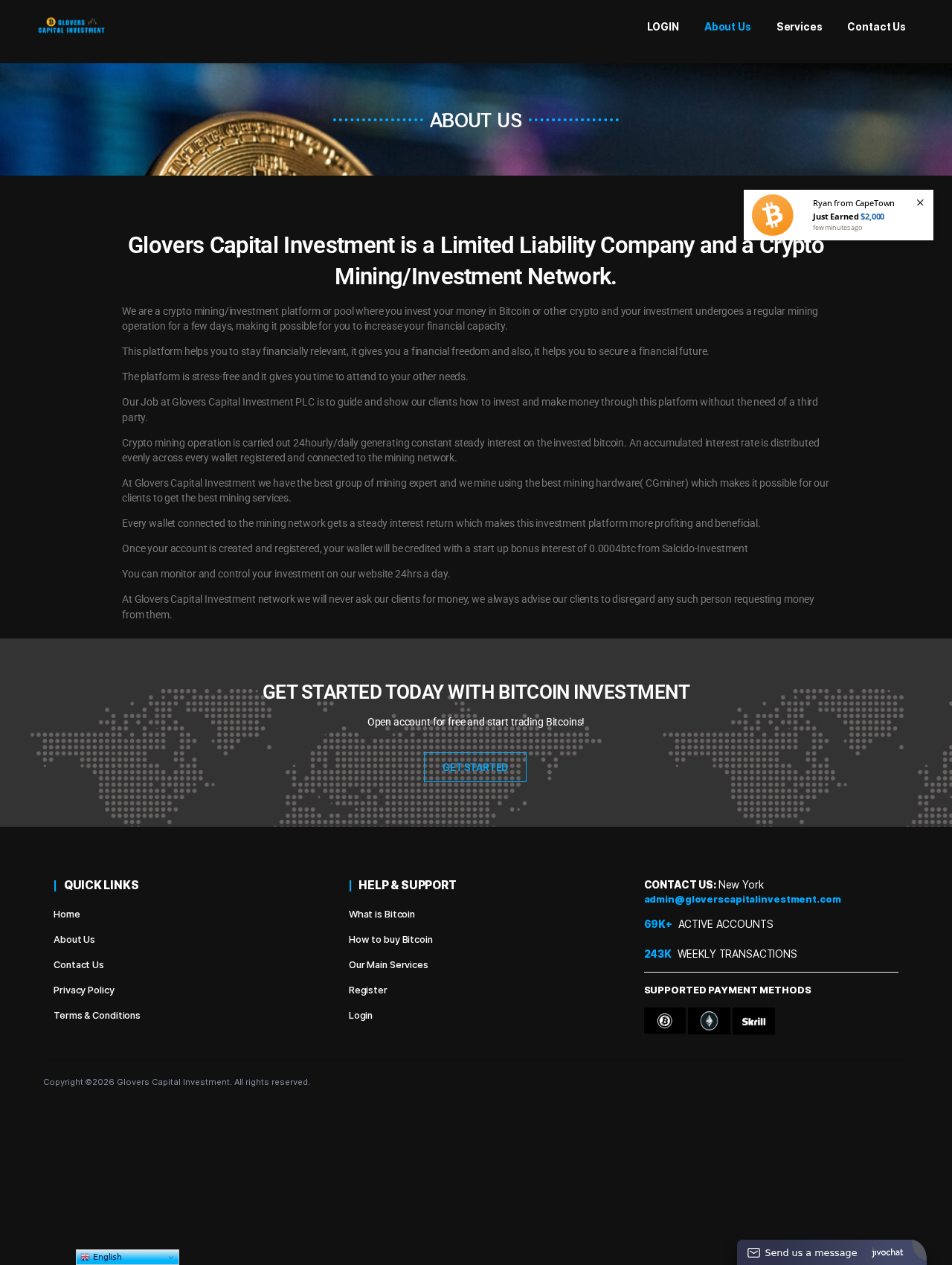
The About page alternates between a limited liability company and a PLC. It also promises an account bonus from a different name, Salcido-Investment.
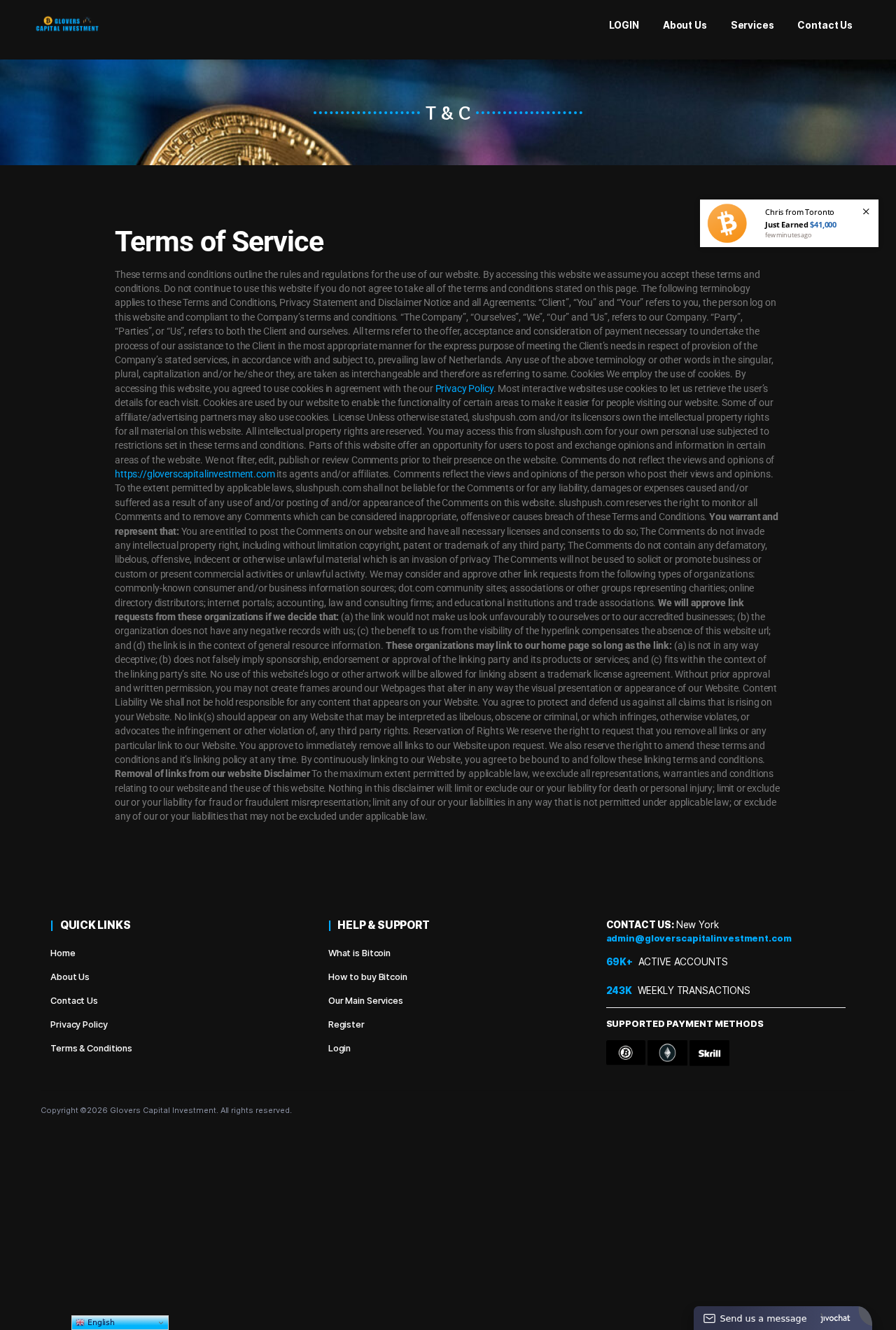
The terms repeatedly refer to slushpush.com, while the footer identifies Glovers. The same terms invoke Dutch law, although the footer’s location is simply New York.
Those inconsistencies make it difficult to determine who is responsible for customer funds. They are directly visible problems, not a third party’s trust score.
Why this is not an offer to test with spare change
- Large advertised returns arrive on an unusually compressed schedule.
- The mining explanation confuses software with equipment.
- The investment contract does not clearly resolve conflicting business identities.
- The public material does not document the mining capacity supporting customer returns.
Do not deposit into this offer. The operator needs to establish its identity and economics before taking money, not after a customer encounters withdrawal trouble.
The CGMiner Claim Does Not Describe a Mining Farm
The About page says Glovers uses mining hardware identified as CGMiner. That description is wrong in a way relevant to the investment pitch.
CGMiner’s original project repository describes mining software written in C for ASIC and FPGA devices. It is not a physical mining machine.
Actual equipment would need separate identification: device models, capacity, power consumption, operating location, pool arrangements, and costs. Naming software provides none of that.
Running mining software also does not establish profitable mining. Hardware efficiency, electricity prices, network competition, and the Bitcoin price all affect the outcome.
The site treats that complicated business as steady interest distributed across connected wallets. It does not explain how the stated returns survive changing operating conditions.
A reader should not need specialist knowledge to spot the problem. The company is offering investment certainty while giving an imprecise description of its basic machinery.
A photograph of equipment would not settle everything either. It would need a demonstrable connection to the contracting business and the capacity sold to customers.
No mining facility was visited and no private operational records were provided. The public offer itself fails to supply a usable account of its claimed operations.
For a genuine capacity-based arrangement, a buyer should be able to understand what capacity is allocated, how output is measured, and which charges reduce the payout.
Mining rewards paid in Bitcoin and profits promised in USD also require an exchange-rate assumption. The offer should explain who absorbs currency movements.
Without those details, a percentage card describes an expectation, not an auditable mining service. More impressive terminology does not make the underlying calculation reproducible.
Read the Three Packages as Money at Risk
The Bronze plan starts at $500, advertises a 15% return over 23 days, and lists a referral reward of 7% plus $2.
At that minimum, a 15% profit would be $75. The important question is what real activity produces that amount after operating costs and referral payments.
The Silver tier starts at $5,000 and lists 25% over 14 days. Taken literally, that is $1,250 profit on the minimum deposit within two weeks.
The Gold tier starts at $50,000 and advertises 40% over five days. That implies $20,000 profit on the minimum deposit during that brief period.
Gold also advertises a 15% referral reward plus $10. The website does not provide a clear accounting that reconciles those incentives with mining income.
These are calculations from posted figures, not validated earnings. Do not extrapolate them into a retirement plan or assume a completed period guarantees repayment.
The plan cards display hash-rate labels, but those labels do not show assigned machines, verifiable pool output, or a customer-specific share of actual mined coins.
The SEC’s investor-education warning about high-yield programs highlights extraordinary returns and reduced-risk promises as serious warning signs.
That guidance does not constitute a case-specific ruling against Glovers. It explains why the offer’s economics need independent substantiation rather than optimism.
How the Glovers Capital Investment Pitch Works
Step 1: Borrow the appearance of a trading business
The homepage displays cryptocurrency prices and TradingView market widgets. These can show real market information without proving anything about the site receiving your deposit.
A working price feed is not a custody record, an investment license, or evidence of profitable trading. Separate the widget provider from the operator.
The site also claims an official Bitcoin Foundation partnership. The public pages inspected do not independently establish that relationship.
Step 2: Make funding the account feel routine
The advertised sequence is simple: create an account, add cryptocurrency, and request the resulting profit. It downplays the gap between transferring assets and controlling them afterward.
Once crypto reaches a destination controlled by another party, a dashboard becomes your view into that party’s records. It is not independent possession of the funds.
Before funding anything, identify the actual contract and custodian. A branded account balance cannot replace either.
Step 3: Encourage larger commitments and introductions
The deposit thresholds rise sharply, while the advertised return increases and the waiting period shortens. That structure can make a larger deposit feel like the rational choice.
Referral rewards add another incentive. Someone recommending the service may be rewarded for your participation rather than offering impartial financial information.
Ask how that person benefits. Their enthusiasm or claimed payout cannot establish the financial condition of the entire operation.
Step 4: Keep the customer dependent on the operator’s promises
The homepage says withdrawals arrive within a day and the packages advertise unlimited withdrawals. Those statements require a functioning business capable of honoring them.
The About page also says the network will not ask clients for money, despite an offer built around funding investments. The language is internally inconsistent.
If anyone introduces a release fee, verification payment, or additional deposit, do not assume it is a legitimate extension of the original plan.
We did not open a funded account or test withdrawals. The warning is based on the documented offer, technical error, and unresolved contracting identity.
The Business Identity, Template Leftovers, and Customer Funds
LLC and PLC are not interchangeable labels
The About page calls the business a limited liability company, then describes a PLC. These are not simply two spellings of the same legal form.
The reader needs the exact registered entity, jurisdiction, and number. A generic company label does not identify the party against which contractual rights would be asserted.
The footer’s New York location does not resolve that uncertainty. Nor does a sentence in the terms selecting the law of another country.
Other brand names remain inside the sales material
Salcido-Investment appears in the promised startup-bonus text. Separately, slushpush.com remains in multiple licensing and comment-liability provisions.
These are strong signs of reused material that was not properly adapted. They do not establish that all named websites share owners or control the same wallets.
For a customer, the immediate consequence is simpler: the paperwork does not consistently identify the business supposedly managing a substantial investment.
The address and support details do not show an operating office
The public footer gives New York and admin@gloverscapitalinvestment.com. It does not supply a sufficiently specific street address to locate an investment office.
An online chat widget adds a contact channel, not a regulated dispute mechanism or assurance that a withdrawal will be honored.
No calls or messages were sent during this investigation. Published contact information should not be confused with a successfully tested customer-support service.
The contract does not document the mining allocation
The terms focus heavily on website use, comments, intellectual property, and links. They do not clearly document the equipment allocation underlying the advertised mining packages.
A customer would need understandable rules for ownership, expenses, duration, payout calculation, loss allocation, withdrawal handling, and termination.
Generic website terms leave those practical investment questions unresolved. Do not let their length create an impression of protection the relevant provisions do not provide.
What a Public Scam Report Adds
A public report dated October 31 labels the domain a fake investment site and links to another person’s account. That submission is a lead, not an adjudication.
A registration lookup is not a substitute for the contract. The customer still needs a consistent business identity tied to the recipient of the deposit.
The directly verifiable problems are more useful: inconsistent legal forms, unrelated names in contractual text, an incorrect hardware description, and unsupported short-period return claims.
Those findings survive even if an anonymous complaint is removed. Readers should not have to trust a stranger’s accusation to recognize the offer’s defects.
Likewise, a successful payment to someone else would not repair those defects. An isolated payout cannot demonstrate sustainable revenue or identify the party holding your assets.
Do not send a small deposit merely to conduct your own experiment. A test can expose you to persuasive follow-up before it answers the underlying questions.
If a friend introduced the site, share the specific page contradictions rather than insulting their judgment. Concrete evidence is more useful than an argument about intelligence.
What to Do If You Funded a Glovers Account
-
Pause additional transfers and stop any automatic funding arrangement you knowingly created. Refuse requests to increase your tier while a withdrawal remains unresolved.
Write down what was actually sent, in the original asset and currency. Keep displayed profits separate from money you personally received.
-
Save account records, package promises, messages, recipient addresses, transaction hashes, and the pages containing inconsistent business names.
Preserve original files where possible. A private chronological folder is more useful to an investigator than screenshots with the key dates cropped away.
-
Ask for withdrawal of available funds without making a fresh payment. Request the contractual explanation for any obstacle and retain the response.
Do not accept instructions to pay a separate account for tax, insurance, wallet activation, or account release simply because a support profile sounds official.
-
Tell the exchange or payment service used for the deposit that you suspect a deceptive investment offer. Provide identifiers that let it locate the transaction.
Ask what reporting and preservation options remain. Be realistic: confirmed blockchain transfers usually cannot be canceled like an unsubmitted bank instruction.
-
Report concrete suspected fraud to the appropriate authorities. Include the domain and names used, while distinguishing verified page content from statements someone made privately.
If seeking professional advice, independently check the adviser’s identity and fees. Do not use a recovery contact supplied by the same promoter.
-
Secure accounts only where there was actual exposure. Change reused passwords and examine permissions if you connected a wallet, but do not share its recovery phrase.
A deposit alone does not demonstrate a malware infection. If remote-access software was separately installed, stop that session and seek exposure-specific help.
Frequently Asked Questions
Is Glovers Capital Investment a legitimate mining investment?
The public material does not establish that. The technical explanation and contracting identity are inconsistent, while the advertised returns lack a documented operational basis.
Do not invest through this offer. That conclusion is narrower than claiming a court has already determined who committed a crime.
Is CGMiner actually mining hardware?
No. CGMiner is software used with mining devices. Calling it hardware does not identify the machines, facility, power costs, or productive capacity supporting customer packages.
Why do Salcido-Investment and slushpush.com appear?
They remain in the About page and terms respectively. Their presence shows inconsistent reused material, not independently proven common ownership.
Customers still need a clear answer about which legal entity accepts deposits and owes any repayment.
Does the Gold plan guarantee $20,000 profit?
The published 40% figure applied to its $50,000 minimum implies that amount. It is advertised arithmetic, not a verified result or dependable guarantee.
Do not budget around a balance that exists only inside the platform.
Are referral payments evidence that the platform works?
No. A reward to one promoter does not establish profitable mining, adequate reserves, or reliable withdrawals for everyone else.
Referral incentives should be disclosed when you evaluate someone’s recommendation.
Should I pay another fee to get my deposit back?
Do not send a fresh payment to release an existing balance. Document the demand, contact your original payment service, and report suspected fraud where appropriate.
Guaranteed-recovery promises can introduce a second loss rather than repair the first.
The Bottom Line
A mining investment should identify its operator, equipment, and economics. Glovers Capital Investment instead presents conflicting names, a basic technical error, and extraordinary short-term figures.
Do not fund it. If you already transferred assets, preserve the evidence and pursue withdrawal and reporting options without paying another supposed release charge.

Join the discussion
0 commentsShare your experience or ask a question about this article.
Discussion
Start the conversation
Have a question or something useful to share? Add the first comment.