

If you’ve seen ads on social media for a Gordon Ramsay Le Creuset cookware giveaway, you may want to think twice before clicking. Unfortunately, this widely-promoted “giveaway” is actually an elaborate subscription scam designed to swindle unaware consumers.
In this comprehensive guide, we will uncover everything you need to know about the Gordon Ramsay Le Creuset Giveaway scam, including how it works, what to watch out for, and most importantly – how to protect yourself.

The Gordon Ramsay Le Creuset Giveaway Scam Explained
Celebrity chef Gordon Ramsay is arguably one of the most famous and influential culinary figures of our time. With dozens of restaurants, TV shows, cookbooks and more under his belt, his global star power is undeniable.
Which is exactly why scammers are leveraging his name and likeness to promote free Le Creuset cookware giveaways across social media platforms like Facebook, Instagram, YouTube and TikTok.
The giveaways are advertised using convincing fake videos that appear to show Gordon Ramsay announcing the promotion. In the videos, an AI-generated Ramsay explains that due to a “packing error,” Le Creuset has thousands of surplus cookware sets that he wants to give away to fans for free.
Understandably, the chance to score premium Le Creuset cookware endorsed by Gordon Ramsay himself seems like an amazing opportunity. But before you get too excited – these giveaways are 100% fraudulent.
Keep reading to learn exactly how the Gordon Ramsay Le Creuset Giveaway scam works, and how to protect yourself from being swindled.
Scam Overview
The Gordon Ramsay Le Creuset Giveaway scam is essentially a form of subscription fraud. Here’s an overview of how it works:
- Promoters run social media ads and fake news articles promoting a free Le Creuset giveaway endorsed by Chef Gordon Ramsay.
- Users click on the ads which lead to phishing sites disguised as Food Network, CNN, Fox News or other trusted brands.
- On the phishing site, users are prompted to pay a small $9.95 “shipping fee” to receive their free cookware set.
- Unsuspecting users enter their payment info, believing they are only paying shipping. But in reality, they are signing up for a sneaky negative option subscription.
- Within a few days, victims are charged as much as $99.95 as the first month’s subscription fee. The scammers continue charging monthly subscriptions indefinitely.
- No free cookware sets are ever shipped out, and users find it extremely difficult to cancel the expensive subscriptions.
This type of negative option billing scam is on the rise, with the Gordon Ramsay giveaways being some of the most widespread versions identified so far. Keep reading for an in-depth look at how the scammers are leveraging fake celebrity endorsements and predatory billing practices to profit off innocent victims.
How The Scam Works
The Gordon Ramsay Le Creuset Giveaway scam is executed systematically in the following steps:
Step 1: Promotion Using Fake Celebrity Endorsements
The scammers behind this fraud rely heavily on fabricating fake celebrity connections to make the giveaway appear legitimate.
Fake Videos
Across social platforms like Facebook, Instagram and TikTok, promoted video ads appear showing Gordon Ramsay announcing the giveaway. In the videos, an AI-generated Ramsay says Le Creuset has thousands of surplus cookware sets they need to give away quickly.
He claims it’s because of a “packing error,” but the real motive is to trick viewers into believing Gordon Ramsay is personally endorsing the free giveaway.
Phony News Articles
In addition to video ads, the scammers also run fake Gordon Ramsay giveaway news articles on scam sites designed to mimic real news platforms like Fox News, CNN, NBC, etc.
These phonies blend in seamlessly, featuring logos and formatting from legitimate news brands. But they contain utterly fabricated claims about Chef Ramsay partnering with Le Creuset for free cookware giveaways.
False Scarcity
Both the video ads and fake articles emphasize a sense of urgency and limited availability to spur viewers into immediate action.
Texts like “Hurry, claim yours today before they’re all gone!” create a false impression of scarcity to panic viewers into clicking without deeper scrutiny.
Step 2: Drive Clicks to the Phishing Site
Once viewers are convinced by the fake celebrity endorsements, the next step is driving traffic to the phishing site.
The ads and articles all include prominent “Claim Now” or “Get Yours Today” type buttons to capture clicks.
Often the phishing site URL will try to mimic Le Creuset’s or Food Network’s real site, with misspellings or extra hyphens to seem plausible.
For example:
- lec-reuset-giveaway.com
- foodnetw0rkpromotions.com
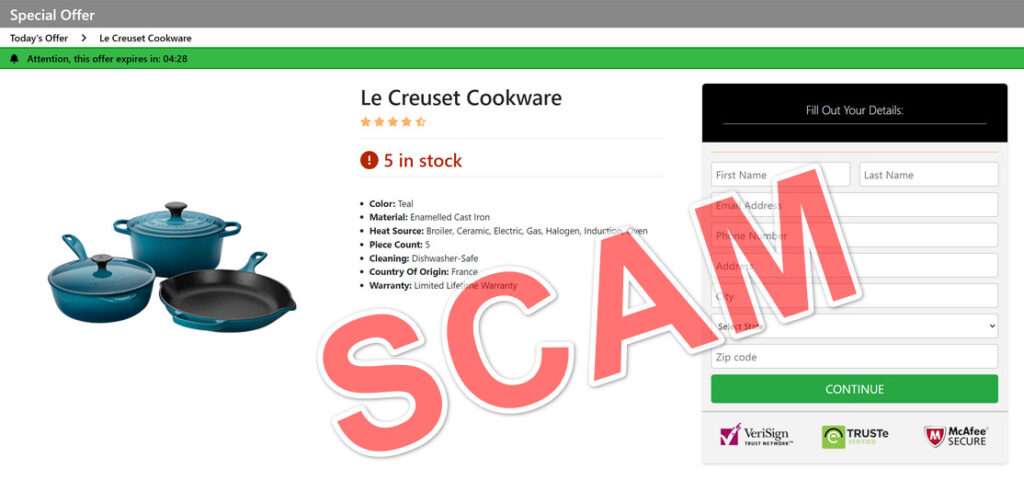
On the phishing site, the scam giveaway is made to look credible with photos of Le Creuset cookware and lots of details about the supposed promotion.
Visitors are drawn in under the false pretense of scoring an amazing freebie.
Step 3: Collect Shipping Payment
The phishing site prompts visitors to cover a small $9.95 “shipping and processing fee” in order to claim their cookware set.
To complete checkout, users must enter their name, address, phone number, email address and payment card details – all sensitive personal information.
This gives scammers access to your private data AND your credit card to start charging hidden monthly fees.
The low $9.95 charge seems totally reasonable for what viewers believe is premium Le Creuset cookware. But unfortunately that first payment opens the door to much larger recurring fees.
Step 4: Auto-Enroll in Monthly Subscription
Here’s the catch. By submitting their payment info, victims are automatically signed up for a negative option monthly subscription without their consent.
Within a few days, the scammers will charge monthly fees of up to $99.95 or more. The small print users missed states these exorbitant charges will continue indefinitely.
Often the subscription terms are only visible in minuscule font, or buried deep in obscure terms and conditions pages. There is NO clear indication users are signing up for a subscription.
Step 5: Difficulty Canceling and Issuing Refunds
Once enrolled in the monthly subscription, most victims have an incredibly difficult time canceling – if they can figure out how at all.
The scammers intentionally make it near impossible to stop the recurring charges or get refunds. Contact info is unavailable, account cancellation links are broken, emails are ignored. Anything to keep squeezing more money from victims.
Sadly, most people end up having to cancel their credit card altogether just to halt the hefty monthly fees. And the promised free Le Creuset cookware never arrives either.
What To Do If You Are A Victim
If you fell for the Gordon Ramsay Le Creuset Giveaway scam and you were charged hidden subscription fees, take the following steps right away:
- Call your credit card company – Alert them to the fraudulent charges and request a chargeback. Provide any details you have about the transaction dates, company names, etc.
- Cancel your card – To prevent future bogus charges, cancel your current card and request a new one with updated card number.
- Contact your bank – If charges were made to your bank account via debit card, call your bank and ask them to block payments.
- Report fraud – File reports with the FTC, FBI, BBB and other organizations exposing this scam. The more reports, the faster action is taken.
- Watch statements – Carefully review your monthly card and bank statements to dispute any other unknown charges promptly.
- Beware “refund” scams – Any calls claiming to offer refunds for an advance fee are also scams. Only work directly with your bank.
- Spread awareness – The more people informed about this scam, the fewer potential victims there will be. Share your experience and what you learned to help protect others.
If enough victims speak up, hopefully the Gordon Ramsay Le Creuset Giveaway scam can eventually be shut down for good. But consumers need to stay vigilant in spotting and reporting similar celebrity-endorsed giveaway scams in the future as well.
Frequently Asked Questions About the Gordon Ramsay Le Creuset Giveaway Scam
Many people have questions about the supposed Gordon Ramsay Le Creuset giveaway promoted on social media. Here we answer some of the most frequently asked questions to uncover the truth about this fraudulent scam.
Is the Gordon Ramsay Le Creuset giveaway real?
No. The Gordon Ramsay Le Creuset giveaway advertised on Facebook, TikTok and other platforms is a complete scam. Gordon Ramsay has no association with this fake promotion.
How does the Gordon Ramsay Le Creuset giveaway scam work?
The scammers run ads using AI-generated videos of Ramsay to falsely claim he is giving away free Le Creuset cookware. The ads drive victims to phishing sites mimicking major news outlets. Victims pay a $9.95 “shipping fee” only to be enrolled in a recurring monthly subscription without consent.
What happens when you pay the shipping fee?
Paying the $9.95 shipping fee signs you up for expensive monthly subscription charges around $99.95 or more, recurring indefinitely. The initial fee is a pretext to obtain your payment information.
Do you actually get free Le Creuset cookware?
No. The free cookware sets promoted are completely fictitious. No physical products are ever shipped out, despite users paying exorbitant recurring fees.
How much does the subscription cost after paying the shipping fee?
You will be charged as much as $99.95 or more every month after paying the deceptive $9.95 shipping fee. The terms are hidden in fine print.
How can you cancel the subscription and get a refund?
Canceling is extremely difficult by design. The scammers make it nearly impossible to stop payments or get refunds. Contact info is unavailable and account links are fake.
Is Gordon Ramsay affiliated with Le Creuset?
No. Chef Ramsay has no partnership with Le Creuset. The fake promotions completely fabricated this celebrity connection to mislead consumers.
How can you report this scam and avoid it?
Report it to the FTC. Warn others on social media. Read closely before paying and avoid celebrity giveaway offers requiring credit card info. The real solution is increased consumer awareness about subscription scams.
Am I able to get my money back if I fell for the scam?
You can request a chargeback via your credit card company. But the scammers make getting refunds difficult. Immediately cancel affected cards/accounts and monitor closely for other unknown charges.
The Bottom Line
While the prospect of scoring free premium cookware endorsed by Gordon Ramsay seems enticing, the unfortunate reality is these promoted social media giveaways are nothing more than subscription scams.
They lure in victims with:
- Fake celebrity endorsements using AI-generated videos of Chef Ramsay
- Phishing sites mimicking trusted brands like Food Network
- Deceptive “shipping fees” that hide expensive monthly subscriptions
- Predatory billing practices and nonexistent customer service
If you see ads for this fraudulent giveaway – avoid them at all costs. And if you did fall victim already, take action quickly to cancel any charges and report the scammers.
With heightened vigilance and awareness, hopefully consumers can avoid being manipulated by celebrity-backed








