


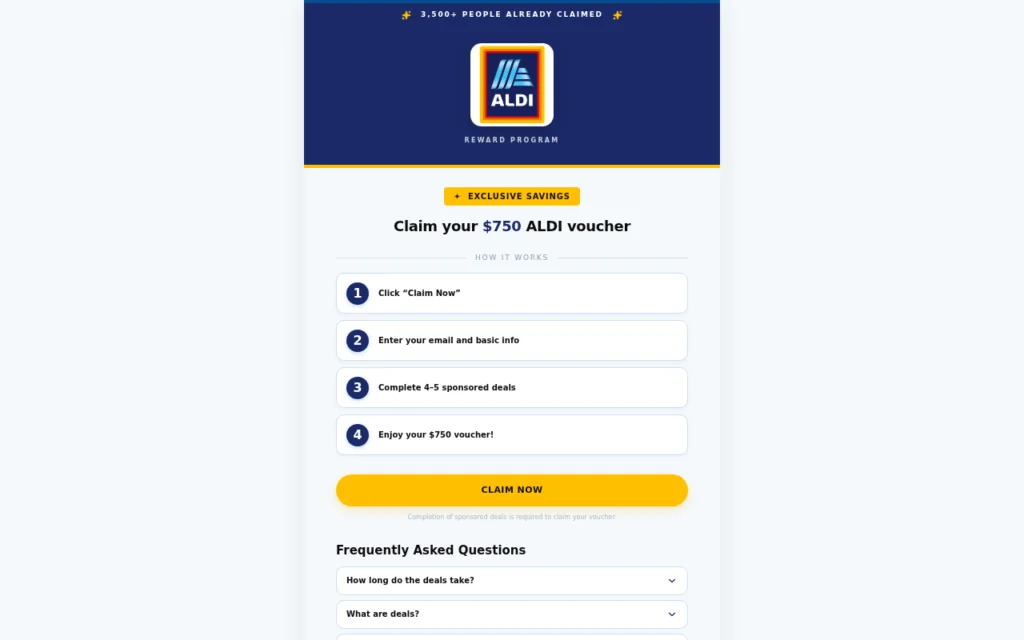
Groceryvouch.com has a tempting offer for anyone watching their spending. Finish a few quick steps, it says, and a big gift card from a famous store is yours.
What you won’t find is a clear explanation of the steps. What you will find is a bright button, and it leads somewhere far from the deal on display.
Overview
Groceryvouch.com’s offer at first glance
Groceryvouch.com hooks you with a big gift card headline and claim button, and similar pages usually add a famous retailer’s logo plus numbered steps toward “claim your card.”
Each step looks minor on pages like this. You enter your email, answer a few questions and complete a few “recommended deals,” which stay vague until you’re already in.
Not the store’s offer, just its name
The retailer won’t be sending a card, because it isn’t running or approving this offer. The site leans on that familiar name for trust it could never earn.
Nothing here connects to the retailer’s own site. The domain is different, and the claim button opens an affiliate network’s tracking link rather than the store.
What the “steps” actually involve
The gift card is the bait, and a lead-generation funnel sits behind it. Typically, a button like this one leads to:
- A tracking link built to pay the operator whenever someone signs up.
- Forms asking for your email, phone number, address and date of birth.
- Sponsored offers like paid trials, subscriptions, app installs and credit applications.
- Moving goalposts that keep the card just one more deal out of reach.
- No named company that answers for delivering the reward.
Treat Groceryvouch.com as what it is: a gift card scam. Your details stay with you, its deals stay untouched, and you shouldn’t expect a card, whatever the page claims.
How the Groceryvouch.com Gift Card Scam Works
Behind Groceryvouch.com sits a script that reward funnels reuse again and again. What changes from page to page? Only the store name, the amount and the domain.
Step 1: A message says you made the cut
A text, an email or a social media ad brings most visitors in. Its pitch: you’ve been “selected” to claim a reward or test products from a famous store.
Big money stops the scroll. A trusted store name does what a little-known website never could on its own: it makes the offer feel trustworthy.
Some messages know your first name or a recent purchase, so they feel personal. That knowledge can come from an earlier data leak, not from the store.
Step 2: A landing page that promises a quick claim
Pages such as Groceryvouch.com usually present the claim as a few numbered steps plus a bright button. “Complete a few deals” sounds short, as if there’s a clear end.
Many of these pages turn up the pressure with countdown timers, “only a few cards left” banners and counters of people who “already claimed.” Those numbers can’t be checked.
Step 3: The claim button leads into an affiliate network
Neither “Claim” nor “Start now” sends you to the store. Both pass you along a tracking link that captures the offer you clicked and the operator’s affiliate ID.
Affiliate links are standard stuff. What they show in this case is simple. You aren’t a winner being rewarded; you’re a lead being sold, right from the first click.
Step 4: The site turns your details into a product
Email comes first. The pages after that want your name, phone number, home address and date of birth. Then, often, a “survey” asks about your income and shopping habits.
The more you answer, the more valuable you become as a lead for marketers. Walk away halfway and those details can still fuel emails, texts and calls for months.
Your details can also travel further than you think. Leave the pre-ticked boxes checked, press “Continue” once, and dozens of “marketing partners” can receive them.
Step 5: Completing the deals costs you something real
To “unlock” the card, the site says you must complete sponsored deals: free trials, streaming plans, insurance quotes, credit applications, or mobile games played to a set level.
Plenty of these offers want a payment card. Miss a trial’s cancellation window and it can become a full-price subscription. A credit application can leave a hard inquiry.
Step 6: You never receive the card
A few deals completed, still no card. The page now says you need more, a deal “didn’t track,” or your claim is “pending review,” and the finish line slides again.
Your sign-ups have paid the operator by now, every one of them. There’s no help desk for the missing card, because the card was never the thing for sale.
Red Flags of Offers Like Groceryvouch.com
Almost every reward funnel shares these signs. The first is decisive by itself.
The card is locked behind “deals”
With a store’s own gift card giveaway, you never have to start paid trials or apply for credit. “Complete a few deals” belongs to an affiliate funnel.
A massive payout for a few seconds of work
Stores hold giveaways, but filling out a form won’t get you a card worth hundreds from one. That generous figure is part of the lure.
A web address that isn’t the retailer’s
An unfamiliar address with a famous store’s name inside it belongs to an advertiser, not the store. Glance at the address bar before you read anything more.
The claim link exits the site
Want proof before clicking? Hover over the claim button on a computer. These pages route it to a tracking domain rather than to the retailer.
Who’s responsible? The page won’t say
The card has no sender you can name: no company, no address, no support contact to answer for it. A tiny “not affiliated” line in the footer won’t fix that.
The surprise message that opens the door
Got a text or email from someone you don’t know saying you’ve “won” or been “selected”? That’s the funnel’s first step, not proof of any prize.
Countdown clocks and claims that cards are running out
These pressure tools exist to stop you from doing your checks. Real store promotions stay the same while you take a day to look into them.
Why the Store’s Name Isn’t Proof
Why a famous store? Because its name sells the scam without extra effort. Costco, Target, Walmart and Amazon gift cards turn up a lot, but any trusted brand fits.
Major retailers regularly caution customers about fake surveys and rewards that misuse their name. They ask people to avoid entering details through links that arrive unexpectedly.
In 2013, the US Federal Trade Commission sued operators of “free gift card” text campaigns that pushed people toward paid offers. Today’s version runs on almost the same script.
Headlines that drop a big store’s name are making a claim, not a promise. Check that claim on the store’s own site. No mention there means no store offer.
What a Real Store Promotion Looks Like
It’s true that real retailers run gift card giveaways. Learn what a genuine one looks like, and the contrast with a fake becomes easy to see.
- The announcement comes from the store’s own channels, meaning its website, app or verified social accounts.
- It publishes official rules naming the organizing company, the prize and the end date.
- It doesn’t make you sign up for trials, download apps or apply for credit to qualify.
- You reach a receipt survey through the address printed on that receipt, and you collect loyalty rewards in your store account or app.
- Winners get notified via the account or channel they signed up through, not a text out of nowhere.
Treat the gift card as bait if the offer fails even one of these. A real promotion shows its conditions instead of hiding them behind a “claim” button.
What the “Deals” Can Cost You
Chasing a card that never arrives still costs you. These are the usual costs:
- Ongoing billing. A free trial or discounted plan that renews at full price if the cancellation window slips by.
- Credit inquiries. Your credit file can pick up hard inquiries from the loan and credit card applications tucked among the offers.
- More spam, more robocalls. The email, phone number and address you typed in get passed along to marketing partners you never chose.
- More scams on the way. Respond to one “you won” offer and you land on a list the next scammer values. Brace for phishing and fake delivery texts.
- Unwanted apps. Games and apps you installed to “unlock” the reward can go on tracking you or showing ads after you quit playing.
- Lost time. Hours of surveys, games and offers, all for a reward that was never coming.
Nothing about the card is real, yet the costs certainly are. The operator earns from every sign-up, and the bills land on the visitor.
Same Funnel, New Domain
Think of Groceryvouch.com as one copy among many. These reward pages are cheap to make, often built with website builders, and they usually go offline within days of a report.
These sites’ claim links often reuse a single affiliate ID across several domains. That repetition points to one operator running many pages at the same time.
Next to one another, the pages leave matching fingerprints:
- A headline built around a famous store’s name and a large gift card amount
- Three or four step-by-step instructions that finish on “claim your card”
- A catch requiring you to “complete a few deals”
- The claim button, which opens an affiliate tracking link
- Timers or counters that give you no way to verify them
A different store or a different amount doesn’t make it a different offer. If the pattern matches, it’s the same funnel under a new address.
How to Check a Gift Card Offer Before You Click
A quick two-minute check is enough. Genuine promotions get through it, but reward funnels don’t.
- Type the store’s address yourself or open its official app, and check whether the promotion actually appears there.
- Hold your cursor over the claim button on a computer, but don’t click. A tracking domain rather than the store’s address is the answer you need.
- Look up the site’s name alongside “scam” or “review.” Often a new funnel has no history at all, and that silence is a warning on its own.
- Go through the fine print looking for “deals,” “offers” or “participation requirements.” Finding any of them means the card has strings attached.
Spot a problem with any check? Close the page. Your email address is too much to give it, and your card details are far too much.
What to Do If You Have Fallen Victim to This Scam
Did Groceryvouch.com get your details, or did you start deals through it? Then act now, while the trial periods are still running, and most of the damage can be limited.
- Cancel each trial and subscription. Don’t skip any deal you started; cancel it before the trial ends and save the confirmation for every one.
- Check your statements. Watch for small test charges and recurring payments you don’t recognize, then dispute them with your bank or card issuer.
- Request a replacement card. If your card details went into any page in this funnel, ask your bank to issue you a new number.
- Review your credit. New inquiries and unfamiliar accounts are what to look for on your credit report if you completed a loan or credit card application.
- Treat follow-ups as scams. That goes for every text and email about “your reward” or “a problem with your claim.” Don’t tap or click the links inside.
- Tidy up your device. Revoke notification permissions these pages got from you. Installed anything? Scan with Malwarebytes Free. AdGuard blocks many ads leading to these pages.
- Fix password reuse. Change the password on your other accounts if you also used it to create an account on the site.
- Handle the unwanted contact. Unsubscribe links are only for companies you recognize. Everything else gets marked as spam, and numbers that start calling or texting get blocked.
- Report it. Let the retailer whose name was borrowed know, flag the ad or message, and file at ReportFraud.ftc.gov in the US or with your national fraud service elsewhere.
If canceling a charge or subscription goes nowhere, turn to your bank or card issuer. They can usually dispute it, but most only accept disputes for a few months.
Frequently Asked Questions
Is the Groceryvouch.com gift card real?
No. Groceryvouch.com is a gift card scam. Its affiliate funnel is built to grab your information and nudge you toward paid deals, and you’ll never receive a card.
Is Groceryvouch.com connected to the store it names?
It isn’t. The offer takes the store’s name, often with its logo, purely to look legitimate. Any real promotion from that retailer would be posted on its own website.
How does Groceryvouch.com make money?
Through affiliate deals that pay per action. Advertisers pay for every email address, survey answer and completed offer, and a share of each payment goes to the operator.
I completed some deals. Will I get the gift card?
No. Ignore the messages telling you a reward is “pending,” and don’t start another deal. Cancel the trials and subscriptions you began and check your statements.
Why do I keep seeing the same offer on new websites?
It’s the same funnel wearing new clothes. A page gets reported quickly, a replacement costs almost nothing, and the operators relaunch it on another domain with another store name.
What should I do if I get one of these offers by text?
Hands off the link. Forwarding to 7726 (SPAM) helps US and UK carriers block similar messages, so send the text there and then delete it.
The Bottom Line
For Groceryvouch.com, the formula is a famous store’s name, a big gift card and a paid affiliate funnel behind them. The card is bait; the deals are the business.
Don’t sign up, don’t fill anything in and don’t start any deals. Close any page that asks you to complete offers to claim a free gift card.
If you started any trials, cancel them all before they renew. Watch your statements closely, and don’t trust a message about your reward. It’s the next scam.

Reviews & discussion
0 commentsShare a firsthand experience, or ask a question.
Community reviews
groceryvouch.com
Moderated reader experiences, not an editorial verdict.
Start the conversation
Have a question or something useful to share? Add the first comment.