

Honey Peak Drops is sold with warm honey imagery, a simple daily ritual, and a story that seems to pass through doctors and famous technology figures before reaching a supplement checkout.
The real offer is less magical. It is a high-priced proprietary blend sold through a separate merchant-of-record platform, with business details scattered across several websites.
We followed the advertising trail, label, checkout, contact information, and related Honey Peak pages.
Overview
What Honey Peak Drops Claims to Offer
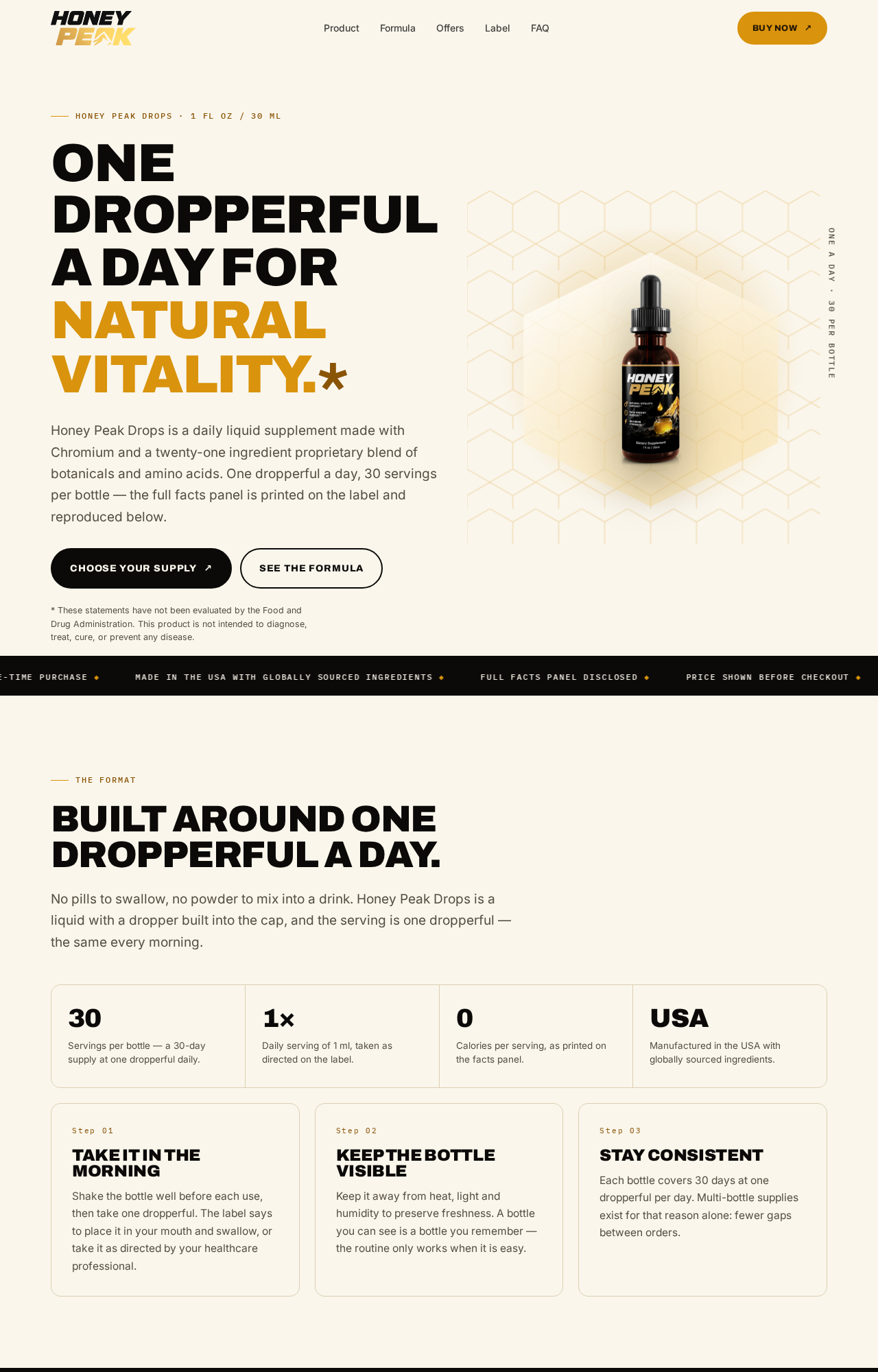
Honey Peak Drops is a 1 fl oz, 30 ml liquid dietary supplement. The page instructs users to take one dropperful daily and markets the formula for energy, vitality, and performance.
The Supplement Facts panel lists 7 mcg of chromium and a 21-ingredient proprietary blend weighing only 15.47 mg in total. The individual amounts for the ingredients inside that blend are not disclosed.
The live packages cost $158 for two bottles, $207 for three, or $294 for six. The checkout we reviewed clearly described the order as a one-time purchase with no autoship.
How the Fake Endorsement Story Changes the Product
The promotional funnel is not limited to modest vitality language. Advertisements have used honey, baking soda, and Vicks imagery alongside alleged appearances by Bill Gates and medical figures, including Dr. Anika Ackerman.
The story implies that respected people revealed or validated a private men’s health formula. We found no credible evidence that those named individuals created, endorsed, or prescribed Honey Peak Drops.
The celebrity narrative and the supplement page perform different jobs. The first creates curiosity and authority. The second collects a multi-bottle payment while using safer, more general wording.
Our Verdict on Honey Peak Drops
We recommend avoiding Honey Peak Drops. The offer relies on an unverified celebrity-and-doctor story, does not disclose individual doses for a very small proprietary blend, and spreads accountability across a distributor, a post office box, a merchant of record, and multiple support channels.
The exact checkout we examined is not a confirmed subscription trap. It says one-time purchase and no autoship. The stronger concern is that the advertising story appears deceptive and the product evidence is too weak for the price and implied results.
Key warning signs include:
- Famous names are used without a verifiable endorsement.
- A complex men’s health promise is attached to a honey-themed “ritual.”
- Twenty-one blend ingredients share only 15.47 mg, with no individual amounts.
- No finished-product clinical trial was presented.
- The brand uses a merchant of record called PagAmerican for payment.
- A related Honey Peak site publishes a phone number reserved for fictional use.
- The same distributor and post office box appear across different Honey Peak formats.
The Honey Ritual Is a Marketing Story, Not Medical Evidence
Familiar Ingredients Make the Claim Feel Plausible
Honey, baking soda, and household remedies are familiar, inexpensive, and emotionally reassuring. They make an advertisement feel like a traditional discovery rather than a commercial pitch.
The campaign then layers in famous people and medical authority. A viewer may believe the recipe was discussed in an interview, suppressed by pharmaceutical companies, or rediscovered by a respected expert.
That is a storytelling device. A believable kitchen ingredient does not verify the identity of the person on screen, prove a hidden medical mechanism, or establish that the bottle at the end of the funnel produces the promised result.
AI Video Can Manufacture an Endorsement
Modern scam advertisements can animate a public figure’s face, clone a voice, splice authentic interview footage, and place synthetic dialogue over familiar broadcast graphics. The result may look more convincing than a traditional fake testimonial.
A real endorsement should be independently traceable to the person’s verified website, public statement, or official social account. It should not exist only inside a sponsored video that leads to a checkout.
We found no reliable evidence connecting Bill Gates, Dr. Anika Ackerman, or other medical figures named by versions of the campaign to Honey Peak Drops.
The Product Page Pulls Back From the Dramatic Claims
Once the viewer reaches the current product page, the language becomes more cautious. It describes support for vitality and performance, uses the standard dietary-supplement disclaimer, and avoids promising a treatment.
This split is common in affiliate funnels. The ad makes the dramatic claim, while the checkout page uses softer language that can be defended as general wellness marketing.
Consumers should evaluate the entire sequence, not only the most legally cautious page. If a fake endorsement caused the purchase, a mild footer disclaimer does not repair that deception.
The Formula Does Not Support the Confidence of the Pitch
Twenty-One Ingredients Share 15.47 mg
The label groups a long list of botanicals and amino acids into a proprietary blend. The total blend weighs 15.47 mg per serving, but the page does not say how much of each ingredient is present.
That makes the impressive ingredient count difficult to interpret. Twenty-one names can look more powerful than three, yet a long label does not show that any ingredient is present at a meaningful or studied amount.
Without individual doses, a buyer and clinician cannot compare the formula with research, assess likely interactions, or understand which component is supposed to produce the advertised effect.
Chromium Is Disclosed, but the Main Blend Is Not
The panel lists chromium separately at 7 mcg. The rest of the formula is hidden behind the proprietary-blend total.
Proprietary blends are legal in the United States when labeled correctly, but legality is not the same as transparency. The seller still needs evidence that the finished product is safe and that its claims are truthful.
We did not find a controlled human study on the exact Honey Peak Drops formula. Research on a single ingredient or a broad category cannot establish what this 15.47 mg mixture will do.
No Batch-Level Proof Is Offered to the Buyer
The page says the product is made in the United States with globally sourced ingredients and displays manufacturing badges. Those statements do not identify the ingredient origins or provide a batch-specific certificate of analysis.
A useful test document would name the laboratory, lot number, methods, and results for identity, potency, microbes, heavy metals, and other relevant contaminants. It should match the bottle being sold.
We did not find that documentation on the public sales path. Do not conclude that the product is contaminated or made in China without evidence, but do recognize that the buyer is being asked to trust more than can be verified.
How the Honey Peak Drops Scam Works
Step 1: A Social Media Video Promises a Private Honey Secret
The ad opens with a familiar ingredient, an intimate problem, and a promise that the answer is surprisingly simple. Honey, baking soda, or another household item provides the visual hook.
The language is designed to keep the viewer watching rather than immediately naming a supplement. That makes the content feel educational or confessional instead of commercial.
Step 2: Famous People Supply Borrowed Trust
Bill Gates, a doctor, or another recognizable person appears to explain why the method works. The clip may use cloned audio, edited footage, synthetic scenes, or fabricated subtitles.
Viewers are encouraged to trust the identity of the speaker instead of asking for product-level evidence. The supposed endorsement exists only inside the seller’s funnel.
Step 3: The “Recipe” Becomes a Branded Bottle
After a long explanation, the viewer learns that the practical way to obtain the alleged benefits is to buy Honey Peak Drops. The kitchen remedy becomes a bridge to a proprietary commercial formula.
The bottle contains many ingredients beyond honey, and the advertisement does not show how the household story maps to the actual doses on the label.
Step 4: The Page Uses Ratings, Badges, and Scarcity
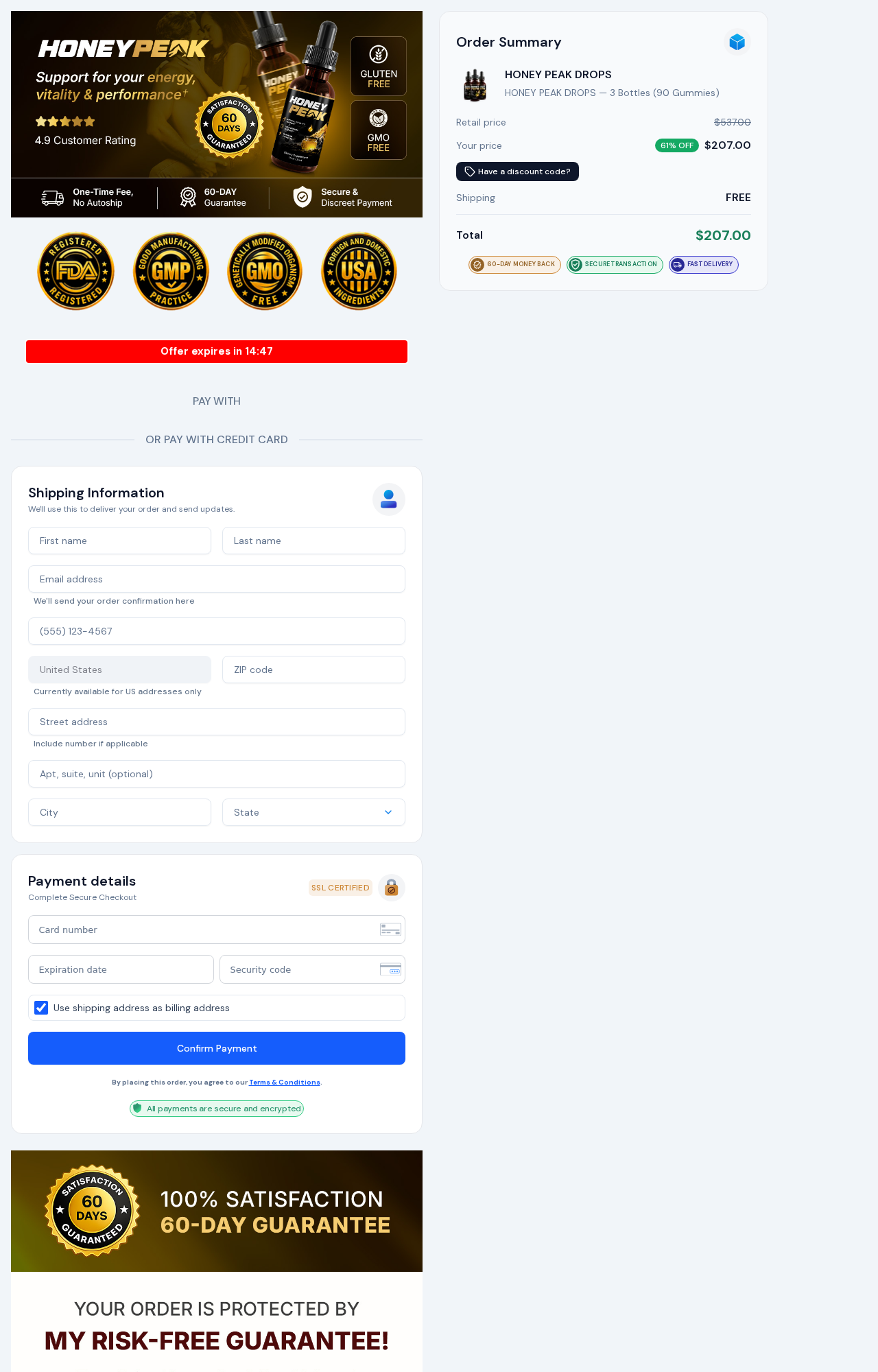
The product and checkout pages show a 4.9 rating, guarantee seals, manufacturing badges, a countdown timer, and a steep discount from a higher retail price.
These elements create confidence and urgency. They are not independent verification of customer satisfaction, FDA approval, or clinical effectiveness.
Step 5: Only Multi-Bottle Packages Are Prominent
The offer begins at two bottles for $158 and strongly promotes three or six bottles. The customer cannot test a single bottle through the main package grid.
That increases the immediate charge and creates a return problem if the product is unsuitable, delayed, or different from what the ad implied.
Step 6: A Separate Merchant Processes the Payment
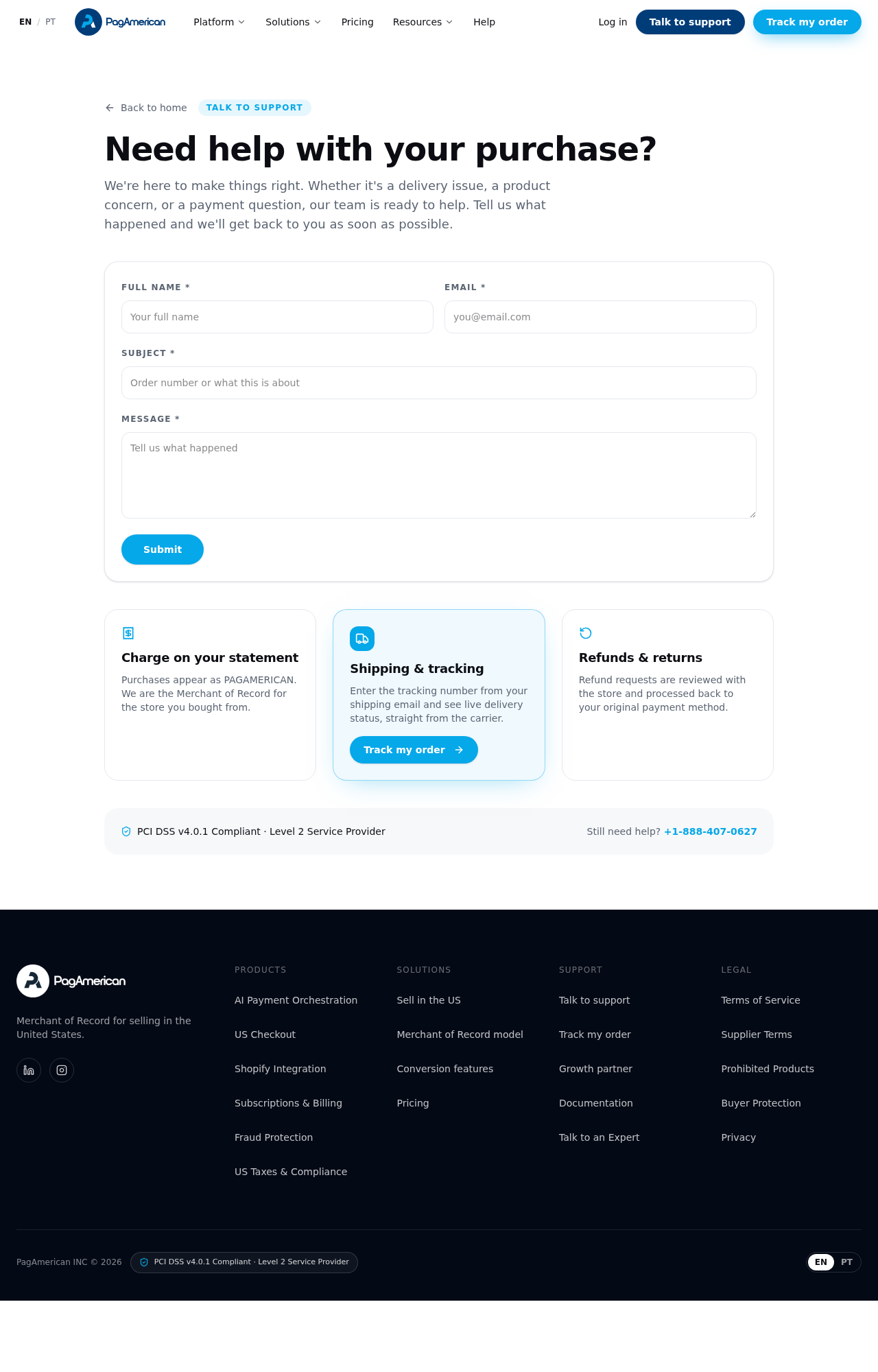
The order is processed through PagAmerican LLC, which identifies itself as the merchant of record. PagAmerican says charges appear as PAGAMERICAN and that refund requests are reviewed with the store.
This is important because Honey Peak is the product brand, Honey Peak Nutrition LLC is named as distributor, and PagAmerican handles payment. Buyers need all three roles to pursue a complaint effectively.
Step 7: Brand Variants Make Online Research Confusing
Honey Peak Drops has a related gummy site using the same package prices, distributor, and Ogden post office box. A separate site called honey-peak.com sells a different performance honey under different terms, including recurring purchases.
We found no basis to merge that separate recurring offer with Honey Peak Drops. The name collision itself is the problem: a buyer searching “Honey Peak subscription” can easily read terms for the wrong seller.
Company, Address, and Fulfillment Checks
The Named Distributor Uses a Post Office Box
The Honey Peak pages identify Honey Peak Nutrition LLC as distributor and list PO Box 12730, Ogden, UT 84412. A post office box can receive business mail, but it does not identify a headquarters, laboratory, manufacturer, or return warehouse.
The page should clearly explain where the product is made, which facility releases each batch, and where consumers report a serious adverse event.
PagAmerican Is the Merchant of Record
The checkout runs through pay.pagamerican.app. PagAmerican’s buyer-support page says purchases appear as PAGAMERICAN on card statements and provides +1-888-407-0627.
Its terms describe a 60-day guarantee unless the product page specifies something different. This can help buyers identify the charge, but it also shows that the brand and payment recipient are not the same entity.
The Published Support Details Are Inconsistent
The exact drops page uses support@carecenterteam.com. The related gummy site uses support@honeypeakgelatin.com and publishes +1 (801) 555-0147.
Numbers from 555-0100 through 555-0199 are reserved in the North American numbering system for fictional, nonworking use. That makes the gummy site’s 555-0147 contact number unsuitable as real customer support.
A Fulfillment Address Is Not Proof of Product Origin
Customers should not assume that a return address or “made in USA” badge proves where every ingredient was sourced. The page itself says globally sourced ingredients.
We found no proof that Honey Peak Drops is mass-produced in China, and we will not make that claim. The documented concern is simpler: the sales funnel does not provide enough traceable manufacturing and testing information for the confidence of its pitch.
The One-Time Checkout Still Requires Careful Documentation
This Exact Offer Says No Autoship
The Honey Peak Drops checkout visibly states “One-Time Fee, No Autoship.” The order summary for three bottles shows a total of $207 with free shipping.
That evidence matters. A responsible investigation should not label a current one-time order a subscription merely because a different business with a similar name uses recurring billing.
Still, buyers should save the final summary. Advertising variants and checkout terms can change, and the saved page is the best record of what was accepted.
The Guarantee Is Only Useful if the Buyer Can Reach the Right Party
The checkout advertises a 60-day guarantee. PagAmerican says refund requests are reviewed with the store and returned to the original payment method.
Consumers should start with the contact in the receipt, copy the brand support address, and contact PagAmerican if the store does not respond. Do not wait until the last days of the guarantee.
Keep the bottle, label, package, and tracking information until the refund is complete. A payment processor may ask for evidence that the seller’s procedure was followed.
What to Do if You Have Fallen Victim to This Scam
- Preserve the full advertising path. Save the social ad, alleged celebrity clip, landing page, ingredient panel, order summary, terms, receipt, and the PAGAMERICAN card descriptor. Note which domain showed each item.
- Confirm what you actually bought. The version we examined was one-time, but check your receipt for autoship, subscription, membership, continuity, recurring, or a future billing date.
- Request a refund immediately. Write to the support address on the receipt and identify the misleading endorsement or other issue. Include the order number, purchase amount, date, and the remedy you want.
- Escalate to PagAmerican when necessary. Use its buyer-support channel and +1-888-407-0627 if the store does not resolve the issue. Ask for a case number and written return instructions.
- Contact your card issuer if the charge remains disputed. Describe the specific problem, provide screenshots, and distinguish an unauthorized charge from a product-quality or misrepresentation dispute.
- Speak with a healthcare professional about side effects. Stop using the supplement and seek advice if you develop a reaction. Do not use the product as a replacement for evaluated treatment.
- Report the ad and endorsement. Report the sponsored post to the platform and submit deceptive-marketing information to the FTC. Serious supplement adverse events can also be reported to the FDA.
- Check the device used for the purchase. Malwarebytes can scan for malicious downloads or unwanted software. AdGuard can reduce exposure to deceptive ads and redirect chains, though neither service can cancel an order for you.
Frequently Asked Questions
Is Honey Peak Drops a subscription?
The exact checkout we examined said one-time fee and no autoship. A separate similarly named site uses recurring billing for a different product, so do not mix the two sets of terms.
Did Bill Gates endorse Honey Peak Drops?
We found no credible evidence that he endorsed the product. Treat a video as fabricated unless it can be verified through his official channels and independent reporting.
Is the 21-ingredient formula strong?
The label discloses only 15.47 mg for the entire proprietary blend, not the amount of each ingredient. An ingredient count alone cannot establish an effective dose.
Who charges the customer?
PagAmerican LLC is identified as the merchant of record, and its support page says the card charge appears as PAGAMERICAN. Confirm the exact descriptor on your own statement.
Who distributes Honey Peak Drops?
The page names Honey Peak Nutrition LLC and lists PO Box 12730, Ogden, UT 84412. That is a mailing address, not proof of the manufacturing site.
Is Honey Peak Drops FDA approved?
No. Dietary supplements are not FDA approved for safety and effectiveness before sale. A registration or GMP badge should not be read as product approval.
The Bottom Line
Honey Peak Drops is sold through a deceptive story that borrows trust from famous people and turns a simple honey ritual into a $158 to $294 supplement purchase. The label and public company trail do not justify that confidence.
The current checkout says one-time purchase, so the evidence does not support calling this exact offer a confirmed refill trap. The fake endorsement, opaque 21-ingredient blend, fictional support number on a related page, and fragmented accountability are sufficient reasons to stay away.








