

An email announces that your address has been selected for a substantial prize. It looks like the sort of news you would want to read twice.
The National Lottery email scam makes that hopeful moment its opening. Before contacting the supposed claims agent, check what connects the message to a real entry.
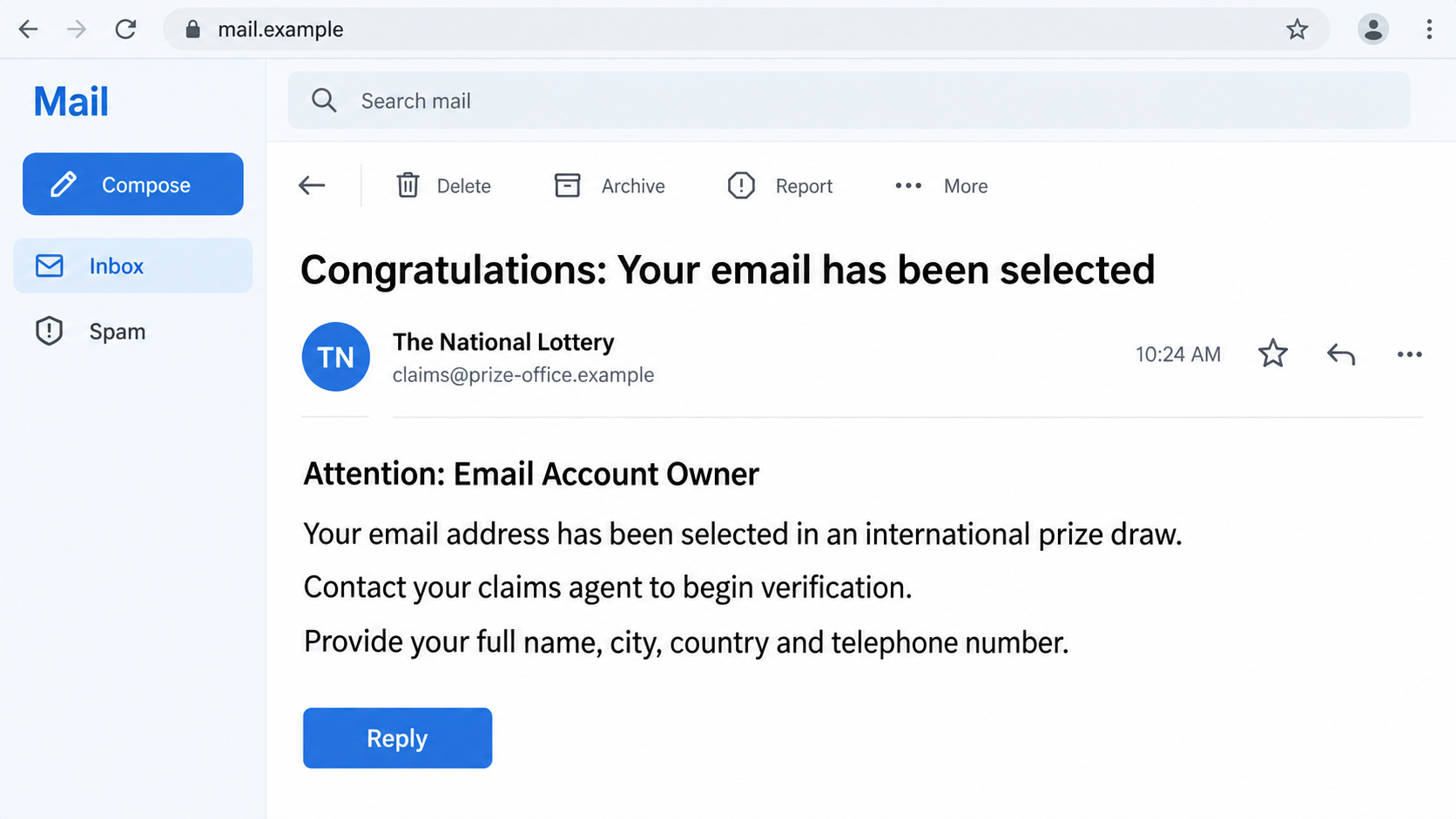
Overview
The message invents a winning entry for your email address
This impersonation pattern claims an email address won an international draw. The recipient is told to contact a claims agent and provide personal information.
Historical examples use the National Lottery name, ticket-like numbers, reference codes, and official-sounding payment titles. Those details make an unsolicited claim appear administratively complete.
They do not establish that you bought or otherwise obtained a genuine entry. An invented reference can look precise without corresponding to any real draw.
The documented example considered here is historical, not proof that its particular sender or agent remains active today.
The prize story can become an advance-fee demand
After a response, lottery fraud commonly introduces payment requirements described as processing, tax, banking, or release costs. The promised prize never arrives.
Report Fraud’s lottery warning describes this progression and the repeated excuses used to request additional fees.
The initial archived message establishes impersonation and information collection. The broader fee sequence is a documented scam pattern, not a completed transaction verified for every recipient.
Keep those stages separate when reporting your experience. Replying, submitting documents, and sending money create different exposures.
A legitimate lottery must be checked outside the email
The real National Lottery is not the fraudulent sender. Actual ticket purchases, syndicate arrangements, and account records need checking through their established channels.
Warning signs in the unsolicited claim include:
- A winning entry supposedly created just because your email address exists.
- No connection to a ticket, draw, or account you recognize.
- A claims agent using an unrelated address or unfamiliar contact route.
- Requests for identity information before the organization is verified.
- Fees that must be paid before an unexpected prize can be released.
- Instructions to keep the claim secret or act before independent checking.
The email image is a fictional illustration of the approach. Its sender domain is deliberately nonfunctional, and it is not evidence against an actual account.
Why Reference Numbers and Claims Agents Feel Convincing
Specific details create the impression of a record
A ticket number, batch code, and regional office title suggest paperwork exists somewhere. The reader may focus on completing that paperwork rather than questioning its origin.
Yet every one of those details can be typed into a message. Precision is not the same as authentication.
The meaningful evidence is a record you can independently connect with a genuine entry. A reference supplied only by the claimant cannot establish that connection.
The first request does not always mention money
An initial form may ask only for your name, location, occupation, and telephone number. That makes the response feel less consequential than a payment.
It still confirms contact and gives the sender information for a more personalized conversation. Later messages can reuse those details as supposed proof of legitimacy.
Do not send information merely to learn whether the prize is real. Verify the organization before entering its claims process.
A named intermediary keeps verification inside the story
The message directs you to a claims agent, payment officer, or coordinator. That person becomes the source of every explanation and next instruction.
A professional title can conceal the absence of an independently verified role. The email has introduced the person whose authority it then asks you to trust.
Additional certificates or supervisor emails do not fix that problem if the same unverified operation supplies them all.
How the National Lottery Email Scam Works
Step 1: An unexpected email announces a supposed prize
The message presents congratulations before establishing participation. A computer-generated selection or international promotion supposedly explains why your address qualifies.
The premise is designed to answer the obvious question: how could you win without recognizing the entry? The explanation remains a claim, not independent evidence.
A display name can say National Lottery while the actual sender address belongs elsewhere. Do not evaluate the email solely by the name above its body.
Older samples also attach official-looking identifiers to the recipient’s address. These are features of the impersonation, not authenticated lottery records.
Start by checking your own tickets, online entries, or syndicate records. If none connects with the alleged draw, do not invent an explanation for the sender.
Step 2: The recipient is directed to a claims agent
The sender introduces a person who supposedly manages prize release. You are encouraged to reply or contact that person rather than use the lottery’s established support.
This separates the recipient from independently verifiable information. The agent controls the questions, evidence, deadline, and proposed payment process.
Different sender and reply addresses deserve scrutiny. A forwarded email or copied logo can disguise where the conversation will actually go.
Do not assume a free email account is the only possible warning. An impostor can operate a custom domain and a polished website too.
The safer test is whether the organization confirms the person and claim through a contact route you obtained without their help.
Step 3: Personal details make the claim appear to progress
The agent requests biographical information or asks you to complete a verification form. The apparent purpose is matching the prize to the right person.
In this fraudulent context, the request instead gathers information without proving any prize exists. Additional document requests can increase identity-related exposure.
A genuine organization may need identity verification in a legitimate claim. That does not make sending documents to an unverified stranger safe.
Check the recipient, claim, and secure submission route first. Never send a passport image merely because the message uses a regulatory or security explanation.
If you already provided documents, record exactly which ones and which identifying details were visible. That information matters when seeking protective advice.
Step 4: A fee is presented as the last obstacle
In the advance-fee branch, the promised award is nearly ready, but a processing, legal, tax, or banking cost must supposedly be paid first.
The gap between the large imaginary prize and the smaller real payment makes the demand appear worthwhile. The money you send is the actual transaction.
The operator may refuse to deduct the expense from the prize and supply an official-sounding reason. That explanation does not establish the fund exists.
Payment to an unfamiliar individual or account is another warning. A certificate bearing a recognizable logo does not authorize that destination.
Do not test the claim by paying a small installment. An initial payment can lead to another requirement rather than any verifiable progress.
Step 5: Additional fees or a recovery approach extend the loss
Once someone pays, the agent can invent another obstacle. The next demand may be framed as a final clearance needed to release the same nonexistent prize.
Previous payments make the recipient more invested in finishing. That pressure is understandable, but it does not create a genuine entitlement to funds.
Report Fraud also warns about later offers to recover lottery-scam losses. A different name and helpful tone do not automatically establish an independent service.
End new payments and preserve the conversation already received. Seek recovery options through your bank, payment provider, and official reporting channels.
No further fee to the unverified claimant proves the prize will arrive. Stop evaluating each new demand through the agent’s explanation alone.
How to Check a Lottery Claim Fairly
Connect the claim with an actual entry
Identify the game, draw date, and entry you recognize. For an online purchase, access your established account separately rather than signing in through the email.
For a ticket bought elsewhere, use the operator’s official checking and claim instructions. For a syndicate, consult the person and records you already know.
This approach does not require buying another ticket. A claim about an existing win should be assessed against that entry, not a new purchase.
Allow legitimate identity checks without trusting an impostor
A real prize claim can involve identity and eligibility verification. A blanket statement that no legitimate lottery ever requests personal details would be misleading.
The difference is whether the organization, claim, recipient, and submission route are independently established. A surprise email cannot supply all that evidence by itself.
Ask verified support what information is required and how to provide it safely. Do not accept a secure-looking upload page as proof of institutional ownership.
Use regulator guidance without confusing HTTPS with authenticity
The Gambling Commission’s fraud guide warns about personal sender accounts and overseas or premium-rate contact requests.
Licensing checks help distinguish an actual operator from a made-up business. They do not authenticate a separate email that has borrowed that operator’s name.
HTTPS only secures the connection to a website. It does not prove the site belongs to a lottery or that its prize claim is truthful.
If an official service is temporarily unavailable from your location, wait or use another established contact channel. Do not treat a lookalike replacement as equivalent.
What to Do if You Have Fallen Victim to This Scam
-
Stop paying and close the unverified conversation.
Do not send a final clearance fee, cancellation payment, or deposit to recover earlier funds. Preserve messages before blocking the sender.
Tell someone you trust about the claim. A second perspective can help interrupt the pressure created by previous payments and repeated promises.
-
Contact the service used to send money.
Explain that a fake lottery claim induced the transaction. Supply the recipient, date, amount, reference, and payment method.
Ask urgently about a transfer recall, charge dispute, or other available intervention. Do not assume recovery is guaranteed, and do not delay while negotiating with the agent.
-
Notify your bank about exposed financial information.
Distinguish a bank account number from a banking password, card details, or security approval. Give the bank the exact information provided.
Ask which controls are appropriate. Monitoring, card replacement, account restrictions, and credential changes address different risks rather than one universal response.
-
Deal with identity documents through trusted protective channels.
If passport or other identity copies were supplied, consult the issuing authority’s current guidance and monitor relevant financial records.
Check for unfamiliar credit applications or accounts. Use a reputable service reached independently, not an identity-protection link the supposed agent introduces.
-
Secure logins if any were disclosed during the claim.
Change affected credentials on the real service and replace reused passwords. Check account recovery options and active sessions.
Replying with a name does not prove your email was hacked. Do not let an unsolicited helper exaggerate the incident to sell unnecessary access.
-
Organize the evidence into a short chronology.
Keep the original email, full headers where available, agent addresses, claimed references, documents received, and payment receipts.
Separate what the sender claimed from what you actually paid or disclosed. That makes the record useful without treating fabricated certificates as verified facts.
-
Report the suspicious email and any loss separately.
Forward suspicious email to report@phishing.gov.uk. Official U.K. reporting instructions explain financial-loss routes for the relevant location.
Give investigators transaction details and the bank’s case reference when appropriate. Public warnings should not expose your documents or complete financial information.
-
Be cautious when someone promises to recover the prize or your payment.
A later contact may claim to represent police, regulators, lawyers, or a recovery department. Independently verify the organization before discussing sensitive details.
An advance payment to obtain a refund repeats the original problem. Continue with the trusted case channels you already established.
Frequently Asked Questions
Can my email address win without an entry I recognize?
An unsolicited claim about a computer-selected email does not establish a genuine lottery entry. Check tickets, online purchases, or known syndicate participation independently.
Do not send personal details to make the sender prove its own story.
Are all National Lottery emails scams?
No. A legitimate account or service can send communications. The scam is the impersonating message and unsupported prize process, not the existence of email itself.
Inspect your established records outside the message before responding.
Does a ticket or reference number verify the win?
Only if it connects with independently verified records. A number typed into a fraudulent email can look formal without corresponding to any genuine entry.
Check the actual draw and your own participation.
Would a real lottery request identity information?
Legitimate claims can require identity or eligibility checks. The recipient organization and submission route must be verified before documents are provided.
A supposed claims agent introduced by a surprise email does not satisfy that requirement.
Should I pay a fee that can be deducted later?
Do not pay an unverified agent to release an unsolicited prize. A promised deduction or reimbursement does not establish that any winnings exist.
Check the claim through the genuine operator first.
Can reporting the scam recover my money automatically?
No. Reporting supports investigation, while your bank or payment service assesses transaction-specific intervention and dispute options.
Contact the payment provider promptly rather than waiting for an investigation or buying a recovery service.
The Bottom Line
The National Lottery email scam invents a prize, introduces its own claims authority, and can turn hope into personal-data exposure and repeated fees.
A real entry needs independently verified records. Check those first, keep documents away from unverified agents, and stop further payments if the claim has already drawn you in.








