


NeoGluco is a blood sugar supplement sold through ads that claimed it could reverse type 2 diabetes. Searchers also look for it as Neo Gluco capsules.
No supplement has been shown to reverse diabetes, and the FDA treats products sold to cure a disease as drugs. No NeoGluco seller or order page can be traced today.
Overview
A diabetes cure sold as a supplement
As our August 2025 report showed, NeoGluco ads promised to reverse diabetes or balance blood sugar in as little as 17 days, with a remedy supposedly hidden by drug companies.
What federal agencies say
The FDA says a product meant to treat or cure a disease is a drug, even if it’s labelled as a supplement. It doesn’t approve supplements before they’re sold.
Where NeoGluco stands now
The matching neogluco.com and neogluco.net domains were registered in August 2025, lapsed in August 2026 and have no archived pages. No NeoGluco order page survives in public archives.
- Don’t stop or change diabetes medicine because of an ad or a supplement.
- Treat any page promising to reverse type 2 diabetes with a capsule or drops as a sales pitch.
- If you bought NeoGluco, check your statements for repeat charges and contact your card issuer.
- Neo glucosamine products are joint supplements and have nothing to do with NeoGluco.
Is NeoGluco Legit?
No. NeoGluco was sold with a promise no supplement can keep: reversing type 2 diabetes. A product marketed that way is making an unproven drug claim.
The ads leaned on fake authority. As our 2025 report showed, they used the names and faces of Elon Musk, Sean Hannity and Karoline Leavitt.
None of them had any link to the product.
The sales path ran through a page dressed up as a health news file, then a video, then an order form.
None of those steps named a company or a manufacturer.
Today no NeoGluco order page, policy or contact detail survives online. That leaves buyers with nothing to hold the seller to.
The FDA’s position on cure claims applies whatever the bottle or the ad calls the product.
Neo Gluco: What the Ads Promised
NeoGluco was pitched as a natural blood sugar support supplement that could do far more than support. The ads talked about reversing diabetes outright.
Some versions promised results in as little as 17 days. Others framed the product as a breakthrough that drug companies wanted suppressed.
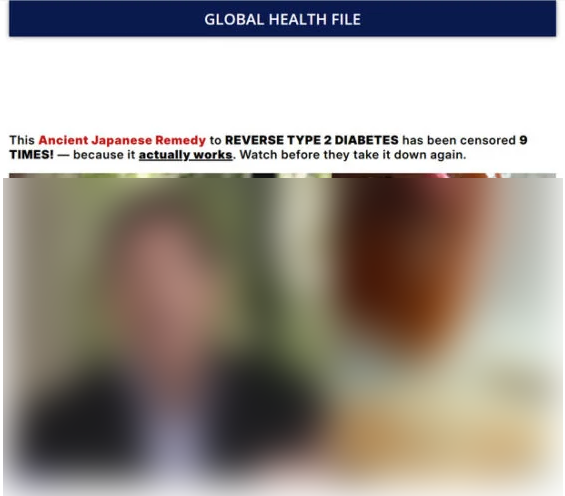
Our August 2025 screenshot of the advertorial page shows the heading Global Health File.
Its headline said an ancient Japanese remedy to reverse type 2 diabetes had been censored nine times because it actually works.
Below the headline sat a video with a presenter, and the page urged visitors to watch before it was taken down again.
Celebrity clips were part of the pitch. Videos made to look like news segments put public figures in front of a diabetes cure story they never told.
Some ads also named a natural-health speaker as the product’s creator, a claim with nothing behind it.
AI tools can now put convincing words in a real person’s mouth. A familiar face in a video ad is no longer proof that the person said anything.
If a public figure really backed a diabetes product, the endorsement would appear on their own channels, not only inside a sales funnel.
The Censored Remedy Story
The censored-nine-times line does two jobs. It explains why a reader has never heard of the cure, and it creates a deadline to watch the video now.
The ancient Japanese remedy adds an exotic, natural feel, but the headline doesn’t say what the remedy is or who studied it.
Real medical findings are published in journals and reviewed by regulators. They aren’t hidden behind a video that may disappear.
A remedy that truly reversed diabetes would be major medical news, reported widely and studied openly.
The same story structure appears across many diabetes supplements. Our February 2026 NeoGluco scam ads report breaks down each funnel stage, billing trap and refund step in more detail.
What the FDA and NIH Say About Diabetes Supplements
The FDA’s guide to dietary supplements says that, in general, a product intended to treat, prevent or cure a disease is a drug, even when labelled as a supplement.
The FDA also says it doesn’t have the authority to approve supplements for safety and effectiveness before they’re sold. A supplement on sale hasn’t been cleared to treat diabetes.
The National Center for Complementary and Integrative Health finds no evidence of benefit on diabetes or its complications for most of the supplements it covers.
A handful, including chromium, cinnamon and berberine, have weak evidence of a possible effect, but NCCIH says those studies don’t lead to clear conclusions.
NCCIH also points to the FDA’s warning against products sold as a natural diabetes cure or a substitute for diabetes medicine, which the FDA calls illegally marketed.
Some supplements cause side effects of their own, kidney damage among them. That matters more because diabetes is a leading cause of kidney disease.
NCCIH stresses that unproven products shouldn’t stand in for diabetes treatment. Over time, blood sugar left too high harms the heart, nerves, eyes and kidneys.
Why a 17-Day Promise Doesn’t Fit Diabetes Care
Type 2 diabetes is tracked over months, not days. Doctors rely on tests such as HbA1c, which reflects average blood sugar over roughly the previous three months.
A product claiming to reverse diabetes in 17 days is promising something no routine lab test could confirm in that time.
Short-term readings can also swing with food, activity, stress and illness, so a few good days after starting a supplement prove nothing.
Any change to diabetes treatment should be planned with a doctor who can watch the results and adjust medicines safely.
NeoGluco Billing and Checkout
No NeoGluco order page or policy survives in public archives, so its prices, bottle bundles and refund terms can’t be confirmed.
Diabetes supplements sold through this kind of video funnel usually offer one, three or six bottles, with the largest bundle pushed hardest.
Our King Sugar Defender report shows that pattern, with 3- and 6-bottle bundles sold through a third-party checkout company.
Charges from these funnels often appear under the name of a payment processor or checkout company, not the product name. That makes them easy to miss on a statement.
If you bought NeoGluco, look for charges you can’t match to an order, including any that repeat monthly.
If a charge appears under an unfamiliar company name, your card issuer can tell you the merchant’s full name and location.
Is Neo Glucosamine the Same as NeoGluco?
No. Glucosamine is a joint supplement, and products with Neo-style names that contain it are sold for joint health, not blood sugar.
Glucosamine is mostly studied for osteoarthritis joint pain, with mixed results.
NeoLife, for example, sells a glucosamine joint formula called Full Motion. Search results also show glucosamine tablets sold under the Neo name in some countries.
Nothing links these products to NeoGluco. The similar spelling is a coincidence of search, and this report makes no claim about them.
If you’re unsure which product you bought, check the brand name, the seller and the label on the bottle rather than the search term.
Signs a Diabetes Supplement Ad Is Fake
- It promises to reverse, cure or end diabetes, or to replace medication.
- It says the remedy was banned, censored or hidden by drug companies.
- It uses celebrity or doctor videos you can’t find on that person’s official channels.
- It sends you to a news-style page that names no publisher or author.
- It names no company, address or manufacturer before you pay.
- It pushes multi-bottle bundles with countdowns or limited-stock warnings.
NeoGluco Reviews
There are no trustworthy NeoGluco reviews to read. Trustpilot has no profile for neogluco.com, and no NeoGluco store page survives to host reviews.
Search results for NeoGluco reviews are mostly promotional posts and other warnings. Many supplement review pages earn a commission when readers order.
Before-and-after stories in these funnels usually come without names, dates or medical records, so readers have no way to confirm them.
If you took NeoGluco, the most useful record is your own blood sugar log and what your doctor sees, not a star rating.
Comments under this report from people who bought NeoGluco help other readers compare what they were charged and what arrived.
How the NeoGluco Scam Works
Step 1: An ad with a cure promise
Social media and video ads promise to reverse type 2 diabetes, often with a familiar face attached.
Step 2: A page dressed as health news
The click lands on a page styled as a health report, such as the Global Health File page, rather than a product page.
Step 3: A video with a suppressed-cure story
A presenter describes an ancient remedy that has supposedly been censored, keeping viewers watching for the reveal.
Step 4: Urgency to act now
The page warns the video may be taken down, pushing viewers to order before they check the claims.
Step 5: An order page with bundles
Funnels like this lead to an order form that pushes multi-bottle packages, with savings that grow as the order gets bigger.
Step 6: The pages go quiet
Once a campaign ends, its pages disappear, often before buyers think to save the terms.
Who Is Behind NeoGluco?
No company named
The surviving NeoGluco material names no company, manufacturer, address or phone number.
A real supplement brand puts its company name and address on the label and the website.
Two domains from August 2025
Neogluco.com was registered August 25, 2025, through Namecheap, and neogluco.net on August 30 at another registrar. Both expired in August 2026, and neither can be tied to the ads.
A news page without a publisher
The Global Health File page was styled as a health publication, but its headline sold a cure, not news.
Its only job was to lead visitors to the video and the order page.
Nothing left to check
Neither domain has a website or an archived copy. Buyers can’t reread the terms they agreed to.
Other Names for the Same Pitch
NeoGluco is one of many diabetes supplements sold with near-identical stories. The product name changes, but the cure claim and the video funnel stay the same.
Our reports on Glykera Gluco capsules and GlycoVista cover other blood sugar supplements sold the same way.
When a new name appears with the same promise, the same advice applies: no supplement replaces diabetes treatment, and a reversal claim is a reason to walk away.
How to Check a Supplement Before You Buy
- Look for the company name and address on the label and the website, and search for them separately.
- Search the product and company name with the words FDA warning letter.
- Read the order page for bundle prices, shipping fees and any recurring charge before entering card details.
- Ask a pharmacist whether the ingredients are safe with your medicines.
- Be wary of any product whose website disappears soon after its ads stop.
Questions to Ask Your Doctor Instead
If an ad like NeoGluco caught your attention, it may be because your current treatment feels slow or hard to manage. That’s worth raising directly.
- Is my current treatment working, and are there other options for me?
- Would changes to diet, activity or weight help my blood sugar?
- Is any supplement I’m considering safe with the medicines I take?
- How often should I check my blood sugar, and what results should worry me?
What to Do If You Bought NeoGluco
- Keep taking any diabetes medicine your doctor prescribed, and tell them you took NeoGluco.
- Stop taking NeoGluco, since its contents are unknown, and get medical advice if you feel unwell or notice signs of low or high blood sugar.
- Report side effects to the FDA through MedWatch.
- Go through your card and PayPal statements for charges linked to the order, including any that repeat.
- Ask your card issuer to block further charges from the merchant and to review any you didn’t agree to.
- If you entered card details on a NeoGluco page, ask your card issuer about a replacement card.
- Keep screenshots of the ad, the video page and any order emails as evidence.
- Report the ads to the FTC and to the platform where you saw them. A report won’t refund you by itself.
Frequently Asked Questions
Can NeoGluco reverse type 2 diabetes?
No evidence shows that. Federal health guidance finds no evidence of benefit for most supplements, and the FDA treats cure claims as drug claims.
Is NeoGluco FDA approved?
No. The FDA doesn’t approve dietary supplements before sale, and a product sold to cure diabetes would need approval as a drug.
Are Neo Gluco capsules the same as NeoGluco?
Yes. Neo Gluco is the same product name split into two words. Our 2025 report spells it as one word, NeoGluco, and searchers often add capsules.
Is neo glucosamine related to NeoGluco?
No. Glucosamine products with Neo-style names are joint supplements, unrelated to NeoGluco and not sold for blood sugar.
Is the NeoGluco website still online?
No. Neogluco.com and neogluco.net expired in August 2026 without a website or archived copy. The ads may have used other addresses.
What should I do if I was charged for NeoGluco?
Contact your card issuer or PayPal with your order emails and statement lines, and ask them to stop any repeat charges.
The Bottom Line
Our verdict: don’t buy NeoGluco or any supplement sold as a type 2 diabetes reversal. The claim has no evidence behind it, and no seller can be traced.
If you already paid, contact your card issuer now and keep taking the treatment your doctor prescribed.
If you want to improve your blood sugar, ask your doctor or a diabetes educator about proven options.

Join the discussion
0 commentsShare your experience or ask a question about this article.
Discussion
Start the conversation
Have a question or something useful to share? Add the first comment.