You have probably seen it in a TikTok, an Instagram ad, or a “curiosity” style quiz funnel.
- What is Origene.app supposed to do?
- Quick credibility check: what are customers saying?
- Domain age and track record: is this a long-running service?
- Who operates Origene.app?
- Important: do not confuse Origene.app with other similarly named companies
- How services like this usually make money
- The biggest red flag: the mismatch between marketing and terms
- Privacy and data risk: you are not just paying with money
- Are the results likely to be accurate?
- So… is Origene.app legit or a scam?
- What to do if you already paid and now you are being charged
- Safer alternatives if you want ancestry information
- Red flags checklist for face-scan “origin” websites
- FAQ
- Is Origene.app a real DNA test?
- Why does it show ancestry percentages if it is not validated?
- What is Origene.app’s Trustpilot rating?
- Is Origene.app the same as OriGene (the biotech company)?
- When was origene.app created?
- If I already paid, how do I stop the charges?
- Should I upload my face photo to services like this?
- Bottom line
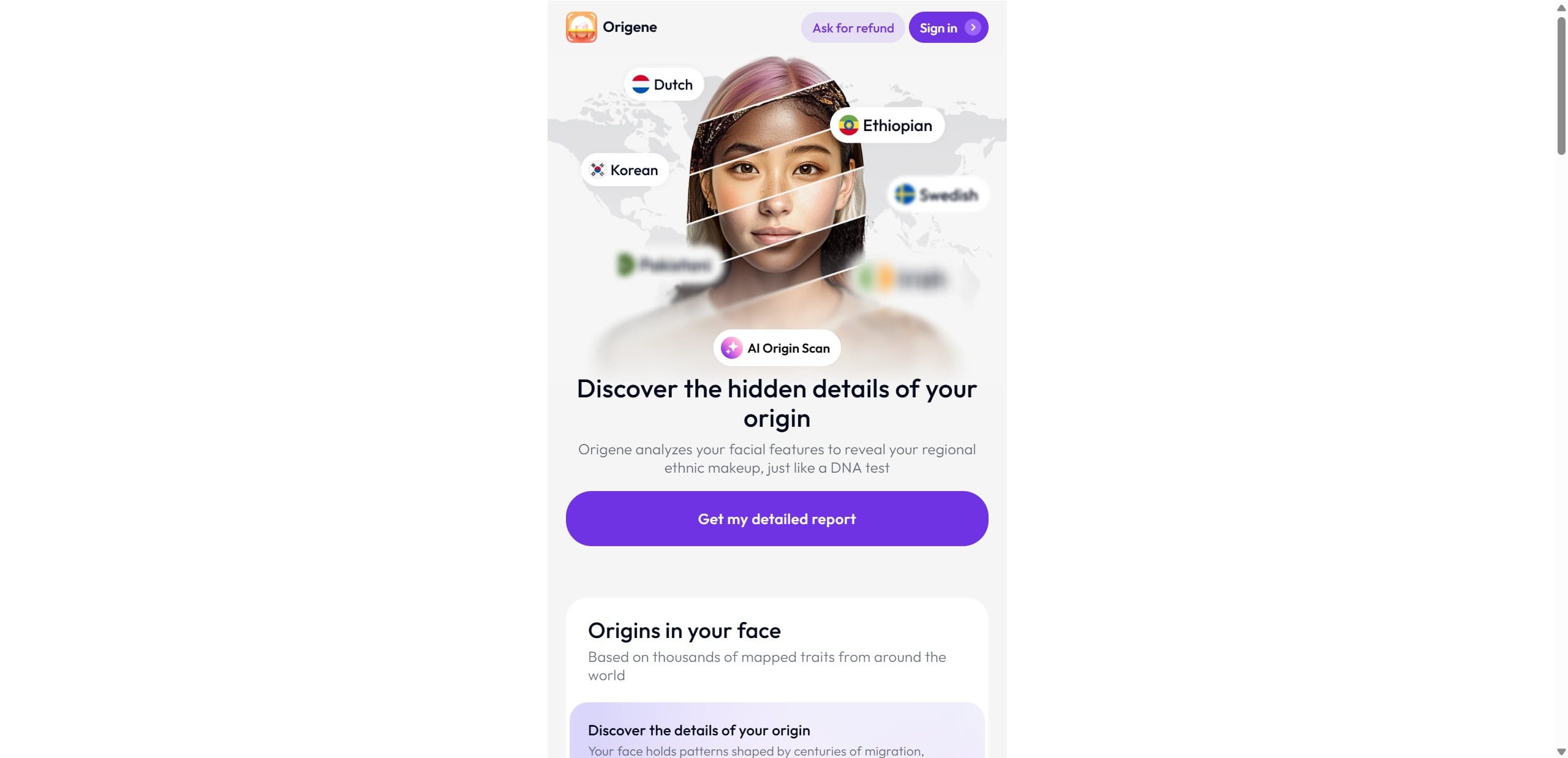
Upload a photo. Let AI scan your face. Get a breakdown of your “ethnic mix”, cultural background, and how your features “match” different regions.
It is the kind of idea that feels harmless at first. Fun, shareable, and just believable enough to trigger that “I need to know” itch.
But Origene.app is also the kind of service where the real story usually starts after you enter your payment details.
In this review, we are going to walk through what Origene.app claims, what its own terms say, what customers report publicly, and the practical steps to take if you have already been charged.
What is Origene.app supposed to do?
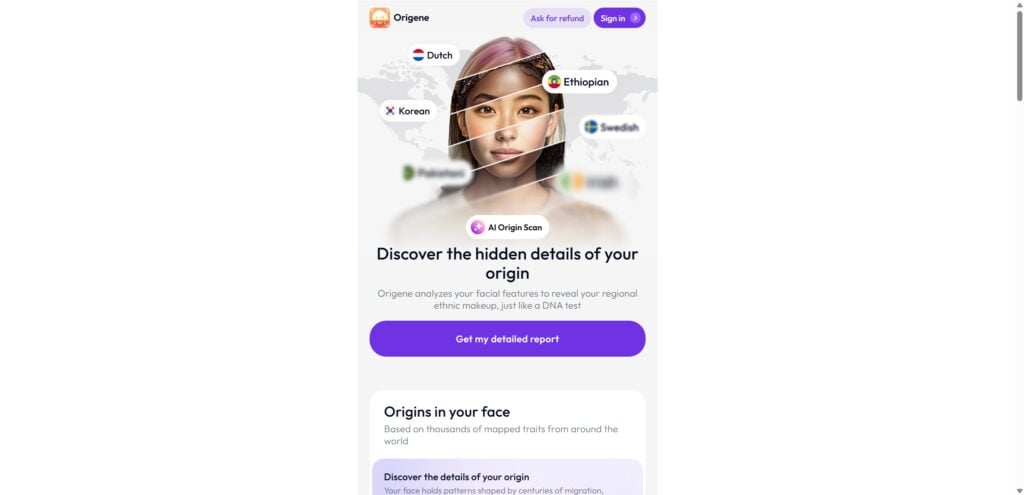
Origene.app presents itself as an AI “origin scan” that analyzes facial traits from an uploaded image and generates a report.
In its Terms of Use, Origene describes “non-genetic facial analysis services” that produce personalized outputs from uploaded facial images, including:
- Ethnicity estimates shown as percentages
- “Visual simulations” of how a user might look as part of different ethnic groups
- A uniqueness index of facial traits
- Global similarity mapping with different populations
So the pitch is basically “DNA test vibes”, but without DNA.
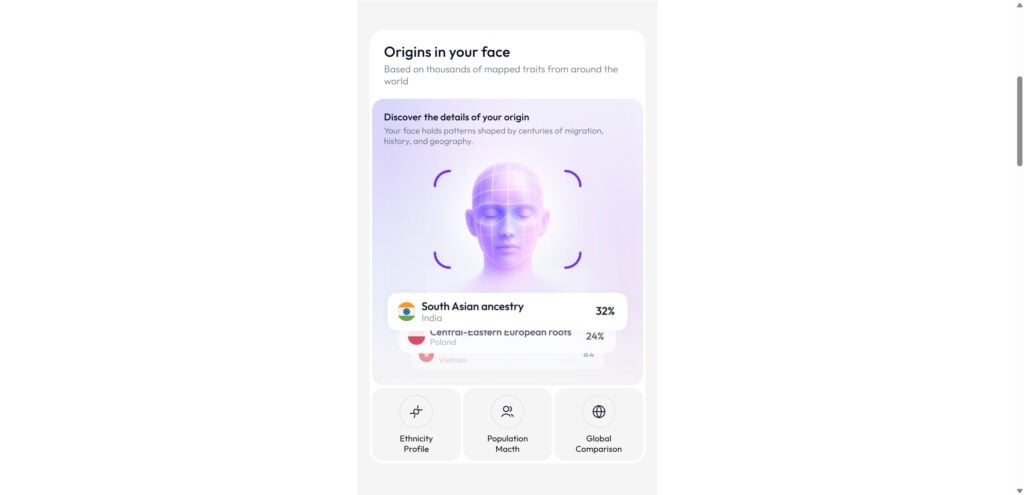
That distinction matters. Because when a website leans into the look and language of ancestry science, a lot of users assume there is real research behind it.
Origene’s own paperwork does not support that assumption.
The platform itself says it is not scientifically validated
This is one of the most important lines in the whole story.
Origene’s Terms state that the service is intended solely for entertainment and general informational purposes, and that results are not scientifically validated and should not be relied upon for medical, genetic, legal, or other critical decisions.
That is a big gap between the marketing vibe (“discover your origins”) and the legal reality (“for entertainment, not validated”).
If you are expecting anything close to a real ancestry test, you are being sold a feeling, not a fact.
Quick credibility check: what are customers saying?
A fast way to sanity-check any subscription-style quiz service is to look at independent review platforms.
On Trustpilot, Origene.app shows a low TrustScore of 1.5 out of 5, with 37 reviews, and is labeled “Bad.”
A low rating alone does not automatically prove fraud.
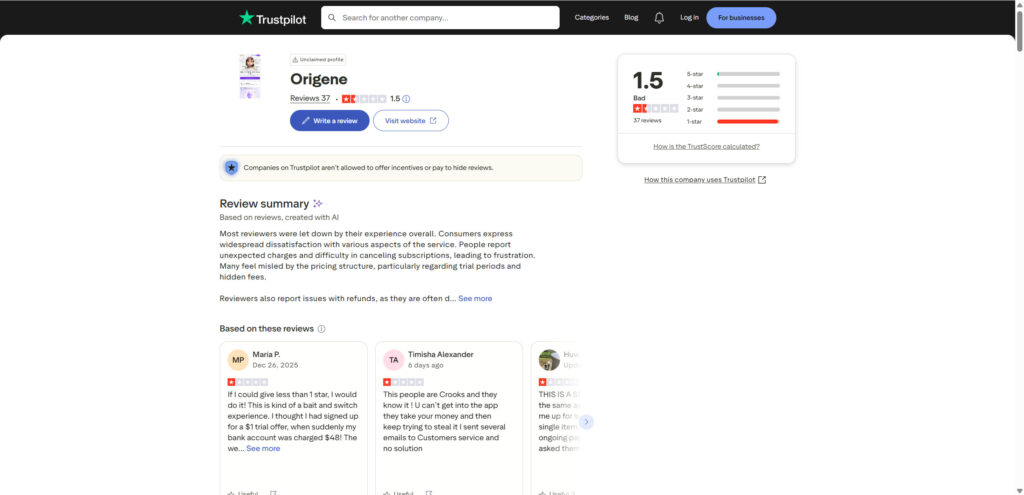
But what matters is why people are upset, and whether the complaints follow the same pattern repeatedly.
Common complaints reported in reviews
Looking at the Trustpilot page, the complaints cluster around a few themes:
1) “Trial” language that turns into bigger charges
Multiple reviewers describe being charged after signing up for what they believed was a free or low-cost trial. One review warns that it is “not free” and references avoiding weekly charges of $24.99.
2) Unauthorized or unexpected charges
Several reviewers explicitly describe money being taken “fraudulently” or charges occurring without clear consent.
3) Cancellation frustration
A repeated accusation is that canceling is difficult, unclear, or effectively blocked.
4) Confusion with similarly named brands
At least one reviewer claims the name resembles an existing company and suggests this can confuse people who try to track down how to cancel.
When you see the same story told by many unrelated people, the safest assumption is that the business model is optimized for misunderstandings.
Not for delight.
Domain age and track record: is this a long-running service?
Another quick signal is domain age.
According to BuiltWith’s technology profile, origene.app was first registered at least 8 months ago on April 26, 2025.
A new domain is not automatically suspicious.
But when you combine “new domain” with “heavy paid ads”, “subscription complaints”, and “refund/cancel disputes”, it starts to look less like a mature product and more like a short-cycle funnel.
Who operates Origene.app?
Origene’s Terms identify the service as owned and operated by “Milky Way Entertainment LLC”, and list an address in Sheridan, Wyoming, plus a phone number.
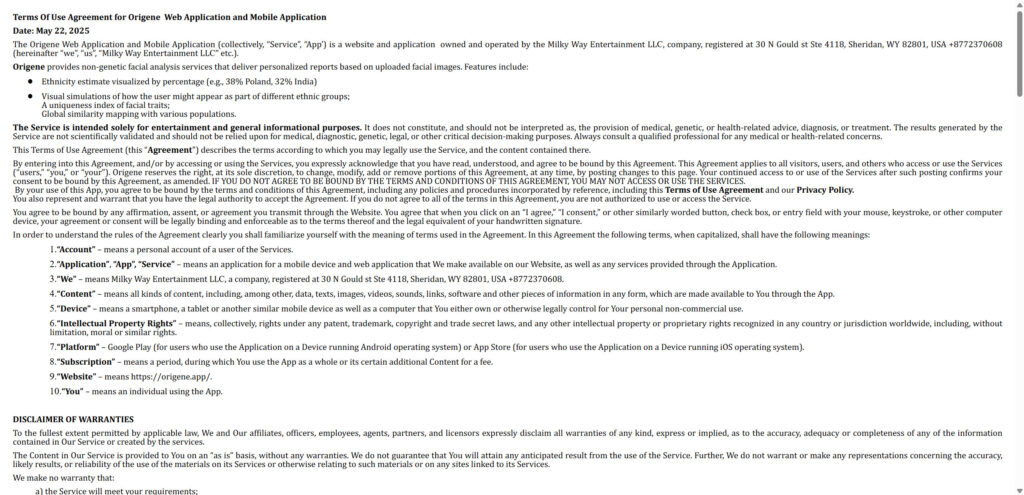
This matters for two reasons:
- If something goes wrong, that is the entity you may need to reference when disputing charges.
- A lot of high-complaint subscription funnels use lightweight company structures and generic contact details, which can make accountability harder.
To be clear: an LLC and a US address do not prove legitimacy or fraud.
But when the customer experience is already full of billing complaints, the corporate footprint becomes part of the risk picture.
Important: do not confuse Origene.app with other similarly named companies
There is a well-known biotech company using the “OriGene” name and the origene.com domain, which dates back to the 1990s.
That does not mean Origene.app is affiliated with them.
In fact, the name similarity is exactly why confusion happens, and why some users report difficulty figuring out what they signed up for.
If you are searching your bank statement and trying to match a merchant name to a website, you can easily end up on the wrong “Origene/OriGene” trail.
That confusion benefits the subscription funnel, not the customer.
How services like this usually make money
To understand why people feel “trapped”, you have to understand the funnel design.
These platforms often run the same playbook:
1) Curiosity hook
An ad promises something personal: ancestry, personality, IQ, “genetic” traits, face mapping, cultural match.
The point is not accuracy. The point is getting you to click.
2) Low-friction quiz + “almost there” moment
You upload a photo or answer questions.
Then the site shows a loading animation, progress bars, and dramatic language that implies deep analysis.
3) Paywall at the moment of maximum curiosity
Right when the user feels invested, the report is locked.
The price is often framed as a tiny trial, a “limited offer”, or a low one-time charge.
4) Subscription mechanics hidden in plain sight
The real revenue comes from recurring billing.
And the recurring billing is where the worst customer stories tend to start.
This pattern is not unique to Origene.app. Trustpilot itself shows “people also looked at” similar online services in the same ecosystem.
The biggest red flag: the mismatch between marketing and terms
This is where Origene.app becomes risky even before the billing problems.
The marketing implies meaningful ancestry insight.
The terms explicitly say it is not scientifically validated and is for entertainment.
That mismatch creates two problems:
- Expectation gap
Users feel tricked when results are generic, inconsistent, or obviously not real ancestry data. - Consent gap
People upload sensitive face photos thinking they are participating in something “DNA-like”, when it is basically a novelty analysis.
If a service needs an entertainment-only disclaimer to protect itself, it is not an ancestry product. It is an effects product.
Privacy and data risk: you are not just paying with money
Uploading a face photo is not like uploading a picture of a sunset.
A face image can be treated as biometric-adjacent data depending on jurisdiction, and it can be misused in ways users do not expect.
Even if a company behaves responsibly, the risk surface is bigger than a typical subscription:
- Your photo can be stored longer than you think
- Your photo can be used to train models (depending on terms and privacy policy)
- Your photo can be exposed if the service has weak security
- Your “report” can be used to push additional upsells or re-billing attempts
Origene’s Terms describe a service built around uploaded facial images.
So even if you never get charged again, you may still regret sharing the input.
Are the results likely to be accurate?
Let’s be blunt.
Real ancestry estimates require genetic information and reference datasets, and even then they are probabilistic and imperfect.
A face-photo-based “ethnicity percentage” is not a scientific method for ancestry.
At best, it is a classifier that guesses appearance clusters based on training data and stereotypes present in the dataset.
At worst, it is random-looking output designed to feel personal.
And again, Origene’s own Terms warn that the results are not scientifically validated.
If you upload two different photos and get two very different results, that does not mean you are “mixed”. It usually means the model is not measuring what you think it is measuring.
So… is Origene.app legit or a scam?
If by “legit” you mean:
- a scientifically grounded ancestry tool
- with reliable results
- transparent billing
- easy cancellation
- strong customer satisfaction
Then the available signals say “no”.
Here is what we can state confidently from public sources:
- Trustpilot shows a 1.5 out of 5 rating with 37 reviews, with many reviewers describing it as a scam and reporting billing and cancellation issues.
- BuiltWith indicates the domain origene.app was first registered in late April 2025, meaning it has a short track record as a consumer product.
- Origene’s own Terms say the results are not scientifically validated and the service is for entertainment and general informational purposes.
Whether you label it “scam” or “predatory subscription funnel” often comes down to how the charges are presented at checkout and how cancellation is implemented.
But from a consumer-protection standpoint, the safest advice is simple:
Treat Origene.app as high risk.
What to do if you already paid and now you are being charged
If you are in the “I tried it and now my card is getting hit” situation, move fast and be methodical.
Step 1: Look for the subscription management path
Check your email inbox for:
- A receipt
- A “subscription confirmed” email
- Any “manage subscription” link
- The merchant name and descriptor
Search your inbox for: Origene, Milky Way Entertainment, subscription, receipt, invoice.
If the cancellation flow is broken or looping, do not waste days fighting the UI.
Step 2: Document everything
Take screenshots of:
- The checkout page (if you can still access it)
- The terms shown at purchase
- Any “trial” language
- The cancellation attempt screen
- Your bank charges (dates and amounts)
This helps if you file a dispute.
Step 3: Contact your bank or card issuer
Tell them:
- You want to stop recurring payments
- You did not authorize ongoing charges (if true)
- The cancellation process is unclear or not working (if true)
- You want to dispute the transactions
If you are in the EU, many issuers are familiar with subscription traps and can block the merchant.
Step 4: Block the merchant and replace the card if needed
If charges keep coming:
- Ask your bank to block the merchant ID
- Consider freezing the card
- If necessary, replace the card
Some users on Trustpilot mention having to stop their card to prevent further payments.
Step 5: Run a basic security cleanup
If you uploaded photos and created an account:
- Change the password if you reused one
- Delete any saved card details in your browser
- Remove permissions for any browser extensions you installed
- Keep an eye on your email for new “subscription” messages
Safer alternatives if you want ancestry information
If your goal is real ancestry insight, look for tools that use DNA, have transparent science, and have long-standing reputations.
If your goal is just fun, look for apps clearly marketed as entertainment filters, ideally from reputable app stores with clear subscription controls.
The key is transparency:
- Clear pricing
- Clear cancellation
- Clear “this is for entertainment” labeling on the marketing page, not buried in legal text
Red flags checklist for face-scan “origin” websites
Use this list anytime you see a similar ad:
Billing and subscription red flags
- “$1 trial” language with vague renewal terms
- No clear subscription page in your account
- Cancellation requires emailing support only
- No obvious way to download an invoice with subscription ID
Credibility red flags
- Brand new domain
- No meaningful track record
- Reviews on the site look perfect, while independent reviews are harsh
- Name resembles a different established company, creating confusion
Data red flags
- Requires face photo upload before you can see pricing
- Privacy policy is vague about retention and reuse
- The service implies DNA-like results while disclaiming validation in the terms
If you see several of these together, do not treat it like a normal subscription.
FAQ
Is Origene.app a real DNA test?
No. Origene’s Terms describe it as non-genetic facial analysis and state results are not scientifically validated.
Why does it show ancestry percentages if it is not validated?
Because percentages look authoritative and “data-like”, which increases conversions. The Terms are where the company reduces legal risk by calling it entertainment.
What is Origene.app’s Trustpilot rating?
At the time of writing, Trustpilot shows a TrustScore of 1.5 out of 5 based on 37 reviews.
Is Origene.app the same as OriGene (the biotech company)?
They appear to be different. There is an established company using origene.com that has existed for decades.
Do not assume affiliation based on name similarity.
When was origene.app created?
BuiltWith lists origene.app as first registered on April 26, 2025.
If I already paid, how do I stop the charges?
Try official cancellation paths first, but if that fails, contact your bank immediately to block recurring payments and dispute charges. Keep screenshots and email receipts as evidence.
Should I upload my face photo to services like this?
If you care about privacy, avoid it. Face images are sensitive personal data, and the upside is usually novelty rather than real insight.
Bottom line
Origene.app sells a very modern kind of temptation: instant identity in a neat-looking report.
But the public reputation and the platform’s own fine print paint a different picture.
- Trustpilot is strongly negative, with many billing and cancellation complaints.
- The domain has a short track record, starting in 2025.
- The Terms say the results are not scientifically validated and are for entertainment.
If you are thinking about trying it, the safest choice is to skip it.
If you already got charged, focus on stopping recurring payments first, then pursue refunds and disputes with documentation.