

You have probably seen it in an ad that looks almost too polished to question.
Two “everyday” women with flawless skin. A bold promise like “erase years of aging at home in just 5 minutes.” Big media logos on the page. A star rating that screams social proof. A discount that feels urgent.
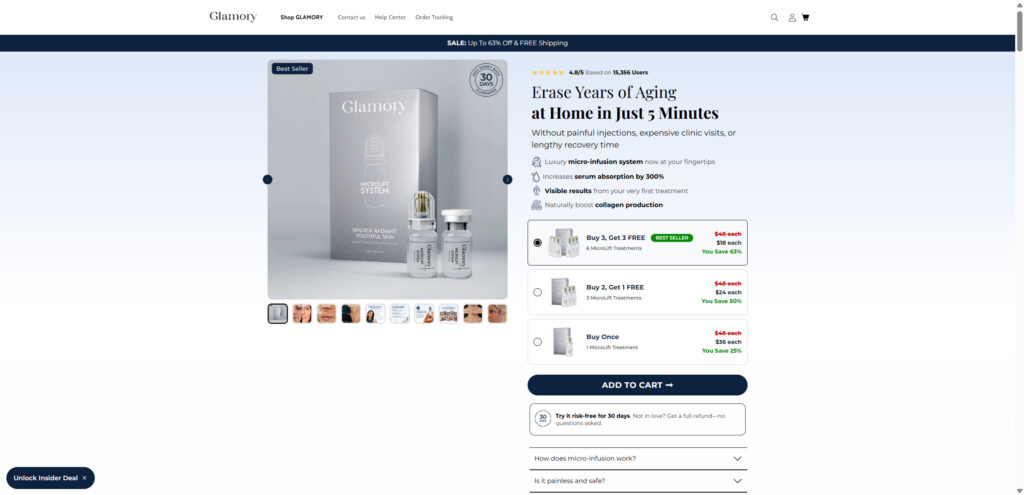
And then the hook: this is not “regular skincare.” This is a micro-needling or “micro-infusion” system that allegedly delivers serum deeper, faster, and better. Supposedly, it can make you look smoother and younger quickly, without a clinic visit, without downtime, and without paying $300+ per session.
If you are even slightly skeptical, you are not being paranoid. You are being smart.
At-home microneedling devices can be real tools, but they sit in a high-risk category where marketing can run wild and where the gap between “sounds impressive” and “safe and worth it” is often huge.
This review will walk you through what the Glamory Micro-Needling System claims, what micro-needling can and cannot do, what to watch for on sales pages like this, and how to decide if buying it is a good idea for you.
Overview
What the Glamory sales page is trying to make you feel
The Glamory site presents itself like a premium, widely trusted brand.
It uses high-end photography, confident headlines, and clean layouts that mirror legitimate beauty companies.
It also leans hard on credibility signals that are designed to short-circuit hesitation.
Common examples shown on the page include:
- A big promise about reversing signs of aging quickly at home
- An emphasis on “professional technology now in your hands”
- A claim that results can be visible from the first treatment
- Metrics like “increases serum absorption by 300%”
- A very high star rating (for example, 4.8/5) paired with a large user count
- Logos resembling major outlets (examples shown include FOX, USA TODAY, and Digital Journal)
- A “happy customers” number positioned like an established brand milestone
- Multiple bundles with big discounts, including a “Buy 3, Get 3 Free” style offer
- Video-style testimonials and before-and-after tiles that make results feel inevitable
None of these elements automatically prove a product is fake.
But together, they form a familiar pattern: a direct-response funnel built to create certainty before you have time to verify anything.

The product category itself is high-risk
Microneedling is not the same as applying a cream.
It is a procedure that involves needles puncturing the skin. Even when needles are small, the action can still:
- Create micro-injuries
- Trigger inflammation
- Increase sensitivity
- Create a pathway for bacteria if the device or skin is not clean
- Worsen certain skin conditions
- Lead to pigment issues in some skin tones if used incorrectly
- Cause irritation, bruising, or scabbing if pressure is too strong
Professional microneedling is performed with medical-grade devices, strict hygiene standards, and clinicians who can assess whether your skin is a good candidate.
When a marketing page treats microneedling like a casual “5 minute glow hack,” it is worth slowing down.
“Micro-infusion” and “micro-needling” are often blended together in marketing
Many at-home brands use softer terms like “micro-infusion” because it sounds gentler than “needles.”
The Glamory page describes a roller with ultra-fine needles (the page references 0.5 mm). It also suggests that the serum is delivered through the device and absorbed more effectively.
Here is the important part: the skin does not work like a sponge you can hack with one trick.
Yes, microneedling can increase penetration of topicals temporarily, and yes, it can stimulate collagen over time. But that does not mean:
- Results are instant
- Results are guaranteed
- Deeper is always better
- Any serum is safe to drive into freshly punctured skin
If the serum contains irritants, fragrance, or ingredients that are fine on the surface but risky inside microchannels, you can end up with a reaction you did not sign up for.
The “300% absorption” style claim is a red flag on its own
A precise percentage claim feels scientific, but it often raises questions like:
- Absorption of what ingredient, exactly?
- Measured compared to what baseline?
- Under what conditions?
- Over what time window?
- On how many people?
- Using what measurement method?
Legitimate clinical-style claims usually come with clear context, methodology, and limitations.
Marketing funnels often present a bold number as a substitute for evidence.
The “featured on” logos can be misleading
Pages like this often display media logos in a way that implies press coverage.
But there is a big difference between:
- A product being independently reviewed by a newsroom
- A brand being mentioned in a press-release distribution network
- A logo being placed as a design element with no real relationship
If a page shows multiple major outlet logos but does not link to specific articles, it should not be treated like proof.
It is a persuasion tactic.
Social proof can be hard to verify
A rating like 4.8/5 based on tens of thousands of users sounds convincing.
The problem is that you, as a buyer, often cannot verify:
- Where those reviews were collected
- Whether they were filtered
- Whether negative reviews were removed
- Whether the “users” number is tied to real orders or is just a marketing claim
It is also common for sales pages to:
- Use generic first names and ages
- Add “verified” badges without a real verification system
- Show short quotes that read like ad copy
- Include dramatic before-and-after photos with unknown lighting, angle, or timeline
Again, none of this proves it is a scam.
But it does mean you should not use the sales page itself as your main source of truth.
The corporate details can be a clue, not a verdict
The page includes company contact details and an address in Sheridan, Wyoming (for example, “30 N. Gould Street Ste R, Sheridan WY 82801”), along with an email like info@try-glamory.com.
That matters because some addresses are frequently used as registered agent or virtual office locations.
A registered agent address is not inherently shady. Plenty of legitimate companies use them.
But when a brand looks “mass-market famous” on the front end and “thinly registered” on the back end, it is a sign to do extra verification before you trust the claims, your payment, and especially your skin.
The discount structure is designed to upsell, fast
The checkout options push you toward buying more than one unit.
Bundles like:
- Buy 3, Get 3 Free
- Buy 2, Get 1 Free
- Buy Once
are classic direct-response tactics because they:
- Increase average order value
- Make you feel like you are wasting money if you buy only one
- Reduce the chance you will refund (because you have multiple units, and returning is more annoying)
If you are already unsure, a heavy bundle push is not your friend.
The core question is not “is it real”
A more useful question is:
Even if the product exists, is it worth buying from this brand at this price, with these claims, and with this level of risk?
For an at-home microneedling device, the bar should be high.
Because if something goes wrong, you do not just lose money.
You can end up with irritation, scarring, pigment changes, or a skin barrier that takes weeks to calm down.
What to consider before buying an at-home microneedling system
If you are still curious about Glamory specifically, here is how to evaluate it like a careful buyer.
1) Is there transparent product detail beyond marketing claims?
Look for specifics like:
- Exact needle material and manufacturing standards
- Sterility and packaging details
- Clear replacement guidance (how often you replace the head)
- Contraindications listed clearly (who should not use it)
- Ingredient list for any serum, fully disclosed
- Safety warnings written in plain language
If the page focuses more on transformation than safety, that is a sign the priorities are not aligned with your skin.
2) Does the brand encourage safe technique?
At-home microneedling requires a careful routine.
A responsible brand should emphasize:
- Hand washing
- Skin cleansing
- Disinfection (when applicable)
- Avoiding active acne and irritated skin
- Not sharing devices
- Not using on broken skin
- Avoiding harsh actives immediately after (like strong acids or retinoids)
- Using sunscreen afterward
If these basics are missing or minimized, it is a problem.
3) Does the page overpromise speed?
Claims like “visible results from your first treatment” can happen for some people due to temporary plumping.
Hydration plus mild swelling can make lines look softer for a short time.
That is not the same as long-term collagen change.
If a page blurs that line, it is selling a feeling, not educating you.
4) Who should avoid microneedling at home?
If any of these apply, you should be very cautious and ideally talk to a dermatologist first:
- Active acne flare-ups
- Rosacea that is easily triggered
- Eczema, psoriasis, or chronic irritation
- History of keloid scarring
- Tendency toward hyperpigmentation after inflammation
- Use of certain acne medications or blood thinners (ask a clinician)
- Recent chemical peels or laser treatments
- Compromised immune system
A funnel that markets to everyone is not treating microneedling with the respect it deserves.
What to do if you have already bought it and feel uneasy
If you purchased the Glamory Micro-Needling System (or any similar microneedling offer) and now you are second-guessing it, here is a calm plan.
- Do not use it immediately if you have doubts.
If your skin is already irritated or you are unsure about the serum ingredients, wait. - Document everything.
Save screenshots of the offer, your receipt, the checkout total, and any guarantee language. - Check your payment method.
Review the charge name on your statement. Keep an eye out for unexpected follow-up charges. - Read the return policy carefully.
Look for deadlines, requirements, and whether you must pay return shipping. - Contact support in writing.
Use email so you have a paper trail. Keep it short, clear, and firm. - If you used the device and had a reaction, treat it seriously.
Stop using it. Avoid strong actives. Focus on barrier support and sunscreen. If symptoms are significant, seek medical advice. - If customer service is unresponsive, escalate through your payment provider.
Card issuers and payment platforms often have dispute processes if goods are not as described or if returns are blocked.
The Bottom Line
The Glamory Micro-Needling System is marketed with a familiar formula: big promises, polished design, strong social proof, and urgency-based bundles.
Microneedling can be a legitimate technique, but at-home microneedling is not a casual beauty trend. It is a procedure that can irritate skin when done incorrectly and can create real consequences when safety is treated like an afterthought.
If you want to try microneedling, the safest route is guidance from a qualified professional, or at minimum, a device and brand that are transparent about safety, ingredients, sterility, and realistic outcomes.
If a page makes it feel like a guaranteed “5 minute” age reversal, you should slow down, verify, and protect your skin first.
FAQ: Glamory Micro-Needling System and Microneedle Marketing
Is the Glamory Micro-Needling System a scam?
Not every product sold through a high-pressure funnel is fake, but the marketing style shown here matches common “miracle device” tactics. The safest approach is to treat the claims as unproven until you can verify the brand, the device quality, the serum ingredients, and the refund process independently.
What is “micro-infusion” and how is it different from microneedling?
“Micro-infusion” is often used as a softer marketing term. In practice, many devices still use small needles to create microchannels. The difference is usually in how the serum is applied or delivered, but the skin is still being punctured, so safety considerations remain.
Does microneedling really increase serum absorption by 300%?
A specific number like 300% is difficult to evaluate without clear methodology. Microneedling can increase penetration temporarily, but precise percentage claims on sales pages are often marketing, not a clinically documented guarantee.
Are the “featured on” media logos real proof of legitimacy?
Not by themselves. Logos can be used to imply credibility even when there is no true editorial coverage. If a page does not link to specific articles from those outlets, treat the logos as marketing until proven otherwise.
Can microneedling erase wrinkles quickly?
Microneedling can support collagen production over time, but meaningful structural change usually takes weeks to months and multiple sessions. Quick “first treatment” improvements are often temporary plumping or mild swelling, not permanent wrinkle removal.
Is 0.5 mm needle length safe for home use?
0.5 mm is not tiny. It is often considered a mid-range length that can irritate skin if used aggressively or too frequently. “Safe” depends on your skin type, technique, cleanliness, and how your skin reacts. If you are new to microneedling, this is not a category to approach casually.
What are the biggest risks of at-home microneedling devices?
Common risks include irritation, infection, scarring, bruising, broken capillaries, and post-inflammatory hyperpigmentation. Risk increases when devices are not sterile, when instructions are vague, or when people use harsh ingredients immediately afterward.
Who should not use microneedling systems at home?
People with active acne, rosacea flare-ups, eczema, psoriasis, a history of keloid scarring, or frequent pigment changes after irritation should be cautious. If you have a medical skin condition or are using prescription treatments, ask a clinician first.
What should I look for to tell if a microneedle product page is suspicious?
Watch for:
- Overpromised speed (“erase years in 5 minutes”)
- Heavy bundle pressure and urgent discounts
- Big ratings and user counts that cannot be verified
- Media logos without linked articles
- Vague safety guidance
- No full ingredient list for serums
- No clear details about sterility and replacement parts
I bought it. How do I avoid being stuck with it?
Act quickly. Save screenshots of the offer and policy, contact support via email for a return, monitor your statement for extra charges, and be ready to dispute the transaction through your card issuer if the company blocks the refund process.
If I used it and my skin reacted, what should I do?
Stop using it immediately. Avoid strong acids, retinoids, and harsh scrubs. Focus on gentle cleansing, fragrance-free moisturizer, and sunscreen. If you have swelling, severe burning, blistering, or worsening redness that does not calm down, seek medical advice.
If you want, paste the product URL (or the checkout page screenshot with the pricing and policy text) and I will rewrite the “red flags” section to match the exact claims and language they are using.








