

Nail fungus is a frustrating, stubborn problem that affects millions of people worldwide. It can make toenails thick, brittle, discolored, and embarrassing to show in public. For many, it also causes pain and discomfort. Because fungal infections are notoriously hard to treat, it’s no surprise that products claiming quick and easy solutions are heavily marketed online.
One of the most aggressively promoted products is the Orivelle Nail Fungus Pen. Ads for this pen promise fast results, natural ingredients, and even full fungus elimination in just days. But can a small pen really cure nail fungus, or is this another overhyped product that preys on people desperate for relief?
In this in-depth article, we will uncover everything about Orivelle, from what the company claims, how the product supposedly works, the red flags in its marketing, and what you should do if you’ve already purchased it. By the end, you’ll know whether Orivelle is worth your money or if you should look for safer, more reliable treatments.
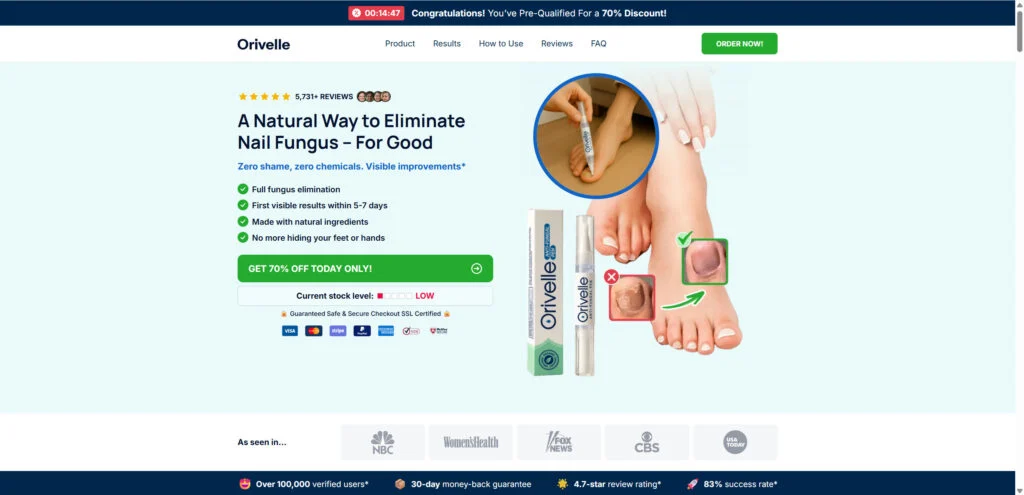
Overview of the Orivelle Nail Fungus Pen
What the Company Claims
The Orivelle Nail Fungus Pen is marketed as a natural, doctor-developed, fast-acting solution for nail fungus. According to the website and ads:
- It eliminates fungus at the root.
- It delivers visible results within 5–7 days.
- It uses 17 natural ingredients like tea tree oil, peppermint, vitamin C, and grape seed oil.
- It is clinically proven to be 83% more effective than other antifungal treatments.
- It restores nails to a healthy, smooth, and clear appearance.
- It comes in a convenient “pen-style” applicator for easy use.
The marketing emphasizes confidence, promising users they can stop hiding their nails, wear sandals again, and feel proud of their feet in as little as two weeks.
The Website Presentation
When you visit the official Orivelle website, you’re immediately greeted with a countdown timer suggesting a “70% off, today-only” deal. This is a classic high-pressure sales tactic designed to push buyers into making quick decisions without researching further.
The website is filled with:
- Before-and-after photos showing dramatic nail transformations.
- “Doctor-developed” claims, supposedly linked to a dermatologist named Dr. Alan Meyers.
- Dozens of glowing reviews with five-star ratings.
- Mentions of mainstream media outlets like NBC, CBS, and USA Today (though without actual links or proof).
At first glance, the site looks polished and convincing, but once you dig deeper, many things don’t add up.
Red Flags in Marketing
Here are some of the biggest concerns:
- Unrealistic Results
- Claiming visible improvement in 5–7 days is medically unrealistic. Even prescription antifungal treatments, whether topical or oral, take months to show noticeable improvement because nails must grow out to replace infected portions.
- The “Doctor Meyers” Problem
- Orivelle says the formula was developed by Dr. Alan Meyers. However, research shows no dermatologists or published scientists by that name connected to nail fungus or skincare. No background, no medical profile, no trace of this doctor exists.
- Contradictory Disclaimers
- At the bottom of the site, a disclaimer clearly states the product is “not intended to diagnose, treat, cure, or prevent any disease.” Yet, the entire site markets it as a fungus cure. This contradiction is a legal loophole companies use to avoid liability while making bold claims.
- Exaggerated Effectiveness Claim
- Saying it is “83% more effective” than all other treatments has no scientific proof. There are no published clinical trials, no peer-reviewed studies, and no supporting evidence.
- Misleading “As Seen On” Logos
- The site displays logos from major media outlets like NBC and Fox News, but no coverage of Orivelle exists on these platforms. This tactic is often used to build false credibility.
- Subscription Auto-Billing in the Terms & Conditions
- Buried in the fine print is a clause allowing automatic recurring billing. Customers who order might unknowingly be enrolled in a subscription, leading to charges every 30, 60, or 90 days until canceled.
- Liability Limitations
- The company’s terms limit their responsibility to just $500, even if the product causes harm. They also are not liable for indirect damages.
Why This Matters
Nail fungus sufferers are often desperate for a cure, which makes them more vulnerable to misleading products. By promising near-instant results and disguising legal disclaimers, products like Orivelle may exploit people’s pain for profit.
Before trusting these claims, it’s important to understand how nail fungus works and whether any product can realistically deliver such rapid results.
How the Orivelle Nail Fungus Pen Supposedly Works
The Orivelle website and ads describe a simple, three-step process for using the product. Let’s break this down in detail and compare it to what is medically known about treating nail fungus.
Step 1: Clean and Dry
Users are instructed to wash the affected area thoroughly and ensure it is completely dry before applying Orivelle.
Why this step exists:
- Fungus thrives in warm, moist environments. Cleaning and drying the nails helps reduce fungal growth conditions.
- This step is standard for most topical antifungal treatments.
Reality check:
- While cleaning and drying is good practice, it alone does not treat fungal infections.
Step 2: Apply Orivelle Pen
The pen-style applicator is designed to “release the formula” by twisting the bottom, then brushing a thin layer directly onto the affected nail and surrounding skin.
Why this sounds appealing:
- The pen format makes application less messy than creams.
- Users feel like they’re targeting the infection directly.
Reality check:
- Nail fungus infections occur deep under the nail bed, not just on the surface. Most topical treatments, including prescription ones, struggle to penetrate deeply enough to kill fungus. The idea that a simple pen can fully cure fungus quickly is misleading.
Step 3: Let It Absorb
The final instruction is to allow the solution to fully absorb without rinsing. For best results, the site recommends using it twice daily, morning and night.
Why this is claimed to work:
- The marketing suggests “deep absorption technology” that penetrates to the nail root.
- They claim their formula eliminates fungus at the molecular level.
Reality check:
- There is no scientific evidence showing Orivelle’s ingredients can penetrate the hard keratin of nails deeply enough to reach fungus at its source.
- Even FDA-approved topical treatments, like ciclopirox or efinaconazole, require months of daily use and still have limited success rates.
Ingredient Claims
The product lists natural ingredients such as:
- Tea Tree Oil: Known to have antifungal properties, but usually effective only for mild infections.
- Vitamin C: Helpful for skin health but not a proven antifungal treatment.
- Peppermint Oil: Provides a cooling sensation, but no strong antifungal evidence.
- Rapeseed Oil, Grape Seed Oil, Lithospermum: Moisturizing agents with some antioxidant benefits, but not medical-grade antifungal cures.
Overall Analysis:
The ingredients may help improve the appearance of nails and provide minor antifungal effects for surface-level infections. However, claiming they can cure fungal infections in just days is scientifically unfounded.
Marketing vs. Medical Reality
- Marketing Promise: Results in 5–7 days, 83% more effective than other treatments, full fungus elimination.
- Medical Reality: Nail fungus treatments typically take months. Even prescription antifungals require long-term use and often relapse. No natural topical product has been clinically proven to cure severe infections this quickly.
In other words, the operation described by Orivelle is more of a cosmetic improvement than a medical cure.
What to Do If You Have Fallen Victim to Orivelle
If you already purchased Orivelle and now realize it might be a scam, here’s what you should do:
- Stop Using the Product Immediately
- While it’s unlikely to cause harm, it also won’t provide the cure you were promised. Do not rely on it for treating nail fungus, as untreated infections can worsen.
- Contact Your Bank or Credit Card Company
- Because Orivelle’s terms include automatic rebilling, contact your bank to block further charges. Request to cancel any recurring subscriptions linked to your purchase.
- Request a Refund
- Reach out to the company’s customer support. Even if they deny it, having a record of your attempt helps if you escalate to your bank or a consumer protection agency.
- Document Everything
- Save screenshots of ads, receipts, and the website. These can help in disputes or complaints.
- Report the Company
- File a complaint with:
- The Federal Trade Commission (FTC) if you’re in the U.S.
- Your country’s consumer protection agency if outside the U.S.
- Better Business Bureau (BBB) for visibility.
- File a complaint with:
- Seek Real Medical Treatment
- Book an appointment with a doctor or podiatrist. Depending on severity, they may prescribe oral antifungal medication, topical solutions, or laser treatments.
- Learn from the Experience
- Always research health products thoroughly before purchasing. Look for FDA approvals, published clinical trials, and credible medical endorsements.
The Bottom Line
The Orivelle Nail Fungus Pen is marketed as a miracle solution, but when examined closely, it raises multiple red flags. Its claims of fast results, doctor development, and superior effectiveness are unsupported by science. The disclaimers and auto-billing terms further indicate that this product is more of a marketing scheme than a legitimate medical treatment.
If you are struggling with nail fungus, consult a licensed healthcare professional instead of relying on quick-fix promises. Real treatment takes time, but it is far more reliable than falling for products that sound too good to be true.
Final Verdict: Orivelle Nail Fungus Pen is not recommended.
Frequently Asked Questions About Orivelle Nail Fungus Pen
Is Orivelle Nail Fungus Pen a scam?
Yes, many signs suggest that Orivelle Nail Fungus Pen is a scam. The company makes unrealistic promises, such as curing nail fungus in just 5–7 days, which is medically impossible. They also use a fake doctor’s name (Dr. Alan Meyers) to boost credibility, even though no evidence of this doctor exists in medical databases. On top of that, their website disclaimer contradicts their marketing claims, and their terms include automatic rebilling that can trap customers into recurring charges.
Does Orivelle Nail Fungus Pen really work?
There is no scientific proof that Orivelle Nail Fungus Pen works as advertised. While some ingredients like tea tree oil and peppermint oil have mild antifungal properties, they are not strong enough to cure nail fungus, especially severe infections. True nail fungus treatment requires months of consistent therapy, and in many cases, prescription medication. Any claims of visible results in a week are highly misleading.
Why is the “5–7 day results” claim unrealistic?
Nail fungus infections occur deep under the nail bed. For nails to look healthy again, new nail growth must replace the infected nail, which takes several months. Even with FDA-approved antifungal medications, results take 3 to 6 months or longer. No topical pen can achieve full fungus elimination in under two weeks. This makes Orivelle’s marketing claim a major red flag.
Who is Dr. Alan Meyers, the doctor behind Orivelle?
The Orivelle website claims the product was developed by Dr. Alan Meyers, but no such doctor exists in dermatology, nail fungus research, or medical literature. Searches across medical journals, licensing boards, and professional directories reveal no trace of him. This strongly suggests that the doctor is a fictional marketing figure created to make the product appear credible.
Is Orivelle Nail Fungus Pen FDA approved?
No, Orivelle Nail Fungus Pen is not FDA-approved. In fact, their own disclaimer states that the product is “not intended to diagnose, treat, cure, or prevent any disease.” This directly contradicts their bold marketing claims of full fungus elimination. FDA-approved treatments for nail fungus, such as efinaconazole or ciclopirox, take months to work and require prescriptions.
Why does the Orivelle website show big discounts and countdown timers?
The 70% off today-only deal and countdown timers are classic high-pressure sales tactics. These are designed to make customers feel rushed into purchasing without taking the time to research. In reality, these discounts are almost always available, and the “low stock warning” is just a marketing trick to create false urgency.
Can I get a refund if I bought Orivelle?
The company advertises a “30-day money-back guarantee,” but many customer reports suggest that refunds are difficult to obtain. In addition, their terms of service allow for automatic rebilling, meaning you may be charged repeatedly for new shipments unless you cancel quickly. If you bought Orivelle, it’s best to contact your bank or credit card provider immediately to block future charges.
What should I do if I already purchased Orivelle Nail Fungus Pen?
If you’ve bought this product, here are the steps to take:
- Stop using the product – It’s unlikely to cure nail fungus and may waste valuable treatment time.
- Cancel auto-billing – Contact your bank or credit card provider to block recurring charges.
- Request a refund – Contact the company, but be prepared for delays or refusals.
- Document everything – Save receipts, screenshots, and emails for potential disputes.
- Report the scam – File complaints with the FTC, BBB, or your country’s consumer protection agency.
- See a doctor – Get professional treatment before the infection worsens.
Are there safer alternatives to Orivelle Nail Fungus Pen?
Yes, there are proven, medically backed treatments for nail fungus, including:
- Prescription oral medications such as terbinafine or itraconazole.
- Prescription topical treatments like ciclopirox or efinaconazole.
- Laser treatments available at podiatry clinics.
- Over-the-counter antifungal creams for mild surface infections.
These methods are backed by science, unlike Orivelle’s exaggerated promises.
How can I spot similar nail fungus scams?
Here are the common warning signs:
- Claims of “instant results” or cures in less than two weeks.
- Fake doctors or experts with no verifiable credentials.
- Disclaimers stating the product does not cure diseases, despite marketing saying otherwise.
- Aggressive discounts with countdown timers.
- Automatic rebilling hidden in the terms and conditions.
- Fake “as seen on” logos with no real media coverage.
What is the final verdict on Orivelle Nail Fungus Pen?
The final verdict is that Orivelle Nail Fungus Pen is not recommended. It relies on deceptive marketing, false medical claims, and auto-billing traps. It is unlikely to cure nail fungus, and customers risk losing money. If you want real results, consult a medical professional instead of relying on products that sound too good to be true.

Join the discussion
41 commentsShare your experience or ask a question about this article.
Discussion
So many ads now on sites such as YouTube that make BIG promises. I now check every one of them online BUT I am aware that the first reviews in a search are often FAKE (i.e. they are created by the seller of the product).
So always dig DEEPER. You only need find a realistic site such as this one to get the TRUTH. The fakes ones have a financial reason to exist (to get you to pay money for a useless product) but a good scam-type investigative site would usually only give a poor review if that was the honest truth.
So THINK this “Is this product being advertised something that gives me hope”. If it is, then it often means it’s not genuine: i.e. a miracle cure (we all seek ‘miracles’), a cooler you can use at a far lower cost than aircon (because it does NOT do what aircon does!), a powerful pressure washer that fits on the end of a garden hose (it’s really just a sprayer – HOW could it be anything else???).
Be cautious – many products are being market untruthfully and only by using our CAUTIOUS BRAINS can we avoid being DUPED.
In reply to Steve
Steve, that’s one of the most useful comments we’ve had. Your point about search results is the key one: the first pages are often affiliate pages written by people paid per sale, which is why they always conclude the product works. And your “does this offer me hope” test is a good instinct, because hope is exactly what these ads are engineered to sell – a miracle cure, air conditioning for pennies, a pressure washer that is really a hose nozzle. Physics and biology don’t get suspended for a Facebook ad. Thanks for writing it out so clearly.
In reply to Steve
And sometimes clues are dropped when several ads for completely different items have adverts that are almost word for word the same, just the odd word cleverly tweaked to make it relevant to the product. Last year YouTube had adverts for ergonomic pillows, Japanese knives and one other item I can’t recall all telling identical stories about how the buyer was about to return the item, decided to just try it first, was delighted and decided to buy more for friends and family, tried to get in on an old discount offer and was told they were luck because they company had overstocked their warehouses temporarily. All with 99.9% of the wording identical.
And, if not identical, don’t they follow the same formula? Brilliant, yet quiet, likeable and humble, scientist has something terrible to contend with, among his work- or class-mates, family or friends, and creates something that makes a tremendous improvement. In fact, it’s a miraculous improvement that goes against the laws of nature! Word spreads and he is in business. But he is offered a deal for it with a big organisation and turns it down, which, for some obscure reason means he loses his job or college place. So now he is offering it to you at 70% off for one day only (offered day after day, ad nauseam). Sooo fake!
In reply to Steve
And sometimes clues are dropped when several ads for completely different items have adverts that are almost word for word the same, just the odd word cleverly tweaked to make it relevant to the product. Last year YouTube had adverts for ergonomic pillows, Japanese knives and one other item I can’t recall, all telling identical stories about how the buyer had been about to return the item, decided just to try it first, was delighted and decided to buy more for friends and family, tried to get in on an old discount offer and was told they were lucky because the company had overstocked their warehouses temporarily. All with 99.9% of the wording identical.
And, if not identical, don’t they follow the same formula? Brilliant, yet quiet, likeable and humble, scientist has something terrible to contend with, among his work- or class-mates, family or friends, and creates something that makes a tremendous improvement. In fact, it’s a miraculous improvement that goes against the laws of nature! Word spreads and he is in business. But he is offered a deal for it with a big organisation and turns it down, which, for some obscure reason means he loses his job or college place. So now he is offering it to you at 70% off for one day only (offered day after day, ad nauseam). Sooo fake!
In reply to Steve
And sometimes clues are dropped when several ads for completely different items are almost word for word the same, just the odd word cleverly tweaked to make it relevant to the product. Last year YouTube had adverts for ergonomic pillows, Japanese knives and one other item I can’t recall, all telling identical stories about how the buyer had been about to return the item, decided just to try it first, was delighted and decided to buy more for friends and family, tried to get in on an old discount offer and was told they were lucky because the company had overstocked their warehouses temporarily. All with 99.9% of the wording identical.
And, if not identical, don’t they follow the same formula? Brilliant, yet quiet, likeable and humble, scientist has something terrible to contend with, among his work- or class-mates, family or friends, and creates something that makes a tremendous improvement. In fact, it’s a miraculous improvement that goes against the laws of nature! Word spreads and he is in business. But he is offered a deal for it with a big organisation and turns it down, which, for some obscure reason means he loses his job or college place. So now he is offering it to you at 70% off for one day only (offered day after day, ad nauseam). Sooo fake!
In reply to ABug
That is a sharp observation, and you have essentially described the industry’s swipe file. The same script is reused and re-skinned across completely unrelated products because it has been tested to convert; only the noun changes. The beats you list – the humble outsider, the suppressed discovery, the rejected corporate offer, the perpetual seventy percent off for today only – are each there to answer an objection a buyer would otherwise raise. Once you have seen the template you cannot unsee it, which is the best protection anyone can have. Thank you for setting it out so clearly for other readers.