

Nail fungus is a frustrating, stubborn problem that affects millions of people worldwide. It can make toenails thick, brittle, discolored, and embarrassing to show in public. For many, it also causes pain and discomfort. Because fungal infections are notoriously hard to treat, it’s no surprise that products claiming quick and easy solutions are heavily marketed online.
One of the most aggressively promoted products is the Orivelle Nail Fungus Pen. Ads for this pen promise fast results, natural ingredients, and even full fungus elimination in just days. But can a small pen really cure nail fungus, or is this another overhyped product that preys on people desperate for relief?
In this in-depth article, we will uncover everything about Orivelle, from what the company claims, how the product supposedly works, the red flags in its marketing, and what you should do if you’ve already purchased it. By the end, you’ll know whether Orivelle is worth your money or if you should look for safer, more reliable treatments.
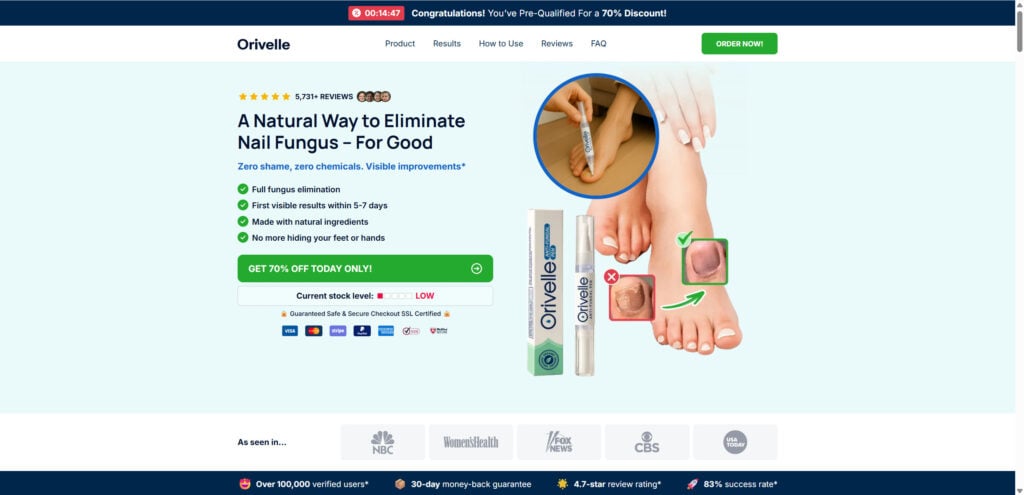
Overview of the Orivelle Nail Fungus Pen
What the Company Claims
The Orivelle Nail Fungus Pen is marketed as a natural, doctor-developed, fast-acting solution for nail fungus. According to the website and ads:
- It eliminates fungus at the root.
- It delivers visible results within 5–7 days.
- It uses 17 natural ingredients like tea tree oil, peppermint, vitamin C, and grape seed oil.
- It is clinically proven to be 83% more effective than other antifungal treatments.
- It restores nails to a healthy, smooth, and clear appearance.
- It comes in a convenient “pen-style” applicator for easy use.
The marketing emphasizes confidence, promising users they can stop hiding their nails, wear sandals again, and feel proud of their feet in as little as two weeks.
The Website Presentation
When you visit the official Orivelle website, you’re immediately greeted with a countdown timer suggesting a “70% off, today-only” deal. This is a classic high-pressure sales tactic designed to push buyers into making quick decisions without researching further.
The website is filled with:
- Before-and-after photos showing dramatic nail transformations.
- “Doctor-developed” claims, supposedly linked to a dermatologist named Dr. Alan Meyers.
- Dozens of glowing reviews with five-star ratings.
- Mentions of mainstream media outlets like NBC, CBS, and USA Today (though without actual links or proof).
At first glance, the site looks polished and convincing, but once you dig deeper, many things don’t add up.
Red Flags in Marketing
Here are some of the biggest concerns:
- Unrealistic Results
- Claiming visible improvement in 5–7 days is medically unrealistic. Even prescription antifungal treatments, whether topical or oral, take months to show noticeable improvement because nails must grow out to replace infected portions.
- The “Doctor Meyers” Problem
- Orivelle says the formula was developed by Dr. Alan Meyers. However, research shows no dermatologists or published scientists by that name connected to nail fungus or skincare. No background, no medical profile, no trace of this doctor exists.
- Contradictory Disclaimers
- At the bottom of the site, a disclaimer clearly states the product is “not intended to diagnose, treat, cure, or prevent any disease.” Yet, the entire site markets it as a fungus cure. This contradiction is a legal loophole companies use to avoid liability while making bold claims.
- Exaggerated Effectiveness Claim
- Saying it is “83% more effective” than all other treatments has no scientific proof. There are no published clinical trials, no peer-reviewed studies, and no supporting evidence.
- Misleading “As Seen On” Logos
- The site displays logos from major media outlets like NBC and Fox News, but no coverage of Orivelle exists on these platforms. This tactic is often used to build false credibility.
- Subscription Auto-Billing in the Terms & Conditions
- Buried in the fine print is a clause allowing automatic recurring billing. Customers who order might unknowingly be enrolled in a subscription, leading to charges every 30, 60, or 90 days until canceled.
- Liability Limitations
- The company’s terms limit their responsibility to just $500, even if the product causes harm. They also are not liable for indirect damages.
Why This Matters
Nail fungus sufferers are often desperate for a cure, which makes them more vulnerable to misleading products. By promising near-instant results and disguising legal disclaimers, products like Orivelle may exploit people’s pain for profit.
Before trusting these claims, it’s important to understand how nail fungus works and whether any product can realistically deliver such rapid results.
How the Orivelle Nail Fungus Pen Supposedly Works
The Orivelle website and ads describe a simple, three-step process for using the product. Let’s break this down in detail and compare it to what is medically known about treating nail fungus.
Step 1: Clean and Dry
Users are instructed to wash the affected area thoroughly and ensure it is completely dry before applying Orivelle.
Why this step exists:
- Fungus thrives in warm, moist environments. Cleaning and drying the nails helps reduce fungal growth conditions.
- This step is standard for most topical antifungal treatments.
Reality check:
- While cleaning and drying is good practice, it alone does not treat fungal infections.
Step 2: Apply Orivelle Pen
The pen-style applicator is designed to “release the formula” by twisting the bottom, then brushing a thin layer directly onto the affected nail and surrounding skin.
Why this sounds appealing:
- The pen format makes application less messy than creams.
- Users feel like they’re targeting the infection directly.
Reality check:
- Nail fungus infections occur deep under the nail bed, not just on the surface. Most topical treatments, including prescription ones, struggle to penetrate deeply enough to kill fungus. The idea that a simple pen can fully cure fungus quickly is misleading.
Step 3: Let It Absorb
The final instruction is to allow the solution to fully absorb without rinsing. For best results, the site recommends using it twice daily, morning and night.
Why this is claimed to work:
- The marketing suggests “deep absorption technology” that penetrates to the nail root.
- They claim their formula eliminates fungus at the molecular level.
Reality check:
- There is no scientific evidence showing Orivelle’s ingredients can penetrate the hard keratin of nails deeply enough to reach fungus at its source.
- Even FDA-approved topical treatments, like ciclopirox or efinaconazole, require months of daily use and still have limited success rates.
Ingredient Claims
The product lists natural ingredients such as:
- Tea Tree Oil: Known to have antifungal properties, but usually effective only for mild infections.
- Vitamin C: Helpful for skin health but not a proven antifungal treatment.
- Peppermint Oil: Provides a cooling sensation, but no strong antifungal evidence.
- Rapeseed Oil, Grape Seed Oil, Lithospermum: Moisturizing agents with some antioxidant benefits, but not medical-grade antifungal cures.
Overall Analysis:
The ingredients may help improve the appearance of nails and provide minor antifungal effects for surface-level infections. However, claiming they can cure fungal infections in just days is scientifically unfounded.
Marketing vs. Medical Reality
- Marketing Promise: Results in 5–7 days, 83% more effective than other treatments, full fungus elimination.
- Medical Reality: Nail fungus treatments typically take months. Even prescription antifungals require long-term use and often relapse. No natural topical product has been clinically proven to cure severe infections this quickly.
In other words, the operation described by Orivelle is more of a cosmetic improvement than a medical cure.
What to Do If You Have Fallen Victim to Orivelle
If you already purchased Orivelle and now realize it might be a scam, here’s what you should do:
- Stop Using the Product Immediately
- While it’s unlikely to cause harm, it also won’t provide the cure you were promised. Do not rely on it for treating nail fungus, as untreated infections can worsen.
- Contact Your Bank or Credit Card Company
- Because Orivelle’s terms include automatic rebilling, contact your bank to block further charges. Request to cancel any recurring subscriptions linked to your purchase.
- Request a Refund
- Reach out to the company’s customer support. Even if they deny it, having a record of your attempt helps if you escalate to your bank or a consumer protection agency.
- Document Everything
- Save screenshots of ads, receipts, and the website. These can help in disputes or complaints.
- Report the Company
- File a complaint with:
- The Federal Trade Commission (FTC) if you’re in the U.S.
- Your country’s consumer protection agency if outside the U.S.
- Better Business Bureau (BBB) for visibility.
- File a complaint with:
- Seek Real Medical Treatment
- Book an appointment with a doctor or podiatrist. Depending on severity, they may prescribe oral antifungal medication, topical solutions, or laser treatments.
- Learn from the Experience
- Always research health products thoroughly before purchasing. Look for FDA approvals, published clinical trials, and credible medical endorsements.
The Bottom Line
The Orivelle Nail Fungus Pen is marketed as a miracle solution, but when examined closely, it raises multiple red flags. Its claims of fast results, doctor development, and superior effectiveness are unsupported by science. The disclaimers and auto-billing terms further indicate that this product is more of a marketing scheme than a legitimate medical treatment.
If you are struggling with nail fungus, consult a licensed healthcare professional instead of relying on quick-fix promises. Real treatment takes time, but it is far more reliable than falling for products that sound too good to be true.
Final Verdict: Orivelle Nail Fungus Pen is not recommended.
Frequently Asked Questions About Orivelle Nail Fungus Pen
Is Orivelle Nail Fungus Pen a scam?
Yes, many signs suggest that Orivelle Nail Fungus Pen is a scam. The company makes unrealistic promises, such as curing nail fungus in just 5–7 days, which is medically impossible. They also use a fake doctor’s name (Dr. Alan Meyers) to boost credibility, even though no evidence of this doctor exists in medical databases. On top of that, their website disclaimer contradicts their marketing claims, and their terms include automatic rebilling that can trap customers into recurring charges.
Does Orivelle Nail Fungus Pen really work?
There is no scientific proof that Orivelle Nail Fungus Pen works as advertised. While some ingredients like tea tree oil and peppermint oil have mild antifungal properties, they are not strong enough to cure nail fungus, especially severe infections. True nail fungus treatment requires months of consistent therapy, and in many cases, prescription medication. Any claims of visible results in a week are highly misleading.
Why is the “5–7 day results” claim unrealistic?
Nail fungus infections occur deep under the nail bed. For nails to look healthy again, new nail growth must replace the infected nail, which takes several months. Even with FDA-approved antifungal medications, results take 3 to 6 months or longer. No topical pen can achieve full fungus elimination in under two weeks. This makes Orivelle’s marketing claim a major red flag.
Who is Dr. Alan Meyers, the doctor behind Orivelle?
The Orivelle website claims the product was developed by Dr. Alan Meyers, but no such doctor exists in dermatology, nail fungus research, or medical literature. Searches across medical journals, licensing boards, and professional directories reveal no trace of him. This strongly suggests that the doctor is a fictional marketing figure created to make the product appear credible.
Is Orivelle Nail Fungus Pen FDA approved?
No, Orivelle Nail Fungus Pen is not FDA-approved. In fact, their own disclaimer states that the product is “not intended to diagnose, treat, cure, or prevent any disease.” This directly contradicts their bold marketing claims of full fungus elimination. FDA-approved treatments for nail fungus, such as efinaconazole or ciclopirox, take months to work and require prescriptions.
Why does the Orivelle website show big discounts and countdown timers?
The 70% off today-only deal and countdown timers are classic high-pressure sales tactics. These are designed to make customers feel rushed into purchasing without taking the time to research. In reality, these discounts are almost always available, and the “low stock warning” is just a marketing trick to create false urgency.
Can I get a refund if I bought Orivelle?
The company advertises a “30-day money-back guarantee,” but many customer reports suggest that refunds are difficult to obtain. In addition, their terms of service allow for automatic rebilling, meaning you may be charged repeatedly for new shipments unless you cancel quickly. If you bought Orivelle, it’s best to contact your bank or credit card provider immediately to block future charges.
What should I do if I already purchased Orivelle Nail Fungus Pen?
If you’ve bought this product, here are the steps to take:
- Stop using the product – It’s unlikely to cure nail fungus and may waste valuable treatment time.
- Cancel auto-billing – Contact your bank or credit card provider to block recurring charges.
- Request a refund – Contact the company, but be prepared for delays or refusals.
- Document everything – Save receipts, screenshots, and emails for potential disputes.
- Report the scam – File complaints with the FTC, BBB, or your country’s consumer protection agency.
- See a doctor – Get professional treatment before the infection worsens.
Are there safer alternatives to Orivelle Nail Fungus Pen?
Yes, there are proven, medically backed treatments for nail fungus, including:
- Prescription oral medications such as terbinafine or itraconazole.
- Prescription topical treatments like ciclopirox or efinaconazole.
- Laser treatments available at podiatry clinics.
- Over-the-counter antifungal creams for mild surface infections.
These methods are backed by science, unlike Orivelle’s exaggerated promises.
How can I spot similar nail fungus scams?
Here are the common warning signs:
- Claims of “instant results” or cures in less than two weeks.
- Fake doctors or experts with no verifiable credentials.
- Disclaimers stating the product does not cure diseases, despite marketing saying otherwise.
- Aggressive discounts with countdown timers.
- Automatic rebilling hidden in the terms and conditions.
- Fake “as seen on” logos with no real media coverage.
What is the final verdict on Orivelle Nail Fungus Pen?
The final verdict is that Orivelle Nail Fungus Pen is not recommended. It relies on deceptive marketing, false medical claims, and auto-billing traps. It is unlikely to cure nail fungus, and customers risk losing money. If you want real results, consult a medical professional instead of relying on products that sound too good to be true.









UPDATE on my scam and fraud case:
I just want others who were scammed by Astonara/Astronara and Orivelle through a Pay Pal payment, that after weeks of sending documents, I finally won my case and got my money returned when I had my bank initiate a chargeback! In retrospect, I would do it different !
1. go straight to number 10 on Stelian’s points on what to do if you have been scammed and defrauded. Get your bank after them right away. Don’t waste time and life arguing with them like I did. Stop the autopays with your bank and have them initiate a chargeback for a full refund. Be sure to insist with your bank to make a note that you never authorized the payment if that is the case.
2. When you lose the case of unauthorized purchase with Pay Pal, as you likely will, if someone tells you to escalate the case to some other reason, say no. If you haven’t gone to your bank after asking pay Pal to stop the autopays, do so immediately. Let the bank take over. Better yet, get the bank to initiate a chargeback right away and save yourself the time, stress, and frustration of dealing with Pay Pal! AND do as Stelian advises in number 10. OR you can go into your Pay Pal settings, find your automatic payments and remove any automatic payments and be sure to state the reason why in the space for that.
My nightmares with Pay Pal continue and did, the entire time I was fighting the case. I’m not sure who or how, but Pay Pal had made my home landline phone into a mobile phone as the primary way to communicate with me. It took me a full week of trying different ways to contact customer service to FINALLY get through to an agent who could help fix all my contact information and make the landline my only phone number… then I could finally call again.
Now I am fighting with Pay Pal to have my bank re-authorized since they reset my account so that my bank is not authorized once my bank got my money back from them. It all makes me question the ethics of Pay Pal, despite their claims of buyer protection. It’s been two more weeks doing that and getting nowhere. I’ve been trying to get my bank authorized and they say they sent micro deposits twice, but never did. This is my last time, #3, I don’t bank online, don’t do QR codes, and if you are Old School like I am, trying to avoid AI and the data centers being built worldwide, you will have troubles like I am having because they want us all digital and under AI. Managed to get my debit card off my payment methods, and as soon as I get the bank account sorted, I will remove that and pay only as a guest. I no longer trust Pay Pal.
Thank you for the detailed update, Sadie. I am glad your bank’s chargeback recovered the money, and your timeline will help other readers understand the value of preserving records and escalating when the seller or payment-platform process stalls. One important caution: always give the bank the exact, truthful dispute reason—an authorized purchase with a product or recurring-billing dispute is different from a transaction you never authorized. Continue monitoring the account and avoid posting financial or identity details publicly.
Thanks, this article got me moving on cancelling the recurring subscription that Orivelle automatically signed me up for. Its been tricky and not 100% sure if completed, but i’ve instructed them to cancel the sub, removed my card from paypal, de-actived Orivelle’s parent co. (ASTRONARA TRADING FZCO) from ‘active’ to inactive on my paypal account. I believe I could also block them on paypal, but didn’t see easily how to do this. my bank could cancel my card and issue a new one as it can’t block a company specifically – though i’ll research that further with its credit fraud centre, but i think it’s sorted. I need to get back to work and its been a mission already, not least emailing orivelle’s AI which is very ‘polite’, but doesn’t do the one thing i needed – cancel my standing order!
Cheers for all the mahi to raise awareness. Sarah
You have already taken several of the most useful steps, Sarah. Keep the cancellation request, PayPal automatic-payment change, and all merchant replies together, then continue checking both PayPal and the underlying bank account for another charge. If anything reappears, contact the payment provider immediately and frame it as a recurring payment made after cancellation. Thank you for documenting the process so carefully for other readers.
Hi Stelian; Thank you for posting my comment to Vera and for commenting on it. My saga with Pay Pal continues. I was misinformed and ill advised to escalate my case to ‘item not received,’ when the issue with Astonara Trading/Orivelle was that it was Unathorized transaction that took my money. Unfortunately, I listened and did that and now I cannot appeal my original dispute against this fraudster. I got so much bad advice from Pay Pal customer service – and I could tell you nightmare stores about it all – including how my land line number was changed to mobile number, primary – so I couldn’t even call customer service. They all tell me the same now… since I escalated, they will just award this business the win and I lose my money. I had already had Pay Pal remove anything else attached to my Pay Pal account. I did manage to get someone good to fix my phone number disasters that I was not allowed to delete, and now i can call Pay Pal. If I had known all you informed us of, I would not have wasted the past ten days fighting the company with their lying, sidestepping emails. I would have kept with the original case. They actually told me at resolution center on the phone that none of my evidence would have stood up. Pay Pal authorized that company and others ,for whatever reason, to preapprove a sale – even though I had never confirmed the sale. That’s how sneaky these shysters are. I FINALLY, out of desperation, got my bank to initiate a chargeback but i have little hope.
For anyone else: it’s probably better to use a credit card, NEVER a debit card.
If you used Pay Pal and made a dispute of unauthorized sale, stick with it! Don’t let someone talk you into giving up your right to keep submitting evidence or appeal. Go to your bank right away, as advised here, to STOP PAYMENT on that transaction. IF you can. Do that first before even filing a complaint or dispute.
This is a fantastic website and i am so glad to have found it, and that it can be translated into English. Thanks so much to you, Stelian.
Still fighting them all and if anything changes for the better I’ll post that result. Don’t give up, people. It’s YOUR money. Fight their false claims too.
I am sorry PayPal’s guidance made an already difficult case worse, Sadie. Moving the evidence to your bank’s chargeback process was a reasonable next step; keep the full PayPal case history, the original unauthorized charge, the seller’s messages, and the bank reference number together. Your warning about preserving the original dispute reason is valuable for other readers, and I hope the bank’s review finally produces a fair result.
So many ads now on sites such as YouTube that make BIG promises. I now check every one of them online BUT I am aware that the first reviews in a search are often FAKE (i.e. they are created by the seller of the product).
So always dig DEEPER. You only need find a realistic site such as this one to get the TRUTH. The fakes ones have a financial reason to exist (to get you to pay money for a useless product) but a good scam-type investigative site would usually only give a poor review if that was the honest truth.
So THINK this “Is this product being advertised something that gives me hope”. If it is, then it often means it’s not genuine: i.e. a miracle cure (we all seek ‘miracles’), a cooler you can use at a far lower cost than aircon (because it does NOT do what aircon does!), a powerful pressure washer that fits on the end of a garden hose (it’s really just a sprayer – HOW could it be anything else???).
Be cautious – many products are being market untruthfully and only by using our CAUTIOUS BRAINS can we avoid being DUPED.
Steve, that’s one of the most useful comments we’ve had. Your point about search results is the key one: the first pages are often affiliate pages written by people paid per sale, which is why they always conclude the product works. And your “does this offer me hope” test is a good instinct, because hope is exactly what these ads are engineered to sell – a miracle cure, air conditioning for pennies, a pressure washer that is really a hose nozzle. Physics and biology don’t get suspended for a Facebook ad. Thanks for writing it out so clearly.
And sometimes clues are dropped when several ads for completely different items have adverts that are almost word for word the same, just the odd word cleverly tweaked to make it relevant to the product. Last year YouTube had adverts for ergonomic pillows, Japanese knives and one other item I can’t recall all telling identical stories about how the buyer was about to return the item, decided to just try it first, was delighted and decided to buy more for friends and family, tried to get in on an old discount offer and was told they were luck because they company had overstocked their warehouses temporarily. All with 99.9% of the wording identical.
And, if not identical, don’t they follow the same formula? Brilliant, yet quiet, likeable and humble, scientist has something terrible to contend with, among his work- or class-mates, family or friends, and creates something that makes a tremendous improvement. In fact, it’s a miraculous improvement that goes against the laws of nature! Word spreads and he is in business. But he is offered a deal for it with a big organisation and turns it down, which, for some obscure reason means he loses his job or college place. So now he is offering it to you at 70% off for one day only (offered day after day, ad nauseam). Sooo fake!
And sometimes clues are dropped when several ads for completely different items have adverts that are almost word for word the same, just the odd word cleverly tweaked to make it relevant to the product. Last year YouTube had adverts for ergonomic pillows, Japanese knives and one other item I can’t recall, all telling identical stories about how the buyer had been about to return the item, decided just to try it first, was delighted and decided to buy more for friends and family, tried to get in on an old discount offer and was told they were lucky because the company had overstocked their warehouses temporarily. All with 99.9% of the wording identical.
And, if not identical, don’t they follow the same formula? Brilliant, yet quiet, likeable and humble, scientist has something terrible to contend with, among his work- or class-mates, family or friends, and creates something that makes a tremendous improvement. In fact, it’s a miraculous improvement that goes against the laws of nature! Word spreads and he is in business. But he is offered a deal for it with a big organisation and turns it down, which, for some obscure reason means he loses his job or college place. So now he is offering it to you at 70% off for one day only (offered day after day, ad nauseam). Sooo fake!
And sometimes clues are dropped when several ads for completely different items are almost word for word the same, just the odd word cleverly tweaked to make it relevant to the product. Last year YouTube had adverts for ergonomic pillows, Japanese knives and one other item I can’t recall, all telling identical stories about how the buyer had been about to return the item, decided just to try it first, was delighted and decided to buy more for friends and family, tried to get in on an old discount offer and was told they were lucky because the company had overstocked their warehouses temporarily. All with 99.9% of the wording identical.
And, if not identical, don’t they follow the same formula? Brilliant, yet quiet, likeable and humble, scientist has something terrible to contend with, among his work- or class-mates, family or friends, and creates something that makes a tremendous improvement. In fact, it’s a miraculous improvement that goes against the laws of nature! Word spreads and he is in business. But he is offered a deal for it with a big organisation and turns it down, which, for some obscure reason means he loses his job or college place. So now he is offering it to you at 70% off for one day only (offered day after day, ad nauseam). Sooo fake!
That is a sharp observation, and you have essentially described the industry’s swipe file. The same script is reused and re-skinned across completely unrelated products because it has been tested to convert; only the noun changes. The beats you list – the humble outsider, the suppressed discovery, the rejected corporate offer, the perpetual seventy percent off for today only – are each there to answer an objection a buyer would otherwise raise. Once you have seen the template you cannot unsee it, which is the best protection anyone can have. Thank you for setting it out so clearly for other readers.
HI I purchased 6 pens ordered one . I have got to say pens are working well half of big toe clear after 4 pens very happy .
Thanks for sharing your experience, Bruce – genuinely glad you are seeing improvement. Worth knowing that a nail takes six to twelve months to grow out completely, so clearing usually reflects new growth rather than the old nail healing, and that is why patience matters more than the product. If progress stalls, a pharmacist or GP can point you to treatments with published evidence behind them. One practical caution: if the six pens arrived from a single order, check your card statement for a recurring charge, since these sellers often enrol buyers in automatic shipments.
hi, I bought orivelle on line today but they charged me an extra 87.10. Canyou please rectify tis for me…Thank you…philcraigen@hotmail.co,….905-213-0065
Hi Phil – just so you know where you’ve landed, this is MalwareTips, an independent site that reviews these products; we’re not Orivelle and we can’t adjust a charge or issue a refund. An unexplained extra $87.10 on top of your order is almost always a bundle upsell or a subscription added at checkout, so call your card issuer today, query that amount, and ask them to block any further billing from the merchant. One thing for your own safety: you’ve posted your email address and phone number in a public comment, and scammers scrape these pages looking for exactly that – expect “refund department” calls if it stays up. Best not to include those details in future.
all above is correct.I was charged several times for different amounts Had a hard time credit Visa finally got it taken care of.
Thank you for confirming it, and I am glad Visa sorted it out in the end. Several different amounts from one order is the standard pattern – a split charge, a “shipping insurance” line, and then a subscription fee a few weeks later – and it is deliberately messy so it is harder to describe on the phone.
For anyone reading who is in the middle of it: list every charge with dates and amounts before you ring, dispute them as a group, and ask for a new card number rather than just blocking the merchant, because these sellers often rebill through a slightly different name.
Orielle has charged me for 6 pens that they added to my order of 1 pen without my apprval.
Orielle are scammers, avoid them!
Silviu Puchianu
UK
Six pens added to an order of one, without approval, is a straightforward unauthorised charge, and in the UK you are in a stronger position than you may realise.
Ring your card issuer and dispute the five you did not order as unauthorised – if it was a credit card and the total came to more than £100, Section 75 also makes the card provider jointly liable with the seller, which is stronger than a chargeback. Ask them in the same call to revoke any continuous payment authority for that merchant and to issue a new card number, since these sellers often bill again a month later. If it was a debit card, you can instruct the bank to cancel a continuous payment authority and they must comply.
Do not post anything back at your own expense. Under the Consumer Contracts Regulations you also have 14 days to cancel a distance purchase, and goods sent that you never ordered are unsolicited – you are not obliged to pay for them or return them at your cost.
Worth reporting to Trading Standards through Citizens Advice on 0808 223 1133, and to Action Fraud at actionfraud.police.uk if you consider it fraud outright.
One small suggestion: I would not leave your full name in a public comment – these pages get harvested and the usual follow-up is someone contacting you offering to recover your money for a fee, which is itself a scam. Say the word and I will remove it from your message.
Ich habe +X betellt und 2x bezahlt kännensie das überprüfen ? dank
Hallo – nein, das kann ich leider nicht überprüfen. MalwareTips ist eine unabhängige Website, die über Online-Betrug berichtet; wir sind nicht der Verkäufer, haben keinen Zugang zu Bestellungen oder Zahlungen und können nichts stornieren oder zurückerstatten. Es tut mir leid.
Was Sie aber selbst tun können, und das wirkt besser als jede E-Mail an den Händler: Rufen Sie Ihre Bank oder Ihren Kartenanbieter an und lassen Sie die doppelte Zahlung reklamieren – bei einer Kreditkarte per Chargeback, bei einer Lastschrift können Sie in der EU innerhalb von acht Wochen ohne Angabe von Gründen zurückbuchen lassen. Verlangen Sie außerdem, dass eine etwaige Abo-Ermächtigung dieses Händlers widerrufen und Ihnen eine neue Kartennummer ausgestellt wird, denn solche Händler belasten oft einen Monat später erneut.
Prüfen Sie zuerst Ihren Kontoauszug: Steht dort tatsächlich zweimal derselbe Betrag, oder einmal der Artikel und einmal ein zusätzliches Produkt, das im Bestellvorgang vorausgewählt war? Das kommt bei diesen Shops sehr häufig vor. Melden können Sie den Fall bei der Verbraucherzentrale und, wenn Sie in Deutschland sind, über watchlist-internet oder die Polizei-Onlinewache.
I did not order this but my husband did months ago, So why is it showing up
on my credit card $71.49
Hi Joan, that sounds like a recurring billing or subscription issue. Check the merchant name on your credit card statement and contact your card issuer immediately. Ask them to block future charges and dispute the $71.49 if you did not authorize it.
Hello I just purchased Oville and also discovered they are scam got overcharged by $67 on top $53 can’t get them to refund so mad sure have read fine prints lol. Wander how many more me are there
You are far from alone, Debora – a small headline price followed by an extra charge nobody knowingly agreed to is the single most common complaint we get about this seller. The fine print is usually a pre-ticked box or a one-click upsell placed after the payment step, positioned so that most people pass it without reading. Do not spend weeks arguing with their support: go straight to your card issuer, dispute both amounts as unauthorised or not as described, and ask them to block further billing from that merchant. Screenshots of the checkout and any emails you have will be enough to make the case.
I’m in unhappy position of having payments pending from my bank account
The bank tell me they can’t stop paying but are investigating the order as fraudulent!!🙄
€110.00 is amount pending from my ACC account
Hi Margaret, I’m sorry you’re dealing with this.
If the payments are still pending, you did the right thing by contacting the bank immediately. Keep pushing the fraud angle with them, especially if the order was misleading or unauthorized. Also save every email, screenshot, and any packaging or receipt you have, because that can help support the investigation.
I hope your bank is able to stop the payment or reverse it once the review is complete.
I do appreciate your investigations for scams. I thought as much on this product , and you proved it. I always try to find reviewss independent of the product site, like yours. Have a great day. One thing I discovered in a past scam I fell for , is that your Credit Card company in general CANNOT cancel your auto charge since you gave permission. Bad news all around on these. There are laws against these scams but no one is enforcing them.
Hi Alan, thank you, I appreciate that.
You are also right to raise that point. In practice, stopping recurring charges is not always as simple as people hope, especially when the seller claims there was “authorization” hidden in trial terms or checkout fine print. That said, it is still worth contacting the card issuer, disputing the charges, and asking them to block future billing or replace the card if needed. Results can vary, but people should still push back and document everything.
And yes, enforcement is far too weak in a lot of these cases. That is a big part of why so many of these scam-style products keep reappearing under new names.
I fell victim to this scam company Orivelle. As soon as I realized it was a scam I called my bank’s Visa Dept. and spoke to a clerk who told me that the amount would not be charged to my credit card as I explained that the company was not legit. I subsequentlyu receibved the pens in the mail on Feb. 4, 2026 and called the bank immediately. Although I had the packet I had not opened it but the clerk in the bank told me to open it then he said now y ou have received it and you were billed for it so I asked him to let me know if a note was not left on the first call saying I was not to be billed as the site was a scam site and noit legit. I think he was very wrong to advise me to open it and I am sorry that I did as my intention was to return the package to the sender Orivelle’s shipping company. The amount was $80.83 Canadian.
I am a retired senior with a disability and I barely have money for food paying rent and paying bills and to be scammed like this is sad. It is not right that Facebook is allowed to have ads which they have not done research on to prove that they are lefgt and allow these scam conpanies to post these ads as people fall prey to these ads not knowing they are false and the results are not as stateds in their ads. It all boils down to FALSE AND MISLEADING ADVERTISING – The government should do something about this as it is rampant on Faceboo and Mark Zuckerberg should pay someone to investigate and do quality control before ads are approved
Hi Vera, I’m very sorry this happened to you.
You did the right thing by contacting your bank quickly, and I agree that you were given poor advice when you were told to open the package. In situations like this, keeping the package unopened can sometimes make it easier to refuse delivery or strengthen the argument that you did not accept the goods. Still, even after opening it, you should continue disputing the charge and make clear that the issue is not simply that something arrived, but that the product was sold through misleading advertising and a scam-style sales process.
Keep the packaging, the item, the shipping label, and any screenshots of the ad and checkout page. Those details can help support your dispute. And yes, a lot of these ads on Facebook are deeply misleading, which is exactly why so many people get caught.
Vera, I’m so sorry you were scammed by this same company I was. Even if you didn’t open the package, they would have told you that you cannot return it – as they did me – because they have your money and there is no way they even have a legitimate return address to send it to. I filed a claim with Pay Pal and am sending tons of documents, screenshots, and the like – in hopes that PayPal will blacklist this company and not allow them to hurt others. I don’t understand how Pay Pal can allow these unscrupulous companies to attach hidden buyers’ agreements to our pay pal accounts without our knowledge and permission.
Forget MarkZuckerberg helping any of us out. He will neer pay for investigations or quality control. We have to learn how to manage this and then teach others so they don’t get scammed. I wish you the very best. Mine was an unauthorized transaction – in other words, they stole my money without my permission or authorization. It stinks~ same position as you, I’m an elder on very low fixed income.
Thank you for taking the trouble to gather all that documentation, Sadie – it does help, because payment providers act on patterns even when a single case seems to go nowhere. One specific tip: in your PayPal account settings there is a list of automatic payments and billing agreements, and it is worth cancelling anything connected to this merchant there directly, since a refund on its own does not remove the authorisation. And if your claim was filed as item not as described when the charge was never authorised at all, ask PayPal to reclassify it, as the unauthorised-transaction route carries stronger protection. I am sorry this landed on you while you are on a fixed income; your comment will spare somebody else the same.
You are doing exactly the right things, Sadie. The documentation you are sending PayPal is what builds a case, and “unauthorised transaction” is the correct framing to use. One thing worth checking today is your PayPal automatic payments page, where these hidden billing agreements sit – cancelling it there stops them charging you again while the claim is still open. I am sorry you were caught by this, and thank you for taking the time to help Vera and everyone else reading.
This doesn’t work!!, I’ve used three pens in a row morning and night n never missing a day , if I wash up or get fingers/toes wet I just Ben reapply it, it’s been months now and nothing has changed, I sent email saying this and now they are trying to sell me a fungal serom as well , don’t wast your money
Thanks for sharing your experience. That upsell to a “stronger serum” after you complain is a common tactic with these products.
If you feel the claims were misleading:
Take photos of the product, packaging, and any emails/ads that promised results.
Contact your card issuer or payment provider and dispute as “item not as described” if the seller won’t provide a real refund.
Watch your statements for repeat charges or subscriptions and block the merchant if needed.
Cancel my orders
I am afraid we cannot do that – MalwareTips is an independent review site, not the seller. We have no connection to the company, no access to their orders and no ability to cancel anything, so writing here will not reach them. I am sorry.
What does work goes around them entirely. Ring the number on the back of your card and ask for four things in one call: cancel and dispute the charges, revoke that merchant’s recurring authorisation, block the merchant, and issue you a new card number. Ask for the new number even if they offer only to block the merchant, because card networks automatically pass updated card details to merchants holding a subscription. That stops the billing whether or not the company ever answers you.
Do not bother with the seller’s own cancellation line – it is a sales line and it will offer you a discount to stay. Anything that arrives afterwards is legally yours to keep under the FTC’s unordered-merchandise rules, so ignore any restocking fee. Then five minutes at reportfraud.ftc.gov is worth it.
Cancel my order don’t want it I live on a fix income
Hi there,
I’m sorry you’re dealing with this.
Quick clarification: we don’t sell products and we can’t cancel or manage orders. If you placed an order through a different website, the fastest way to stop it and protect your money is to go through your payment provider.
What to do now:
1. Contact your bank or card issuer immediately
Tell them you want to stop payment and dispute the charge for a purchase you no longer want. Ask them to block future charges from the same merchant as well.
2. If you paid with PayPal
Open PayPal directly (use the official app or type the site address yourself), then:
* Open a dispute for the transaction
* Check “Automatic Payments” and remove any approval tied to that seller so they can’t bill you again
3. If the seller claims it already shipped
Refuse delivery if it arrives. If it gets delivered anyway, keep the package and label and take photos. Do not use the product.
4. Do not pay any “cancellation” or “restocking” fees
Scam sellers often demand extra money to cancel or refund. Don’t send any additional payments.
5. Save evidence
Keep screenshots of the product page, your order confirmation, any emails, and the merchant name shown on your statement. This helps your bank or PayPal.