

Power Pro Genius offers a tempting answer to an expensive electricity bill: plug in a small box and let it improve the power around your home.
The price looks easier to manage than a major upgrade. But there is another number worth noticing before you order: the time available to ask for a refund.
Overview
The current offer needs more than an appealing explanation
This Power Pro Genius review concerns the electricity-optimization device sold at powerprogenius.com, not every similarly named store or every advertisement circulating online.
The product page describes a simple way to improve household efficiency. Its public materials do not provide a controlled, model-specific household savings report that justifies buying it.
That missing evidence matters more than how polished the explanation sounds. A product can arrive, light up, and still fail to deliver the financial benefit that motivated the purchase.
The waiting period deserves attention before the guarantee does
The sales instructions suggest allowing six to eight weeks for results, while the store advertises a 60-day guarantee. Those periods leave little room if they start together.
Eight weeks is 56 days. Under that same-start assumption, only four days remain. The important question is when your own refund period begins and what must happen before it ends.
Do not treat a promise of future savings as permission to postpone a return decision. Get the applicable dates in writing.
Check the order, not just the saving badge
A bundle or optional warranty can make a reassuring starting price harder to follow. Look at the whole purchase before deciding what the offer is worth.
- Check how many units the final order includes.
- A glowing indicator does not measure savings on your utility account.
- The published return policy expressly says purchases are not subscriptions.
- A refund promise still needs a clear deadline and a workable return process.
Do not order this device as a proven solution to a high electricity bill. If you already purchased it, protect the return window while checking the actual charge.
What Would Count as Evidence of Lower Electricity Costs?
A useful result must match the job you are paying for
If the reason for buying is a lower bill, the relevant outcome is lower billed energy or another charge your tariff actually includes.
An improved-looking waveform, a technical diagram, or a light on the box answers a different question. None automatically tells you what your household will save.
Ask for testing of the exact model under realistic loads, including the method, comparison conditions, and measured results. A general explanation of electricity is not that report.
You should also be able to tell who performed the test. A seller repeating its own claim in a manual does not make the result independent.
Power-quality problems are real, but they need a diagnosis
PG&E’s power-quality guidance explains issues such as voltage disturbances and electrical noise. It also warns that some marketed devices have unclear or unverified technical claims.
That guidance is not a test of Power Pro Genius. It explains why diagnosing a particular electrical problem matters before choosing equipment to address it.
A refrigerator fault, unusually high heating use, and equipment sensitive to voltage changes are not interchangeable problems. One vague promise should not become the treatment for all three.
If lights behave abnormally or an appliance develops a fault, describe the symptoms to the appropriate professional. Do not let an online offer replace that assessment.
Industrial terminology does not establish a household saving
Power-factor correction has legitimate applications. That does not make every small plug-in product a suitable household investment.
Energex’s business guidance ties possible power-factor savings to large customers on demand tariffs and specialist assistance.
The lesson is to match the equipment to the load and the bill. A business example cannot be carried over to your kitchen simply because both use electricity.
The useful question is simpler than the terminology: what charge on your own bill would this device reduce, and where is the evidence?
How the Power Pro Genius Sales Funnel Works
Step 1: A familiar household expense becomes a hidden-efficiency problem
The pitch begins where many households already are: trying to control bills without replacing expensive appliances. A small device feels like a manageable first move.
Its published user guide describes voltage stabilization, reduced waste, and longer appliance life. It supplies installation instructions rather than controlled household test results.
That distinction can get lost because a manual feels more substantial than an advertisement. Instructions tell you what the seller wants you to do, not what independent testing found.
Before accepting the proposed hidden cause, check what changed in your actual bill. More usage, a different rate, or a longer billing period requires its own explanation.
Step 2: A discounted single unit introduces larger package choices
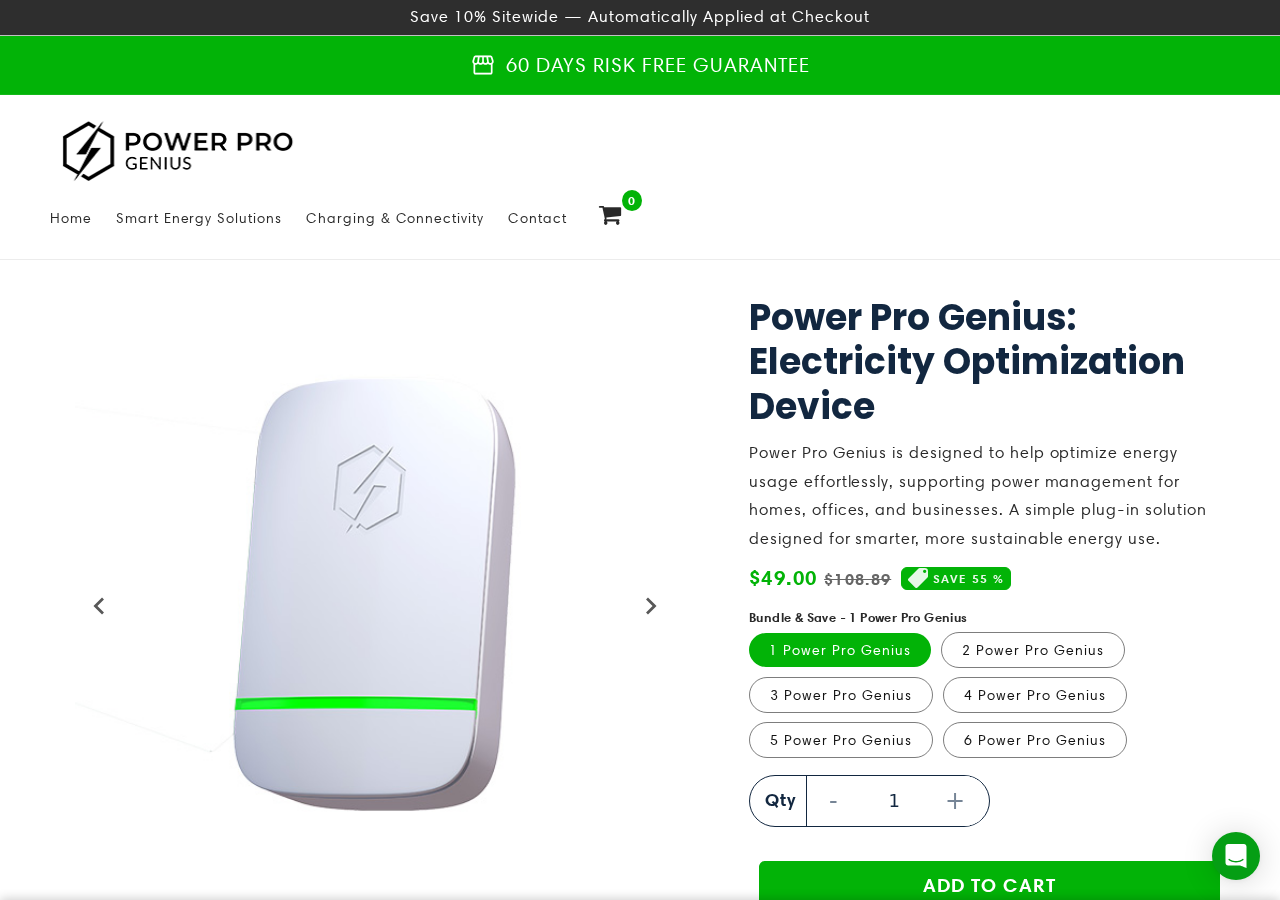
The captured product page shows $49 against $108.89, a 55% saving label, and choices for one through six units.
Those are the page’s displayed figures, not verification that the crossed-out amount was a genuine previous selling price. Confirm the final offer rather than calculating value from the badge.
A package selector is not evidence that customers are secretly charged for six units. However, the quantity you choose changes what you are agreeing to buy.
Check the unit count and complete total together. A larger package cannot compensate for missing evidence that one device delivers the claimed benefit.
Step 3: A working light can feel like an early success
The guide asks buyers to check the indicator after connecting the device. That can create a reassuring moment before any utility bill arrives.
Keep the observation precise: you have seen an indicator illuminate. You have not yet measured a change in the account charged by your electricity supplier.
Delivery, appearance, and ease of installation are separate from performance. A straightforward setup should not be mistaken for proof of a complex household-wide effect.
There is no reason to open the casing or improvise electrical tests to settle the question. Ask for credible product evidence instead.
Step 4: The promise shifts toward results several bills later
The sales page recommends reviewing two or three bills and waiting for the effect to develop. That schedule can outlast a buyer’s comfortable decision period.
You may hesitate to request a return because the next bill could look better. Meanwhile, the order date and the seller’s paperwork do not move with that hope.
Set your own decision date early enough to obtain instructions and act. A trial should give you a practical opportunity to decline, not merely a reason to keep waiting.
If support recommends extra time, ask how that affects your eligibility. Save the written answer rather than relying on an encouraging conversation.
The Seller, Support and Return Route
The storefront name does not identify every business involved
The store terms identify the operator using the Power Pro Genius name. They also refer to Canadian governing law, while the contact information gives a Boise location.
That combination does not establish where the business is incorporated. Nor does it prove that the address or operator is fictitious.
For your own order, compare the seller on the confirmation, invoice, payment statement, and return instructions. Ask for an explanation if materially different names appear.
Knowing which business took the payment helps when you need a correction. A product logo alone does not tell you who should handle the refund.
The listed return address is not a verified factory
The contact page lists 1147 E Exchange St, Boise, ID 83716 as the return address.
The shipping policy says orders ship from a Boise warehouse, with most arriving within 10 to 12 business days of ordering.
These are published seller statements, not independently completed delivery tests. A warehouse or return route would not, by itself, establish where the device was manufactured.
Before sending a parcel, obtain the instructions applicable to your order. Keep authorization and tracking together so the return can be connected to the original purchase.
Published support details are different from tested support
The store publishes email, chat, and telephone contact options. Published details are a starting point, not confirmation that your particular request has reached someone who can resolve it.
Use the contact information in your actual purchase records. In writing, state the order number, requested action, and date, without sending unnecessary identity documents.
A useful answer tells you what happens next. Ask for confirmation of cancellation or a return authorization, rather than accepting a general statement that help is available.
If you call, follow up with a written record. That gives both sides a clearer account of the request and any promised action.
The exact model and safety documentation still matter
The sales material mentions compliance marks and recognized components. A component’s recognition is not the same claim as independent certification of the complete finished product.
Ask for the model identifier and matching documentation. A broad badge should not substitute for information that can be checked against the unit being supplied.
This review examines the public offer, not a purchased-unit teardown, completed delivery, support test, or laboratory trial. The device’s internal construction and manufacturing origin remain unconfirmed.
Do not assume a particular defect, but do not use a reassuring badge as your safety assessment either. Obtain documentation that matches the finished unit.
What the Refund Promise Does and Does Not Cover
The return policy describes a 60-day guarantee, with customer service supplying approval and return instructions. Clarify whether your deadline runs from purchase or receipt.
It also explicitly describes purchases as one-time transactions. Hidden subscriptions should not be alleged merely because other online offers use them.
Optional package protection is listed at $4.95, and an extended warranty at $9.95. Together that is $14.90 if both are selected, not evidence either was automatically charged.
Look at the order’s separate line items. A warranty addresses specified product problems; it is not independent evidence that the device lowers an electricity bill.
The cancellation terms say changes depend on whether processing or shipment has begun. Refusing delivery is not treated as a valid cancellation.
If you change your mind, communicate the cancellation promptly. Do not assume leaving a parcel uncollected produces the same result as an accepted written request.
What to Do If You Ordered Power Pro Genius
-
Collect the purchase records before deciding your next step. Save the confirmation, invoice, payment entry, relevant offer, and the policy attached to your order.
Write down the order and delivery dates separately. Include the selected unit count and optional extras so a later conversation concerns the actual transaction.
Keep an unedited private copy. Remove your address, payment details, and order identifiers before sharing an experience publicly.
-
Request cancellation immediately if you no longer want an unshipped order. Use the seller’s established contact route and ask for written confirmation.
State clearly that you want cancellation, not placement advice or another package. If it has entered fulfillment, ask which return procedure now applies.
Keep any response with the original request. A sent message records your action but does not, on its own, confirm the seller canceled.
-
Protect the refund window instead of waiting indefinitely for another bill. Ask when the period starts and what must be completed before its end.
Request the return destination, any authorization number, and clarification of costs or deductions. Do not invent charges the policy does not state.
Retain posting and delivery evidence if you return the item. Check that any offered extension is written and specific to your order.
-
Explain unresolved payment problems accurately to your provider. Describe whether the issue is non-delivery, a disputed product claim, cancellation, or a promised refund.
An authorized order you regret is different from a payment you never approved. Give the provider the correct facts and ask which review process applies.
Ask about its deadlines without waiting for the seller’s guarantee to expire. Available remedies depend on the payment method and circumstances; reimbursement is not assured.
-
Handle any electrical concern without experimenting. If the device or outlet seems abnormal, stop using it when safe and obtain appropriate professional advice.
Do not open the box, adjust wiring, or work inside an electrical panel to investigate a purchase. Photograph accessible labels without creating a new hazard.
A seller discussion about placement should not postpone attention to an actual safety problem. Keep the technical concern separate from the refund paperwork.
-
Follow the refund through to the account itself. Ask for the amount and reference when the seller says a credit has been issued.
Compare that with your provider’s records and expected processing time. A message saying resolved is not the same as money appearing in the account.
For misleading advertising or an unresolved consumer complaint, use the appropriate consumer agency or ReportFraud.ftc.gov. Report specific facts, not assumptions about every buyer.
A More Useful Starting Point for a High Bill
Before buying equipment, compare billing days and energy units, not only the amount due. A tariff change can alter cost without changing consumption.
Note heating or cooling use, household occupancy, and unusual appliance operation. These details help a utility adviser or qualified professional identify the expense you actually need to reduce.
A change after installation is not automatically caused by the new device. Weather, routines, and billing adjustments can change at the same time.
You do not owe an expensive offer a home experiment. Ask your supplier about suitable usage checks and efficiency assistance before spending more on an unproven shortcut.
Frequently Asked Questions
Is Power Pro Genius proven to lower my electricity bill?
The public materials examined do not provide the independent, model-specific household savings evidence needed for that recommendation. Do not order it as a proven bill-reduction solution.
Does its indicator light demonstrate energy savings?
No. An illuminated indicator is not a measurement of your billed consumption. Appearance and operation need to be distinguished from the promised financial outcome.
Why compare the waiting period with the guarantee?
A long wait can consume most of the available return period. Confirm your own dates and required actions before allowing that window to run down.
Does the published policy say this is a subscription?
No. It expressly describes one-time purchases. Review your actual order and optional extras rather than assuming recurring billing occurred.
Should I buy more units to make the first one work?
No. A larger package does not supply missing performance evidence. Resolve the original purchase or return question before spending more.
Can I get a refund without proving a criminal scam?
Request the seller’s advertised remedy using your purchase records. An unresolved consumer dispute can be raised accurately without making an unsupported criminal accusation.
The Bottom Line
Do not buy Power Pro Genius as a proven electricity-saving solution. Its marketing does not supply the independent household performance evidence that should justify that expense.
If you already ordered, contact the seller promptly and establish your return deadline in writing. Keep your payment provider informed if cancellation or a promised refund remains unresolved.

Join the discussion
0 commentsShare your experience or ask a question about this article.
Discussion
Start the conversation
Have a question or something useful to share? Add the first comment.