


A familiar face appears in a weight-loss video. The explanation sounds simple, the bottle looks ordinary, and a money-back promise makes trying it feel safe.
Then you search ProZenith before ordering, or after a package arrives. The details worth checking are not the ones that get the biggest headlines.
Overview
What ProZenith Is Being Sold As
ProZenith is a supplement name associated with weight-loss promotions, including the pink salt story. This article concerns that sales campaign, not a homemade recipe.
The problem starts when a familiar celebrity, a scientific-looking explanation, and a refund guarantee stand in for evidence about the actual capsules.
A November 2025 BBB warning identified AI-generated Oprah endorsements, reports of turmeric arriving instead of the advertised supplement, and refund complaints.
Why the Pages Do Not Tell One Consistent Story
Prozenith.com now displays a parked-domain page. The similarly spelled proznith.com displays a domain-sale message rather than a supplement offer.
Separate ProZenith-branded contact and policy pages remain accessible under crystalwellnesspath.com. Their refund instructions disagree about when the 60-day clock starts.
For someone trying to get money back, that difference matters more than a reassuring guarantee badge. Lost time can become a reason to reject a return.
The Warning Signs That Matter Most
- A celebrity sales pitch that does not match the celebrity’s own statements.
- Conflicting return deadlines across pages carrying the same supplement name.
- Customer complaints about unexpected ingredients and refunds that never arrive.
- A fulfillment address that is not the supplement company’s headquarters.
- Scientific references that do not identify a trial of the product being sold.
These are reasons to avoid the offer, not reasons to spend longer watching its sales video. If you already paid, preserve the transaction evidence now.
ProZenith Reviews and Complaints: What Buyers Describe
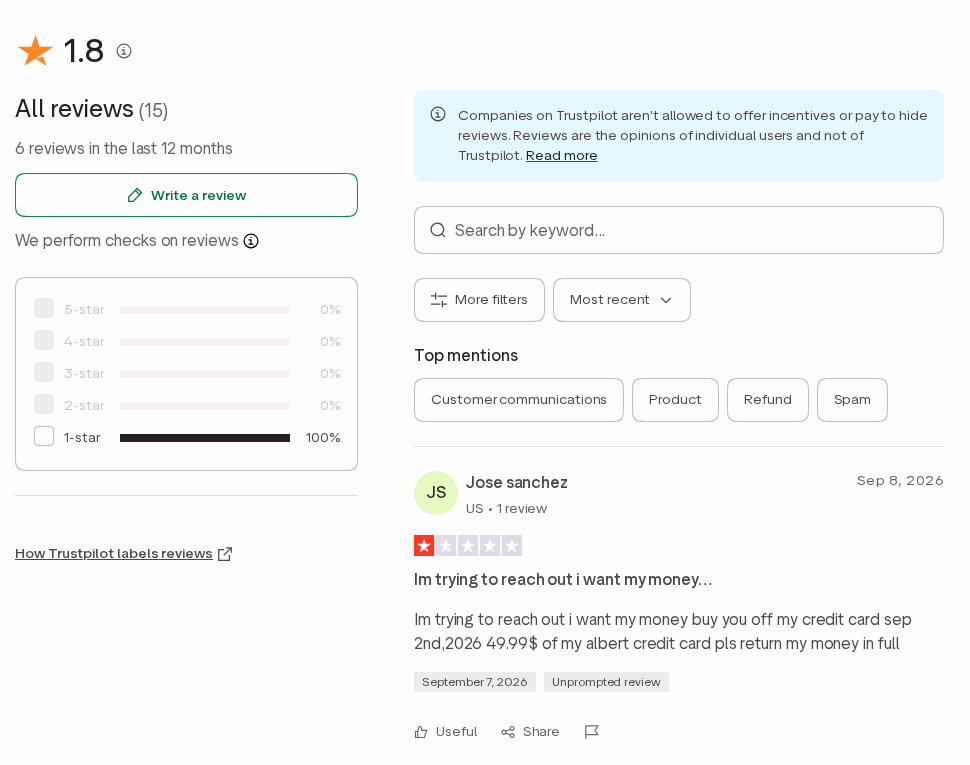
The ProZenith Trustpilot profile shows a 1.8 score from 15 reviews, with 100% of its ratings at one star.
That is a small, self-selected sample, not a measurement of every customer’s experience. Its recurring complaint themes are nevertheless directly relevant to a purchase decision.
Michelle Isaacs described receiving capsules labeled as turmeric and black pepper. Kate described ingredients that differed from the website and advertising video.
Other reviewers described difficulty getting return instructions, sending bottles back without receiving refunds, or being offered coaching instead of the money requested.
A May 2026 review from Cindy Genin described seeking a refund for over a year. A September 2026 review also requested money back.
Customer accounts are allegations, not laboratory results. The practical lesson is to document the bottle, promised formula, return authorization, and payment together.
BBB separately reported 115 complaints, 172 scam reports, and 52 negative reviews over four months, with average reported losses around $300.
That dated warning and the continuing review record are more useful than a promotional article repeating a product description under a reassuring headline.
Look for an accountable purchase history. A page that only lists supposed benefits, a discount, and an order link has not independently tested the supplement.
How the ProZenith Scam Works
Step 1: A Familiar Celebrity Makes the Pitch Feel Personal
The opening hook is not usually a careful explanation of capsule ingredients. It is a familiar person seemingly sharing the answer to a frustrating weight-loss problem.
Oprah’s public discussions of weight and health make her image particularly useful to deceptive advertisers. Familiar footage can make a new sales message feel established.
But the endorsement must exist outside the advertisement. On her own August 2025 page, Oprah discussed fake AI videos using her image to sell products, including pink salt.
BBB specifically identified fabricated Oprah endorsements in the ProZenith campaign. A convincing face or voice does not turn those promotions into her recommendation.
If a friend forwards the clip, the added trust comes from your friend, not from any new evidence about the bottle. Share the warning instead.
Step 2: A Simple Trick Becomes a Supplement Purchase
The pink salt angle draws attention because it sounds like something already sitting in a kitchen. Buying a course of capsules is a different proposition.
Watch for the moment the story changes. A supposed household discovery becomes a formula, and access to that formula becomes an order.
Those transitions matter. Evidence about a dietary pattern, an ingredient, or someone’s real weight-loss treatment does not establish that the advertised supplement produces the same results.
The surviving ProZenith references page lists topics such as ketones, minerals, low-carbohydrate diets, and fasting. It does not identify a ProZenith product trial.
A bibliography can look impressive while leaving the central question unanswered: did people taking this exact product, at its actual doses, achieve the advertised outcome?
Our separate Japanese pink salt recipe report explains why the story needs checking separately from whichever bottle appears at the end.
Step 3: Authority Cues Replace Product Evidence
Badges and scientific language reduce the feeling of risk. They can encourage a buyer to move past the label and straight to the package selector.
BBB reported false approval claims and unauthorized use of its accreditation seal. A displayed seal should be verified with the organization it supposedly represents.
The FDA explains that dietary supplements are not approved for safety and effectiveness before marketing. Facility registration is not approval of the finished supplement.
The ProZenith policy footer itself says its statements have not been evaluated by the FDA. That disclosure cannot rescue a contradictory approval claim elsewhere.
Likewise, a natural ingredient is not a clinical result. The NIH weight-loss supplement guide explains that evidence varies and that some products can cause harm.
You should not have to decode contradictory regulatory language before finding out what you are buying. Confusion here benefits the sale, not the customer.
Step 4: The Package Arrives, but the Promise Becomes Harder to Pin Down
Once an order exists, the important records are mundane: product name, quantity, total, ingredient panel, shipping label, receipt, and payment descriptor.
A parcel arriving is not proof that the advertised promise was fulfilled. Compare the contents with the formula and quantity shown before payment.
If the ingredients differ, photograph that difference before using anything. A claim about the wrong goods needs evidence of both what was promised and what arrived.
Do not accept a support explanation that the advertised ingredient was merely a metaphor or that you must buy something else to make the first purchase work.
Keep the original order separate from later offers. Additional bottles, coaching, or another formula are new purchases, not automatically a remedy for a disputed one.
Step 5: The Guarantee Turns Into a Deadline Problem
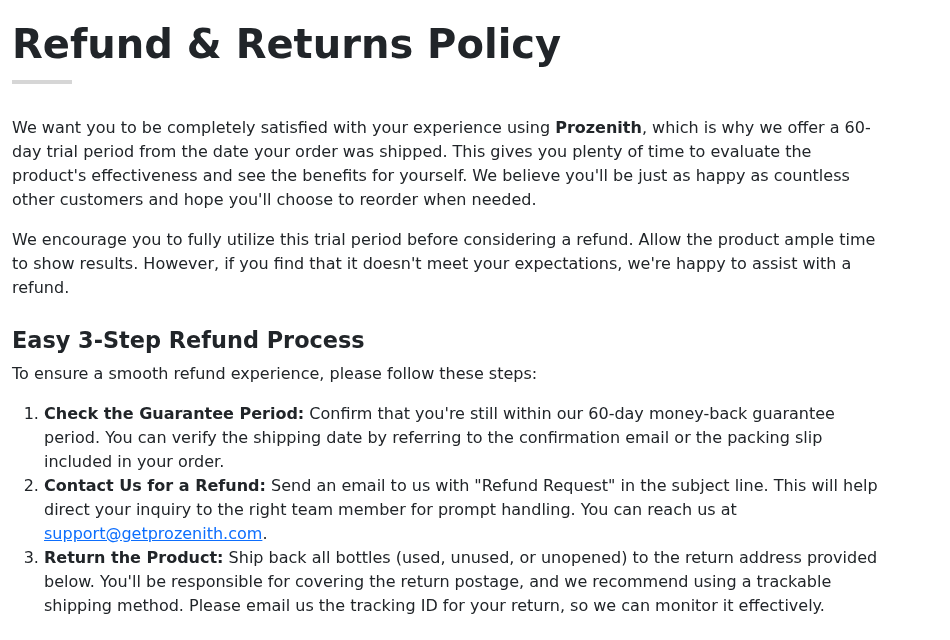
The refund page promises a 60-day trial period from the date your order was shipped
. Its language encourages customers to give the product time.
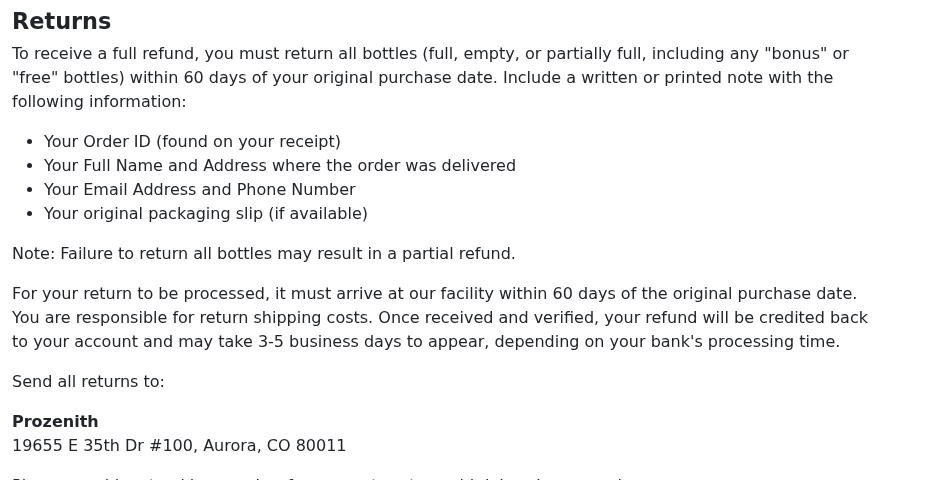
The shipping policy uses a stricter starting point: purchase date. It also requires the returned bottles to arrive at the facility within that period.
Those are different deadlines. Waiting to finish a trial, then requesting authorization and mailing a parcel, can consume the time needed for the return itself.
For example, a purchase on May 1 followed by shipment on May 5 creates a four-day difference before transit time is even considered.
That example illustrates the conflicting wording, not a prediction about a particular order. The safest response is to request a refund promptly and document both policies.
A seller asking for more patience should not be allowed to run down your payment-dispute options. Contact the payment provider while you pursue the return.
Company, Contact Details, and Return-Policy Checks
The Name on the Page Is Not the Whole Merchant Identity
The accessible legal pages use ProZenith branding and a ClickBank retailer disclosure. The terms also mention American Health Daily in their text-message consent section.
That mixture does not clearly identify the company behind every ProZenith advertisement. Your receipt and payment record are essential to identifying your particular transaction.
BBB described the business’s true location as unknown and could not verify an active ProZenith state registration. Its warning also reported a Slimjaro rebrand.
Different domains, similarly named products, and shared service providers should not be collapsed into one owner without evidence. That boundary does not erase the documented campaign.
The Aurora Address Is a Fulfillment Location
The return pages list ProZenith, 19655 E 35th Dr #100, Aurora, CO 80011. BBB identified that location as belonging to fulfillment company ShipOffers.
A fulfillment warehouse can receive and dispatch parcels for other businesses. Its address does not establish where a supplement was formulated, manufactured, or managed.
The same address appears in our LipoVive investigation. Shared fulfillment is a documented connection, not proof that the brands have the same owner.
For a return, use instructions tied to your own order. Sending a parcel to a shared warehouse without a recorded authorization can complicate matching it.
The Listed Support Channel Needs a Written Record
The contact page lists support@getprozenith.com and (323) 529-8488. It promises a response within 48 hours, while the refund page asks buyers to email first.
Ask for the return authorization, complete address, deadline, expected refund amount, and confirmation of any cancellation in writing. Keep the message and its timestamp.
A generic acknowledgement is not confirmation that a refund was approved. Nor is a tracking link an answer to a request for money back.
If a call produces instructions, summarize them in a follow-up email. That creates a usable record instead of relying on a conversation you cannot show.
The Policies Put Costs and Timing on the Buyer
The refund page requires used and unused bottles to be returned at the buyer’s expense. The shipping policy includes free and bonus bottles in that requirement.
It also allows a partial refund when bottles are missing and says packages marked delivered do not qualify for refunds if the customer did not receive them.
These conditions make keeping packaging worthwhile. They also make a broad risk-free impression misleading: the customer can face postage costs, disputed delivery, and conflicting deadlines.
The available pages do not establish one current formula, manufacturing origin, or universal subscription arrangement across every site using this name.
Use your bottle and receipt for those details. The confirmed fake-endorsement campaign, complaints, and contradictory return terms already justify avoiding the offer.
Other pink salt promotions deserve the same separation of story and product. Our Barislend capsules report addresses that separate supplement, not an assumed ProZenith alias.
What to Do If You Bought ProZenith
Start with the payment and the parcel, not another sales conversation. You do not need to prove the entire advertising operation to explain your own complaint.
- Save your order evidence.
Keep the receipt, full page address, advertisement, confirmation email, promised ingredients, quantity, and price. Download copies rather than relying on pages staying online.
Photograph every bottle, label, seal, batch number, and shipping package. If the product differs from the offer, place the two records together.
- Request the refund immediately.
Use the merchant details on your receipt. State the order number, amount, reason, and requested remedy, and ask for written return authorization.
Attach the relevant policy and explain any ingredient or quantity mismatch. Do not let offers of coaching replace the refund request you actually made.
- Contact your payment provider before time runs out.
The FTC recommends contacting the payment provider promptly when you paid a scammer. Ask what evidence and deadlines apply to your payment.
Describe the facts accurately: goods not as described, an unprocessed promised refund, or an unauthorized charge. A disappointing result and an unauthorized transaction are different issues.
For credit cards, follow the issuer’s dispute instructions. The FTC’s billing-error guidance explains why written notice and timing can matter.
- Make any return traceable.
Confirm the destination and authorization for your order, photograph the contents, retain the postal receipt, and save delivery confirmation.
Ask how the conflicting deadlines apply before paying postage. If the seller does not answer, tell the payment provider instead of silently letting the issue expire.
- Check for additional billing.
Compare your statement with the original total. If later charges appear, ask the merchant and provider to identify them and stop any arrangement you did not authorize.
Save cancellation confirmation. A refund request, an email unsubscribe, and cancellation of recurring billing are separate actions, so specify which you need.
- Protect your health and report the facts.
Do not keep taking an unfamiliar supplement simply to qualify for a refund. Ask a pharmacist or clinician about its actual label and your medications.
For a suspected adverse reaction, stop using the product and seek medical advice. Severe symptoms require urgent care, not a customer-service ticket.
The FDA explains how to report supplement reactions. Report deceptive selling to the FTC or your local consumer authority with your saved records.
Frequently Asked Questions
Is ProZenith Legit or a Scam?
The campaign involving fake Oprah endorsements is deceptive. BBB’s warning and the conflicting return policies support a clear recommendation: do not buy through this pitch.
When resolving an existing order, identify the merchant from the receipt. The name alone cannot tell you which payment route handled your purchase.
Does Oprah Recommend ProZenith or the Pink Salt Trick?
The ProZenith campaign identified by BBB used fabricated endorsements. Oprah has also warned in her own words about fake videos selling products such as pink salt.
A real interview about weight loss does not authorize an advertiser to insert a supplement recommendation. Look for the recommendation in the original, complete source.
What Do ProZenith Reviews Say About Refunds?
The Trustpilot record includes complaints about unanswered requests, returned bottles without refunds, and alternatives offered instead of repayment. Those accounts describe individual experiences.
Keep your own proof of payment, return authorization, and delivery. Those documents help a payment provider assess your dispute more directly than a screenshot of another complaint.
Is ProZenith the Same as the Barislend Pink Salt Offer?
A shared pink salt story does not establish the same formula or seller. Barislend has separate product coverage and should be checked against its own offer.
Compare the actual bottle, ingredients, merchant, and receipt. Do not transfer an old guarantee or contact address from one supplement name to another.
Is ProZenith FDA Approved, and What About Side Effects?
Dietary supplements are not FDA-approved before sale. An approval badge is not evidence that ProZenith has demonstrated the advertised weight-loss results.
Safety depends on the actual ingredients, doses, and your health circumstances. Keep the label and consult a clinician rather than treating a natural claim as protection.
How Do I Get a ProZenith Refund if the Website Is Parked?
Start with your receipt, confirmation email, and payment provider. A parked domain does not remove the payment record or mean a dispute is impossible.
Submit the promised terms, what arrived, and your unanswered requests. Ask about deadlines promptly, and do not pay a recovery service promising a guaranteed refund.
The Bottom Line
Do not buy ProZenith through a celebrity pink salt pitch. The documented campaign and contradictory return rules are serious problems, not minor wording issues.
If you already ordered, save the evidence, request repayment in writing, and contact your payment provider now. Do not buy another bottle to fix the first purchase.

Join the discussion
0 commentsShare your experience or ask a question about this article.
Discussion
Start the conversation
Have a question or something useful to share? Add the first comment.