

Rituals Cosmetics has quickly become one of the most popular luxury beauty and personal care brands. But unfortunately, Rituals’ success and reputation for quality has caught the eye of nefarious scammers running fake online clearance sales. This in-depth guide will uncover how these Rituals clearance scams work, what to watch out for, and most importantly, how to protect yourself from being ripped off.
Scam Overview
In just two decades, Rituals Cosmetics has skyrocketed to become one of the most desired luxury beauty and personal care brands. Rituals brings a unique blend of natural ingredients, sublime scents, and indulgent formulations to its extensive product range spanning skincare, body care, makeup, and home fragrances.
Rituals’ tremendous growth now encompasses over 870 retail stores globally. But this success has also attracted the attention of predatory scammers seeking to illegally cash in on Rituals’ stellar reputation and loyal customer base.
These fraudsters construct sophisticated fake ecommerce websites carefully designed to appear nearly identical to the real Rituals website. The scam sites prominently splash the distinctive Rituals branding and logo throughout.
They copy product descriptions, clinical trials, ingredient lists, packaging designs, and other content directly from legitimate Rituals sites to make their store seem authentic. Stolen high-resolution product images showing items like the Ritual of Sakura body care range or The Ritual of Ayurveda oil treatments are used to populate the site.
To trick visitors into thinking they’ve landed on an authorized Rituals retailer, the fake sites also mimic features shoppers expect like customer reviews, rewards programs, gift cards, and special offers. Some even list a customer service phone number and physical address, although the contact details are fake.
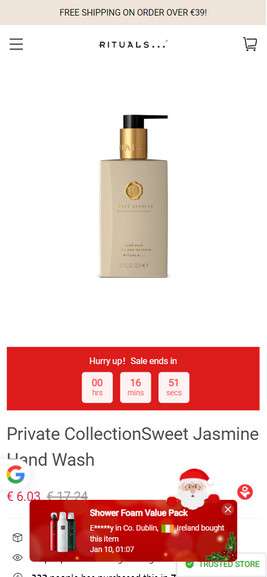
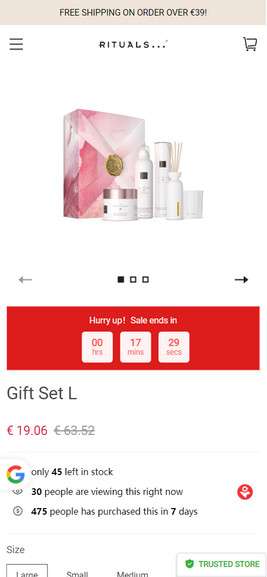
Once set up, the fraudulent sites advertise eye-catching “blowout” Rituals clearance sales with prices slashed up to 90% off MSRP. For example, a Rituals gift set worth $150 might be touted at an unbelievable “clearance price” of just $29. Or a luxurious Rituals diffuser kit could be advertised marked down from $300 to $39.
These dramatic discounts are intended to entice bargain seekers into purchasing from the sham websites. However, once a customer places an order believing they’ve scored big savings on indulgent Rituals goods, the ugly truth becomes evident.
Not only will shoppers never receive the actual premium Rituals products they paid for, but they also handed their personal and payment data directly to sophisticated scammers to enable financial fraud and identity theft.
The harsh reality is that offers like a $500 skin care regimen discounted to $39 are deceptive tricks, not real savings. When deals seem too good to be true, they always are. Scammers bank on using fabricated discounts to manipulate shoppers and hijack their better judgment.
But by understanding how these frauds operate, consumers can take precautions to detect and avoid fake clearance sales. Checking for red flags like unbelievable prices and researching seller legitimacy helps protect your hard-earned money and sensitive information.
How the Rituals Clearance Scam Unfolds
Swindlers use clever techniques to dupe their victims into believing their Rituals clearance sales are genuine. Here is an inside look at how scammers carry out these fraudulent sales:
Step 1: Build Elaborate Fake Rituals Websites
Meticulous effort goes into making the fraudulent sites appear practically indistinguishable from the real Rituals store. The scam sites feature the Rituals logo prominently throughout.
The products displayed encompass Rituals’ full range – skincare, body care, home fragrances, makeup, men’s products, and gift sets. Scammers steal product descriptions, ingredients lists, clinical trial results, usage directions, packaging photos, and other details directly from authentic Rituals sites and catalogs to populate their store.
High-resolution product images are likewise ripped off from Rituals’ official website and social media pages. Rituals imagery is used without authorization to showcase products like the Sakura shower foam, Ayurveda oil blends, or Reed Diffuser collection.
To increase legitimacy, the sites also mimic features typical of online shops like customer reviews, signup forms, opt-in checkboxes, FAQs, shipping policies, and luxury branding throughout. Some even list a customer service phone number or physical address, though any contact info leads nowhere.
Step 2: Heavily Promote Fake Sales on Social Media
Once fully constructed, the scam sites concentrate on funneling traffic to their fraudulent stores through social media promotions. They run Facebook and Instagram ads geared towards demographics most likely to purchase Rituals products based on interests, age, and geography.
The ads tout the fake blowout Rituals sales, such as “Rituals Warehouse Sale! Today Only! Up to 90% off!” When users click on the compelling ads, they get directed straight to the scam sites. The social promotion adds a veneer of legitimacy that the sales are real.
Step 3: Fool Shoppers With Deceitful Discounts
On the fake sites, Rituals products are displayed alongside dramatically lowered prices. For example, a $150 gift set might be discounted to $29. Or a $500 collection of skincare products could be advertised at an unbelievable 90% off.
Scammers often utilize scarcity and urgency tactics as well, including limited quantity messaging, short countdown timers, or notices like “Almost Gone!” to pressure visitors into hastily purchasing before these unbelievable deals supposedly disappear.
Step 4: Trick Users Into Inputting Payment and Personal Data
At checkout, the sites require visitors to input a wealth of sensitive personal and payment information, including full name, physical address, phone number, email address, and credit card number. All this data gets captured directly by the fraudsters running the sham operations.
To complete transactions, customers must hand over everything scammers need to easily commit financial fraud or steal identities. The criminals thrive on the trusting nature of shoppers wanting to jump on clearance deals.
Step 5: Never Ship the Promised Products
After duping shoppers into inputting their confidential information, the scammers receive payment but customers never receive shipments containing the deeply discounted Rituals products they ordered.
At best, some victims eventually receive inferior fake products clearly not the premium Rituals items advertised. More commonly, excited buyers report receiving absolutely nothing after placing orders.
By the time shoppers realize they’ve been scammed, the fraudsters have already stolen their money, information, and disappeared without a trace. Learning to recognize these deceptive techniques is key to avoiding falling into this insidious trap.
8 Clear Warning Signs of a Fake Rituals Website
While scam sites may look surprisingly real at first glance, upon closer inspection their fraudulent nature emerges. Watch for these tell-tale indicators:
- Too-good-to-be-true pricing – Real Rituals products won’t be 90% off or $29. Severely discounted prices signal a scam.
- Generic product photos – Scammers use stock images rather than unique product photos. Reverse image searches reveal copies.
- Missing contact information – No working customer service phone number or physical address provided.
- No SSL certificate – Secure sites have “https://” URLs and a padlock icon in the browser. Lack of SSL means entering information is risky.
- Grammatical errors – Poor grammar, typos and other errors signal foreign fraudsters created the site quickly.
- No reviews – Authentic retailers encourage buyer reviews. Lack of reviews indicates a new scam site.
- High-pressure tactics – Countdown timers, limited quantity messages, and other tactics pressure visitors into hasty purchases.
- Shady domain name – Fake sites use recently registered domains with random numbers or letters.
How to Spot Rituals Scams on Social Media
In addition to fraudulent websites, scammers also leverage social platforms like Facebook, Instagram, and TikTok to promote their fake Rituals deals. Here’s what to watch out for on each platform:
Identifying Rituals Scams on Facebook
- Be wary of Facebook ads promoting Rituals products at absurdly low prices like 90% off or $29. Authentic retailers will not offer such unrealistic discounts.
- Reverse image search any product photos used in the ads. Scammers typically steal images directly from Rituals’ website and catalogs. Matching results indicate a scam.
- Click on the Page name running the ads. Verify they have Rituals’ blue checkmark for official brand pages. Lack of verification indicates an impersonator account.
- Check for mentions of the Page being a scam in reviews and comments. Use caution if other users report never receiving items ordered or getting knockoffs.
- Research the Page history for sudden name changes. Fraud pages switch names frequently once reported to try evading detection.
How to Identify Fake Rituals Sales on Instagram
- Look out for Instagram ads promoting Rituals products at absurdly cheap prices like $500 worth of items for $39. That’s a major red flag for a scam.
- Reverse image search product photos used in Instagram posts. Fraudsters often steal images directly from Rituals’ Instagram and Pinterest accounts.
- Check user reviews on the seller’s profile. Lack of reviews or mentions of orders never arriving should raise major alarms.
- Click through the seller’s location tag. Scam accounts use vague locations instead of real store addresses.
- Beware influencers promoting unbelievable Rituals deals in sponsored posts. They may have been paid by scammers to bait victims.
Spotting Fake Rituals Deals on TikTok
- Search for the product and analyze shoppable video reviews. Generic videos with stock footage indicate a scam seller.
- Engage cautiously with high performing videos. Scammers pay for fake views, likes and comments to appear reputable.
- Reverse image search product photos used in posts. Matching results point to recycled media, not unique products.
- Vet sellers making wild claims like $300 worth of products discounted to $29. Search for evidence of past scamming.
- Watch for urgent captions like “Almost gone!” or “Today only!”. Scammers create false scarcity to prompt rushed purchases.
Carefully vetting seller legitimacy on social channels provides important protection. Spotting the warning signs of Rituals scams keeps your money and identity secure.
Protect Yourself If Scammed by a Fake Rituals Website
If you placed an order on a scam Rituals site and either received nothing or inferior counterfeits, take these steps immediately to reduce damages:
- Contact your credit card provider – Report the charge as fraud to initiate a chargeback and get your money reimbursed. Act quickly, as chargeback rights expire.
- Monitor statements closely – Watch for any additional suspicious charges from the stolen credit card info by scammers and report them ASAP.
- Change passwords – Update passwords anywhere you reused the same password entered on the fake site. Use unique, complex passwords for every account.
- Freeze credit – Contact all three credit bureaus to implement a credit freeze preventing scammers from opening new accounts in your name.
- Check credit reports – Order free annual reports from Equifax, Experian and TransUnion to check for signs of identity theft. Report any fraudulent accounts immediately.
- Report fake sites – Submit details to the FTC, BBB and Rituals so appropriate action can be taken to get scam sites removed and prevent further victimization.
Frequently Asked Questions About Fraudulent Rituals Sales
Rituals has skyrocketed to popularity for its indulgent bath, body, and home products. Unfortunately, scammers are exploiting Rituals’ reputation to rip off customers through fake online clearance sales. This FAQ covers key questions about how to avoid these Rituals scams.
What exactly is the Rituals clearance scam?
Fraudsters create elaborate fake websites impersonating an authorized Rituals retailer. They lure in shoppers with unrealistic deals like 90% off to steal credit card and personal information as well as money from victims.
How can I spot a fake Rituals website?
Watch for excessively low prices, stock photos, no customer reviews, recent domain registrations, only email contacts, grammatical errors, and inability to find a real physical address. These are clear signs of a scam.
Why are Rituals products on these sites so cheap?
The huge markdowns like $500 worth of products for $39 are fabricated to hook bargain hunters. No legitimate retailer offers anywhere near 90% off authentic Rituals merchandise. The low prices are a trick.
Will I get real Rituals products if I order from these sites?
Absolutely not. The scam sites have no relationship with Rituals. Customers either get low-quality knockoffs or random, unrelated items. Many report getting nothing after payment.
Is it safe to enter my information on these sites?
Never enter your personal or payment information on questionable sites. The sites exist solely to obtain your data for financial fraud and identity theft. Only shop trusted, authorized retailers.
How can I get a refund if scammed?
Getting a refund is very difficult since the retailers are fake. Immediately contact your credit card company to dispute the charges as fraud and request a chargeback. This is the best chance for getting money returned.
Where can I report a fake website?
Report scam sites to the FTC, BBB, IC3, and Rituals to get fraudulent sites shut down. Providing details prevents further victimization and helps bring scammers to justice.
Should I trust Rituals sales ads on social media?
Exercise extreme caution with sales on social media from unknown sellers. Thoroughly vet any site you are directed to and look for multiple red flags before purchasing. Avoid unrealistic deals.
How can I safely buy Rituals products on sale?
Only order directly from Rituals’ official website or authorized retailers like Sephora and Bluemercury. Carefully research any unfamiliar seller and inspect sites for scam indicators before entering payment information.
Using caution and common sense helps avoid falling victim to convincing Rituals impersonators. If an offer appears too good to be true, it should set off alarm bells. Protect yourself by only shopping trusted sites.
The Bottom Line
Rituals has earned tremendous popularity and loyalty for its indulgent, natural beauty and home products. But sadly, Rituals’ reputation for quality has also captured the attention of nefarious scammers seeking to illegally profit from the brand’s good name.
These fraudsters create fake ecommerce websites advertising deep discounts on Rituals products that seem almost too good to pass up. However, these sites have absolutely no relationship with the genuine Rituals company. Their sole purpose is to harvest credit card and personal data.
In reality, amazing deals like 90% off are never legitimate. When an offer appears unrealistic, it always is. Savvy consumers can protect themselves by carefully researching unfamiliar sites, reading reviews, confirming contact details, and watching for other scam red flags.
Sticking with real authorized retailers like Rituals.com, Sephora, and Bluemercury ensures you’ll get authentic products and the full Rituals experience. Shopping smart provides peace of mind that you won’t fall prey to convincing Rituals impersonators running fake clearance sales. By learning their tricks, we can enjoy the indulgence of quality self-care products without the ugly side effects of fraud.

Join the discussion
0 commentsShare your experience or ask a question about this article.
Discussion
Start the conversation
Have a question or something useful to share? Add the first comment.