It usually starts innocently.
You are scrolling a social feed, and a short video grabs you with a scary line about “silence” and what it might be doing to your brain. If you have tinnitus, or if you are worried about hearing changes, that message hits fast. You are not just annoyed by ringing. You are suddenly anxious about what it “means.”
A click later, you land on a page dressed up like a trusted health outlet, complete with a familiar-looking header and a dramatic headline about a veteran doctor revealing a simple “cupboard ingredient” that can end tinnitus in weeks.
And then, right when you expect the helpful tip, the page pivots.
Instead of giving you the promised remedy, it pushes you toward one thing: buying SonusZen.
This article is about that pivot. Not the supplement label. Not the vague ingredient list. The marketing machine behind it, the scam-style ads, and the red flags that show up again and again in these tinnitus “miracle cure” campaigns.
Overview
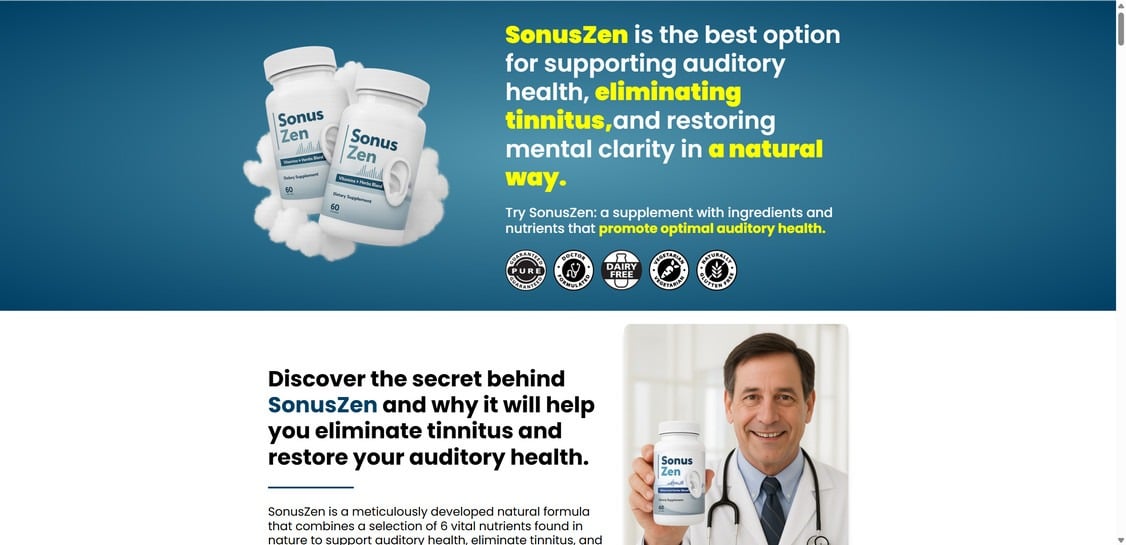
SonusZen is marketed as a dietary supplement that claims to support auditory health, eliminate tinnitus, and even restore mental clarity “naturally.” Those are not small promises. They are life-changing promises aimed at a condition that can be persistent, stressful, and deeply disruptive.
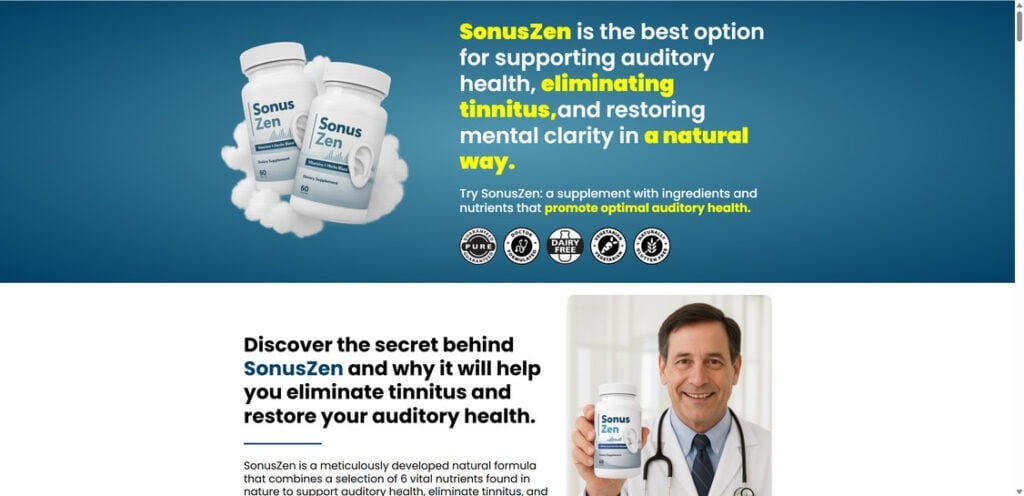
On one SonusZen-branded site, the pitch is blunt: it is “the best option” for supporting auditory health, “eliminating tinnitus,” and restoring mental clarity.
Another site frames the product as an “advanced” tinnitus and ear health solution that works at the “root level,” often pairing tinnitus relief claims with brain benefits like better focus and memory.
The way it is sold matters just as much as what it claims.
Because when you trace how people are led to SonusZen, you see a familiar funnel that shows up across the internet for many different “miracle” products:
- A fear-based social ad that triggers urgency
- A fake news-style landing page that borrows credibility
- A long, emotional story that never delivers the promised “secret”
- A hard sell that pushes expensive multi-bottle bundles
If you have seen the SonusZen campaign in the wild, you have likely noticed how heavily it leans on authority signals.
That includes:
- A page layout that mimics CNN branding and “health news” navigation
- A “doctor with decades of experience” narrative
- Official-sounding badges and quality seals such as “doctor formulated,” “guaranteed pure,” and “gluten free”
- “FDA” and “GMP” language designed to sound like approval, not what it actually is
Here is the key reality that these pages rarely make clear upfront: dietary supplements are not approved the way prescription drugs are approved.
Under U.S. law, U.S. Food and Drug Administration does not “approve” dietary supplements for safety and effectiveness before they are marketed. Companies can sell supplements without pre-market approval in many cases.
That is why “FDA approved” badges on supplement pages are such an important red flag. They often trade on a public misunderstanding. Even when a facility is “FDA-registered,” that is not the same as the product being proven effective for a medical condition.
Now add tinnitus to the mix, and the marketing becomes even more loaded.
Tinnitus is not one simple disease with one simple cure. It is a symptom that can have many causes, from noise exposure to hearing loss to other health factors. The science is also clear on a point that matters here: there is currently no cure for tinnitus, although there are treatments and strategies that can reduce the impact of symptoms.
This matters because SonusZen ads are not positioned as “this may help you cope.” They are positioned as “this ends it.”
That leap is exactly where scam-style supplement marketing thrives: taking a real problem, attaching a dramatic origin story, and promising a clean, fast outcome.
What the SonusZen marketing claims to do
Across SonusZen campaign pages, you will see versions of these claims:
- It works at the “root cause” rather than masking symptoms
- It improves blood flow to the ears and brain
- It protects auditory cells from “oxidative stress”
- It reduces ringing and restores clearer hearing
- It boosts memory, focus, and mental clarity
You can see examples of these promises on sales pages that explicitly list tinnitus relief and cognitive benefits as outcomes of consistent use.
On some campaign pages, it goes further into emotional manipulation: using scary statistics, “breakthrough” language, and phrases like “instantly reduces ringing” or “nothing on the market matches” it.
Those are not neutral wellness claims. They are strong health claims.
And in the U.S., when you make strong health claims in advertising, you are supposed to have solid evidence to back them up. Federal Trade Commission is explicit that health-related advertising claims must be supported by appropriate substantiation.
This is where the SonusZen campaign structure becomes the story.
Because the funnel is designed to replace evidence with persuasion.
Instead of clinical trials, you get:
- A dramatic “doctor reveals” headline
- A borrowed media look-and-feel
- A video frame that implies “breaking news”
- Big review counts and “verified purchase” labels that cannot be independently checked
- Urgency tactics: limited-time pricing, “most popular” flags, and bundle discounts
The most important red flags at a glance
If you want the quick checklist before we go deeper, these are the highest-signal warning signs in the SonusZen marketing campaigns:
- A fake news-style page that imitates a recognizable media brand, creating the impression that a trusted outlet is “reporting” the story.
- A “secret ingredient” hook that is never actually revealed unless you buy something.
- Claims that go beyond support and into cure territory, especially “eliminating tinnitus.”
- Misleading “FDA” language and badges that suggest approval even though supplements are not approved like drugs.
- Heavy reliance on testimonials and “review volumes” instead of verifiable, independent evidence.
- Pricing engineered to steer you into high-dollar bundles, not a cautious first try.
- A checkout experience that looks detached from a well-known retailer or established brand presence.
Some independent scam-tracking writeups describe this exact pattern for SonusZen: social media ads funneling into fake news pages, then into a sales push that emphasizes cure-like outcomes without solid proof.
Now let’s break down how the operation works, step by step, so you can recognize it instantly the next time you see it.
How The Operation Works
This section is intentionally detailed.
Scam-style marketing is rarely one big lie. It is a chain of small, strategic moves designed to guide your emotions from curiosity to fear to urgency to purchase, before you slow down enough to verify anything.
Step 1: The social ad that targets a vulnerable moment
The first contact is usually a short-form video on Facebook, often presented as a Reel or sponsored clip.
The messaging tends to do three things immediately:
It escalates the problem.
Instead of “ringing is annoying,” it suggests tinnitus is destroying your brain, your memory, or your future.
It implies a hidden conspiracy.
Many versions hint that “they” do not want you to know the real cure, often pointing a finger at hearing aid companies or the medical system.
It promises a simple, immediate revelation.
A “cupboard ingredient.” A “1-minute trick.” Something you supposedly already have.
This is a psychological setup, not health education.
If the ad can make you feel that you are in danger and that the solution is simple, you are far more likely to click immediately.
Step 2: The fake news pre-lander that borrows trust
After the click, you land on a page that looks like health journalism.
In the SonusZen campaign, one version mimics the look of a major media health section and uses a bold headline about a doctor with decades of experience revealing the cupboard ingredient that can end tinnitus in weeks.
This is not an accident.
These “pre-landers” exist to do one job: make you lower your guard.
If the page looks like a news story, many readers switch into “reading mode,” not “shopping mode.” That means fewer questions, fewer checks, and more emotional absorption.
Common elements include:
- A familiar logo placement and navigation menu
- A dramatic headline written like breaking news
- A video embed or a large video thumbnail with a play button
- Mention of doctors, labs, or institutions without clear verification
The goal is to create the impression that you are being informed, not sold.
Step 3: The “secret ingredient” stall that keeps you scrolling
This is one of the most consistent scam-ad patterns online:
The ad promises a simple ingredient or technique.
The page never gives it to you.
Instead, it stretches the story.
You get paragraphs of setup: how tinnitus works, how doctors missed it, how a surprising discovery happened, how elite groups used it first.
The reader keeps going because the brain hates an unfinished story.
This is the same mechanism behind clickbait, but applied to health anxiety. The longer you scroll, the more likely you are to accept the eventual pitch as the “missing answer.”
Step 4: Authority stacking to replace evidence
Once you are emotionally invested, the campaign shifts into what you can think of as “authority stacking.”
This is where the page floods you with signals that feel like credibility, even if they are not proof.
In the SonusZen sales environment, those signals often include:
Badges and seals.
“Doctor formulated.” “Guaranteed pure.” “Gluten free.” “Vegetarian.” These badges are easy to create and visually powerful, even when they mean very little about clinical effectiveness.
Regulatory language that sounds like approval.
You will see “FDA-registered facility” and “GMP-certified” presented as a reason to trust the product. The words are chosen carefully because they trigger a shortcut in the consumer mind: FDA equals tested, safe, and proven.
But as noted earlier, the FDA does not approve dietary supplements for safety and effectiveness before they are sold, and that is a crucial difference.
A “root cause” story.
Many pages claim the supplement addresses the root cause of tinnitus. This is persuasive language because it implies precision and science. But tinnitus can have many causes, and reputable medical sources emphasize management strategies rather than miracle cures.
Science-sounding terms without real substantiation.
“Oxidative stress,” “circulation,” “auditory nerves,” “inflammation.” These are real concepts. But using real words in a sales story is not the same as demonstrating that this product reliably stops tinnitus.
Step 5: Expanding the fear beyond tinnitus
A striking pattern in SonusZen-style campaigns is that they rarely sell tinnitus relief alone.
They expand the fear.
You will see references to:
- Brain fog
- Memory loss
- Mental clarity
- Concentration problems
- Mood changes
- Social isolation
This is not random. It widens the audience.
Someone might ignore ringing in the ears. But if you suggest it is tied to cognition, aging, and identity, you activate a much deeper emotional response.
It also creates a two-for-one promise: fix your hearing and sharpen your mind.
That dual promise is visible in marketing language that bundles tinnitus relief with “mental clarity” outcomes.
Step 6: The testimonial factory and “verified purchase” theater
Once the campaign has your attention and your concern, it offers reassurance in the form of other people’s success stories.
This is where many scam-style supplement pages become especially aggressive.
You may see:
- Huge review counts in the tens of thousands
- Star ratings presented as if from a major platform
- “Verified purchase” labels that cannot be checked
- Highly polished testimonial photos
- Dramatic timelines like “in 2 weeks” or “in 3 weeks”
Some SonusZen pages present “real users” with very specific claims about ringing fading, hearing returning, and concentration improving within weeks.
This is persuasive because it simulates the feeling of independent validation.
But it also creates a trap: readers start trusting the crowd instead of asking for evidence.
A simple reality check helps here.
If thousands of people truly had consistent tinnitus elimination from one supplement, you would expect:
- Coverage by reputable medical outlets
- Clear, verifiable clinical studies
- Broad, consistent discussion in established health communities
What you often get instead is a closed loop: the only “proof” lives on the same sites selling the product.
Step 7: Price anchoring that pushes you into the biggest order
Now the funnel moves from persuasion to conversion.
The pricing page is typically engineered, visually and emotionally, to make one option feel like the “smart” choice.
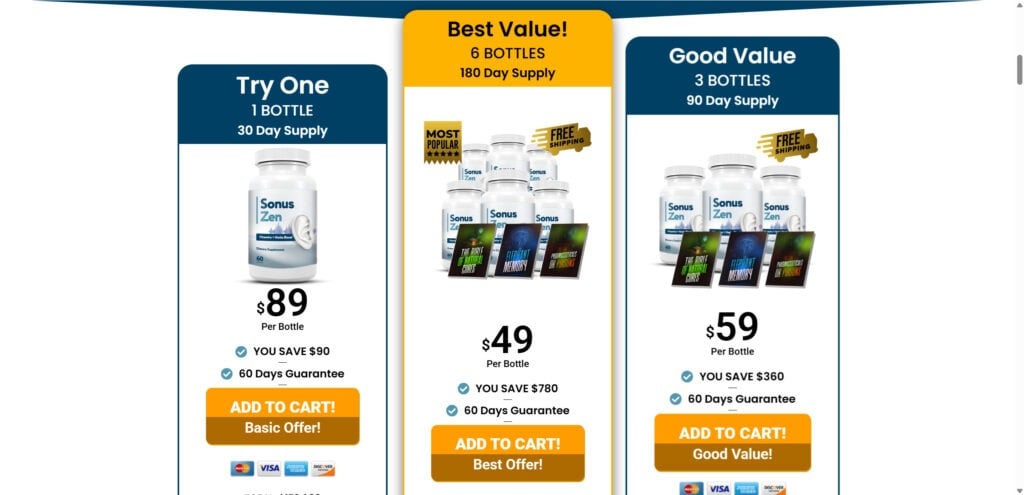
In the SonusZen sales flow you shared, the structure follows a classic pattern:
- A single bottle option priced high at $89
- A three-bottle option priced lower per bottle at $59
- A six-bottle option labeled “Best Value” at $49 per bottle
- A 60-day guarantee message attached to all options
This is not just discounting. It is behavioral design.
Here is what it accomplishes:
It makes caution feel expensive.
If you want to “try it,” you are punished with the highest per-bottle price.
It makes commitment feel rational.
The “best value” option looks like a responsible decision, even if it is hundreds of dollars.
It uses visual hierarchy to steer attention.
The middle offer is often brighter, larger, or marked as “most popular.”
And it reframes the decision.
Instead of “should I buy this,” you are choosing “which deal should I take,” which is a very different mental process.
You can see similar discount framing on campaign pages that emphasize limited-time “$49 per bottle” pricing.
Step 8: Checkout infrastructure that can obscure who you are really buying from
The checkout experience is often where buyers get surprised later.
Not necessarily because the checkout is technically unsafe, but because it can be detached from a clear, established merchant identity.
Many supplement funnels use third-party checkout platforms.
One platform that appears frequently across these campaigns is Cartpanda, which markets itself as infrastructure for selling products online, including supplements.
Some Cartpanda-hosted checkout pages explicitly state that the purchase may appear on your bank statement under “Cartpanda,” and that you are buying through that system, not necessarily through a familiar retail brand.
Why this matters:
- It can make it harder to recognize the charge later.
- It can complicate customer support if you do not know which entity handles refunds.
- It can enable rapid cloning of funnels, since a checkout template can be reused for many products.
This does not automatically mean “fraud,” but in combination with fake news pre-landers and cure-like promises, it becomes another strong red flag.
Step 9: Post-purchase pressure and refund friction
After the purchase, many buyers report a familiar experience across scam-style supplement funnels:
- A flood of confirmation emails and upsell offers
- Pressure to “stick with it” for months to see results
- Confusing return steps, often requiring you to email support and wait
- Partial refund offers instead of full refunds
- Complicated “unused bottles only” terms
Even when a site advertises a 60-day guarantee, the practical reality can depend on who answers support and what return conditions are enforced.
This is one reason these funnels push multi-bottle orders so hard. The more you buy upfront, the harder it feels to unwind the purchase later.
Step 10: Why this model keeps showing up
If you step back, the business logic becomes clear.
A scam-style health funnel does not need a product that reliably works.
It needs:
- Cheap traffic from viral ads
- A persuasive narrative that converts quickly
- High average order value from bundle steering
- Just enough “guarantee” language to reduce hesitation
- A support process that discourages refunds through friction
That is why the marketing details matter.
They are not decoration. They are the mechanism.
What To Do If You Have Bought This
If you purchased SonusZen after seeing these ads, you are not alone, and you are not foolish. These funnels are designed to work on normal human psychology, especially when someone is anxious about health.
Here is a practical, calm checklist that helps you protect your money, your accounts, and your health.
- Save everything nowTake screenshots of the ad, the landing page, the pricing page, the checkout confirmation, and any email receipts.Save the order number, the merchant name shown on the receipt, and any support email address provided.
- Check what name the charge uses on your bank statementLook at your card or bank transaction details and note the exact descriptor.If the charge name is unfamiliar, do not assume it is a separate fraud charge. It may be the payment processor or checkout platform used by the funnel. (Eight Supplements)
- Look for subscription languageSome funnels include optional subscriptions, continuity programs, or add-ons that can be easy to miss.Search your confirmation email for words like “subscription,” “auto,” “monthly,” “recurring,” “membership,” or “rebill.”
- Request a refund in writing, clearlySend a short message that includes:
- Your full name
- Order number
- Date of purchase
- A direct statement: “I am requesting a full refund under the 60-day guarantee.”
- If you do not get a clear response quickly, contact your card issuerIf support stalls, refuses, or offers only partial refunds, call your bank or credit card company.Explain that you purchased based on misleading advertising and that you attempted to resolve it with the merchant. Ask about dispute or chargeback options.
- Monitor your account for additional chargesCheck for:
- Multiple transactions
- Separate charges days later
- Charges that match an “upsell” you do not remember accepting
- If the product has not shipped yet, request cancellationMany companies can cancel before fulfillment, but only if you act quickly.Ask for written confirmation that the order is canceled and that no further charges will occur.
- If you already received the product, document the conditionTake photos of:
- The package
- The bottles
- Any paperwork included
- If you took the supplement and feel unwell, stop and talk to a clinicianSupplements can interact with medications or medical conditions.If you have side effects, stop using it and speak to a qualified healthcare professional, especially if you take prescription meds or have chronic health issues.
- Report the ad if it used fake news branding or medical promisesYou can report deceptive ads directly inside the social platform.You can also submit a complaint to consumer protection authorities. In the U.S., the FTC collects reports on deceptive marketing practices.
- Reset your expectations about tinnitus treatmentIf you bought SonusZen out of desperation, it may help to ground yourself in what reputable sources say.There is currently no cure for tinnitus, but there are evidence-based approaches that reduce distress and improve quality of life.
- Protect yourself from follow-up scamsOnce you engage with one health funnel, you can be retargeted by many more.Be cautious about new ads that promise a different “secret” cure, especially those that copy the same fake-news format.
The Bottom Line
SonusZen is being pushed through a classic scam-ad playbook: fear-driven social videos, fake news-style pages that borrow trust, a “secret ingredient” hook that never truly delivers, and sales pages engineered to steer you into expensive bundles.
The biggest red flag is not one line of copy. It is the entire structure: bold cure-like promises for tinnitus and mental clarity, wrapped in borrowed authority and urgency, without the kind of independent, verifiable evidence a claim like “eliminating tinnitus” would require.
If you already bought it, focus on documentation, refund steps, and protecting your payment accounts. If you are still deciding, the safest move is to step out of the funnel, talk to a professional about tinnitus management options, and only trust products that can stand up to independent scrutiny, not just persuasive storytelling.