

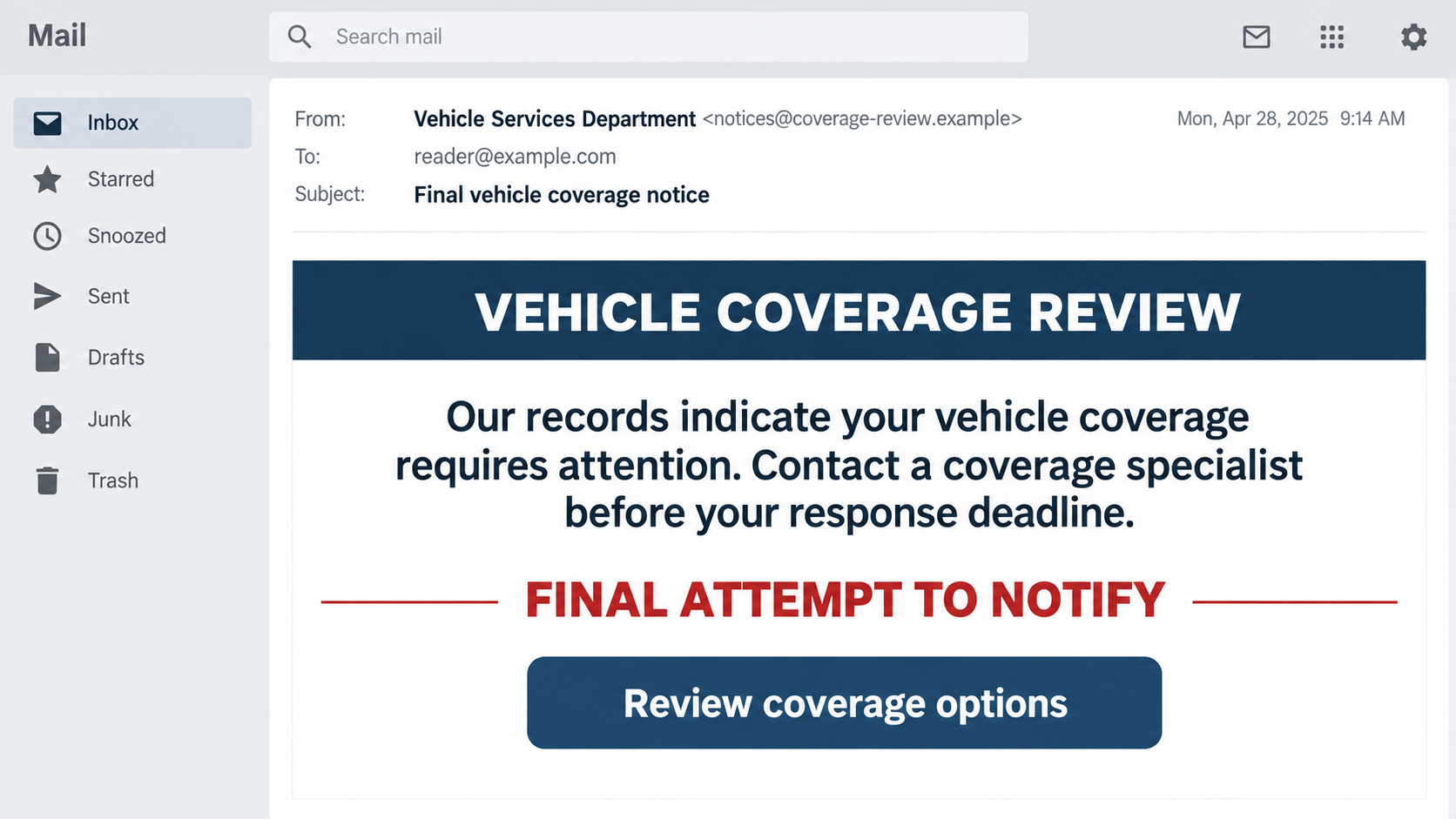
A notice says your vehicle coverage needs attention. The name sounds like a department connected to your car, and the response deadline makes it feel like paperwork you should have handled already.
Before calling back, take a closer look at who is asking. Searches for the Vehicle Services Group scam bring together two issues that need separating: confirmed company impersonation and misleading vehicle warranty pitches.
Overview
A real company has warned about unauthorized callers
Vehicle Service Group, usually shortened to VSG, issued a June 2026 impersonation warning. It says unauthorized individuals have claimed to represent the company in telemarketing calls, including calls to people on the National Do Not Call Registry.
The notice identifies 800-640-5438 as a VSG number misused as a callback number. That is not evidence that the legitimate number’s owner is committing fraud. The warning also describes possible number spoofing and misuse of company or employee names.
VSG says it does not make telemarketing calls to individual consumers and has not authorized the callers. Its published verification contacts are 1-812-273-1622 and info@vsgdover.com. Check the company’s official warning independently before using contact details supplied by a caller.
A familiar-sounding department is not proof of a relationship
Names such as Vehicle Services Group, Vehicle Service Department, and Vehicle Services Division can sound official without identifying the legal seller. A generic department label does not tell you who holds a contract, administers claims, or receives payments.
Do not assume every variation belongs to VSG or to one criminal network. The specific impersonation warning establishes misuse of the real company’s identity. A separate warranty advertisement must be assessed from its own statements and paperwork.
That assessment should focus on whether the sender falsely claims a relationship with your manufacturer or dealer, misrepresents existing coverage, or pressures you to pay before explaining the proposed contract.
The practical risk is paying before understanding the offer
A vehicle warranty and a separately purchased service contract are not the same thing. Some independent contracts are legitimate. The problem is a seller presenting an optional purchase as an urgent obligation or using another company’s identity to obtain trust.
- A supposed expiration notice does not prove your current coverage is ending.
- A caller knowing your vehicle model does not establish dealer authorization.
- A familiar telephone number does not authenticate an incoming call.
- A deposit request should not come before a readable contract.
- An official-sounding department name should lead to an identifiable business.
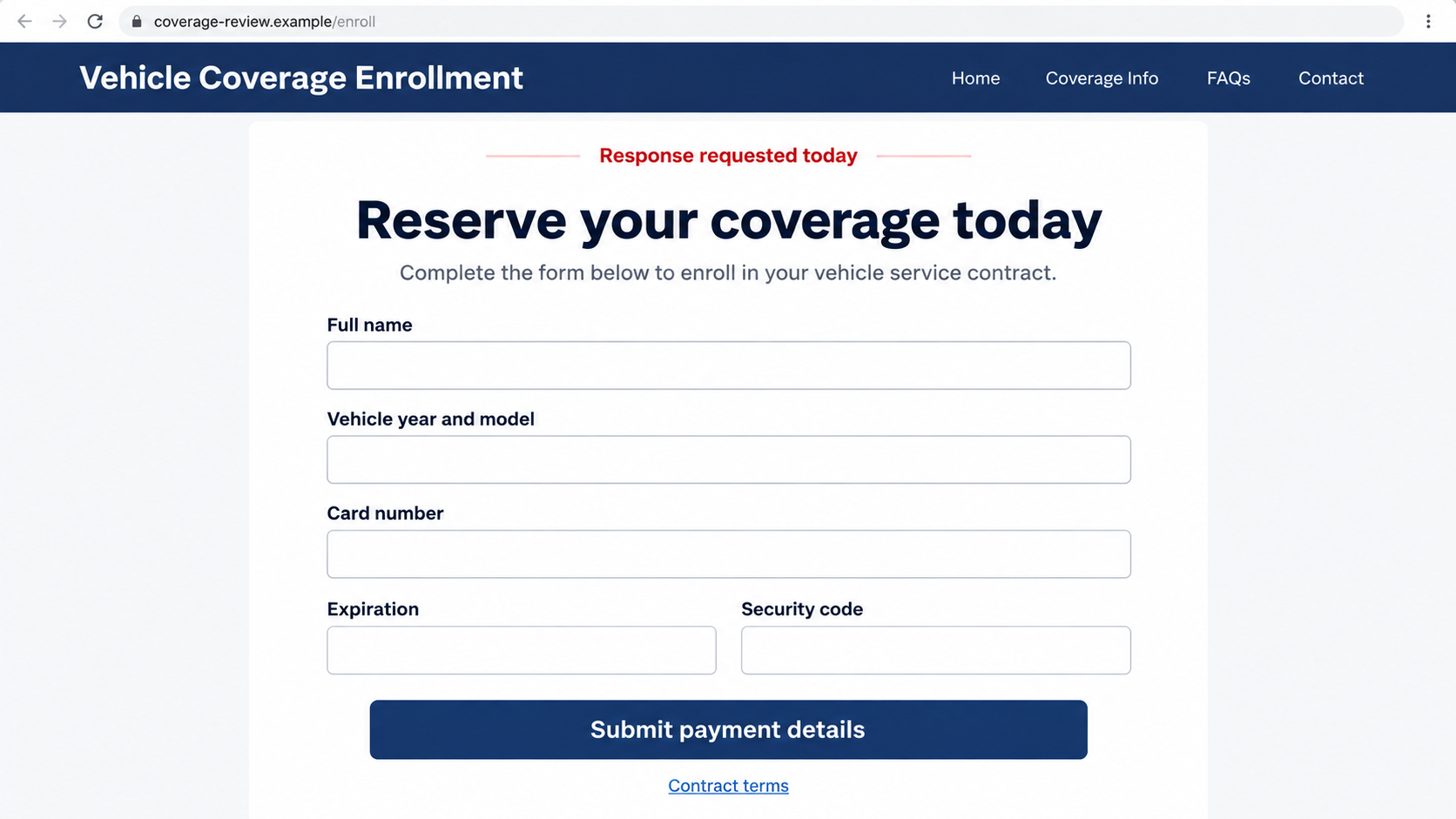
The images in this article reconstruct a generic coverage notice and enrollment page. They use fictional addresses and illustrate the sales pressure being discussed. They are not captures of VSG communications or evidence linking a particular website to the impersonators.
The Difference Between Coverage and a Sales Pitch
Start with the paperwork you received when you bought the car. A manufacturer’s warranty normally defines coverage by time, mileage, and particular systems. A separate service contract has its own provider, price, exclusions, and claims process.
The FTC’s guide to auto warranties and service contracts explains that an optional service contract is a separate purchase. It also warns about messages that imply a connection to your dealer or manufacturer while pushing an urgent sale.
You may genuinely be approaching the end of existing coverage. That does not give an unknown caller authority over the decision. A true fact about the vehicle can be used to sell an unrelated product.
A useful offer should survive basic questions. Who is the legal seller? Who decides whether a repair is covered? What will the entire agreement cost? Can you read it before providing payment details?
If the response is that these answers are only available after enrollment, pause. You are being asked to agree before seeing the thing you would be buying. A friendly conversation cannot substitute for the actual terms.
How the Vehicle Services Group Scam Works
Step 1: An official-sounding name creates a connection
The contact presents itself as a vehicle-related office, department, or service group. The name encourages you to assume it already has a role in your ownership records, even if you have never agreed to deal with it.
In the confirmed VSG impersonation issue, the company specifically says callers have falsely represented it. In other warranty pitches, the claimed connection may instead be to a manufacturer, dealership, or administrative department.
Those claims should be checked separately. Do not merge them into a single allegation about everyone using similar words. Write down the exact business name, number, and relationship asserted in your own message.
Step 2: A deadline makes verification feel risky
The message may frame its offer as a final opportunity to avoid losing coverage. The effect is to make you worry that taking time to compare the proposal will leave you personally responsible for a major repair.
A deadline on a marketing notice is not necessarily the expiration date in your warranty. Check the actual agreement and ask your dealer or manufacturer about coverage through a contact route you already trust.
Also distinguish a safety recall from a paid coverage offer. If the message raises a safety concern, investigate it with the manufacturer rather than purchasing a contract to make the warning go away.
Step 3: The conversation gathers vehicle and payment information
An agent may ask about your vehicle, mileage, and ownership. Such questions can be normal when obtaining a legitimate quote, but they do not establish who is collecting the answers or why.
Do not correct an unknown caller’s incomplete records with a full set of your own details. If the caller claims an existing relationship, ask them to identify it, then verify independently without volunteering additional information.
A request for banking passwords or a one-time login code is not a normal way to price vehicle coverage. Neither is a demand to install remote-control software so someone can complete enrollment for you.
Step 4: Payment is requested before the agreement is clear
The discussion may turn to securing a rate, reserving eligibility, or making an initial payment. A monthly amount can sound manageable while leaving the total commitment, number of payments, and cancellation process unclear.
The fictional enrollment image shows why a polished payment form is not enough. The important information is the complete agreement behind it, not how quickly the page can collect a card number.
Never infer that a plan is fraudulent simply because it offers online enrollment. Instead, ask whether the seller’s identity, payment terms, and coverage promises can be verified before money changes hands.
Step 5: The paperwork may not match the conversation
If documents arrive after payment, compare them with the promises made during the pitch. Record differences in the named business, covered components, deductible, waiting period, or claims authorization requirements.
A contract can be real yet materially different from what you thought you bought. That is a different problem from an impostor collecting money without any service. Describe the mismatch accurately when seeking help.
Do not assume every plan excludes the same repairs or that every claim will fail. The actual contract controls what was promised in writing. Your evidence should show the specific terms and statements relevant to your purchase.
Step 6: Confusion can delay cancellation or a dispute
You may discover that the telephone seller, contract administrator, and card statement merchant have different names. That can happen in legitimate arrangements, but the relationship should be explainable and documented.
When it is not, consumers can lose time calling the wrong company. Keep the original notice, receipt, agreement, and transaction descriptor together so you can identify which party received payment and which one claims responsibility.
Act promptly if you want to cancel or challenge a misrepresentation. Do not wait for a future repair to test a contract you already believe was sold under false pretenses.
Company, Contact, and Contract Checks
The legal seller should have a name you can verify
Ask for the full business name rather than accepting a department label. Compare it with the agreement, receipt, and payment descriptor. If several companies are involved, ask what each one does.
A registration record can establish that a business exists, but it does not authenticate the person calling you. Verify contact information independently. An impostor can borrow the details of an entirely legitimate company.
An address should explain where notices belong
Read the address for cancellation or formal correspondence in the actual agreement. A mailing address is not automatically a headquarters, claims office, or proof that the caller operates there.
You do not need to visit an address or confront anyone. Preserve the information and use documented channels. If the seller gives conflicting instructions, request clarification in writing before sending sensitive material.
Support must be distinct from a pressured sales call
Ask for a customer-service route you can use after reviewing the paperwork. A salesperson’s urgency should not prevent you from contacting the named administrator or checking whether the dealer recognizes the claimed relationship.
If the pitch uses the VSG name, the company’s published impersonation warning is the appropriate starting point. Do not use the suspect caller as the intermediary who supposedly verifies their own authority.
The promised coverage should be traceable to the contract
Identify the administrator, claims instructions, covered components, exclusions, and payment schedule. Ask how a repair shop gets authorization and what you might owe before a repair is approved.
Keep answers tied to the document rather than broad phrases such as complete protection. A salesperson describing a plan enthusiastically does not tell you whether the particular repair you are concerned about is included.
Questions Worth Asking Before Buying Any Plan
Put your questions in a short checklist and keep the answers with the proposed agreement. This makes it easier to compare offers without getting pulled back into a sales script.
- What is the full cost, including the initial payment and later installments?
- Does this duplicate coverage I already have?
- Which business authorizes a claim and pays the repair facility?
- Where are the exclusions and cancellation instructions written?
- What happens if I sell the car before the agreement ends?
- Can I take time to ask my usual repair shop about the proposal?
Do not treat a refusal to answer as something you need to overcome by being more cooperative. A buyer needs enough information to make a decision. You can simply decline an offer that does not provide it.
Keep expectations realistic about call blocking as well. Blocking a number may reduce repeat contact from that number, but it does not prove future calls are safe. Impersonators can change the numbers they display.
What to Do if You Have Fallen Victim to This Scam
- Stop dealing with the unsolicited caller.
Do not send another payment to activate a refund, maintain eligibility, or close a supposed account. Save the call details and return to your own paperwork before deciding which organization to contact.
- Determine whether a contract was actually purchased.
Locate the receipt, agreement, payment schedule, and legal seller’s name. If you received no paperwork, record that fact. If documents exist, compare them with the specific coverage and affiliations claimed during the sale.
This helps distinguish a billing dispute, a misleading sale, and straightforward impersonation. You do not need to solve the entire case before contacting your payment provider.
- Request cancellation through the documented channel.
Follow the agreement’s cancellation instructions if there is a genuine identifiable provider. Send a clear written request, keep delivery records, and ask for confirmation of the effective date and any refund calculation.
Do not assume a universal cancellation window applies to every contract. Terms and applicable rules can differ. If the seller obstructs cancellation or the instructions conflict, preserve the evidence and seek consumer-protection assistance.
- Contact your card issuer or bank promptly.
Explain whether the payment was unauthorized or whether you authorized it because of specific false statements. Provide dates, amounts, the merchant descriptor, and cancellation evidence. Ask about the available dispute process and its deadlines.
If payment details were exposed to an impostor, ask about replacing the card and controlling further charges. Stopping a payment and cancelling a real contract are not necessarily the same action.
- Secure any credentials or identity information you disclosed.
Change an exposed password wherever it was reused. If you supplied identity documents or sensitive identifiers, review the appropriate recovery steps at IdentityTheft.gov. Monitor for accounts or activity you do not recognize.
- Check devices only if there was a digital exposure.
A nuisance warranty call does not itself infect your device. If you installed software or downloaded a suspicious attachment during the interaction, Malwarebytes can help inspect supported devices for malware and unwanted programs.
AdGuard may help block malicious advertising and known dangerous pages when you encounter online coverage pitches. It cannot determine whether a service contract suits your needs or recover a payment already sent.
- Report the relevant conduct with specific evidence.
Report impersonation or deceptive sales practices through ReportFraud.ftc.gov and your state consumer-protection office as appropriate. Include the exact name used, callback instructions, dates, and what was promised.
For unwanted calls, the FCC complaint center provides a reporting route. Explain when a number may have been spoofed rather than accusing its legitimate owner solely because it appeared on your screen.
- Keep checking for follow-up charges and refund impostors.
Review later statements and retain the cancellation confirmation. Someone contacting you unexpectedly with a guaranteed refund may be another impersonator. Verify them independently and never disclose a banking code to release a refund.
Frequently Asked Questions
Is the real Vehicle Service Group behind these calls?
VSG’s June 2026 warning says the impersonators are unauthorized and unaffiliated. It also states that the company does not make telemarketing calls to individual consumers. Do not blame the legitimate company for an unverified caller’s claim.
Does the number 800-640-5438 prove the call is genuine?
No. VSG identified that number as one being misused in callback instructions. Its appearance does not authenticate the caller. Consult the company’s official warning and verify through independently obtained contact information.
Are all extended vehicle service contracts scams?
No. Manufacturers, dealers, and independent businesses sell legitimate contracts. The concerns are false affiliation, misleading coverage promises, and pressure to pay before seeing the agreement. Assess the specific offer rather than the product category alone.
What if the caller knows the car I drive?
Vehicle information does not establish a relationship with your dealer or manufacturer. Do not volunteer additional details to fill gaps in the caller’s story. Check the claimed relationship through your own trusted records.
Can ignoring the notice cancel my existing warranty?
An unknown sender cannot establish that consequence merely by printing a deadline. Check your existing warranty terms and contact your dealer or manufacturer directly if concerned. Do not buy a separate plan just to satisfy an unverified notice.
Will I automatically get my payment back?
No outcome is guaranteed. Contact the seller where appropriate and your payment provider promptly, preserve evidence, and ask about cancellation and dispute options. Describe accurately whether you authorized the payment and what representations influenced that decision.
The Bottom Line
The Vehicle Services Group scam warning is about checking identity before trusting an official-sounding pitch. VSG has confirmed impersonation of its name, while unrelated warranty offers require their own careful review.
Verify existing coverage independently, read any proposed contract before paying, and keep the seller’s identity separate from the company it claims to represent. If you already paid, act on the documented transaction rather than continuing the caller’s conversation.








