

Win 7 Defender 2013 is a computer virus which will display fake security alerts,reporting that malware has been detected on your computer.This alerts are professional looking pop-ups and when you click on them, you are advised to buy Win 7 Defender 2013 in order to remove the detected threats.
In reality, none of the reported issues are real, and are only used to scare you into buying Win 7 Defender 2013 and stealing your personal financial information.
Apart from the bogus alerts,as part of its self-defense mechanism,Win 7 Defender 2013 has disabled the Windows system utilities, including the Windows Task Manager and Registry Editor,and will block you from running certain programs that could lead to its removal.Further more,this rogue antivirus has modified your Windows files associations and now,whenever you are trying to any programs that have a .exe extension ,Win 7 Defender 2013 it will display a bogus notification in which will report that the file is infected,in an attempt to scare you.
If your computer is infected with Win 7 Defender 2013,then you are seeing this screens:
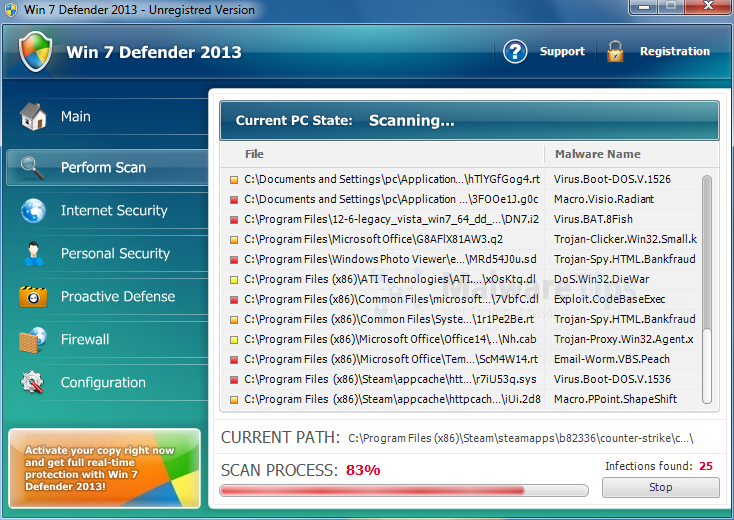
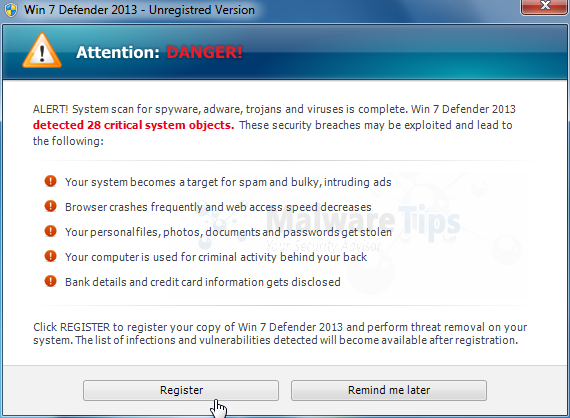
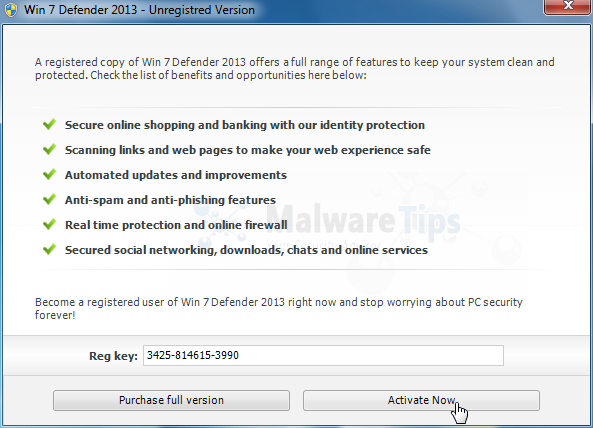
We strongly advise you to follow our Win 7 Defender 2013 removal guide and ignore any alerts that this malicious software might generate.
Under no circumstance should you buy this rogue security software as this could lead to identity theft,and if you have, you should contact your credit card company and dispute the charge stating that the program is a scam and a computer virus.
Registration codes for Win 7 Defender 2013
As an optional step,you can use the following license key to register Win 7 Defender 2013 and stop the fake alerts.
Win 7 Defender 2013 License Key: 3425-814615-3990
Please keep in mind that entering the above registration code will NOT remove Win 7 Defender 2013 from your computer , instead it will just stop the fake alerts so that you’ll be able to complete our removal guide more easily.
Win 7 Defender 2013 Removal Guide
STEP 1: Remove Win 7 Defender 2013 malicious files with Malwarebytes Anti-Malware
Malwarebytes Chameleon technologies will allow us to install and run a Malwarebytes Anti-Malware scan without being blocked by Win 7 Defender 2013.
- Download Malwarebytes Chameleon from the below link, and extract it to a folder in a convenient location.
Download Malwarebytes ChameleonOpens the download page in a new tab.
![[Image: Extract Malwarebytes Chameleon utility]](https://malwaretips.com/blogs/wp-content/uploads/mwt-media/b2/b265e12a96e5ac88c372b34158e04f937bacfee747f63c719f50a4771b7048e8/9809c2be34df15eae377a9982d27eae3d60d2cc1b556e7f1f9fa6be62f380051-374.webp "Extract Malwarebytes Chameleon utility")
- Make certain that your infected computer is connected to the internet and then open the Malwarebytes Chameleon folder, and double-click on the svchost.exe file.
![[Image: Double click on svchost.exe]](https://malwaretips.com/blogs/wp-content/uploads/mwt-media/d6/d67768b1c785b16a82c92c81bcce063bb5b8ad9c8f1e7edb48a80040f7e803a3/b05e0bf111c8d18f1c641cfb91f746b45de4454ba605ef516ccfa0ed7cdc5c99-662.webp "Double click on svchost.exe")
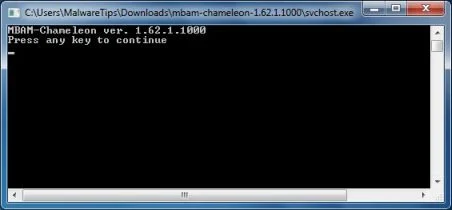
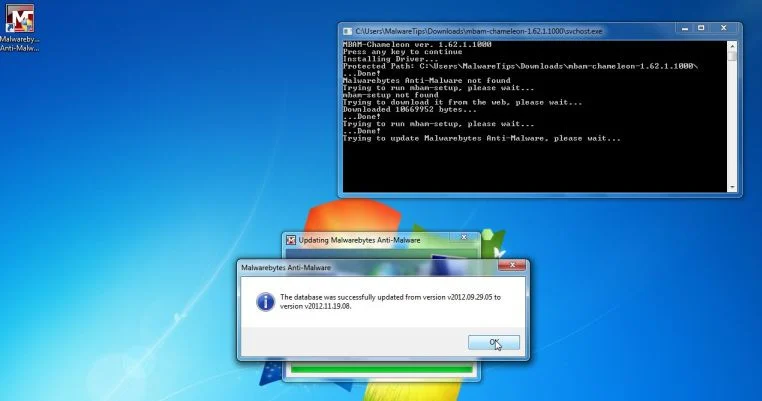
IF Malwarebytes Anti-Malware will not start, double-click on the other renamed files until you find one will work, which will be indicated by a black DOS/command prompt window. - Follow the onscreen instructions to press a key to continue and Chameleon will proceed to download and install Malwarebytes Anti-Malware for you.
- Once it has done this, it will update Malwarebytes Anti-Malware, and you’ll need to click OK when it says that the database was updated successfully.
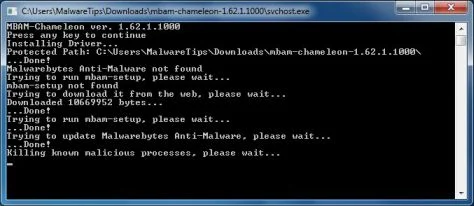
- Malwarebytes Anti-Malware will now attempt to kill all the malicious process associated with Win 7 Defender 2013.Please keep in mind that this process can take up to 10 minutes, so please be patient.
- Next, Malwarebytes Anti-Malware will automatically open and perform a Quick scan for Win 7 Defender 2013 malicious files as shown below.
![[Image: Malwarebytes Anti-Malware scanning for Win 7 Defender 2013]](https://malwaretips.com/blogs/wp-content/uploads/mwt-media/f6/f6ecfba43df64204df40586070483f260cb91fa07d5cc90cb4c3a588d159ff30/5b6b2687853201a40d29fe27e142cc66b0852745bbad3900a21030a10399cb4c-521.webp "Malwarebytes Anti-Malware scanning for Win 7 Defender 2013")
- Upon completion of the scan, click on Show Result
![[Image: Malwarebytes Anti-Malware scan results]](https://malwaretips.com/blogs/wp-content/uploads/mwt-media/84/84c62dd46289424dbc686abc53672cb0810111920c8c0bbd69e973844d0a9ab0/a4c04aa700e641f47afec9965f79ff346740668e5952955ccbe5b4c3658b5897-521.webp "Malwarebytes when the system scan has completed")
- You will now be presented with a screen showing you the malware infections that Malwarebytes Anti-Malware has detected.
Make sure that everything is Checked (ticked),then click on the Remove Selected button.
![[Image:Malwarebytes removing virus]](https://malwaretips.com/blogs/wp-content/uploads/mwt-media/d8/d86b6a8bac0e4ece9fd2d259a83db71487943f6b04b567edb0e9adcc3200f492/4eb94651b0e34cc99689c56dc71cd0a49444498ed05c5803ea55fda1cfee1b1f-521.webp "Click on Remove Selected to get rid of Win 7 Defender 2013")
- After your computer restarts, open Malwarebytes Anti-Malware and perform a Full System scan to verify that there are no remaining threats
STEP 2: Remove Win 7 Defender 2013 rootkit with HitmanPro
In some cases,Win 7 Defender 2013 will also install a rootkit on victims computer.To remove this rootkit we will use HitmanPro.
- Download HitmanPro from the below link,then double-click on it to start this program.
Download HitmanProOfficial Sophos download. Free scan, free 30-day trial to remove threats.
IF you are experiencing problems while trying to start HitmanPro, you can use the Force Breach mode.To start HitmanPro in Force Breach mode, hold down the left CTRL key when you start HitmanPro and all non-essential processes are terminated, including the malware process. (How to start HitmanPro in Force Breach mode – Video) - HitmanPro will start and you’ll need to follow the prompts (by clicking on the Next button) to start a system scan with this program.
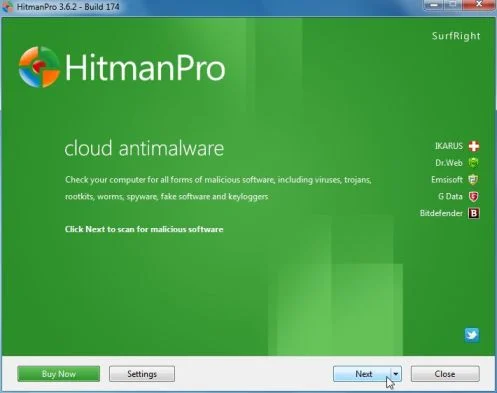
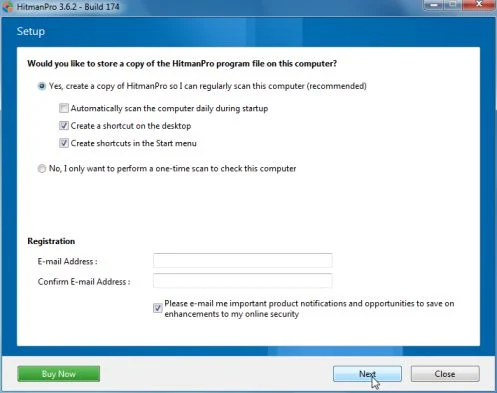
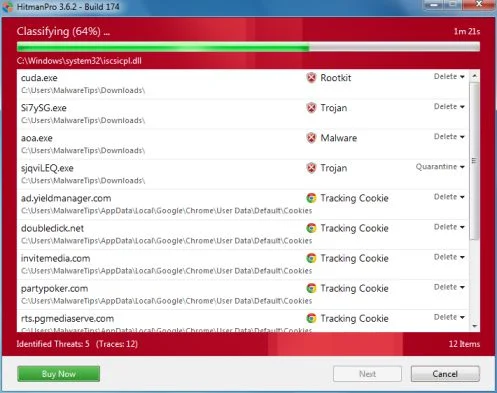
- HitmanPro will start scanning your computer for Win 7 Defender 2013 malicious files as seen in the image below.
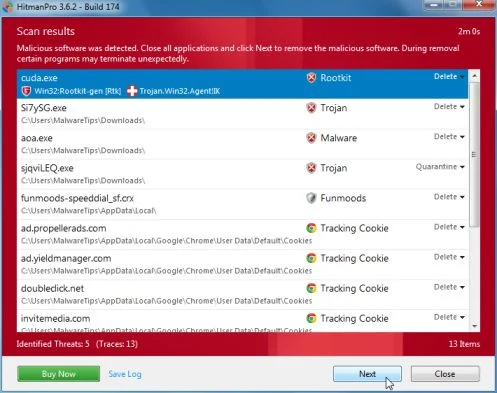
- Once the scan is complete,you’ll see a screen which will display all the infected files that this utility has detected, and you’ll need to click on Next to remove this malicious files.
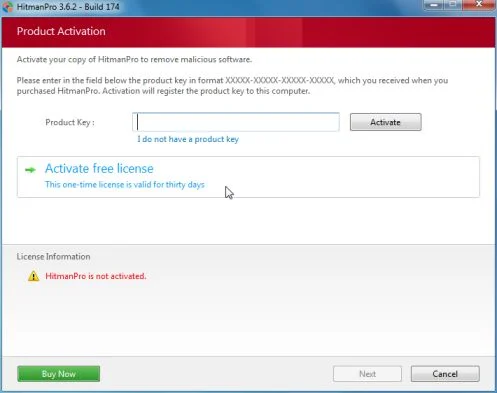
- Click Activate free license to start the free 30 days trial and remove all the malicious files from your computer.
STEP 3: Double check for any left over infections with Emsisoft Emergency Kit
- You can download Emsisoft Emergency Kit from the below link,then extract it to a folder in a convenient location.
Download Emsisoft Emergency KitOpens the download page in a new tab. - Open the Emsisoft Emergency Kit folder and double click EmergencyKitScanner.bat, then allow this program to update itself.
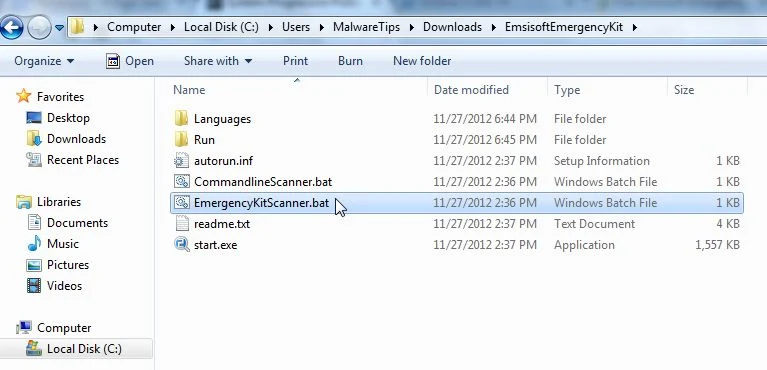
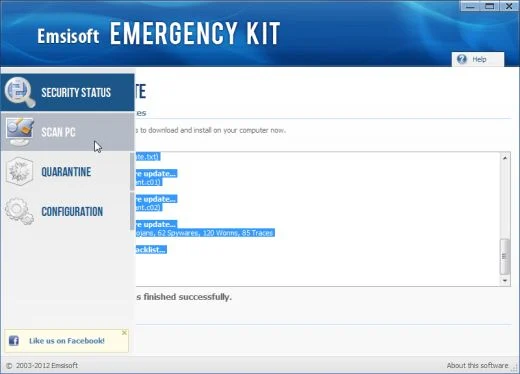
- After the Emsisoft Emergency Kit has update has completed,click on the Menu tab,then select Scan PC.
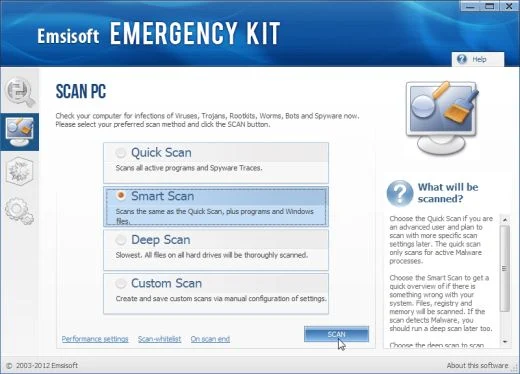
- Select Smart scan and click on the SCAN button to search for Win 7 Defender 2013 malicious files.
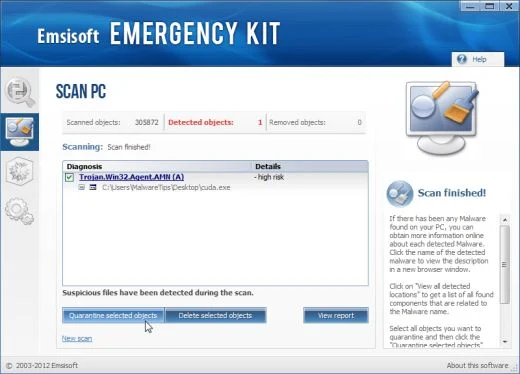
- When the scan will be completed,you will be presented with a screen reporting which malicious files has Emsisoft detected on your computer, and you’ll need to click on Quarantine selected objects to remove them.

Join the discussion
37 commentsShare your experience or ask a question about this article.
Discussion
Hello Marie,
Can you download all the software on a clean computer and transfer them to the infected PC?
The steps just worked great for me. Followed all the steps from 1 to 6.
But one problem, when i tried to use the activation key, Win 7 Defender 2013 License Key: 3425-814615-3990 it did not work and got Invalid Key error. Even in Safe Mode.
I couldn’t get browser to run in Safe Mode.
Work around: downloaded all the programs on a different machine. Copied them over to the infected machine while being in Safe Mode.
Tip: If you couldn’t get Windows Explorer to run, try and use my documents or any folder option in Start Menu. It worked for me to browse the USB and copy over the files to desktop for easy access.
Thanks for the great article.
I performed all steps 1-7. I wan’t sure if I need to go through all of them, because right after step 4 everything seemed like it is back to normal, but I went ahead with step 5-7 just to be on the safe side. My computer works fine now, thank you very much for these detailed instructions.
Thanks Thanks Thanks I followed your instructions step by step and got my computer up and running again. This is the most difficult virus that I have ever encountered , and now it is gone.
Thank you Stelian for sharing your knowledge with us all out here on the www. Took me a long time and i did have to tweak a little but finally I have my computer free of the win7 defender virus. The first time I have ever had a virus on my computer….my first computer was in 1999, xo I guess that isn’t too bad really. I was running Nortons but it didn’t pick it up obviously. Thanks once again for your kindness sharing with us all. Jennifer
Hi, I am also having big problems with this virus. Have downloaded RKill onto a stick on a clean computer. Have then tried to open on infected computer and not able to connect to internet due to the Win7 Defender pop ups stating ‘Firewall Alert’
In reply to Rich
Hello Rich,
On the infected computer, right click on the Internet Explorer’s icon, or any other browser’s icon, and select Run As or Run as Administrator. If you are using Windows XP, you will be prompted to select a user and enter its password. It is suggested that you attempt to login as the Administrator user. For Windows 7 or Windows Vista, you will be prompted to enter your Administrator account password. This should allow your browser to open where you can then download Rkill from the above link and save it to a folder that your infected account can access.
I havent got internet connection , but i have downloaded rkill , registryfix and anti malware on my usb and transfer it to my infected computer. When i do the virusscan it stops with downloading at around 80.000 objects. I have deleted 25 objects ,but the virus is stil coming. And when i start the normal modus i get a blue screen and the pictures become white. by started rkill it said :You should now be able to run your normal security programms so that you can scan for computer infections ………………. …………….. please help
In reply to Michael
Hello Michael,
You most likely have a nasty rootkit installed on this machine.Can you please transfer onto the infected computer RogueKiller and run a scan with this product:
RogueKiller Download Link (This link will automatically download RogueKiller on your computer)
Thank you a lot Stelian. Your method worked wonders!! Saved my Christmas day. Very accurate, everything worked perfect.
As for Rkill the name that worked for me was Rkill.com as iExplorer.exe ended with .exe and triggered again Windows Defender 2013 alert.
Thank you a lot.
Many thanks! Instructions were easy enough to follow, the pictures with the red arrows helped when I was unsure. Thanks again! But do I have to keep the reports from the software downloaded though?
In reply to Roxanne
Hello Roxanne,
You can delete the reports and uninstall any tools that we’ve used in this guide!Stay safe!
thank you bro, my problem solved. i’am from indonesia
Stelian….THANKS man!!
Awesomee !!!!! Arriba Barcelona que no ni no!!
Merry Christmas and Happy new Year!!!!
Hi there, merry xmas…i am trying to follow ur list to remove win 7 dfender but I am not able to open internet .it won.t allow me…so I am stuck…don.t know what to do now..can.t.use.my.laptop..Please help me ..need to ,now hoe download the links to get rid of this win 7….hopr to hear from you
In reply to anita
Hello Anita,
You’ll need to download Rkill on a clean computer and then transfer the program to the infected computer. You can transfer the files via a CD/DVD, external drive, or USB flash drive.
Run it and then you’ll be able to download Malwarebytes to perform the removal guide.
In reply to Stelian Pilici
I had to go through every step but I am up and running again!!! THANKS!!!!!
Thank you very much….clear, easy to understand instructions which seems to have worked perfectly!
this actually helped. big time. i get rid of that stupid win7 defender virus. thanks a million. you are a lifesaver. i believe this article has helped a lot of people as well.
one question though. is it safe to remove anything we installed during this process, like, for example the registryfix? especially the registryfix. just curious. thanks again! :)
In reply to Amirul M
Hello Amirul,
Yes, you can delete the registryfix.reg and uninstall any of the tools that we’ve used in this removal guide.
Stay safe!
I had the win defender virus and used your excellent instructions to remove it.
Although i consider myself not to have a lot of computing knowledge the instructions were easy to follow and extremely successful…Many Thanks
Stelian thanks so much. Followed your steps and took care of this virus. Had to use a “clean” computer and save the registry files on a flash drive to transfer them to the infected computer. Even with my limited computer abilites, was easy to do. Took a little while to run all the scans but it is fixed! Thank you!
thank you so much!this guide was the only one that really worked.
Thanks Stelian
Awesomee!!10x!
Thank you so much. It’s nice to know that while the world is full of so many losers with nothing better to do than develop viruses and malware to cause harm to others, there are also others who go out of their way to help. I followed the instructions (up to step 6 right now) and by step 4 I was already able to start up my computer normally and run IE without any obvious issues. Since I was unable to connect to the internet with my affected computer to download the registry fix and rkill files needed in steps 2 and 3, I just copied them to a flash drive from my unaffected computer and dragged them to the desktop of my infected computer to run them (in safe mode). After that I was able to run IE to install and run Malwarebytes program. That took about an hour to run and detected 13 infected files. Not sure if I needed to go any further but I did run HitmanPro which found 24 suspicious files in my cookies folder that were deleted and am running RogueKiller now. Thank you again!
I followed your instructions all worked great thanks!