

The Wolverine FLL Club email or text message or text message scam is a scam that targets unsuspecting people with text messages claiming to offer them a generous donation from the winners of a $1.05 billion Mega Millions jackpot. The scam is designed to trick people into revealing their personal information and paying fees to claim their fake winnings. Here is what you need to know about this scam and how to avoid it.
The Wolverine FLL Club Scam: What is it and How does it work?
The Wolverine FLL Club email or text message scam is based on a real event that happened in January 2021, when four members of a lottery club in Michigan won the third-largest lottery prize in US history. The winners, who called themselves the Wolverine FLL Club, chose to remain anonymous and claimed their prize through a lawyer. They also announced that they planned to stay humble and pay it forward through charitable giving.
However, some scammers decided to exploit this story and use it as a bait to lure people into their trap. They started sending text messages to random phone numbers, pretending to be the Wolverine FLL Club and offering them a donation of $3,600 to $20,000 each. The text messages included a link to a YouTube video that showed the real winners’ interview. The scammers claimed that the recipients were randomly selected after a spin ball and that they only needed to send their name, address and a picture of their ID to verify their identity and claim their winnings.
Of course, this was all a lie. The scammers had no connection to the real winners and had no intention of giving away any money. Their goal was to collect personal information from the victims and use it for identity theft or other fraudulent purposes. They also asked for fees or taxes to process the payments, which they never sent. Some victims reported losing hundreds or thousands of dollars to this scam.
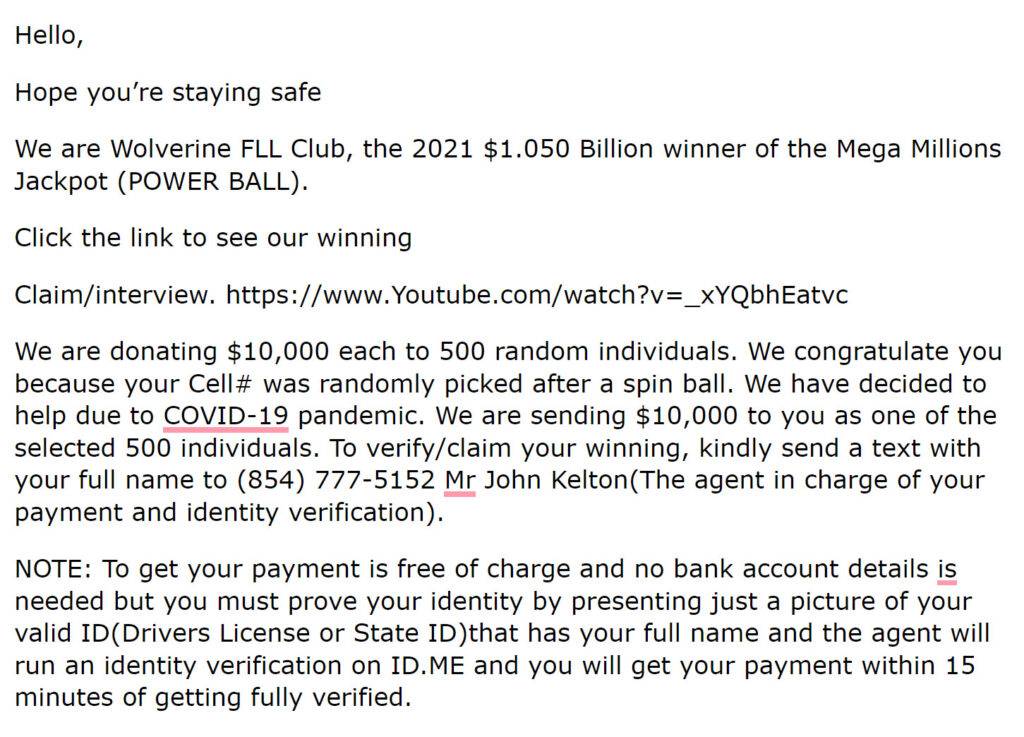
Here is how the Wolverine FLL Club email or text message scam looks:
Hello,
Hope you’re staying safe
We are Wolverine FLL Club, the 2021 $1.050 Billion winner of the Mega Millions Jackpot (POWER BALL).
Click the link to see our winning
Claim/interview. https://www.Youtube.com/watch?v=_xYQbhEatvc
We are donating $10,000 each to 500 random individuals. We congratulate you because your Cell# was randomly picked after a spin ball. We have decided to help due to COVID-19 pandemic. We are sending $10,000 to you as one of the selected 500 individuals. To verify/claim your winning, kindly send a text with your full name to (854) 777-5152 Mr John Kelton(The agent in charge of your payment and identity verification).
NOTE: To get your payment is free of charge and no bank account details is needed but you must prove your identity by presenting just a picture of your valid ID(Drivers License or State ID)that has your full name and the agent will run an identity verification on ID.ME and you will get your payment within 15 minutes of getting fully verified.
What to do if you have fallen victim to the Wolverine FLL Club email or text message scam?
If you have received a text message from the Wolverine FLL Club email or text message scam, do not reply or click on any links. Delete the message immediately and block the sender’s number. If you have already responded or provided any information or money to the scammers, you should take the following steps:
- Contact your bank or credit card company and report any unauthorized transactions or charges. Ask them to freeze your accounts or cancel your cards if necessary.
- Contact the three major credit bureaus (Equifax, Experian and TransUnion) and place a fraud alert on your credit reports. This will make it harder for the scammers to open new accounts in your name.
- File a complaint with the Federal Trade Commission (FTC) at https://reportfraud.ftc.gov/. This will help them track down and stop the scammers.
- File a report with your local police department and get a copy of the report. This will serve as evidence if you need to dispute any fraudulent charges or claims.
- Use a browser-based content blocker, like AdGuard : Content blockers help stop malicious ads, Trojans, phishing, and other undesirable content that an antivirus product alone may not stop.
- Scan your device for malware. If you suspect your device might be infected with malware, you can run a free scan with Malwarebytes Anti-Malware Free.
Wolverine FLL Club email or text message scam: Final thoughts
The Wolverine FLL Club email or text message scam is one of many examples of how scammers use current events and emotional appeals to trick people into giving away their money and information. You should always be wary of any unsolicited offers or requests that seem too good to be true. Remember that legitimate lottery winners do not contact strangers or ask for fees or taxes to claim their prizes. If you have any doubts about an offer or request, do some research online or contact a trusted source before responding. Stay safe and protect yourself from scams.








