

Zappify is sold as a simple answer to a problem that can spoil any summer evening. Place the rechargeable lamp nearby, the advertising says, and its light and electric grid will create a mosquito-free space without sprays, odors, or complicated equipment.
The current product page looks polished, but the wider record tells a different story. A huge markup over generic hardware, sweeping performance claims, contradictory return terms, persistent checkout pressure, and overwhelmingly negative independent reviews make Zappify an offer shoppers should avoid.
Overview
The Zappify scam is a high-markup online sales operation built around rechargeable mosquito zappers and repellent accessories. The products are promoted through dramatic social media videos, polished lifestyle images, large discounts, seller-controlled testimonials, and promises that one compact lamp can protect a family from mosquitoes indoors or outside.
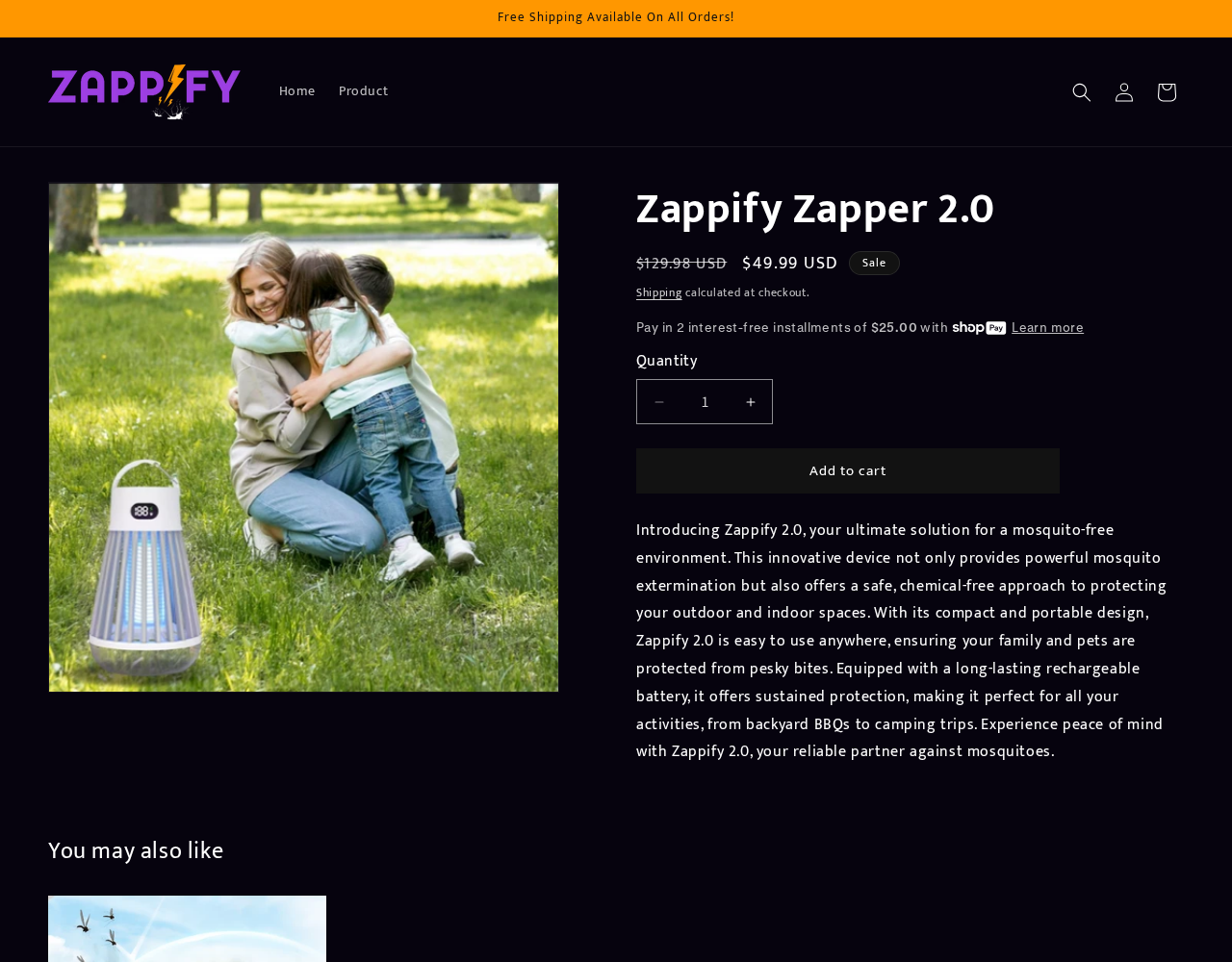
Zappify.com currently lists the Zappify Zapper 2.0 for $49.99 and displays a crossed-out price of $129.98. The page describes the device as an “ultimate solution” for a mosquito-free environment and says it provides powerful extermination with a safe, chemical-free design.
The FAQ says LEDs attract mosquitoes to an electric coil. It identifies a 2000mAh rechargeable battery and promises up to 14 hours of use. Another instruction recommends leaving the device on for two hours before using an area, claiming this will rid that space of all mosquitoes.
Those promises are much broader than the evidence provided. Zappify does not publish independent field trials showing that the retail unit eliminates mosquitoes from occupied rooms, patios, campsites, or backyards. It does not explain which species were tested, how many were captured, or how its results compare with professional traps that use additional attractants.
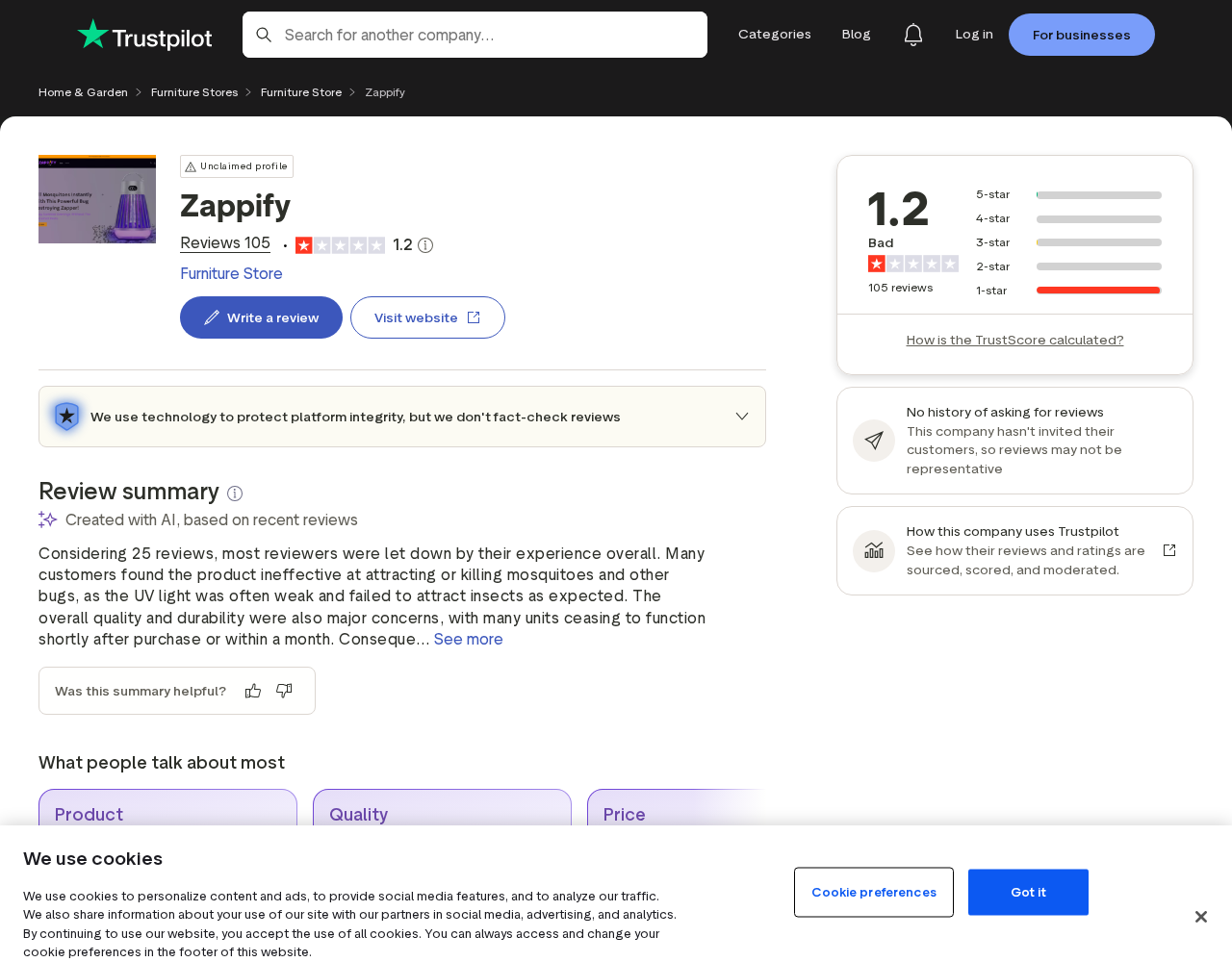
The independent customer record is exceptionally poor. As of August 6, 2026, Zappify’s Trustpilot page showed a TrustScore of 1.2 out of 5 from 105 reviews. The rating distribution displayed 98% 1-star reviews, and the profile was marked unclaimed.
Many reviewers report that the devices did not attract or kill mosquitoes as expected. Other recurring complaints describe weak light, short battery life, units that stopped charging, unexpected costs, slow delivery, difficult cancellation, return postage, and deductions from refunds.
MalwareTips does not recommend ordering Zappify. A small electric lamp may kill some insects that touch its grid, but that limited function does not justify the marketing promises, retail price, pressure tactics, or refund risk surrounding this product.
Zappify promises more than a small LED zapper can prove
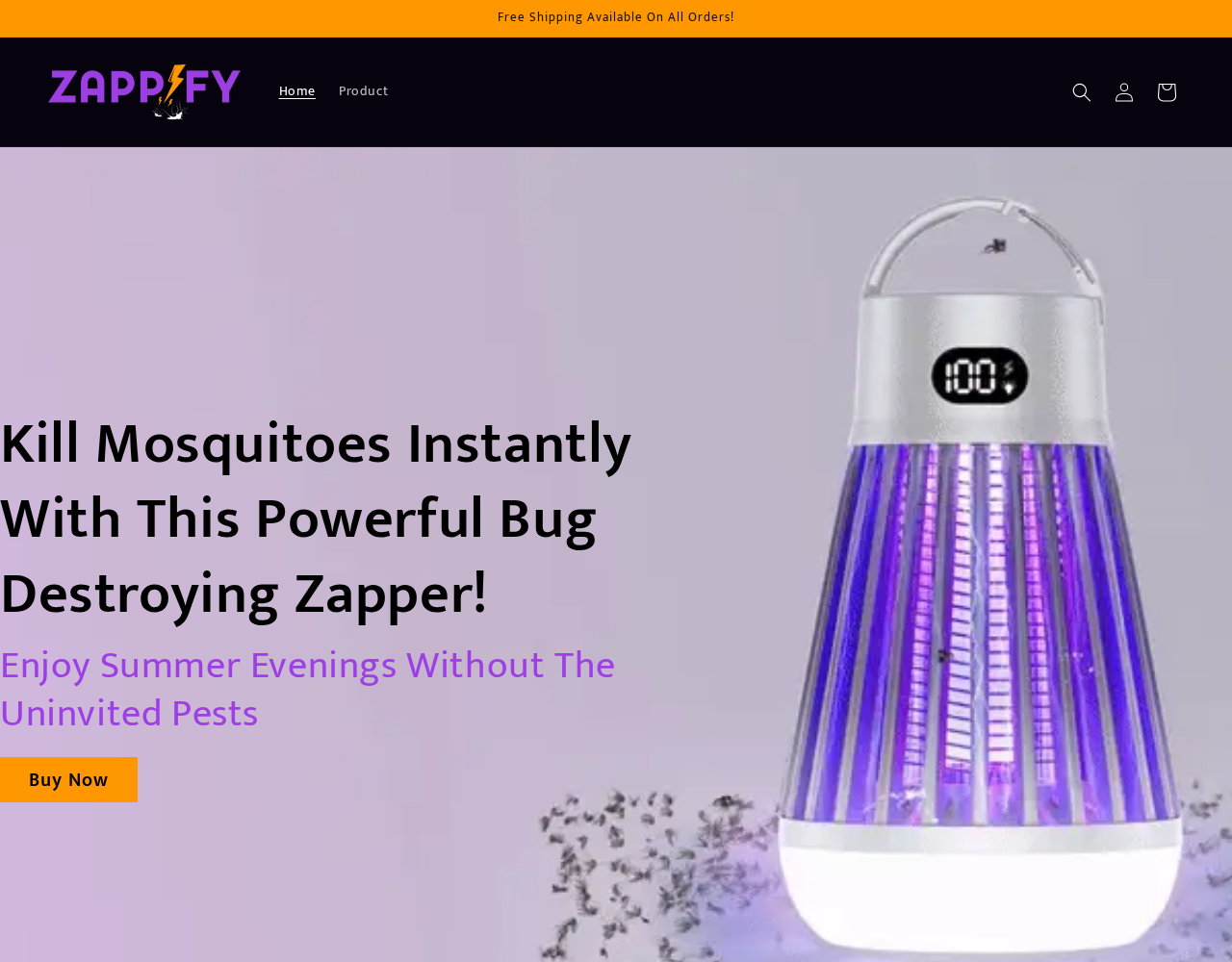
The current homepage tells shoppers they can “kill mosquitoes instantly” and describes the device as a powerful bug-destroying zapper. Another section says Zappify creates an effective 360° anti-mosquito shield that will remove unwanted pests once and for all.
The product page adds several specific promises:
- A safe, chemical-free way to protect indoor and outdoor spaces.
- LEDs that attract mosquitoes to an electric coil.
- A 2000mAh lithium rechargeable battery.
- Up to 14 hours of use on one charge.
- Portable use for barbecues, camping, bedrooms, and family activities.
- Easy cleaning with an included brush.
- Removal of all mosquitoes from an area after two hours of operation.
- A 30-day return policy.
Some of these are ordinary product features. A rechargeable battery, electric grid, LED, hanging loop, and cleaning brush are common in inexpensive mosquito-lamp products. The unsupported leap occurs when those basic components are presented as reliable protection against bites across a large or occupied area.
Professional mosquito traps use more than a glowing light
Mosquitoes do not all respond to one cue in the same way. Host-seeking females can react to carbon dioxide, human scent, heat, moisture, movement, contrast, and other signals, with important differences between species and environments.
The CDC mosquito surveillance guide says professional programs use attractants such as carbon dioxide, octenol, and human-scent lures to increase catches of female mosquitoes. CDC light traps are commonly paired with dry ice because it releases carbon dioxide.
A light can attract some flying insects and may catch some mosquitoes. That is not the same as proving that Zappify clears a space, prevents bites, or provides a protective shield around people who may be more attractive to mosquitoes than the lamp.
A responsible performance study would compare equivalent occupied spaces, count mosquitoes by species and sex, measure bites or landings, disclose environmental conditions, and repeat the experiment. Zappify provides lifestyle marketing and testimonials instead of that level of evidence.
The Trustpilot record contradicts the seller’s confident testimonials
The Zappify store includes enthusiastic quotes from people presented as satisfied users, including a testimonial attributed to an environmentalist. These endorsements appear on the seller’s own page and do not provide order verification or a link to an independent testing record.
Trustpilot shows a very different pattern. The page had 105 reviews and a score of 1.2 out of 5 when captured. Its summary of recent reviews said customers frequently found the product ineffective at attracting or killing mosquitoes, while also reporting weak UV output, poor durability, and units that failed shortly after purchase.
Individual reports describe consistent themes. One reviewer said a three-unit order included a faulty device and a weak light. Another said a promised 10-hour battery lasted roughly 45 minutes. Several buyers wrote that their lamps caught no mosquitoes, stopped charging, or became unusable within a short period.
Billing and checkout complaints are also important. Reviewers describe extra shipping or insurance costs, difficulty canceling after a rapid checkout, and money lost to return postage or deductions. These reports are user allegations, not findings by MalwareTips, but their consistency and overwhelming rating pattern deserve serious weight.
The wholesale market shows how inexpensive this product category can be
The Alibaba comparison provided to MalwareTips shows generic rechargeable camping lights with mosquito-killing grids offered from $4.80 to $6.80 at wholesale. Some include a front flashlight, hanging handle, solar or USB charging, electric grid, and cleaning brush.
The pictured orange units are not identical to the current white and purple Zappify Zapper 2.0. The image does not establish Zappify’s exact supplier or factory cost. It does show that portable light-and-grid mosquito lamps are common, low-cost products rather than rare inventions.
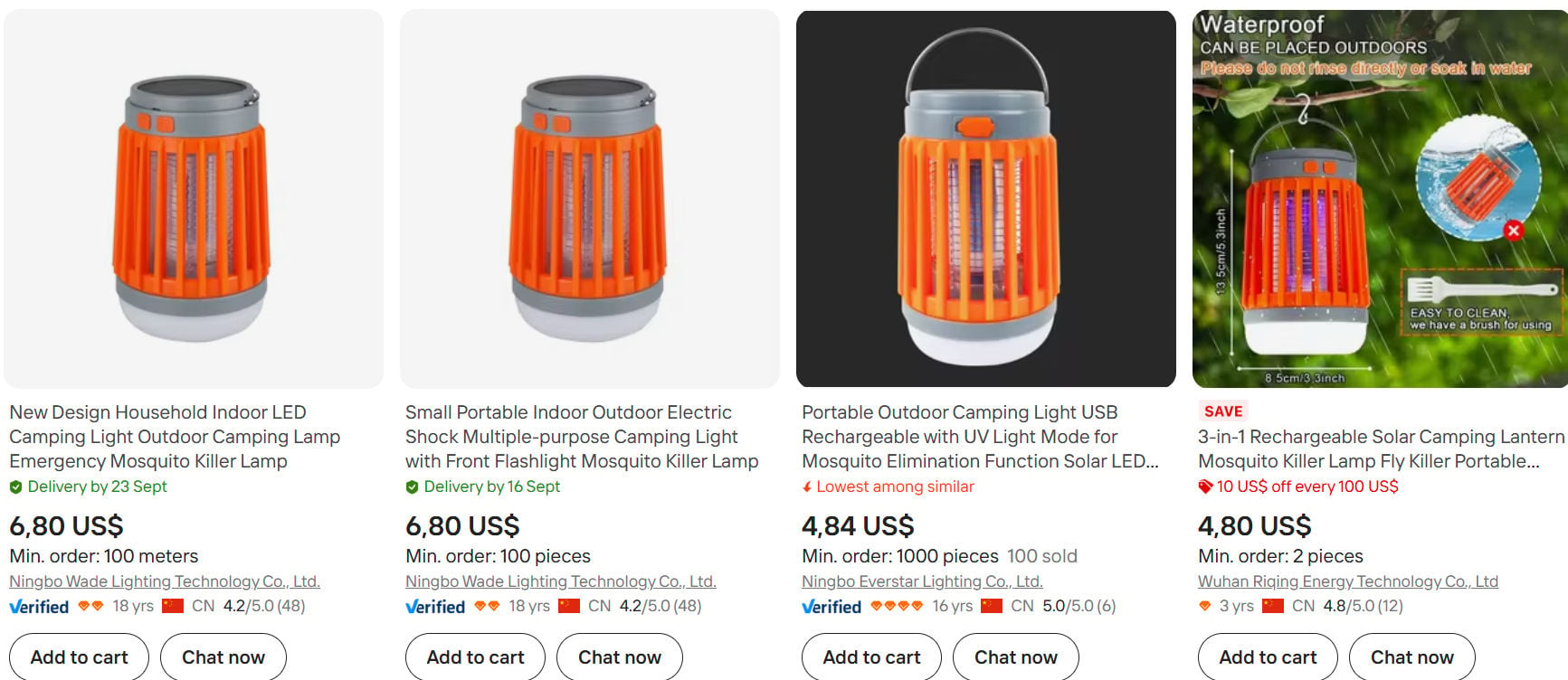
Zappify sells its current unit for $49.99 and says the normal price is $129.98. Even allowing for a different housing, battery, fulfillment, advertising, and customer support, the gap is large enough that buyers should demand strong independent proof of performance and quality.
Instead, the store’s evidence comes mostly from its own descriptions and testimonials. The large crossed-out price can make $49.99 feel like a bargain without showing that ordinary customers ever paid $129.98 for a sustained period.
The current refund policy conflicts with the sale label
Zappify.com advertises a 30-day return policy, but the conditions are restrictive. The item must be in the same condition received, unused, with tags, and in the original packaging. Customers must contact support first and wait for instructions and a destination.
The policy then says sale items cannot be returned. The Zappify Zapper 2.0 product page visibly labels the $49.99 offer as a sale, reduced from $129.98.
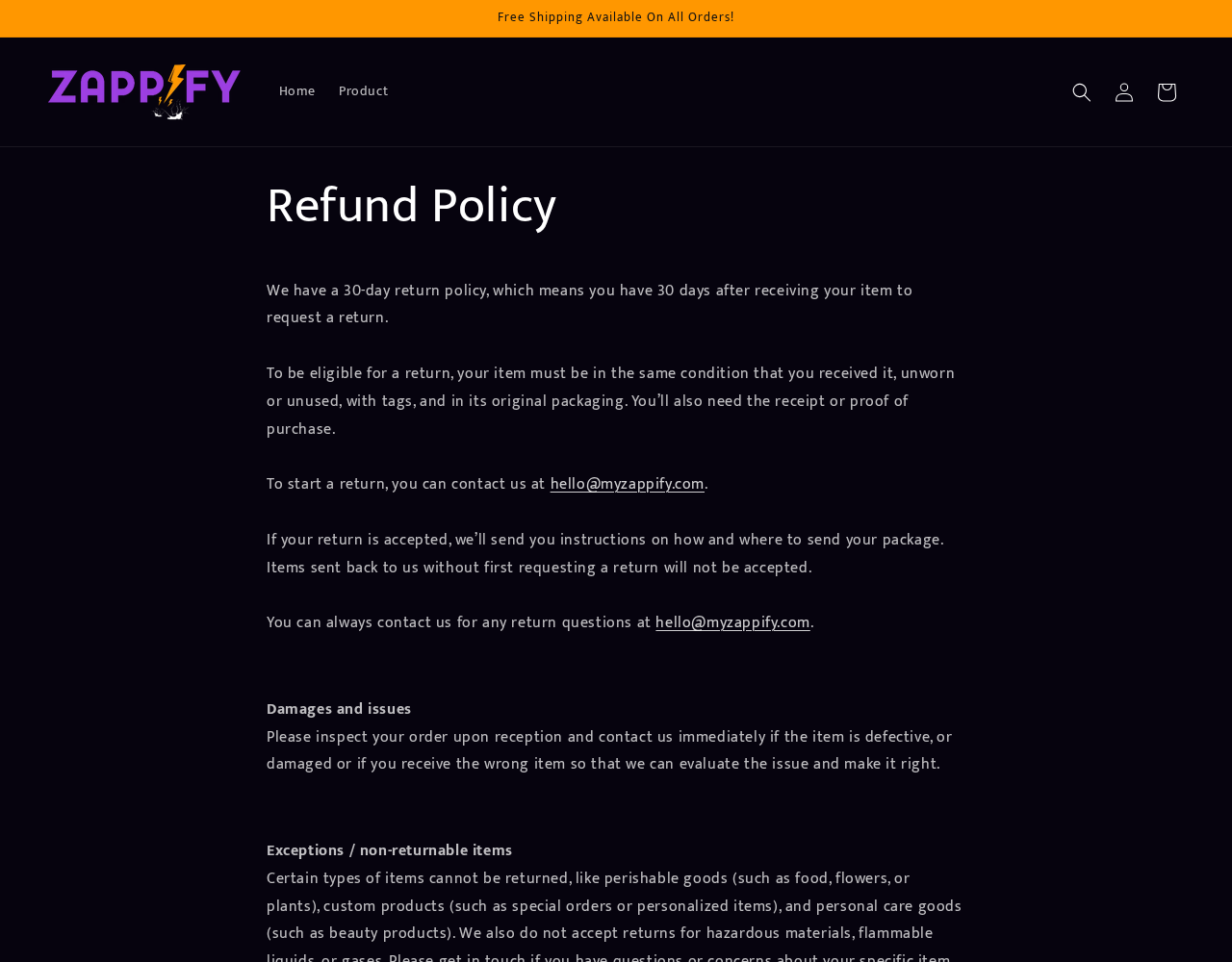
This creates an obvious conflict for a buyer. The product must be opened and used to discover weak mosquito attraction, poor battery life, charging failure, or a defect. Yet use can make it ineligible, while the sale-item exception may exclude the advertised offer before performance is even considered.
The policy does not publish the return warehouse address. It says approved customers will receive instructions. Without a destination, a shopper cannot estimate postage, determine whether the parcel must go overseas, or know whether a $49.99 return is financially worthwhile.
Other Zappify terms add more confusion
Zappify has appeared through more than one sales route. Zappify.com identifies SG Brands LLC in its footer, while the contact section of its terms names Sapience Brands at 78 John Miller Way in Kearny, New Jersey. MyZappify.com terms identify Sapience Group LLC at the same street address.
The separate MyZappify terms allow cancellation fees of up to 15% in certain cases and up to 25% when a customer changes their mind and returns an item. They require a return address supplied by customer service, make the buyer responsible for return shipping, and allow return processing to take up to 30 days after receipt.
Those terms also say replacement shipping can cost $10 per item or more and that an approved card refund may take up to 45 working days to appear. The company states that it is based outside the EU, EEA, and UK despite presenting a New Jersey contact address.
These different entities, policies, phone numbers, and sales pages make it harder for a buyer to know which exact terms govern a transaction. Save the URL, checkout, confirmation, merchant descriptor, and policy displayed during your own purchase.
The alternative order funnel relies on timed pressure
The MyZappify order page presents multi-unit packages and a 50% discount. During our capture, a large pop-up offered another 10% off and showed a countdown under five minutes.
The message claimed only a handful of people receive the coupon each week and warned that it would be given to another customer if not activated immediately. Automated countdowns are designed to stop buyers from leaving to research reviews and return costs.
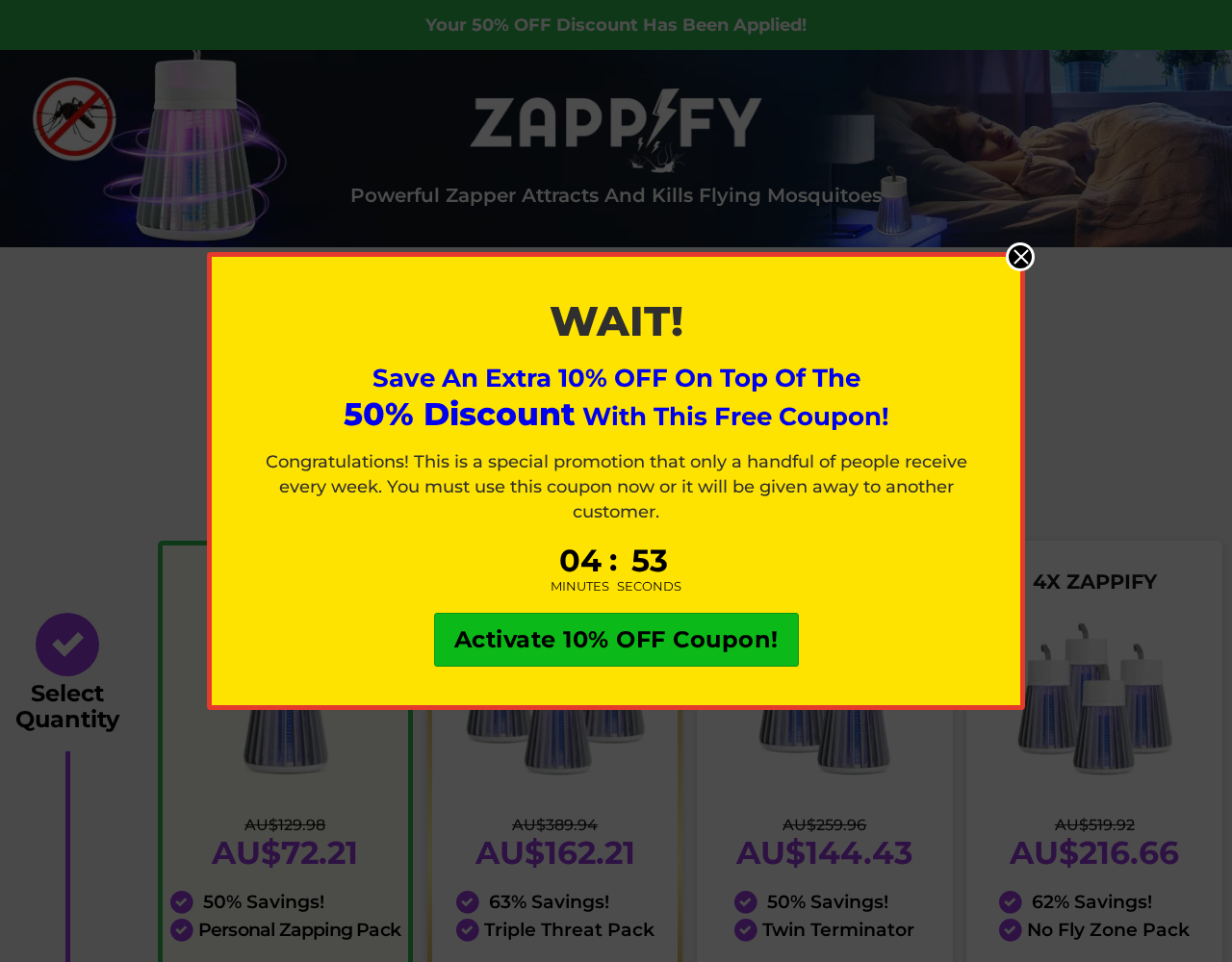
A legitimate discount does not become more valuable because a timer is blinking. Close the page, search the seller independently, and compare the full total. If the offer is genuinely suitable, it should survive a few minutes of careful research.
AI-style advertising makes generic products look revolutionary
Social media campaigns for Zappify and similar mosquito products use highly polished family scenes, enlarged product renderings, dramatic insect effects, quick cuts, and testimonial-style narration. Some creatives appear AI-generated or heavily composited.
An attractive scene does not show that the exact retail device caught the insects pictured. The most useful demonstration would be a continuous, independent video showing the unopened package, serial markings, full charge, placement, environment, and final insect count.
AI tools also make it easy to produce many versions of an ad for different audiences and countries. A seller can change the voice, family, setting, price, or urgency message while continuing to ship the same generic product.
Why the complaint pattern matters more than a single bad review
Any product can receive an unfair or mistaken review. A score of 1.2 from 105 reviews, with 98% at 1-star, is not one isolated disagreement. It is a broad warning that the customer experience repeatedly fails to match expectations.
The FTC advises shoppers to consult multiple independent sources, inspect recent review patterns, read sale-item restrictions, and identify return shipping and restocking costs before purchasing. Its online shopping guidance also recommends paying by credit card for stronger dispute protections.
Zappify’s recurring complaints align with weaknesses visible in the store itself: performance claims without independent testing, aggressive discounting, seller-controlled testimonials, no published return address, and a sale-item exception.
Quick Zappify warning signs
- The store promises a mosquito-free environment and removal of all mosquitoes from an area.
- Independent field testing for the exact Zappify Zapper 2.0 is not provided.
- The claimed regular price is $129.98, while the sale price is $49.99.
- Generic mosquito-lamp products are widely available at low wholesale prices.
- Trustpilot shows a 1.2 out of 5 score from 105 reviews.
- 98% of Trustpilot ratings are 1-star.
- Buyers repeatedly report poor attraction, battery, charging, and durability.
- The refund policy requires unused original condition.
- The same refund policy says sale items are not accepted.
- The product itself is prominently sold as a sale item.
- Return destinations are supplied only after customer-service approval.
- Different Zappify pages reference SG Brands, Sapience Brands, and Sapience Group LLC.
- An alternative order funnel uses bundles, scarcity language, and a countdown timer.
How The Operation Works
The Zappify funnel turns an ordinary nuisance into an urgent emotional purchase. Each step makes the generic device appear more powerful and the decision more time-sensitive.
1. A summer problem is made to feel immediate
The ad begins with buzzing, bites, worried parents, ruined sleep, or an outdoor meal surrounded by insects. These scenes are familiar, so viewers quickly imagine the product solving a real problem in their own home.
The campaign does not begin with battery specifications or field results. It begins with relief.
2. Polished media turns a small lamp into a protective system
The product is enlarged beside families, campsites, or bedrooms. Purple light, sparks, animated insects, and confident narration create the impression of a powerful shield.
AI-generated or composited video can show effects that were never produced by the retail unit. Short edits prevent the viewer from checking continuity.
3. Basic components receive dramatic descriptions
An LED becomes a mosquito-attraction system. A small charged grid becomes powerful extermination. A rechargeable battery becomes all-night protection.
The product may contain each physical component, but the wording encourages the shopper to assume a level of real-world mosquito control that has not been independently demonstrated.
4. A high crossed-out price makes the offer feel premium
The $129.98 reference price tells shoppers this is expensive technology. The $49.99 sale then feels like a rare opportunity rather than a steep markup on a generic product category.
Most buyers will not open a wholesale marketplace while watching a social video. The funnel depends on that information gap.
5. Testimonials remove the final doubt
Seller-controlled endorsements describe quick results, simple cleaning, and successful outdoor use. The page repeats some testimonials and provides no independent purchasing verification.
A shopper who has not yet seen the 1.2 TrustScore may assume the visible praise represents typical customer experience.
6. A timer and package discount accelerate checkout
The alternative order funnel offers several quantities, applies a large discount, and introduces another coupon with less than five minutes remaining. The visitor is warned that somebody else will receive it.
Rushing increases the chance of overlooking quantity, shipping, insurance, currency, or a missing final review step.
7. The buyer discovers performance only after opening the box
The lamp may light up and the grid may energize, but meaningful mosquito performance requires real use. Battery duration, attraction strength, charging quality, and durability become clear only after opening and testing.
That puts the customer in conflict with a policy requiring an unused item in original condition.
8. Cancellation and return costs protect the seller’s margin
A shopper who tries to cancel may find that fulfillment has already begun. A return requires approval and an address from support. Depending on the sales route, deductions, postage, or sale-item restrictions may apply.
Even when a refund is approved, return shipping on a $49.99 device can consume a substantial portion of the recovery.
9. The campaign continues through different domains and companies
Zappify.com, MyZappify.com, affiliate links, and landing pages can present different prices and policies. Company names and contact details vary between documents.
This layered setup makes complaints harder to research and allows marketing to continue even when one page accumulates negative attention.
What To Do If You Have Fallen Victim
If you ordered Zappify and regret the purchase, start documenting now. A clear timeline can make the difference between a successful refund and a vague quality complaint.
- Save the exact sales route. Capture the social ad, affiliate URL, Zappify or MyZappify page, product description, crossed-out price, quantity, countdown, and guarantee. Different pages contain different terms.
- Identify the merchant on your statement. Write down the posted amount, currency, date, and merchant descriptor. Compare it with the order confirmation and screenshot any extra shipping, insurance, or quantity.
- Request cancellation immediately if the order has not shipped. Use the support email shown in your confirmation and the website contact form. Ask for written confirmation and the exact refund amount.
- Do not discard packaging. Keep the box, labels, inserts, charger, brush, and every accessory. Photograph the unopened parcel before breaking the seal if you expect a dispute.
- Document performance carefully. Record charging time, actual battery duration, weak light, failure to power on, missing components, and the absence of catches during normal use. Do not create unsafe tests or touch the energized grid.
- Ask which return policy applies. Point out that the product was marked as a sale item and request a written explanation if support still advertises a 30-day guarantee. Ask whether opening the product prevents return.
- Demand the physical return address before shipping. Confirm the destination, deadline, required authorization number, tracking requirement, and recipient name. Never send a parcel to an address found in an unrelated review.
- Calculate every deduction. Ask whether original shipping, return postage, insurance, cancellation fees, restocking, or currency conversion will be lost. Request the net refund in writing.
- Keep a contact timeline. Record every email, phone call, automated reply, tracking update, and promised response date. Save full message headers when possible.
- Contact your payment provider promptly. If the total is wrong, the product is defective, the order was not delivered as agreed, or support refuses a valid remedy, explain the issue and ask about the dispute process. Do not let repeated delays consume your deadline.
- Describe the problem precisely. “Merchandise not as advertised,” “wrong amount,” “duplicate transaction,” and “defective product” are more useful than simply saying “scam.” Attach the exact promise and evidence that contradicts it.
- Be cautious with a partial refund. Ask the bank whether accepting a small amount will close or weaken a dispute. Do not agree merely because overseas postage looks expensive.
- Monitor the card after the purchase. Report any unauthorized transaction immediately and ask whether the card number should be replaced. Change a reused account password if you created one on the store.
- Report the campaign. Report the social media ad and submit your screenshots, amount, company name, and URLs to the FTC at ReportFraud.ftc.gov. Honest Trustpilot or platform reviews can also warn other shoppers, provided they stick to documented facts.
The Bottom Line
Zappify sells a common rechargeable mosquito-zapper concept as premium protection. The $49.99 sale price, $129.98 reference price, unsupported promise to clear an area, high-pressure order funnel, restrictive sale-item return terms, and 1.2 TrustScore form a clear buyer-warning pattern.
Do not order Zappify expecting a mosquito-free home or backyard. If you already paid, preserve the exact advertisement and packaging, request cancellation or return instructions in writing, calculate the real refund, and contact your payment provider before its dispute window closes.








