


514-375-2413 is a Montreal number that has placed automated calls in Quebec since at least 2018. Most detailed reports describe a recorded survey, not a demand for money.
Here’s who holds the number on paper, which survey programs people name, what isn’t confirmed and how to stop the calls or report one that asks for money.
Overview
What 514-375-2413 is
The 514-375 exchange belongs to Zayo Canada, a business carrier that Local Calling Guide lists as Allstream. The number may have moved to another carrier since.
Reports on three caller-ID sites since July 2018 describe automated survey calls, mostly in French, that ask you to press 1 and then send a survey link by text.
Who calls from +1 (514) 375-2413?
Three reports name mavilleecoute.ca, a “Ma Ville” survey or Tell City Hall. Advanis runs both programs, but neither website lists this number, so the link rests on those reports.
Is 514-375-2413 a scam?
The reports point to unwanted survey robocalls, not a scam. Nobody describes losing money to it, though two reports mention calls asking for card details or fees. The key points:
- Our May 2024 article called this a US scam tied to IRS and tech support calls. No report supports that, and that description is withdrawn.
- The number sits in a Montreal block held by a business carrier.
- The most recent rating on any of the three sites, dated June 18, 2026, labels the call a survey.
- Survey and polling calls are exempt from Canada’s National Do Not Call List.
- No genuine survey asks for a card number, banking details or a Social Insurance Number.
Who Is Behind 514-375-2413?
Phone numbers don’t come with a name tag. Carrier records, caller reports and the survey programs’ own pages narrow down who uses this one.
The carrier record
Canada’s numbering administrator lists the 514-375 exchange as in service for Zayo Canada Inc. at the Montreal rate center, with an assignment date of July 30, 2004.

The Local Calling Guide shows the same block under operating company number 8304, listed as Allstream Inc. Two 800notes users in 2018 also named the caller as Allstream.
Numbers can move between carriers. The record shows where the number started, not necessarily which company or call center uses it today.
The survey programs named in reports
In May 2019, an 800notes user blamed mavilleecoute.ca, part of Advanis, and called it a telemarketing scam. Two ShouldIAnswer reports mention Ma Ville and Tell City Hall.
MaVilleÉcoute is the French-language counterpart of Tell City Hall. Both describe themselves as public-sector survey programs of Advanis, a Canadian market research company.
MaVilleÉcoute lists a mailing address on Rosemont Boulevard in Montreal, while Tell City Hall lists an office in Edmonton, Alberta.
Our Tell City Hall report explains how that program works, who pays for its surveys and why the name looks official on caller ID.
What Advanis says about its calls
Both programs’ FAQ pages say numbers are picked by random digit dialing within rate centers. That explains why people with unlisted numbers still get the calls.
The program says it calls at most once every six weeks. It sends the survey link by text after you agree, then sends reminders after two days and a week.
Some studies are paid for by governments or non-profits. Others are self-funded by Advanis, which may offer the results to governments later.
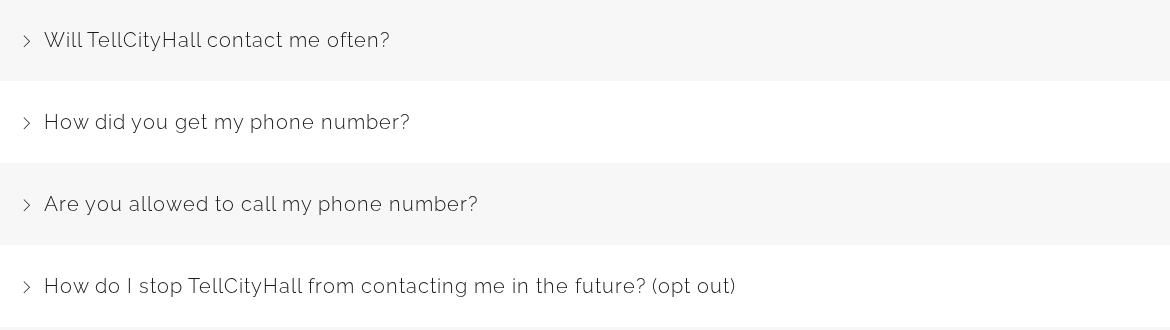
Both programs keep their own do-not-call list and take opt-out requests by email or toll-free voicemail, in English through Tell City Hall and in French through MaVilleÉcoute.
What isn’t confirmed
Neither program’s website lists 514-375-2413, and no carrier record names Advanis. The connection comes only from people who answered and recognized the survey name.
Two reports describe different calls. One from June 2019 says a fake survey ended with a free cruise offer that required a Visa or Mastercard number.
Another report, in French, describes a Chinese-language call demanding fictitious fees. Caller ID can be faked, so these may come from other callers showing this number.
How a +1 514-375-2413 Survey Call Works
Reports that describe the call in detail follow the same sequence. It matches what the Advanis programs say about their own survey calls.
Step 1: An automated voice asks for your opinion
The call is a recording, usually in French and sometimes in English. Reported topics include cannabis legalization, the legal age for cannabis, vaping, COVID-19 and Quebec government decisions.
Step 2: You press 1 to agree or 9 to decline
One report from the COVID-19 period says pressing 1 gave consent to receive a text with a link, while pressing 9 meant you weren’t interested.
Step 3: A text with a survey link arrives
A February 2019 report says the survey link came by text from a Manitoba number in area code 204, not from 514-375-2413. The survey itself runs online.
If you didn’t agree to a survey, don’t tap a link that arrives afterward. A text you weren’t expecting deserves the same suspicion as any other.
Step 4: Unanswered calls are retried
Reports describe repeated calls, and four comments mention a one-word robotic voicemail. One says the word was ARRÊT, French for stop.
One person says the number called about once a week, more often than the six-week limit Advanis describes. A 2019 call reached a mobile phone before 7:30 a.m.
Step 5: The survey asks about you, not your money
The program’s FAQ says surveys ask for your exact age and the first three characters of your postal code. Nothing in that process requires a payment or a card number.
What People Report About +1 (514) 375-2413
On 800notes, 24 comments and their replies run from July 2018 to January 2024. Nine say the caller left a robotic message or that they didn’t answer.
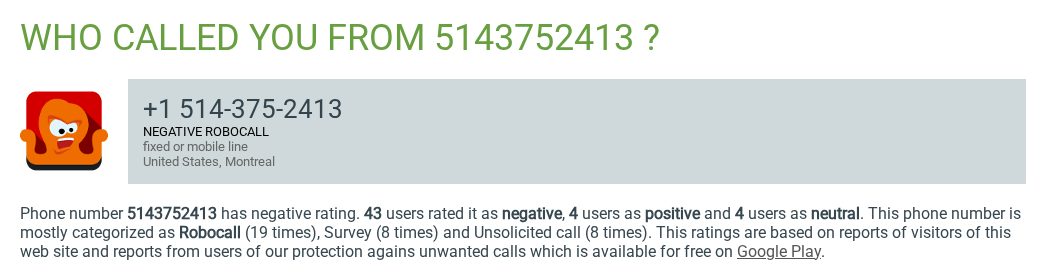
ShouldIAnswer lists 51 ratings: 43 negative, 4 positive and 4 neutral. The most common labels are Robocall, Survey and Unsolicited call, and the latest entry is dated June 18, 2026.
SpamCalls.net shows 39 user reports with a high spam-risk rating. Its latest report is dated May 10, 2026.
At least six French-language reports use the word sondage, French for survey, including one that labels the call sondage automatisé.

Most reports that call it a scam give no reason or cite repeated calls and the Do Not Call List. Only two describe a request for money or card details.
A 2019 comment says the calls aim to get card numbers, and a January 2025 SpamCalls entry says phishing. Neither describes what the caller asked for.
One person who phoned back says the agent claimed to be from Statistics Canada. That claim isn’t confirmed anywhere else.
Statistics Canada says it typically calls from 1-833-977-8287, and its staff never ask for a Social Insurance Number or bank details. Its survey FAQ explains how to check a call.
What Changed Since Our 2024 Report
Our May 2024 article tied this number to IRS, Apple, Microsoft, Amazon and Social Security impersonation, romance and lottery schemes. Apart from one 2019 cruise-prize call, no report describes them.
That version also showed screenshots of other scams, such as a bank text message. They didn’t involve this number, so they aren’t repeated here.
What the reports do show is steady survey activity from 2018 to 2026, with the topic changing over time and the same press-1 format.
What the 514 Area Code Tells You
Area code 514 covers the Island of Montreal and Île Perrot. Since 2006 it has shared that area with the overlay code 438, and since October 2022 with 263.
The +1 prefix is the country code for the whole North American numbering plan. So +1 514-375-2413 is a Canadian number, even though US numbers start with +1 too.
Carriers receive numbers in blocks of 10,000 that match one prefix in one rate center. That’s why 514-375 points to one carrier and city, but not to a person.
ShouldIAnswer labels the number United States, Montreal, which mixes up the country. Montreal is in Quebec, Canada.
Are Survey Calls Allowed in Canada?
Yes, within limits. The CRTC says market research, poll and survey calls are exempt from the National Do Not Call List because they don’t sell anything or ask for donations.
A survey call that turns into a sales pitch or a request for money is no longer just a survey.
The CRTC doesn’t require survey firms to keep do-not-call lists. Blocking stops this number only, while an Advanis opt-out covers any number its programs call from.
Our report on 202 area code scam calls explains why a familiar number on caller ID doesn’t prove who is calling.
For calls that do ask for money, our report on Canada Post scam calls shows what a fake parcel or customs fee call looks like.
Why These Calls Feel Like a Scam
An unknown number, a recorded voice, repeated retries and a request to press a key all match how scam robocalls work.
Scammers use the same tools, which is why caller-ID sites fill with scam labels even when the call is a survey.
How to Tell a Real Survey Call From a Fake One
A genuine survey robocall and an impostor can sound alike for the first few seconds. The difference shows up in what the caller asks for next.
- A real survey names its sponsor. Tell City Hall says it states the sponsor when recruiting you, on the survey login page and on the last page.
- A real survey asks for opinions and basic details, such as age or a partial postal code, never a Social Insurance Number or bank details.
- A real survey offers a way out, such as an opt-out email or a toll-free voicemail.
- A fake survey ends with a prize, a fee or a request for card details to claim something.
- No survey needs you to install an app or allow remote access to your device.
If a caller claims to be a government agency, hang up and call that agency back on a number from its official website.
If You Already Took the Survey
Finishing one of these surveys usually means you shared opinions, your age and the first three characters of your postal code.
Tell City Hall says answers are never linked to your name, number or email and are reported only at group level.
Both programs also say they share results only with governments and non-profits, not with private companies.
If a call you thought was a survey later asked for payment, card details or remote access, treat it as fraud and use the reporting steps below.
What to Do If 514-375-2413 Called You
Most people only need to opt out or block the number. The later steps are for calls that asked for money or financial details.
- Let it go to voicemail.
A survey call can wait. If you answer, you can hang up at any time without explanation.
- Opt out if the call named Tell City Hall or MaVilleÉcoute.
Email info@tellcityhall.ca or info@mavilleecoute.ca with your number, or leave a voicemail at 1-888-883-7094 or 1-888-501-1698.
- Never give financial details.
No survey needs a card number, bank account, Social Insurance Number or one-time code. Hang up if a caller asks for any of them.
- Forward suspicious texts to 7726.
Forward an unexpected link text to 7726, which spells SPAM, as Get Cyber Safe advises. Then delete it.
- Block the number if calls continue.
Use your phone’s block feature or your carrier’s call filter after you’ve asked to be removed.
- Report fraud to the CAFC.
If a caller asked for money or card details, report it at reportcyberandfraud.canada.ca or call the Canadian Anti-Fraud Centre at 1-888-495-8501.
- Call your bank if you shared card details.
Ask for the card to be canceled and recent charges reviewed, then contact your local police.
- Report from the US if it reached you there.
US residents who get a money request from this number can report it at ReportFraud.ftc.gov.
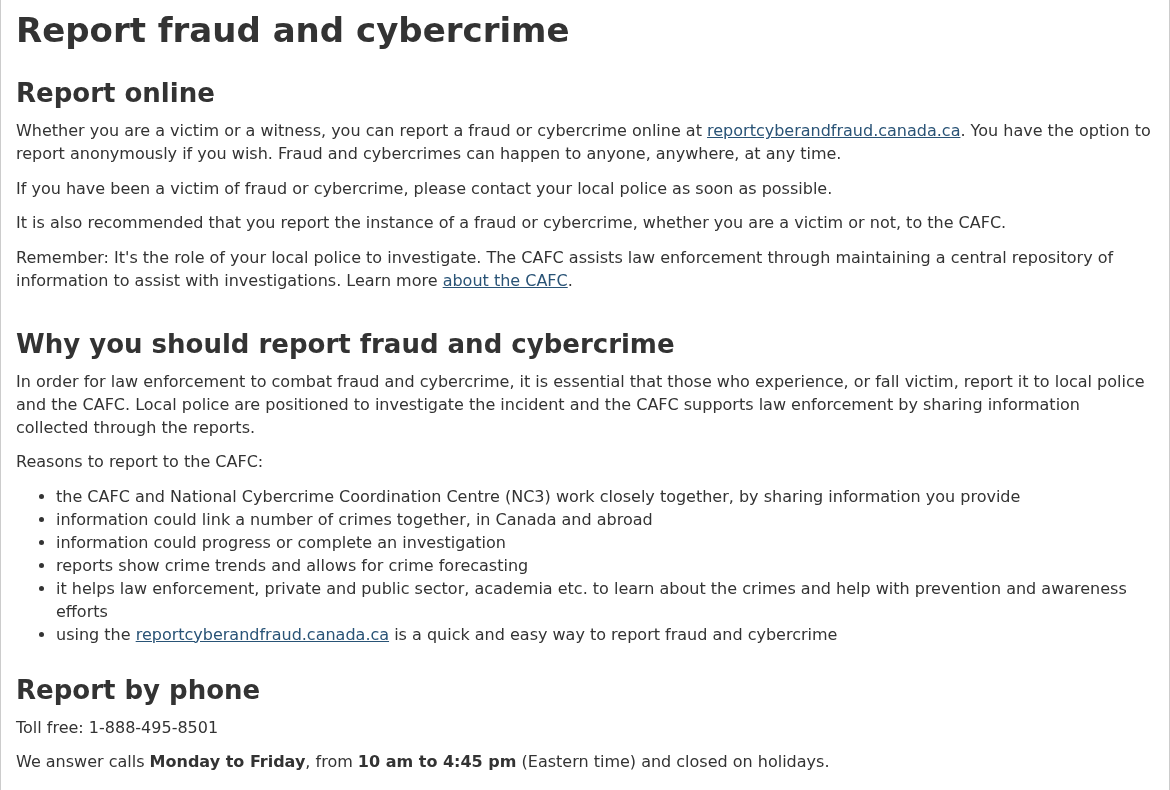
The CAFC answers its phone line Monday to Friday, 10 a.m. to 4:45 p.m. Eastern time. Its online system also accepts anonymous reports.
Frequently Asked Questions
Who owns 514-375-2413?
No official record names the user. The number sits in a Montreal block held by Zayo Canada, and three reports link it to Advanis survey programs.
Is +1 (514) 375-2413 Statistics Canada?
Nothing confirms that. Statistics Canada usually sends a letter or email first and calls from 1-833-977-8287 for most surveys.
Why do I get calls when I’m on the Do Not Call List?
Survey and polling calls are exempt from the list. Ask the survey program directly to remove your number, then block it.
Should I call 514-375-2413 back?
There’s no need. People who called back describe a dropped line, an offer to text a survey link or an agent claiming to be Statistics Canada.
Is it safe to answer the survey?
Taking part is optional. A real survey names its sponsor and asks only for opinions and basic details, so stop at once if it asks for money or ID numbers.
Does 514-375-2413 send text messages?
Reports describe the survey link arriving by text, sometimes from another number. Statistics Canada texts only from 782-782 or 236-732, so other numbers using its name aren’t genuine.
The Bottom Line
You don’t need to answer or call back 514-375-2413. Reports describe a Montreal survey robocall, and the scam claims in our 2024 article don’t hold up.
Opt out by email or voicemail and block the number if calls continue. Never give card details on a survey call, and report money requests to the CAFC at 1-888-495-8501.
Pressing 1 or taking a survey needs no follow-up. If you entered a password through a text link, change it. If you shared card details, call your bank.

Join the discussion
0 commentsShare your experience or ask a question about this article.
Discussion
Start the conversation
Have a question or something useful to share? Add the first comment.