

A voicemail says your tax deadline has passed and interest is building. Even when you are unsure you owe anything, that message can get your attention.
The callback number is 833-766-1884. Before returning the call, take a moment to understand what the message actually establishes about your situation.
Overview
What the 833-766-1884 Message Says
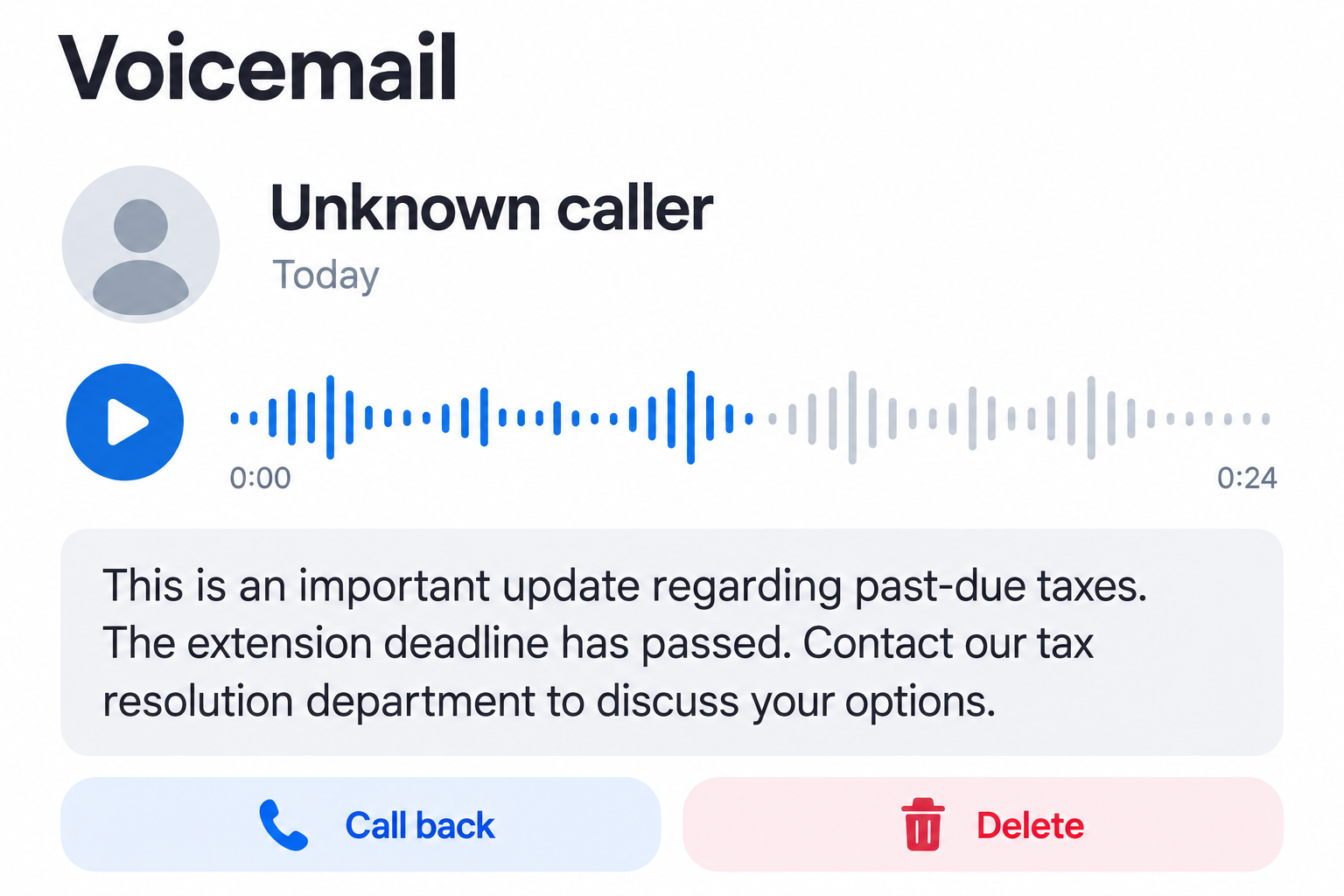
The recorded voicemail discusses overdue taxes, an expired extension deadline and time-sensitive resolution options. It encourages a prompt callback to discuss reducing interest and further collection activity.
It does not give a taxpayer’s name, tax year, assessed balance or a clearly identified business. Those missing details prevent the message from establishing a particular debt.
The interface illustration above depicts the type of pressure involved. It is not a screenshot from a recipient’s phone or an authenticated IRS communication.
What the Recording Does Not Prove
The message does not authenticate the caller as the IRS, identify a verified tax professional or demonstrate authority to stop collections.
It also does not establish who currently controls the callback number. Numbers can be reassigned, and caller ID can be spoofed.
The safe decision is not to pay or disclose personal information based on this voicemail. Verify any real tax issue through a channel you obtain independently.
The Warning Signs in Plain English
- The caller starts with an asserted debt rather than establishing who is speaking.
- An expired deadline creates pressure without identifying which deadline applies to you.
- Potential relief is suggested before your actual account circumstances are verified.
- The callback number becomes the proposed solution to the fear the message creates.
These are serious warning signs. They support rejecting this unsolicited approach, while the operator’s identity and any later payment demand remain unverified.
A Voicemail Is Not a Tax Account Record
The most unsettling part of the script is how confidently it assumes you already know about overdue taxes.
That can make someone search their memory for a missed letter or filing mistake. The worry may arise before the caller supplies any supporting information.
Do not reverse the burden of verification. An unexpected caller has not proved a debt merely by sounding certain that one exists.
You may genuinely owe taxes. You may also have filed correctly, paid in full or received a message intended for someone else.
None of those possibilities gives this unidentified caller authority over your account. The account question and the caller-authentication question need separate answers.
The IRS online account is an independently accessible starting point for reviewing federal balances and account information.
If you have a notice, use its identifying information and official verification routes. Do not ask the voicemail sender to authenticate its own claims.
Federal and state taxes are also different systems. A vague reference to taxes does not identify which agency, period or account the speaker means.
How the Tax-Resolution Callback Pitch Unfolds
Step 1: The Message Assumes an Existing Problem
The recording begins as though it is providing an update about a matter already known to you. It does not start with a transparent introduction.
That wording can create the impression of an established relationship. A listener may hesitate to ignore what sounds like a follow-up.
Ask what prior relationship actually exists. If you never hired the speaker and have no verified agency contact, the implied familiarity does not authenticate anything.
Step 2: A Deadline Makes Delay Feel Expensive
The voicemail refers to an extension deadline having passed. Without a year, account or specific notice, that statement cannot tell you what action your situation requires.
Filing deadlines, payment obligations and collection procedures are not one interchangeable deadline. The speaker’s compressed description obscures those distinctions.
The intended effect is clear: waiting feels risky, so returning the call starts to look like the responsible thing to do.
Verification is the responsible action. It does not have to happen through the number supplied by the person creating the pressure.
Step 3: Interest and Collections Supply the Threat
The recording brings up growing interest and further collection activity. It presents contact with the caller as a way to address those consequences.
Real debts can have real consequences, which is why this language is effective. A true general statement does not establish a true claim about your account.
Nor does it establish that this particular organization can reduce charges or stop enforcement. That depends on facts and authority not supplied by the voicemail.
Be wary of anyone treating a callback as the only route to prevent an immediate financial consequence.
Step 4: The Callback Number Becomes the Next Instruction
The script repeats 833-766-1884, making the number easy to retain. Repetition can create familiarity, but it does not verify ownership or legitimacy.
A toll-free prefix is simply a numbering feature. Government agencies, legitimate businesses and abusive callers can all use toll-free services.
The displayed calling number may also differ from the requested callback destination. Preserve both if you are documenting the incident.
Do not use an online reputation score as the sole verdict. A newly used number may have little history, while an old listing may describe a previous operator.
Step 5: A Conversation Could Turn Into Data Collection or a Sale
The available recording stops at the callback request. It does not document what a live representative actually asks for afterward.
If a follow-up conversation seeks your Social Security number, tax returns, bank details or payment, stop until the recipient is independently verified.
A caller may describe the next stage as a free review or eligibility check. Those labels do not make disclosure safe.
Likewise, a proposed tax-relief service requires a written scope, transparent fees and a professional whose credentials you can check independently.
This possible escalation explains the risk. It is not a claim that a recorded purchase, theft or particular fee was established for this number.
Does the IRS Ever Call or Use Automated Messages?
Generic wording alone does not prove impersonation. An agency may avoid putting private account information in an automated message for legitimate privacy reasons.
Here, the problem is the combination of unverified identity, pressure and a callback instruction that has not been independently authenticated.
Even a later caller who knows your name or address has not established authority. Basic personal information can come from public records or previously exposed data.
Ask whether a proposed contact route can be confirmed through the agency itself. If it cannot, do not use the speaker’s confidence as a replacement.
Yes. The blanket advice that the IRS never phones anyone is inaccurate and can create confusion when a real account matter exists.
The agency’s contact guidance explains that initial contact normally comes by mail, while certain later contacts may include telephone calls.
It also describes automated messages that direct people to IRS.gov for secure account management. That is different from treating an unidentified callback as verification.
The right question is not whether a telephone was used. It is whether the contact follows a verifiable process and can be checked independently.
A name, badge number or statement that a call is recorded can be asserted by anyone. Do not let those details replace independent authentication.
Be especially cautious about instructions to keep the conversation secret, stay continuously on the phone or avoid contacting your usual tax professional.
Those actions interfere with the very checks that would protect you. End the conversation and choose your own route to the relevant agency.
Real Tax Relief Does Not Begin With a Guaranteed Outcome
Legitimate tax professionals can help people understand obligations and available options. Their existence does not validate this particular unsolicited approach.
A credible professional should explain what they will do, what they charge and which outcomes depend on the agency’s decision.
They should not promise to eliminate an unknown debt before reviewing the relevant facts. A confident sales statement is not an eligibility determination.
The IRS warns about offer-in-compromise mills that promote debt settlements to people who may not qualify.
A genuine program’s existence can be used to sell an unsuitable service. The name of the program does not establish that the salesperson can obtain it for you.
Before hiring help, ask who will perform the work and who, if anyone, is authorized to represent you. Request a complete written fee schedule.
Read cancellation terms and distinguish an initial assessment fee from the full cost. Do not authorize an open-ended debit because a caller says time is running out.
If you already have a trusted preparer, ask them to review the actual notice. They can help separate a real account issue from a sales approach.
Do not ignore a verified tax obligation because a suspicious caller mentioned taxes. Reject the caller’s channel while still addressing any independently confirmed problem.
What to Do If You Received or Answered This Call
-
Save the message without following its instructions. Keep the audio, date, displayed caller ID and requested callback number. Note any business name mentioned later.
Then block the unwanted call if appropriate. You do not need to engage, press an option or challenge the speaker to preserve evidence.
-
Check your tax situation independently. Type IRS.gov yourself or use a trusted bookmark. Review your account and any genuine notices already received.
For a state-tax issue, locate the state’s revenue agency through its official site. Do not rely on a search ad offering urgent tax help.
-
Stop further disclosure. If you called back, do not continue sharing documents until you know who received them and why.
Write down exactly what you disclosed. A name and phone number create a different risk from a Social Security number, signed authorization or banking credentials.
-
Protect exposed financial access. If you supplied payment information, contact the bank or card issuer using its own app or published number.
Explain the payment and authorization accurately. Ask about stopping unwanted debits, disputing specific charges and any steps needed to prevent continuing access.
-
Use an identity-theft response when sensitive identifiers were exposed. Start at IdentityTheft.gov for a recovery plan matched to what happened.
Consider appropriate credit protection and review accounts for unfamiliar activity. Do not assume the absence of an immediate charge means the information cannot be misused later.
-
Secure accounts or devices only where the exposure calls for it. Change a disclosed password from a trusted device and enable stronger authentication.
If the caller persuaded you to install remote-access software, disconnect the session, remove unauthorized access and consider Malwarebytes for a security scan.
If links led to malicious advertising, AdGuard may reduce later ad exposure. Neither tool can erase a tax debt or cancel a service contract.
-
Report the facts and watch for follow-ups. Use official IRS reporting guidance for suspected impersonation and appropriate consumer-reporting channels for deceptive solicitation.
Describe what the caller actually said. Do not claim the IRS itself made the call or identify an operator you have not verified.
Ignore a second caller offering guaranteed tax cleanup or recovery for another fee. A new urgent promise does not repair the first problem.
If You Already Signed Up for a Service
Find the agreement and identify the exact contracting business. A callback number and a salesperson’s first name are not enough to understand your obligations.
Request the work completed, the remaining scope, the total fees and the cancellation process. Keep the response and any promised refund amount.
Check whether you signed an authorization affecting representation or information access. Ask your established tax adviser how to review or withdraw an unwanted authorization appropriately.
Do not assume canceling a debit automatically ends the service agreement. Payment controls and contractual cancellation may require separate steps.
Likewise, do not stop paying a verified agency obligation because a private salesperson says they are handling everything. Confirm any change through the actual agency.
Build a short timeline of calls, documents, payments and promised work. It will make a bank inquiry, professional review or complaint easier to assess.
Frequently Asked Questions
Is 833-766-1884 an Official IRS Number?
No official connection was established for the examined voicemail. Obtain agency contact information independently rather than treating the callback instruction as proof.
Does the Voicemail Prove I Owe Back Taxes?
No. It does not identify a verified account, tax year or balance. Check your records and the relevant agency through official channels.
Can the IRS Leave Automated Messages?
Yes, in certain circumstances. Its guidance describes messages directing people to IRS.gov. Automation alone does not determine whether a particular call is legitimate.
Should I Call Back to Ask Who They Are?
Not based on this message. Verify any real account issue independently first. You do not need to engage an unidentified caller to check your taxes.
What If I Really Do Have an Unpaid Balance?
Address it through the verified agency or a professional you choose independently. A genuine balance does not authenticate an unsolicited tax-relief pitch.
Is My Phone Infected Because I Heard the Voicemail?
Simply listening does not establish infection. Additional security action depends on what followed, such as installing software, sharing credentials or opening a suspicious link.
The Bottom Line
Do not call 833-766-1884, pay or send tax documents because this voicemail says a deadline has passed. Its pressure does not establish an official account issue.
Check any real obligation through IRS.gov or your state’s agency. If you already responded, protect the specific information or payment access you exposed.

Join the discussion
0 commentsShare your experience or ask a question about this article.
Discussion
Start the conversation
Have a question or something useful to share? Add the first comment.