

The Lux Blaze Lighter is marketed as a “military-grade plasma torch” that is 20x more powerful than regular lighters, can burn through metal, and works in any weather.
The reality is far less impressive.
Behind the aggressive ads and polished landing pages, LuxBlaze shows nearly every hallmark of a high-risk dropshipping operation: inflated claims, fake authority signals, AI-generated marketing, and a generic product sold at a massive markup.
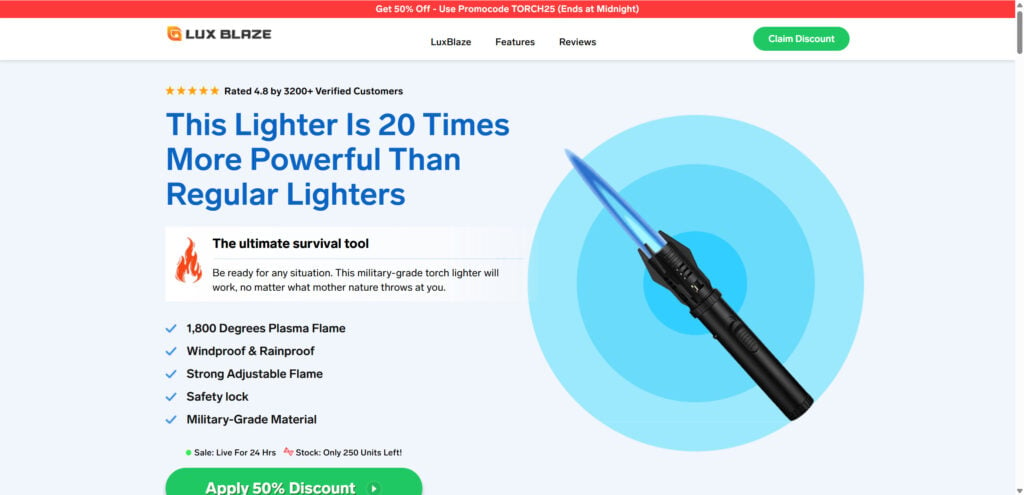
Scam Overview
What the site claims
The LuxBlaze sales page promotes:
- “1,800-degree plasma flame”
- “military-grade survival tool”
- works in wind, rain, snow
- “20x more powerful than regular lighters”
- “last lighter you’ll ever need”
- major media mentions (ABC, Forbes, Insider, etc.)
- large discounts and limited stock warnings
These claims are designed to position it as a premium survival gadget.
What it actually is
Independent analysis shows:
- it is a generic butane torch lighter
- identical models are sold wholesale for $2–$5
- it is rebranded and resold for $30–$50+
- no evidence supports the “plasma” or “military-grade” claims
This is a classic high-margin viral gadget funnel.
Major Red Flags
1. Identical product sold for a few dollars
The exact same lighter design appears on wholesale platforms:
- listed as “jet torch lighter” or “BBQ lighter”
- bulk price: ~$2–$4 per unit
- mass-produced in Chinese factories
LuxBlaze sells it at a massive markup.
This is not innovation. It is repackaging.
2. Fake “As Seen On” logos
The site displays logos like:
- Forbes
- Insider
- ABC
- Daily Mail
There is no verifiable evidence these outlets featured the product.
This tactic is used to:
- create instant credibility
- reduce buyer hesitation
- simulate legitimacy
It is one of the most common signals in dropshipping funnels.
3. Misleading “plasma” and performance claims
The product is marketed as:
- “plasma lighter”
- “no gas needed”
- “extreme heat capable of burning metal”
In reality:
- it uses butane fuel
- it produces a standard jet flame
- it is not an electric arc plasma device
Community reports highlight this clearly:
“I wanted a plasma one… got a butane one.” (Reddit)
That is not a minor detail. That is core product misrepresentation.
4. AI-generated and heavily edited marketing
The product relies on:
- hyper-polished visuals
- unrealistic flame effects
- cinematic survival scenes
- exaggerated use cases
These are often:
- AI-enhanced videos
- stock composites
- staged demonstrations
The goal is simple: make a cheap product look premium.
5. Fake scarcity and urgency tactics
The page uses:
- “Only 126 units left”
- “Sale ends today”
- countdown timers
These are typically:
- reset for every visitor
- not tied to real inventory
They exist to push impulse purchases.
6. Dropshipping and affiliate structure
Evidence suggests:
- LuxBlaze is not the manufacturer
- orders may be fulfilled by third parties
- the site acts as a marketing layer
Typical flow:
- You buy from LuxBlaze
- Order is forwarded to supplier
- Product ships from overseas
- Support becomes difficult
This explains many of the issues buyers report.
Customer Complaints & Risks
Receiving a different product than advertised
Buyers report:
- receiving a standard butane torch
- not matching “plasma” claims
- lower build quality than shown
Receiving multiple units unexpectedly
Some users report:
- being charged for bundles
- receiving more units than intended
- confusing checkout upsells
This is often caused by:
- pre-selected bundle options
- unclear pricing structure
Long shipping times
Because of overseas fulfillment:
- delivery may take weeks
- tracking may be inconsistent
- delays are common
Returns are extremely difficult
This is one of the biggest risks.
Common issues:
- returns require shipping to China
- return cost can exceed product value
- refund requests delayed or ignored
Once you receive the item, you are often stuck with it.
Poor customer support
Typical reports include:
- slow or no responses
- generic replies
- no clear resolution path
How the Operation Works
This follows a standard dropshipping model:
Step 1: Source a cheap product
Generic torch lighter for a few dollars.
Step 2: Rebrand it
Add:
- “LuxBlaze” name
- survival positioning
- premium storytelling
Step 3: Build a high-conversion page
Include:
- fake urgency
- bold claims
- fake authority logos
- inflated reviews
Step 4: Run ads
Heavy promotion via:
- TikTok
- YouTube
Step 5: Fulfill from overseas
- long delivery times
- inconsistent quality
Step 6: Limit refunds
- high return friction
- expensive shipping
- delayed support
Is It a Scam or Legit?
The reality
- The product exists
- Some units will work
But the operation shows strong warning signs:
- misleading product description
- inflated pricing
- fake trust signals
- difficult refunds
- generic dropshipping model
Verdict
High-risk dropshipping product.
Not a pure “you get nothing” scam
But clearly not what the marketing promises
Should You Buy It?
Reasons to avoid
- massive markup vs real value
- misleading “plasma” claims
- fake authority logos
- AI-enhanced marketing
- poor refund experience
- unclear seller accountability
Better approach
If you want a torch lighter:
- buy from established brands
- use reputable retailers
- avoid single-product “viral” sites
What To Do If You Already Ordered
1. Save all evidence
Keep:
- product page screenshots
- claims (plasma, military-grade, etc.)
- order confirmation
- payment receipt
2. Inspect immediately
Check:
- does it use butane
- does it match advertised design
- build quality
3. Request a refund early
Do not wait:
- contact support immediately
- ask for written return instructions
4. Expect resistance
Be prepared for:
- delayed replies
- expensive return shipping
- partial refund offers
5. File a chargeback if needed
If they refuse:
- contact your bank or PayPal
- claim “item not as described”
Bottom Line
LuxBlaze is not a revolutionary survival tool.
It is:
- a generic $2–$5 torch lighter
- sold with aggressive marketing
- wrapped in fake authority and exaggerated claims
The biggest risk is not that you get nothing.
The risk is paying 10–20× more for a product that does not match what you were promised.









scam,scam,scam. do not buy this product, you will not get what you thought you were buying then you will not get a response from them, they have a reservation from LUCIFER, hopefully soon.
I report these ads to google every time see them. Google/YouTube does not care they are implicit in the scam.
yes, exactly. I reported quite a few. they always follow the same pattern, sometimes almost exact script, but google/meta and other platforms just ignore them. very sad for people who might still trust these adverts.
This is a SCAM. Believe me!!!!!
Thanks for the warning – and if you were caught by it, two things are worth doing while it is still recent. Ring your card issuer, dispute the charge as not as described, and ask them to revoke any recurring authorisation and issue you a new card number, because this kind of checkout usually hides a monthly charge that appears four to six weeks later. Then put it on the record at reportfraud.ftc.gov.
If you have any detail you can add – what was advertised against what arrived, or how the billing behaved – it genuinely helps the next person who searches for this before paying.
If scam then why hasn’t our government filed law suits?
It is a fair question, and the honest answer is that they often do – it just happens slowly and quietly, and it rarely stops the underlying business.
The FTC brings cases in this area continually, and some are large: hundreds of millions in judgments against sellers running exactly this model of fabricated endorsements and subscription billing, plus state Attorneys General suing individually. What you do not see is a quick result, because a case takes two to four years, requires evidence of who actually controls the operation, and by the time it lands the brand name has been abandoned. The people behind it register a new company, a new domain and a new product name, and the judgment attaches to a shell with nothing in it. A good share of these operations are also offshore, which puts them outside any US court’s practical reach.
The other constraint is arithmetic. There are thousands of these campaigns running at once and a limited number of investigators, so cases get chosen for scale and provability. A seller taking $69 from fifty thousand people is a serious matter but a hard case; one taking $199 a month from the same people for a year is the kind that gets filed.
Which is why the boring advice matters more than it sounds: dispute the charge with your card issuer, and file at reportfraud.ftc.gov and with your state Attorney General. Those filings are the evidence base a case is built from, and when a judgment does produce money, the FTC distributes it to people who complained – listed at ftc.gov/refunds. The chargeback is faster and more certain, though. Payment processors drop merchants whose chargeback ratio climbs, and losing card processing kills one of these operations in weeks rather than years.
next time i will check to see if it is a reputable item.
That is the right instinct, and here is the shortest version of how to do it, since “reputable” is exactly what these ads are engineered to look like.
Check the domain’s registration date with any free WHOIS lookup – a shop selling a “breakthrough” product from a domain registered six weeks ago is the single most reliable warning sign there is. Search the product name with the word “complaints” rather than “reviews”, since review results are dominated by affiliate pages earning commission on each sale. Run the product photo through a reverse image search to see whether it belongs to somebody else. Look for a real street address and a phone number that actually answers. And read the small print under the buy button for a recurring charge, which is where most of the damage in these cases is done.
One more habit worth adopting: pay by credit card, never by transfer, gift card or crypto, and if your bank offers virtual card numbers, use one with a spending limit for any shop you are unsure about. That way a hidden subscription simply fails.
I got burned this thing is a EXTREEMLY overpriced butane lighter.
An expensive butane lighter is a fair summary of that whole category – the housing is different, the mechanism is not, and the price is set by the sales video rather than by anything inside it.
If it is still within a few months, dispute the charge with your card issuer as not as described; the gap between what the advertisement claimed the device was and what it actually is, is the substance of the claim. You generally have up to 120 days. Do not post it back at your own expense unless they provide a prepaid label with tracking, and do not accept a partial refund to keep it, since agreeing effectively settles the matter.
One practical warning while you have it: butane devices sold through these ads do not go through the safety certification a retail lighter does, and we have seen reports of leaking valves and failures in the ignition. I would not leave it charging or in a hot car, and if it leaks, dispose of it rather than trying to fix it. Faults like that are reportable to the CPSC at saferproducts.gov, and reportfraud.ftc.gov takes the advertising side.