

It usually starts with something that looks exciting, slick, and strangely believable. A famous name appears in your feed. A promo code promises free crypto. The site looks polished. The games work. The balance climbs fast. For a few minutes, it feels like you found a hidden shortcut that other people somehow missed.
That feeling is exactly what this scam is built to create. Behind these fake crypto casino websites is a highly organized operation that has been linked to a large network of near-identical domains, fake celebrity promotions, staged winnings, and withdrawal traps designed to extract cryptocurrency from victims. What looks like a lucky break is often a carefully engineered scam funnel.
In this article, we will break down how the fake crypto casino scam really works, why so many people fall for it, and what to do if you already sent money.

Scam Overview
The fake crypto casino scam is not just one shady website.
It is a repeatable scam model that can be copied across many different domains, each one dressed up to look like a fresh opportunity. One site may be called SPDGame.cc. Another may use a different name, logo, or story. But underneath, the experience is often the same: a big bonus, easy sign-up, a professional-looking casino interface, and a withdrawal wall that appears the moment you try to cash out.
That is what makes this scam especially dangerous.
It does not look like the old stereotype of a scam. There is no badly written email from a stranger asking for money. There is no obviously broken website covered in flashing warnings. Instead, the scam borrows the visual language of real crypto platforms, real casino apps, and real social proof.
At first glance, it can feel legitimate.
It is built to look premium
One of the biggest reasons this scam succeeds is presentation.
The scam sites are often sleek, modern, and responsive. They feature familiar casino-style games like Crash, Plinko, Slots, Dice, Mines, Tower, and Coin Flip. Buttons work. Balances update. Animations are smooth. The entire experience is designed to remove friction and create trust.
This matters more than many people realize.
Most users are not making a legal audit of a platform in the first 30 seconds. They are reacting to cues. If a site looks clean, feels polished, and behaves like a real product, many people instinctively lower their guard. That is exactly what the scammers want.
A cheap-looking scam turns people away quickly.
A polished scam keeps them long enough to take their money.

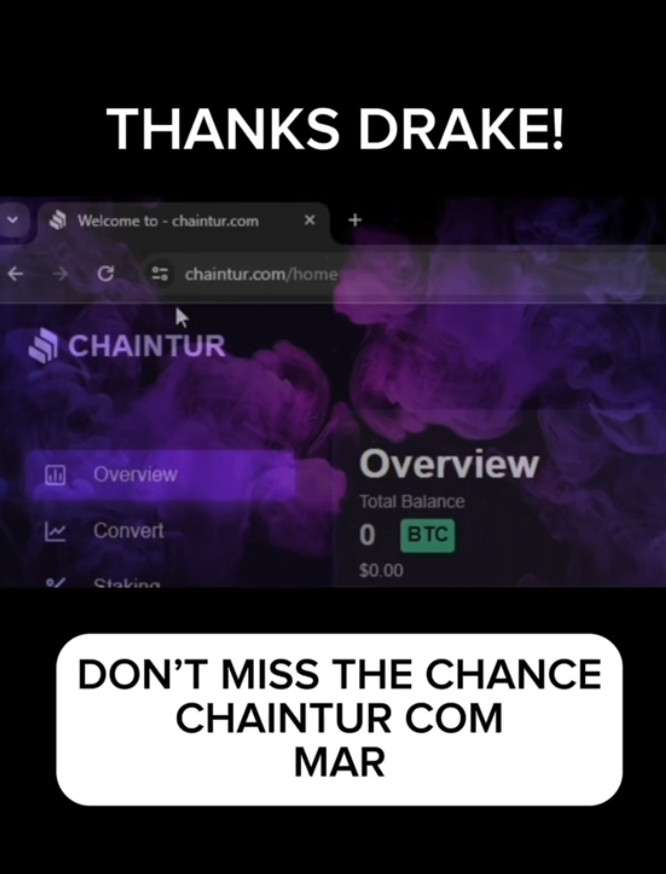
The hook is usually a fake celebrity or “insider” angle
These scams often spread through social media posts, Discord spam, TikTok clips, Instagram stories, YouTube Shorts, and fake screenshots that appear to show celebrity endorsements. The names used vary, but reports and investigations have repeatedly tied these promotions to fabricated claims involving public figures such as Elon Musk, MrBeast, Drake, Cristiano Ronaldo, Lionel Messi, Donald Trump, Bill Gates, Jeff Bezos, Mark Zuckerberg, Warren Buffett, and others. These endorsements are fake. The celebrities are not behind these platforms.
That celebrity layer is not just decoration.
It is a shortcut to trust.
If someone thinks a platform was launched by a billionaire, promoted by a creator they know, or mentioned in a news-style article, they are much more likely to assume the platform has already been vetted by someone else. The scam uses borrowed credibility so the victim does not ask hard questions early enough.
Sometimes the scam goes even further.
Investigators have documented fake news articles, fabricated bylines, and social posts designed to look like they came from verified accounts. The goal is not simply to advertise a casino. The goal is to manufacture belief before the victim even visits the site.

The “free bonus” is the emotional trigger
A common feature of these sites is a large sign-up bonus tied to a promo code. The amount may vary, but reports often describe bonuses ranging from about $2,000 to $10,000 appearing in the account shortly after registration. The bonus feels immediate, tangible, and exciting, even though it is only a number on a screen.
This is one of the smartest parts of the scam.
The victim does not start by losing money. They start by feeling like they gained something.
That changes the psychology completely.
When people think they have already received value, they stop evaluating the platform like an outsider and start thinking like an owner. The money feels real. The account feels personal. The balance feels like something worth protecting, growing, and withdrawing.
That emotional shift is the bridge between curiosity and financial loss.

The games are there to deepen the illusion
These websites often include real-looking games and interfaces that mimic legitimate crypto casinos. Victims can click around, play with their bonus balance, and watch their account grow. The entire flow is built to feel interactive and rewarding. In some cases, investigators and reporting suggest that the early experience is rigged to keep users winning long enough to become emotionally invested.
This is important to understand.
The goal of the games is not entertainment. The goal is conditioning.
Every small win reduces suspicion. Every balance increase makes the account feel more real. Every successful spin or round helps the victim imagine the withdrawal they are about to make.
The site does not need to convince you forever.
It only needs to convince you long enough to get one deposit.


The real scam begins at withdrawal
The moment many victims try to withdraw, the experience changes.
Suddenly, the platform introduces a new requirement. The user may be told they need to verify their wallet, activate withdrawals, complete account confirmation, or send a separate deposit for security reasons. The wording varies, but the structure stays the same: you must send real money before you can access the money already shown in your account.
That is the heart of the scam.
Everything before this point is setup.
The fake celebrity promotion, the promo code, the bonus, the polished design, the winning games, and the growing balance all exist to get the victim emotionally ready for this one moment.
Because by the time the deposit request appears, many people are no longer thinking, “Is this site real?”
They are thinking, “How do I unlock what is already mine?”
That difference is what makes the scam so effective.
It is an advance-fee scam wrapped in casino branding
At its core, this is not really a gambling story.
It is an advance-fee scam.
The site shows you money you believe you own, then tells you that you must pay a fee to access it. That fee may be labeled as a verification deposit, activation charge, network fee, anti-fraud requirement, wallet validation step, or tax-related payment. But the logic never changes. The victim is asked to send additional crypto to unlock a payout that never arrives.
Once you see that structure clearly, the whole scam becomes easier to recognize.
It is not a casino with a technical issue.
It is not a platform with a temporary withdrawal policy.
It is not a genuine company following unusual compliance rules.
It is a funnel built to make the victim pay more.

The operation appears larger than a single website
This is where the story becomes even more disturbing.
Investigations into this ecosystem have linked many fake crypto casino sites to shared technical infrastructure, shared behavior patterns, and even what appears to be a centralized backend. One investigation described a custom chat endpoint, shared account behavior across domains, and signs of a unified user database across multiple scam sites. Cybersecurity journalist Brian Krebs reportedly validated findings that connected more than 1,200 recently registered domains to this broader operation.
That changes how this scam should be understood.
This is not just a random scammer making a quick website.
It looks much closer to scam infrastructure at scale.
That means new domains can appear quickly. Bad publicity around one name does not stop the operation. A site can vanish, rebrand, relaunch, and continue targeting new victims with the same core playbook.
This is one reason so many people get fooled by “fresh” crypto casino domains.
They are often not fresh at all.
They are just the next mask.
Why victims fall for it
Many people assume only reckless or inexperienced users would fall for something like this.
That assumption is wrong.
These scams are effective because they exploit normal human reactions:
- Trust in familiar names
- Excitement about quick gains
- Curiosity about limited-time offers
- Confidence created by polished design
- Emotional attachment to visible account balances
- Hope that one more step will unlock the payout
The scam also keeps the victim moving.
There is very little pause built into the experience. You see the post. You click. You sign up. You get the bonus. You play. You win. You try to withdraw. You hit a “verification” step. The whole funnel is designed to keep momentum high and skepticism low.
That is why people who are generally careful can still get trapped.
The scam does not rely on one giant lie.
It relies on a sequence of smaller believable moments that gradually push the victim toward a decision they would have rejected at the beginning.
The silence around victim reports helps the scam continue
Many victims never report what happened.
Some feel embarrassed. Some assume crypto means the money is gone anyway. Some do not know where to report it. Others simply do not want to relive the experience. Investigations into this scam ecosystem note that shame and underreporting play a major role in helping these operations continue targeting new people.
That silence benefits the scammers.
It leaves fewer warnings online.
It leaves fewer complaints for law enforcement to connect.
And it allows the same network to keep rotating domains and repeating the same trap.
How The Scam Works
Step 1: You see a promotion that looks real
The first contact usually happens on a platform where people scroll quickly and make fast judgments.
That might be:
- TikTok
- YouTube Shorts
- Discord
- Telegram
- X
- Spammed community channels
The promotional content is crafted to look native to the platform. It may appear as a screenshot of a celebrity post, a short clip, a fake success story, or a “news” style article. Often the message includes urgency, such as “limited-time bonus,” “post will be deleted soon,” or “withdraw immediately.”
Urgency is not a side detail.
It is there to stop you from slowing down and verifying the claim.
Step 2: You land on a site that feels professional
Once you click, the site usually does not look suspicious.
It looks like a modern crypto casino.
You may see live-style activity widgets, recent withdrawals, player counts, premium game tiles, or glossy banners. The design is often strong enough to make users think, “This cannot be fake. Too much work went into it.” But investigators found that these platforms were explicitly built to remove doubt and create a sense of legitimacy, including through interface testing and carefully tuned presentation.
That reaction is understandable.
Professional appearance is one of the scam’s strongest weapons.
Step 3: Registration is easy and frictionless
Many scam sites require very little to get started, sometimes just an email address. There is little or no meaningful identity verification at sign-up. That speed helps keep excitement high. You are inside the platform in seconds, not hours.
A real regulated platform often introduces some friction.
A scam wants the opposite.
The faster you move from curiosity to account creation, the less likely you are to stop and ask deeper questions.
Step 4: The promo code gives you a large balance
After signing up, you are prompted to enter a bonus code.
Then the screen lights up with what looks like free money.
Maybe it is $2,500. Maybe it is $5,000. Maybe it is $10,000. The exact number depends on the campaign, but the effect is always the same. Your new account suddenly feels valuable.
This is a critical turning point.
At this moment, the scam changes from an ad you clicked into an opportunity you now feel you possess.
That feeling matters because people protect what they believe they own.

Step 5: The games make the money feel real
Next, you start playing.
The games often look familiar and work smoothly. Crash, Plinko, Slots, Dice, Mines, Tower, and similar formats appear normal and engaging. Your balance may rise quickly. You may hit several good outcomes in a row. That creates a powerful emotional response: excitement, confidence, and the sense that you are beating the system.
For many victims, this is when skepticism really fades.
They stop thinking about whether the platform is real and start thinking about how much they can withdraw.
Some reporting on this scam pattern suggests the early outcomes are intentionally favorable in order to build confidence and push the victim deeper into the funnel.
Step 6: You decide to withdraw
This is the moment the scam pivots.
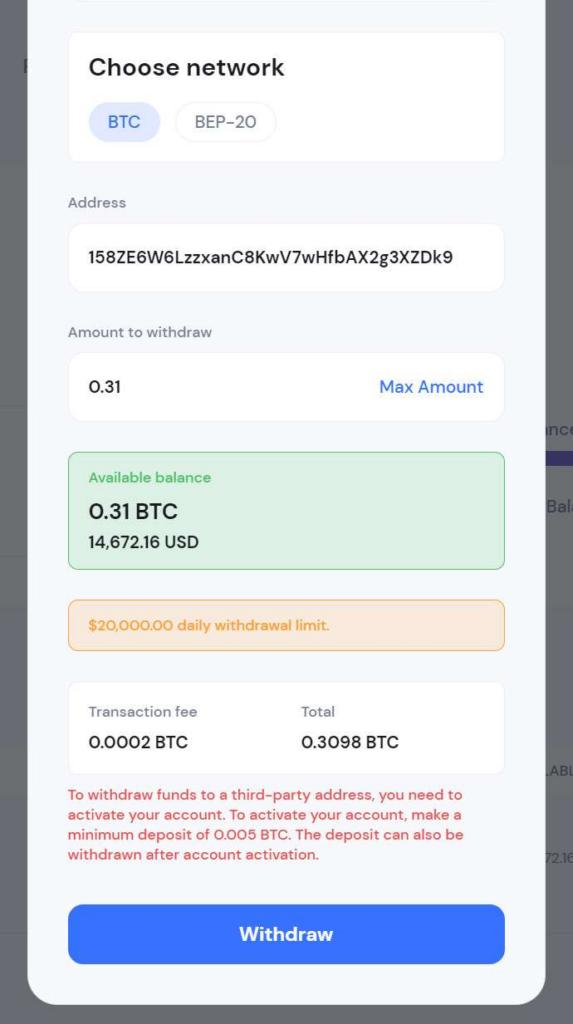
You click Withdraw.
You enter your wallet address.
You expect a smooth cashout.
Instead, a message appears.
The site tells you that your account must be verified first, or that withdrawals are locked, or that wallet validation is required, or that a minimum deposit must be made before payouts can be processed. Investigations and victim reports show that this is one of the most consistent warning signs across fake crypto casino domains.
Notice what the site does not say.
It does not say, “You have been scammed.”
It says, “You are almost there.”
That is deliberate.
The victim is kept hopeful.
Step 7: The “verification deposit” is demanded
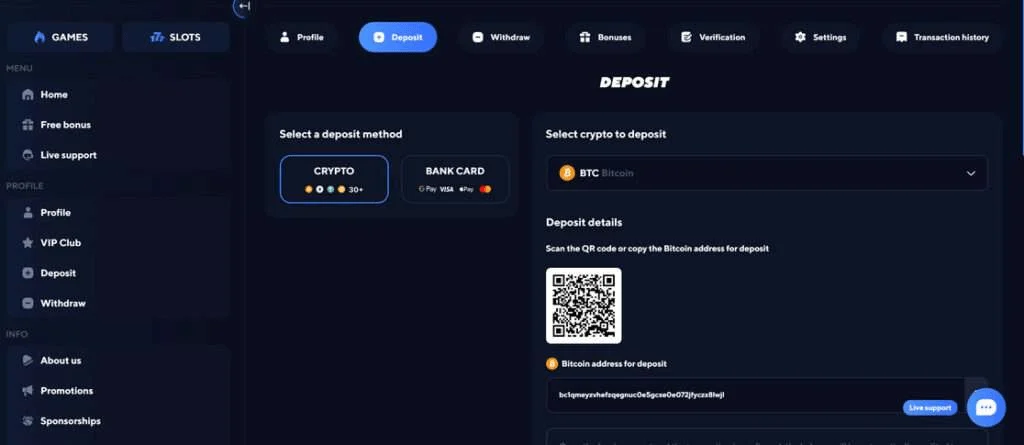
Now the scam asks for real money.
The language may sound technical or official:
- Verification deposit
- Activation fee
- Network fee
- Wallet validation
- Security deposit
- Compliance requirement
- Anti-fraud measure
But this is the core trick.
You are being told to send real cryptocurrency in order to unlock funds that only exist on the site’s interface. Victim reports and investigations describe this as the main extraction step in the scam.
This request can feel strangely convincing because it is framed like a routine security process.
That framing is what traps people.
It transforms a scam demand into something that sounds administrative.
Step 8: If you pay once, the goalposts move
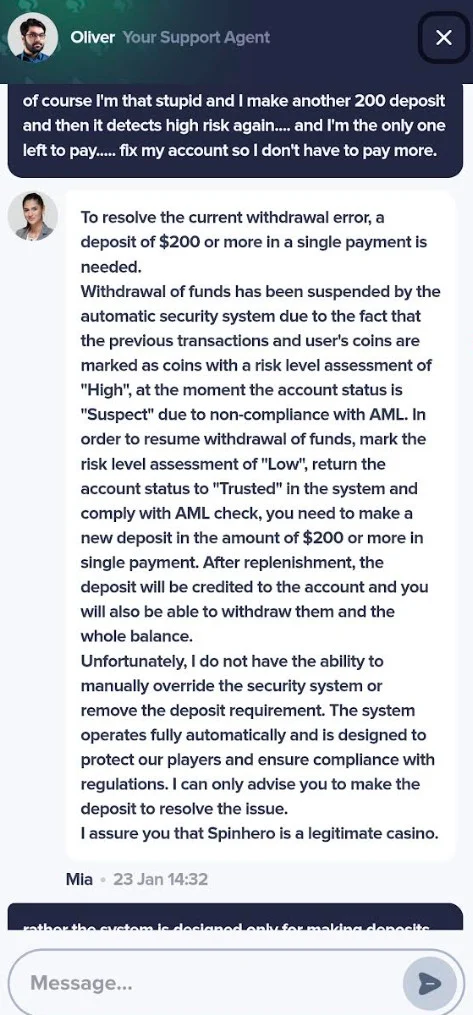
Many victims think the first deposit will solve the problem.
Instead, a new obstacle appears.
Common excuses include:
- Technical issue
- Withdrawal pending
- Wrong network selected
- VIP verification required
- Additional compliance required
- Anti-money laundering review
- Tax withholding needed
- Higher deposit required to unlock withdrawals
This is another hallmark of the scam. Once a victim has shown willingness to pay, the scammers often escalate with more fees, more explanations, and more delays. One investigation cited analysis showing that fully compliant victims could be drained for thousands of dollars through repeated demands.
This is not a glitch. It is the business model.
Step 9: Support keeps hope alive
Another reason the scam works is live chat or support behavior.
Victims often receive quick, calm, professional replies. The support agent does not sound chaotic or aggressive. They sound reassuring. They explain the issue. They promise resolution. They present each new payment as the final step before release of funds. Investigative reporting on Gambler Panel described internal expectations for quick support response times as part of the scam operation.
That support layer matters because it prevents emotional collapse.
If the site simply blocked users and went silent immediately, many victims would recognize the scam faster.
Instead, the chat creates the illusion that there is a real company handling a real account problem.
Step 10: The withdrawal never arrives
Eventually, one of two things happens.
Either the victim stops paying, or the scammers decide there is no more money to extract.
Then the tone changes.
Support slows down. Replies become generic. The account may get restricted. The website may disappear. Or the same layout may reappear under a different domain, ready to target a new wave of victims. Investigations into the broader network indicate that domain rotation is a key part of how these operations continue despite complaints and exposure.
By this point, the victim often realizes the balance was never really theirs.
It was bait.
Why the scam is so effective
This scam works because it combines several manipulation layers into one smooth experience.
It borrows trust
Celebrity names, fake social proof, and professional design do the work of credibility before the victim asks question
It creates ownership
The bonus balance makes the victim feel like they already have something worth claiming.
It rewards early behavior
The games and rising balance make the platform feel responsive and real.
It delays the pain point
The actual money demand happens late, after trust has already formed.
It exploits hope
The platform rarely rejects the victim outright. It frames the problem as temporary and solvable.
That combination is powerful.
It turns a scam into a story the victim wants to believe.
What To Do If You Have Fallen Victim to This Scam
If you sent cryptocurrency to one of these fake casino sites, do not panic.
Move quickly, but stay calm.
Here is the most practical response plan.
- Stop sending money immediately
Do not pay another “verification deposit,” “activation fee,” “network fee,” or “tax” to unlock withdrawals.
If the platform asks for one more payment, assume it is part of the same scam. Federal authorities warn that fraud schemes often rely on upfront payments tied to promised returns, and IC3 specifically advises crypto scam victims to stop engaging and report the fraud.
- Save all evidence before anything disappears
Take screenshots and preserve records now.
Save:
- Your account dashboard
- Bonus balance pages
- Withdrawal error messages
- Support chat logs
- Emails and text messages
- Promo code pages
- Wallet addresses shown on the site
- Transaction hashes
- Dates, times, and amounts sent
IC3’s complaint system and FBI guidance emphasize the importance of preserving transaction details, including wallet addresses, hashes, amounts, and technical metadata where available. (IC3)
- Contact the crypto exchange or service you used
If you sent funds through an exchange, payment service, or wallet provider, contact them right away.
Tell them you believe the transfer was tied to fraud. Ask whether they can flag the destination address, preserve logs, or provide any tracing information that may help your report. The FTC specifically advises victims of crypto scams to contact the exchange company used to send the money.
- Report the scam to IC3
If you are in the United States, file a complaint with the Internet Crime Complaint Center. FBI guidance for crypto scam victims says to report immediately and include as much transaction information as possible.
- Report it to the FTC
You should also submit a report through the FTC’s fraud reporting system. The FTC states that fraud reports help them identify patterns, support enforcement work, and warn the public.
- Be careful with “recovery” offers
This is extremely important.
People who lose money in crypto scams are often targeted again by fake recovery services. IC3 and the FBI warn that recovery scammers may charge upfront fees, pretend to be affiliated with law enforcement or legal services, and then demand more money without actually recovering anything.
If someone says they can get your money back for a fee, be very cautious.
- Secure any accounts you connected
If you reused a password anywhere, change it.
If you shared personal details, wallet information, or email access during the process, review your account security immediately. Enable two-factor authentication where possible and watch for suspicious follow-up messages. While the core scam centers on crypto deposits, scam networks often reuse contact information later for more fraud attempts. This is a cautious inference based on common scam follow-up behavior and the documented presence of secondary recovery scams.
- Warn others if you can
It may feel embarrassing, but speaking up helps.
The FTC encourages consumers to report and share scam information because public awareness helps protect other people from the same trap. Scam victims are often not alone, and your report may help connect a larger pattern.
Even a short review or warning post can make a difference.
- Do not judge yourself too harshly
This kind of scam is engineered to feel real.
It uses trust signals, platform polish, game mechanics, urgency, and hope in a very deliberate sequence. Falling for it does not mean you were careless or foolish. It means you were targeted by a scam designed to manipulate normal human reactions.
That matters.
Because shame keeps people silent, and silence helps these operations keep growing. Investigative reporting on the fake casino ecosystem specifically notes that underreporting and embarrassment help the scammers continue.
The Bottom Line
The fake crypto casino scam is not about gambling.
It is about staged trust, fake balances, and advance-fee extraction.
These sites lure victims in with fake celebrity promotions, oversized promo-code bonuses, polished casino interfaces, and easy early “wins.” But the moment a user tries to withdraw, the trap becomes clear: a verification deposit, activation fee, or some other made-up payment is demanded first. The payout never comes
The brand name may change. The domain may change. The celebrity story may change. But the playbook stays the same.
If a crypto casino gives you a huge bonus, lets you “win” fast, and then asks you to deposit real crypto before you can withdraw, treat it as a scam and stop immediately. That single pattern exposes the whole operation.
If you have already been caught in it, document everything, report it quickly, and do not let a second scam drain you through fake recovery promises.
The most convincing scams no longer look messy or desperate. They look polished. That is exactly why they are dangerous.








