

Vylera Pain Relief Balm is being promoted as a topical balm for back pain, sciatica, stiffness, spasms, hip discomfort, and radiating nerve pain. The sales page makes it sound like a natural solution that can calm irritated nerves, improve movement, and deliver relief without pills or expensive treatments.
Before ordering, buyers should look carefully at the product claims, checkout process, refund promise, and the broader pattern behind these social media pain-relief offers. Vylera raises several concerns, including aggressive health claims, generic herbal balm similarities, discount pressure, possible multi-unit or subscription risks, and refund terms that may be harder to use than the sales page suggests.
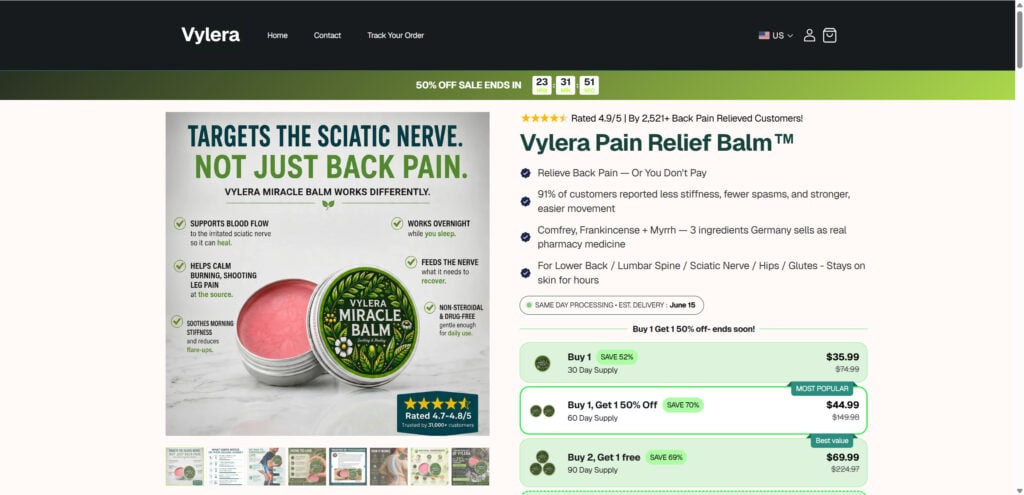
What Is Vylera Pain Relief Balm?
Vylera Pain Relief Balm is sold through Vylera.co as a topical herbal balm for lower back pain and sciatic nerve discomfort. The product page describes it as a balm that should be applied directly to the lower back, hips, glutes, sciatic nerve pathway, or affected area.
The advertised claims include:
- Relief for lower back pain
- Support for sciatic nerve pain
- Less stiffness and fewer spasms
- Easier movement
- Relief in days
- Nerve calming within the first week
- Deeper results after 2 to 6 weeks
- Support for lumbar inflammation
- Support for tight muscles
- “Feeds the nerve’s blood supply”
- “Rebuilds crushed blood vessels”
- “Reduces pain receptors on the nerve”
- 60-day money-back guarantee
- Free shipping
- 50% off sale timer
- Larger-order discounts
The product page says the balm contains ingredients such as comfrey, frankincense, myrrh, Angelica sinensis, Radix Angelicae Dahuricae, sesame oil, peppermint oil, beeswax, and “Fenghuang.”
The issue is not that herbal balms cannot feel soothing. Many topical balms can create warming, cooling, or massage-related relief. Some people may feel temporary comfort from ingredients like peppermint oil, essential oils, or massage application.
The problem is that Vylera is not marketed as a simple comfort balm. It is marketed with strong nerve, disc, blood supply, inflammation, and sciatica claims. That moves the product into a much riskier category.
Why Vylera Raises Red Flags
1. The pain claims are very aggressive
Vylera’s product page does not simply say the balm may soothe sore muscles. It says the balm can calm lumbar inflammation, stabilize irritated nerves, reduce radiating discomfort, quiet sciatic pain, and support the nerve’s blood supply.
Those are serious claims.
Back pain and sciatica can have many causes, including:
- herniated disc
- spinal stenosis
- nerve compression
- muscle strain
- arthritis
- sacroiliac joint problems
- piriformis syndrome
- injury
- infection
- inflammatory disease
- kidney-related pain
- tumor-related pain in rare cases
A topical balm cannot diagnose the cause of back pain or sciatica. If pain is persistent, severe, radiating, associated with weakness, numbness, bladder problems, fever, unexplained weight loss, or worsening symptoms, medical evaluation matters.
A balm may provide temporary surface comfort. It should not be treated as a real fix for nerve compression or disc-related problems.
2. “Feeds the nerve’s blood supply” sounds like pseudoscience marketing
Vylera repeatedly claims that the balm works by feeding the nerve’s blood supply instead of blocking the pain signal.
That is a strange and highly specific biological claim for an over-the-counter topical balm. The page suggests that compression starves the sciatic nerve of oxygen, and that applying the balm helps restore the nerve’s blood supply over time.
This is not how buyers should evaluate a pain product.
If a balm claims to rebuild blood vessels, calm compressed nerves, or reverse the effects of disc compression, the seller should provide strong clinical evidence on the exact finished product. A few ingredient descriptions or customer testimonials are not enough.
3. The page claims comfrey “rebuilds crushed blood vessels”
The product page says comfrey rebuilds microscopic blood vessels that compression crushes around the nerve.
That is an extraordinary claim.
Comfrey has been used historically in topical preparations, and some comfrey products are marketed for minor aches or bruising. But saying it rebuilds crushed blood vessels around compressed nerves is much stronger than ordinary topical comfort language.
Buyers should be skeptical of any product that uses medical-sounding explanations without showing actual clinical testing on the finished formula.
4. The page compares the ingredients to pharmacy medicine
Vylera says comfrey, frankincense, and myrrh are “3 ingredients Germany sells as real pharmacy medicine.”
That wording is designed to make the product feel medically validated. But even if certain herbal preparations are sold in pharmacies in some countries, that does not prove this exact Vylera balm works for back pain, sciatica, nerve compression, or spasms.
Ingredient reputation is not the same as clinical proof for a specific product.
5. The Nanjing University study claim is vague
The page claims that two Nanjing University studies confirmed frankincense and myrrh quiet compressed sciatic nerves.
That sounds scientific, but the visible sales page does not clearly provide enough information for buyers to verify the claim, such as:
- study titles
- authors
- publication dates
- dosage
- whether the study was in humans
- whether it tested the exact Vylera formula
- whether it was topical
- whether it involved compressed sciatic nerves
- whether the results apply to back pain patients
Without clear sourcing, this should be treated as marketing copy.
6. The page contains a brand-name inconsistency
In the FAQ, the page says: “Instead of passing through digestion like pills, Harmovia is applied directly where pain begins.”
That appears to be a copy-and-paste mistake from another product or brand.
This is a major trust issue. If a product page selling Vylera refers to another name, it suggests the page may be built from a reused template. Dropshipping and direct-response supplement funnels often reuse sales copy across multiple products.
When a health product page contains brand-name mistakes, buyers should be cautious.
7. The support email is a Gmail address
The product page lists contact as vylera.store@gmail.com.
A Gmail address does not automatically prove a scam. However, for a product making strong pain-relief claims and offering a 60-day guarantee, buyers should expect clearer business transparency.
A trustworthy health product seller should provide:
- company name
- physical address
- professional support email
- clear return address
- refund policy
- shipping policy
- terms of service
- product labeling details
- manufacturer information
- country of origin
- batch or lot information
A Gmail-only support setup makes accountability harder if there is a refund or subscription problem.
8. The product appears similar to generic herbal pain balms
Vylera’s formula category is not unique. Herbal pain balms, comfrey salves, frankincense and myrrh balms, Chinese herbal oils, muscle rubs, and topical pain creams are widely sold under many names.
Wholesale supplier platforms list many pain relief balms, herbal massage creams, Chinese medicine oils, essential balms, and private-label pain products. These products can be manufactured cheaply, labeled with a new brand name, and sold through social media ads.
That does not prove the exact Vylera jar is fake. But it does suggest the product may belong to a generic private-label category rather than being a unique medical breakthrough.
9. Social media ads can make the product look more credible than it is
The user flagged Vylera as being sold through fake or exaggerated social media ads. That fits a common pattern for pain-relief products.
These ads often use:
- dramatic before-and-after stories
- fake doctor-style authority
- emotional testimonials
- “ancient remedy” claims
- secret ingredient stories
- “pharmacies don’t want you to know” messaging
- fake urgency
- discount countdowns
- exaggerated customer review numbers
- claims that the product works better than pills or injections
These tactics are designed to make buyers act quickly, especially people dealing with real pain.
Pain is a strong emotional trigger. If someone has sciatica or back pain, they may be willing to try almost anything. That is exactly why these ads work.
10. The 60-day guarantee may not be as safe as it sounds
Vylera’s page says buyers can try the balm for 60 days and get every cent refunded if they are not satisfied. It also says “no questions asked,” “no hoops,” and “no hassle.”
That sounds reassuring. But buyers should not rely only on guarantee text shown on a product page. The real test is whether the seller has a clear refund policy, a professional support process, and a reliable return system.
With dropshipping-style health products, buyers often report that refund promises become difficult in practice. Problems may include:
- support delays
- automated email replies
- partial refund offers
- requests for photos or videos
- refusal to refund opened products
- unclear return address
- international return shipping
- no refund of shipping charges
- support disappearing after purchase
For a topical balm, the refund issue is especially important. You cannot know whether it works without opening and using it. If the seller later claims opened products are not returnable, the guarantee becomes much less useful.
11. Buyers may receive multiple units
Vylera’s FAQ says one jar lasts around 3 to 4 weeks and recommends “stocking up,” because larger orders come with bigger discounts.
That is a classic funnel tactic. Instead of simply selling one jar, the page encourages multi-jar purchases before the buyer knows whether the product works.
This creates several risks:
- buyers may order more jars than intended
- the checkout may highlight larger bundles
- upsells may appear after payment
- the final charge may be higher than expected
- extra units may be difficult to return
- opened products may be rejected for refunds
Before paying, buyers should check the final quantity and total price carefully.
12. Unwanted subscription risk should be checked at checkout
I did not find clear subscription wording on the visible Vylera product page. However, the user specifically flagged unwanted subscription risk, and this is common in social media health-product funnels.
Buyers should inspect the checkout for:
- Subscribe and Save
- auto-refill
- recurring billing
- monthly shipment
- VIP membership
- future shipments
- “keep me stocked”
- reorder plan
- continuity program
- post-purchase one-click offers
- extended warranty or membership add-ons
Do not assume an order is one-time until the final checkout page clearly confirms it.
If the seller uses a post-purchase upsell flow, do not click additional offers unless you truly want them.
How the Vylera Sales Funnel Appears to Work
Step 1: The ad targets people with real pain
The marketing focuses on lower back pain, sciatica, stiffness, spasms, hip pain, and radiating discomfort.
This audience is highly motivated. Back pain can affect sleep, work, walking, driving, and daily life. A balm that promises relief without pills or doctor visits sounds appealing.
Step 2: The product uses a “root cause” story
Vylera says the problem is not simply pain signals. The page claims compression starves the nerve of blood and oxygen, and the balm helps feed the nerve so it stops firing.
This gives the buyer a simple explanation for their pain and makes the product sound deeper than a normal muscle rub.
The problem is that this explanation is not supported on the page with convincing clinical evidence.
Step 3: Ancient ingredients create trust
The page references Roman soldiers, Chinese doctors, frankincense, myrrh, angelica root, beeswax, and ancient civilizations.
This makes the product feel natural, time-tested, and safer than modern pain medication.
But historical use does not prove that a specific balm can treat sciatica or nerve compression.
Step 4: Testimonials reduce skepticism
The page shows customer stories from people claiming their back pain improved after using the balm.
Testimonials can be persuasive, but they are not proof. They are seller-controlled and may not represent typical results.
Step 5: Discounts and timers push fast decisions
The page uses a 50% off sale timer and “people are viewing this product” messaging.
These are urgency tactics. They encourage buyers to act before comparing similar balms, checking policies, or asking whether the claims make medical sense.
Step 6: Bundles may increase the order value
The page recommends stocking up and says larger orders save more. That can push buyers into buying multiple jars before testing one.
This is risky because if the balm does not work, the buyer may be stuck with several jars and a difficult refund process.
Main Red Flags
- Strong claims around back pain, sciatica, spasms, nerve pain, and lumbar inflammation.
- Claims the balm “feeds the nerve’s blood supply.”
- Claims comfrey rebuilds crushed microscopic blood vessels.
- Claims frankincense and myrrh reduce pain receptors on the nerve.
- Mentions studies without clear study details on the page.
- Uses ancient-remedy storytelling.
- Uses 50% off sale timer and urgency messaging.
- Shows large customer review counts and seller-controlled testimonials.
- Page contains a brand-name inconsistency: “Harmovia” appears in the FAQ.
- Contact is a Gmail address.
- Similar herbal pain balms are widely available as private-label products.
- The page encourages stocking up with larger orders.
- Buyers may risk multiple-unit purchases through bundles or upsells.
- Buyers should check carefully for auto-refill or subscription terms.
- Refund promise may be difficult to enforce if support is poor or opened products are disputed.
Is Vylera Pain Relief Balm a Scam?
Vylera may ship a real topical balm, so this may not be a simple “pay and receive nothing” scam.
The bigger issue is the marketing.
A fair conclusion is this: Vylera Pain Relief Balm appears to be a high-risk social media pain-relief offer because it combines aggressive back pain and sciatica claims, generic herbal balm signals, urgency discounts, seller-controlled testimonials, limited business transparency, and possible checkout risks involving bundles, upsells, or unwanted refills.
The balm may feel soothing for some users. It may provide temporary warmth, cooling, massage-related comfort, or mild topical relief. But buyers should not treat it as a proven solution for sciatica, disc compression, nerve damage, chronic back pain, or muscle spasms.
What Vylera May Actually Help With
Vylera may help some buyers with:
- mild temporary soreness
- massage-related relief
- skin-level warming or cooling sensation
- short-term comfort
- muscle tightness
- minor aches after activity
- relaxation before sleep
Vylera is unlikely to truly fix:
- herniated discs
- nerve compression
- spinal stenosis
- severe sciatica
- numbness or weakness
- chronic inflammatory back disease
- serious injury
- spinal instability
- pain caused by infection or tumor
- progressive neurological symptoms
If symptoms are serious or worsening, do not rely on a topical balm.
Safety Concerns Buyers Should Consider
Do not use Vylera or any topical balm on:
- broken skin
- open wounds
- infected skin
- rashes
- burns
- irritated skin
- areas with severe swelling
- mucous membranes
- near the eyes
- skin recently treated with heat or harsh chemicals
Stop using it if you notice:
- burning
- rash
- itching
- swelling
- blistering
- dizziness
- breathing difficulty
- worsening pain
- numbness
- skin discoloration
Be especially cautious with herbal products if you are pregnant, breastfeeding, taking medication, have allergies, have liver disease, or are applying the balm frequently over large areas.
Comfrey is a particular ingredient buyers should research carefully. Oral comfrey has known safety concerns, and topical comfrey should be used cautiously, especially if the product does not clearly state whether it is PA-free.
When to See a Doctor Instead
Seek medical care promptly if back pain includes:
- leg weakness
- numbness in the groin area
- loss of bladder or bowel control
- fever
- unexplained weight loss
- severe night pain
- pain after trauma
- progressive numbness
- severe radiating pain
- symptoms lasting more than a few weeks
- pain with a history of cancer
- pain with immune suppression
- pain with IV drug use
These symptoms should not be treated with an online balm.
What To Do Before Buying
1. Check the checkout page carefully
Before paying, confirm:
- exact number of jars
- final price
- shipping cost
- tax
- discount applied
- whether a subscription is selected
- whether auto-refill is active
- whether any membership is added
- whether any post-purchase offer appears
- merchant name on the charge
Take screenshots.
2. Avoid bundles first
Do not buy several jars before testing one. If it does not work, extra jars make the refund problem worse.
3. Ask support questions before ordering
Email support and ask:
- Is this a one-time purchase?
- Are there any automatic refills?
- Are opened jars refundable?
- Who pays return shipping?
- Where is the return address?
- Where is the product manufactured?
- Is the comfrey PA-free?
- Can you provide third-party testing?
- Can you provide clinical evidence for sciatica claims?
If the answers are vague, consider that a warning sign.
4. Compare similar products
Search for:
- herbal pain relief balm
- comfrey frankincense myrrh balm
- Chinese herbal pain relief cream
- topical nerve pain balm
- private label pain relief balm
- OEM herbal pain balm
- comfrey salve back pain
If similar products are much cheaper elsewhere, slow down before buying.
5. Use a protected payment method
Use a credit card or PayPal when possible. Avoid payment methods that make disputes difficult.
What To Do If You Already Ordered
1. Check your confirmation email
Look for:
- number of jars ordered
- total amount charged
- shipping cost
- subscription language
- next billing date
- merchant name
- order number
- support email
2. Cancel immediately if you see refills
If you see any auto-refill, subscription, or membership language, email support immediately.
Use clear wording:
“I am canceling all subscriptions, auto-refills, memberships, recurring billing, and future shipments connected to this order. Please confirm in writing that no future charges will occur.”
3. Save proof
Save:
- product page screenshots
- pain-relief claims
- guarantee wording
- checkout page
- order confirmation
- payment statement
- support emails
- shipping/tracking page
- photos of the product
4. Do not open every jar
If you ordered multiple jars and may request a refund, keep extra jars sealed.
5. Patch test first
Apply a small amount to a small area first. Wait to see if irritation occurs before using it on a larger area.
6. Request a refund in writing
If it does not work as advertised, use direct wording:
“The product was advertised as pain relief for back pain and sciatica, but it did not perform as claimed. I am requesting a full refund under the advertised 60-day guarantee.”
7. Dispute if necessary
Contact your bank, credit card issuer, or PayPal if:
- you were enrolled in a subscription without clear consent
- you were charged again after cancellation
- you were charged for more units than ordered
- the product never arrives
- the seller refuses the advertised guarantee
- support does not respond
- the product is not as advertised
- the refund process is unreasonable
Use clear wording such as:
- “item not as described”
- “unauthorized recurring charge”
- “subscription not clearly disclosed”
- “unauthorized quantity charged”
- “merchant refuses advertised refund”
- “misleading pain-relief claims”
FAQ
What is Vylera Pain Relief Balm?
Vylera Pain Relief Balm is a topical herbal balm marketed for lower back pain, sciatica, stiffness, spasms, hip pain, and nerve-related discomfort.
Is Vylera a scam?
Vylera may ship a real balm, but the offer has several red flags: aggressive pain-relief claims, seller-controlled testimonials, generic product similarities, Gmail support, copywriting errors, and possible checkout risks involving bundles or refills.
Does Vylera really help sciatica?
Be cautious. A topical balm may provide temporary comfort, but sciatica is often related to nerve irritation or compression. A balm should not be treated as a proven sciatica treatment.
Can Vylera rebuild blood vessels around nerves?
That claim should be treated skeptically. The sales page does not provide clear clinical proof that the exact balm rebuilds crushed blood vessels or restores nerve blood supply.
Is Vylera made in China?
The product page does not clearly prove manufacturing origin. However, similar herbal pain balms are widely available from China-based suppliers and private-label manufacturers, which raises generic sourcing concerns.
Can buyers receive multiple jars?
Yes, that is a risk with bundle-based funnels. Vylera encourages stocking up and larger orders. Buyers should check the cart carefully before paying.
Does Vylera have unwanted subscriptions?
The visible product page does not clearly show subscription terms, but buyers should inspect checkout for auto-refill, VIP membership, recurring billing, or post-purchase upsells.
Is the 60-day guarantee reliable?
The page advertises a 60-day no-questions guarantee, but buyers should still confirm whether opened jars are refundable, who pays return shipping, and where returns must be sent.
Is comfrey safe?
Comfrey has known safety concerns, especially when taken orally. Topical use should be cautious, and buyers should look for PA-free testing and avoid broken skin or long-term heavy use.
Should I buy Vylera?
Be cautious. If you still want to try it, buy only one jar, avoid subscriptions, screenshot the checkout, patch test first, and do not use it as a substitute for medical care.
The Bottom Line
Vylera Pain Relief Balm is marketed as a natural balm for lower back pain, sciatica, spasms, stiffness, and radiating nerve discomfort. The product may ship and may provide temporary topical comfort for some users.
The warning signs are significant. The page uses strong nerve and blood-supply claims, ancient-remedy storytelling, large review numbers, urgency marketing, a Gmail support address, and copywriting mistakes that suggest a reused sales-page template. Similar herbal balms are widely available through generic supplier channels, and buyers should be alert for bundles, upsells, or unwanted refills.
Vylera should be treated as a topical comfort balm, not a proven medical solution for sciatica or chronic back pain. If you order, buy only one jar, avoid any recurring option, document the checkout, and be ready to dispute the charge if the advertised guarantee is not honored








