

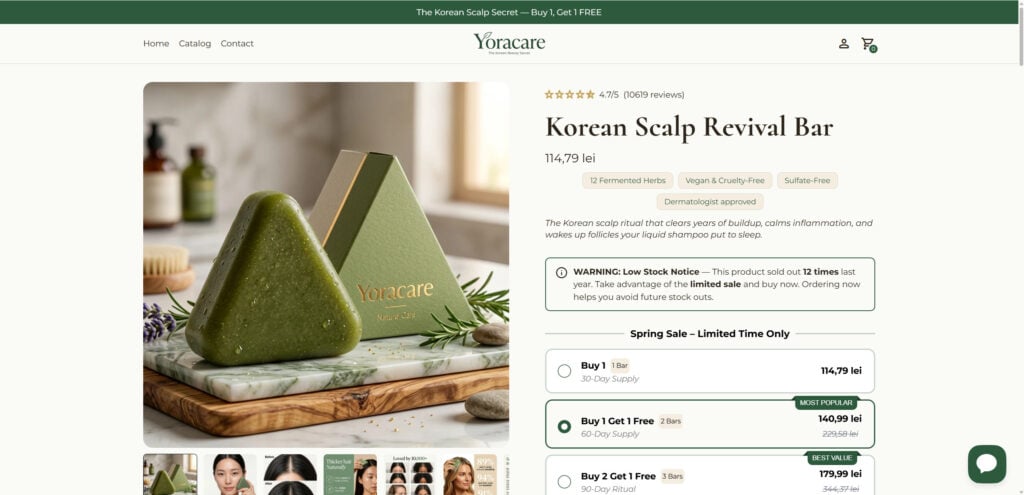
The Yoracare Korean Scalp Revival Bar is marketed as a “Korean scalp ritual” for buildup, shedding, thinning hair, scalp inflammation, and weak follicles. The offer is built around a simple promise: switch from liquid shampoo to a concentrated herbal bar and see healthier, thicker-looking hair over time.
Before ordering, buyers should look closely at the claims, refund policy, product similarities, and checkout risks. The product raises several red flags commonly seen in dropshipping-style beauty funnels, including exaggerated hair-growth claims, “Korean secret” marketing, low-stock pressure, reused sales copy across multiple sites, generic shampoo-bar similarities, and return terms that may make refunds difficult once the product is opened or used.
What Is the Yoracare Korean Scalp Revival Bar?
The Yoracare Korean Scalp Revival Bar is a solid shampoo-style bar sold on Yoracare.com. It is promoted as a scalp-first haircare product made with “12 fermented Korean herbs.”
The product page claims it can:
- clear years of scalp buildup
- calm inflammation
- “wake up” follicles
- reduce shedding
- help baby hairs appear
- improve scalp health
- make existing serums absorb better
- support thicker-looking hair
- work for women and men
- work for all hair types
- provide visible results in 6–8 weeks
- deliver full results in 3–6 months
- be safe during pregnancy and breastfeeding
- replace water-filled liquid shampoo
The page lists the bar at $24.99, reduced from $40, and uses urgency language such as “Buy 1, Get 1 FREE,” “low stock,” and claims that the product sold out 12 times last year.
The product may clean the scalp like a shampoo bar. It may also contain botanical oils and extracts that some users enjoy. But the marketing goes much further than ordinary hair cleansing. It suggests the bar can help with shedding, dormant follicles, postpartum hair loss, and visible regrowth.
That is where buyers should be careful.
Why Yoracare Raises Red Flags
1. The hair-growth claims are too strong for a shampoo bar
Yoracare is not simply marketed as a shampoo bar. It is marketed as a scalp treatment that can clear buildup, calm inflammation, wake dormant follicles, reduce shedding, and help hair grow.
Those are serious claims for a rinse-off product.
Hair shedding and thinning can be caused by many different issues, including:
- androgenetic alopecia
- postpartum shedding
- iron deficiency
- thyroid problems
- stress
- rapid weight loss
- scalp inflammation
- autoimmune conditions
- medication side effects
- hormonal changes
- traction hairstyles
- fungal infection
- genetics
A shampoo bar cannot diagnose the cause of hair loss. It also cannot reliably reverse follicle miniaturization, hormonal hair loss, autoimmune hair loss, or nutritional deficiency-related shedding.
A gentle shampoo can support scalp hygiene. It cannot be treated as a proven hair-regrowth medication.
2. “Wakes up follicles” is marketing language
Yoracare repeatedly uses language about “waking up” follicles that liquid shampoo supposedly put to sleep.
That phrase sounds scientific, but it is vague.
Hair follicles do not simply fall asleep because of liquid shampoo. Hair growth cycles are influenced by genetics, hormones, inflammation, nutrition, health conditions, medications, and scalp environment.
If the product claims to reactivate follicles, reduce shedding, and produce baby hairs, buyers should expect clinical evidence on the exact finished product. A list of herbs and customer testimonials is not enough.
3. The “Korean scalp secret” angle feels like a sales hook
The page frames the product around “Korean scalp science,” “Korean scalp ritual,” and “12 fermented Korean herbs.”
K-beauty is popular, and scalp care can be a legitimate category. But “Korean secret” language is often used in direct-response beauty funnels to make a generic product feel more exotic, premium, and culturally validated.
The issue is not whether Korean scalp care exists. The issue is whether this exact bar has credible evidence behind its claims.
4. The page uses aggressive emotional testimonials
Yoracare displays testimonials from women claiming they tried Rogaine, biotin, rosemary oil, expensive serums, and nothing worked until this bar. One testimonial discusses postpartum hair loss and says the part line narrowed and ponytail felt fuller.
That is persuasive, but it is not clinical proof.
Testimonials can be selected, edited, copied, or difficult to verify. They also do not prove typical results. Hair shedding can naturally improve over time, especially postpartum shedding, which often resolves as the hair cycle normalizes.
When a seller uses emotional hair-loss stories, buyers should ask whether the product has real controlled testing.
5. The review count is difficult to verify
Yoracare claims a 4.7/5 rating from more than 10,000 reviews and says the product is loved by 10,000+ women.
Large review numbers can make the product feel established, but seller-controlled reviews should be treated cautiously. A product page can display handpicked reviews, imported reviews, or review widgets that are hard for buyers to independently verify.
The page also uses percentage claims such as:
- 89% said it visibly reduced shedding
- 94% said their scalp felt healthier
- 91% said they would not go back to liquid shampoo
Those numbers sound like a study, but the page does not clearly explain the sample size, methods, controls, duration, or whether the results were independently verified.
6. “Safe during pregnancy and breastfeeding” is too broad
Yoracare says the bar is safe during pregnancy and breastfeeding because it contains natural, plant-derived ingredients and no pharmaceuticals or hormones.
That is a broad safety claim.
“Natural” does not automatically mean safe for everyone. Essential oils, herbal extracts, and botanical ingredients can cause irritation, allergic reactions, or sensitivity. Pregnancy and breastfeeding safety should not be assumed simply because a product is plant-based.
Anyone pregnant, breastfeeding, or dealing with postpartum hair loss should be careful with products making broad safety and regrowth claims.
7. The product is sold on multiple sites with similar copy
The same or very similar “Korean Scalp Revival Bar” appears on multiple websites and marketplaces, including Yoracare, MoonWhite, Cleara, Amazon-style listings, and other shopping pages.
Some sites use nearly the same claims:
- 12 fermented herbs
- sulfate-free
- vegan and cruelty-free
- clears buildup
- calms inflammation
- wakes up follicles
- visible results
- 60-day guarantee
- low-stock messaging
- buy-one-get-one style offers
That is a major dropshipping/private-label red flag.
When the same product name, images, and claims appear across different sites, buyers may not know:
- who actually owns the product
- which seller handles support
- where the product is manufactured
- where returns go
- whether the reviews are copied
- whether the formula is identical
- whether the brand is real or temporary
- whether the product is simply being resold under different storefronts
This is common with viral beauty products pushed through social media ads.
8. Similar shampoo bars are extremely cheap from suppliers
Solid shampoo bars, herbal hair soaps, “hair growth” bars, rice water shampoo bars, rosemary bars, ginseng bars, and anti-hair-loss herbal soap bars are widely available from Chinese wholesale and private-label suppliers.
Many supplier listings show similar product categories at very low unit prices, often with custom branding and bulk ordering options.
That does not prove the exact Yoracare bar comes from one specific supplier. But it does support the broader concern: this product category is easy to source cheaply, rebrand, and sell as a premium “Korean scalp ritual.”
A cheap herbal shampoo bar can be turned into a high-margin viral product by adding:
- K-beauty language
- before-and-after claims
- fake scarcity
- review widgets
- emotional hair-loss testimonials
- “dermatologist approved” wording
- bundle discounts
- a polished Shopify page
The product may be real, but the perceived value may be inflated.
9. The “dermatologist approved” claim is not properly explained
Yoracare says the bar is “dermatologist approved.” But the page does not clearly show:
- the dermatologist’s name
- qualifications
- location
- disclosure of payment
- test protocol
- whether the dermatologist tested the final product
- whether the claim applies to safety only or hair-growth results
- whether it was an independent evaluation
Without that detail, “dermatologist approved” is just a trust-building phrase.
10. The refund policy excludes opened or used skincare/cosmetic products
This is one of the biggest issues.
The product page promotes a 60-day money-back guarantee and says buyers can return it for a full refund if not satisfied.
But Yoracare’s refund policy says items must be unused, with tags, and in original packaging. It also says opened or used skincare/cosmetic products are not eligible for return or refund for hygiene and safety reasons.
That creates a practical contradiction.
A buyer cannot know whether the bar reduces shedding, improves scalp health, or helps with hair growth without opening and using it for weeks. But once opened or used, the refund policy may make the product ineligible.
So the “60-day guarantee” may be much weaker than it looks.
11. Return shipping is the customer’s responsibility
Yoracare’s policy says customers must contact support before returning an item. If approved, the customer receives instructions on where to send the package, and return shipping costs are the customer’s responsibility.
That creates refund friction.
For a low-cost beauty product, paying return shipping may not be worth it. If the return address is inconvenient or international, the refund may become impractical.
12. The business details are not very reassuring
Yoracare lists a contact email and a Miami address, while its terms say the governing law is France. The site is powered by Shopify and uses standard ecommerce policy language.
This does not automatically prove wrongdoing. But for a product making strong hair-growth and shedding claims, buyers should expect stronger business transparency, including:
- clear company registration
- manufacturer details
- country of origin
- product label photos
- batch information
- third-party testing
- real dermatologist verification
- clear return address
- independent clinical evidence
Those details are not clearly presented on the product page.
13. The site uses urgency pressure
Yoracare uses messaging such as:
- Buy 1, Get 1 FREE
- low stock notice
- sold out 12 times last year
- limited sale
- avoid future stockouts
This is classic direct-response marketing. It pushes buyers to order quickly before they verify claims, compare similar products, or read the refund policy.
Hair-loss anxiety makes this more effective. Someone worried about shedding may act quickly if they believe the product is about to sell out.
14. Buyers may receive multiple bars
Yoracare’s headline promotes “Buy 1, Get 1 FREE.” Other sites selling the same bar promote bundles such as 2 bars, 4 bars, or 120-day rituals.
Multi-bar offers create several risks:
- buyers may order more units than intended
- checkout may preselect a bundle
- one-click upsells may appear after payment
- the final charge may be higher than expected
- extra bars may not be returnable if opened
- the seller may reject returns because personal-care products are used or unsealed
If you only want to test the product, do not buy a large bundle first.
15. Unwanted subscription risk should be checked at checkout
I did not find clear subscription language on the visible Yoracare product page. However, this type of beauty funnel often uses email opt-ins, post-purchase upsells, refill offers, VIP clubs, or recurring shipment options.
Before paying, buyers should inspect the checkout for:
- Subscribe and Save
- auto-refill
- monthly shipment
- membership
- VIP discount
- future delivery
- recurring billing
- hidden add-ons
- one-click post-purchase offers
- shipping protection
- mystery products
If you only want a one-time purchase, make sure the checkout clearly says so.
How the Yoracare Sales Funnel Appears to Work
Step 1: The ad targets hair-loss anxiety
Hair shedding is emotional. It affects confidence, identity, and self-image. Yoracare’s messaging speaks directly to people worried about widening parts, shower-drain hair, postpartum shedding, and thinning hair.
Step 2: The product offers a simple “root cause” explanation
The page suggests the problem is not your hair, but your scalp. It says liquid shampoos leave buildup, trigger inflammation, block follicles, and prevent hair products from working.
That story is simple and persuasive. But it also oversimplifies hair loss.
Step 3: The bar is positioned as a missing first step
Yoracare says the bar clears buildup and opens follicles so serums like The Ordinary or Vegamour can actually reach the scalp.
That makes the product feel necessary even for people already using other products. It turns the bar into an add-on purchase rather than just a shampoo.
Step 4: Testimonials create emotional proof
The page uses stories from women claiming visible baby hairs, narrower parts, and reduced shedding.
These stories are designed to reduce skepticism. But they are not a substitute for independent clinical data.
Step 5: Urgency and BOGO increase conversions
The “Buy 1, Get 1 FREE” offer and low-stock warning push buyers to order quickly and buy more than one unit before testing the product.
Step 6: The refund policy creates friction later
If the buyer opens and uses the bar, the written refund policy may exclude the product as an opened or used cosmetic item.
That is the key risk: the guarantee sounds broad, but the policy gives the seller a way to deny refunds after real-world use.
Main Red Flags
- Marketed with hair-growth and anti-shedding claims.
- Claims to “wake up” follicles.
- Claims liquid shampoo causes chronic scalp inflammation.
- Claims visible results in 6–8 weeks.
- Uses emotional postpartum and hair-loss testimonials.
- Claims 4.7/5 from 10,619 reviews.
- Uses percentage claims without clear study details.
- Says it is safe during pregnancy and breastfeeding.
- Uses “dermatologist approved” wording without clear proof.
- Same or similar product appears on multiple websites.
- Similar herbal shampoo bars are available cheaply from suppliers.
- Uses “Korean scalp secret” and “12 fermented herbs” branding.
- Uses low-stock and sold-out urgency.
- Promotes Buy 1, Get 1 Free.
- Refund policy excludes opened or used skincare/cosmetic products.
- Customer pays return shipping.
- Buyers should check carefully for upsells, bundles, or recurring billing.
Is Yoracare Korean Scalp Revival Bar a Scam?
Yoracare may ship a real shampoo bar, so this may not be a simple “pay and receive nothing” scam.
The concern is the marketing and refund structure.
A fair conclusion is this: the Yoracare Korean Scalp Revival Bar appears to be a high-risk dropshipping-style beauty offer because it combines aggressive hair-loss claims, generic shampoo-bar similarities, multiple-site resale signals, urgency marketing, emotional testimonials, and refund terms that may block returns after the product is opened or used.
The bar may clean the scalp. It may make hair feel fresher, less oily, or less weighed down. Some users may like it as a shampoo bar.
But buyers should not treat it as a proven solution for hair loss, postpartum shedding, androgenetic alopecia, or dormant follicles.
What Yoracare May Actually Help With
Yoracare may help some users with:
- scalp cleansing
- oil reduction
- product buildup removal
- fresher scalp feeling
- mild flaking from buildup
- lightweight hair feel
- travel-friendly shampoo use
- reduced residue compared with some heavy shampoos
Yoracare is unlikely to reliably fix:
- genetic hair loss
- androgenetic alopecia
- postpartum shedding
- thyroid-related shedding
- iron deficiency hair loss
- autoimmune hair loss
- traction alopecia
- scalp infections
- severe dandruff or seborrheic dermatitis
- true follicle miniaturization
- long-term hormonal hair thinning
If hair loss is persistent, sudden, patchy, painful, or associated with scalp redness, scaling, or itching, a dermatologist is a better option than an online shampoo bar.
Safety Concerns Buyers Should Consider
A shampoo bar can still cause irritation. Yoracare contains many botanical extracts and essential oils, including rosemary, peppermint, tea tree, ginger, frankincense, cedarwood, and lemongrass-related ingredients.
These may irritate sensitive scalps.
Stop using it if you notice:
- burning
- itching
- redness
- rash
- scalp tenderness
- increased flaking
- swelling
- worsening shedding
- eye irritation
- allergic reaction
Be careful if you have:
- eczema
- psoriasis
- seborrheic dermatitis
- scalp wounds
- sensitive skin
- fragrance sensitivity
- essential oil allergies
- pregnancy or breastfeeding concerns
- recent scalp procedures
Natural ingredients can still irritate the skin.
What To Do Before Buying
1. Do not buy it as a hair-loss treatment
Treat it as a shampoo bar. Do not buy it expecting regrowth.
2. Avoid bundles first
Do not buy multiple bars until you know whether your scalp tolerates the product.
3. Read the refund policy
Do not rely only on the 60-day guarantee. Check whether opened or used products qualify. On Yoracare’s policy page, opened or used skincare/cosmetic products are excluded.
4. Compare similar products
Search for:
- Korean Scalp Revival Bar
- herbal shampoo bar
- solid shampoo bar hair growth
- green soap for hair
- rosemary amino acid shampoo bar
- Yoracare alternative
- Korean scalp shampoo bar
- private label shampoo bar
- Alibaba herbal hair soap
If very similar products are sold under multiple names, be cautious.
5. Ask support direct questions
Before ordering, email support and ask:
- Is this a one-time purchase?
- Are there any automatic refills?
- Are opened bars refundable?
- Where are returns sent?
- Who pays return shipping?
- Where is the product manufactured?
- Who approved the “dermatologist approved” claim?
- Can you provide clinical testing on this exact bar?
If the answers are vague, consider that a warning sign.
6. Screenshot everything
Save screenshots of:
- product claims
- guarantee wording
- review count
- low-stock warning
- checkout page
- selected quantity
- total price
- return policy
- shipping policy
- support contact
This helps if you need a dispute later.
What To Do If You Already Ordered
1. Check the order confirmation
Confirm:
- how many bars were ordered
- total amount charged
- shipping cost
- discount applied
- whether any extra products were added
- whether any subscription or refill appears
- merchant name on the charge
2. Cancel fast if needed
If you ordered by mistake or bought multiple bars unintentionally, contact support immediately.
Use clear wording:
“I am requesting immediate cancellation of this order and a refund to my original payment method. Do not ship additional items or enroll me in any recurring plan.”
3. Save all evidence
Save:
- product page screenshots
- guarantee claims
- review claims
- order confirmation
- payment receipt
- return policy
- tracking information
- support emails
4. Do not open every bar
If you received multiple bars, keep extras sealed. Opened or used products may not qualify for return.
5. Patch test first
Use a small amount on a limited scalp area first, especially if you have sensitive skin or react to essential oils.
6. Stop if irritation occurs
If your scalp burns, itches, becomes red, flakes more, or sheds more, stop using it and document the reaction.
7. Request a refund quickly
Use direct wording:
“The product does not match the advertised claims. I am requesting a refund under the 60-day guarantee shown on the product page.”
8. Dispute if necessary
Contact your bank, credit card issuer, or PayPal if:
- the product never arrives
- you were charged for more units than ordered
- a subscription charge appears
- the seller refuses the advertised guarantee
- the return policy contradicts the sales page
- the product is not as advertised
- support does not respond
Use clear dispute wording such as:
- “item not as described”
- “merchant refuses advertised refund”
- “return policy contradicts sales page”
- “unauthorized quantity charged”
- “unauthorized recurring billing”
- “misleading hair-growth claims”
FAQ
What is the Yoracare Korean Scalp Revival Bar?
It is a solid shampoo-style bar marketed for scalp buildup, shedding, thinning hair, and healthier-looking hair.
Is Yoracare a scam?
Yoracare may ship a real product, but the offer has several red flags: aggressive hair-growth claims, generic product similarities, multiple-site resale signals, low-stock pressure, and refund terms that exclude opened or used cosmetics.
Does Yoracare really regrow hair?
Be cautious. A shampoo bar may clean the scalp and improve how hair feels, but it should not be treated as a proven hair-regrowth treatment.
Can Yoracare stop shedding?
It may reduce breakage or make the scalp feel cleaner for some users, but shedding can have many causes. Persistent shedding should be evaluated by a dermatologist.
Is Yoracare made in Korea?
The product is marketed with Korean scalp-care language, but the visible product page does not clearly prove that it is manufactured in Korea.
Is Yoracare a cheap China product?
The exact manufacturer is not clearly disclosed on the visible page. However, very similar herbal shampoo bars and “hair growth” bars are widely available from China-based suppliers and marketplaces, which supports the generic/private-label concern.
Why is the 60-day guarantee concerning?
The product page promotes a 60-day guarantee, but Yoracare’s refund policy says opened or used skincare/cosmetic products are not eligible for return or refund.
Can I return Yoracare after using it?
That may be difficult. The refund policy excludes opened or used skincare/cosmetic products.
Is there a subscription risk?
The visible product page does not clearly show a subscription plan, but buyers should still check checkout for auto-refill, memberships, or post-purchase upsells.
Should I buy Yoracare?
Be cautious. If you still want to try it, buy only one order, avoid bundles, screenshot the checkout, keep extra bars sealed, and do not rely on it as a medical hair-loss treatment.
The Bottom Line
The Yoracare Korean Scalp Revival Bar is promoted as a concentrated herbal shampoo bar that can clear scalp buildup, reduce shedding, wake follicles, and support thicker-looking hair. It may work as a cleansing bar, and some buyers may like the feel of it.
The problem is the gap between ordinary shampoo-bar benefits and the stronger hair-loss claims used to sell it. The product appears across multiple sites, resembles cheap private-label shampoo bars, uses urgency marketing, displays large review claims, and relies on a 60-day guarantee that may be weakened by refund terms excluding opened or used cosmetic products.
Treat Yoracare as a shampoo bar, not a proven hair-regrowth solution. If your hair loss is sudden, severe, patchy, postpartum, hormonal, or persistent, speak with a dermatologist instead of relying on a viral social media product.
10 SEO Titles
- Yoracare Korean Scalp Revival Bar Review: Scam or Legit?
- Yoracare Scam Warning: Korean Scalp Revival Bar Claims Exposed
- Yoracare Korean Scalp Bar Review: Hair Growth Claims vs Reality
- Is Yoracare Legit or a Dropshipping Shampoo Bar?
- Yoracare Korean Scalp Revival Bar Exposed: Refunds, Claims, and Red Flags
- Yoracare Hair Growth Bar Scam? Read This Before Buying
- Yoracare Shampoo Bar Review: Generic China Product or Real K-Beauty?
- Yoracare 60-Day Guarantee Warning: Returns May Be Hard After Use
- Korean Scalp Revival Bar Review: Multiple Sites, Big Claims, and Buyer Risks
- Yoracare Hair Loss Bar Exposed: Viral Shampoo Claims Under Review








