

ShapeOil is marketed as a nano microneedle patch for weight control, fat burning, bloating, appetite support, metabolism, digestion, and skin firmness.
The offer looks like a typical viral social media wellness funnel: bold body-shaping claims, AI-style ad creatives, large bundle discounts, subscription billing, generic patch similarities, and refund promises that may be difficult to use once the product is opened or tested.
What Is ShapeOil?
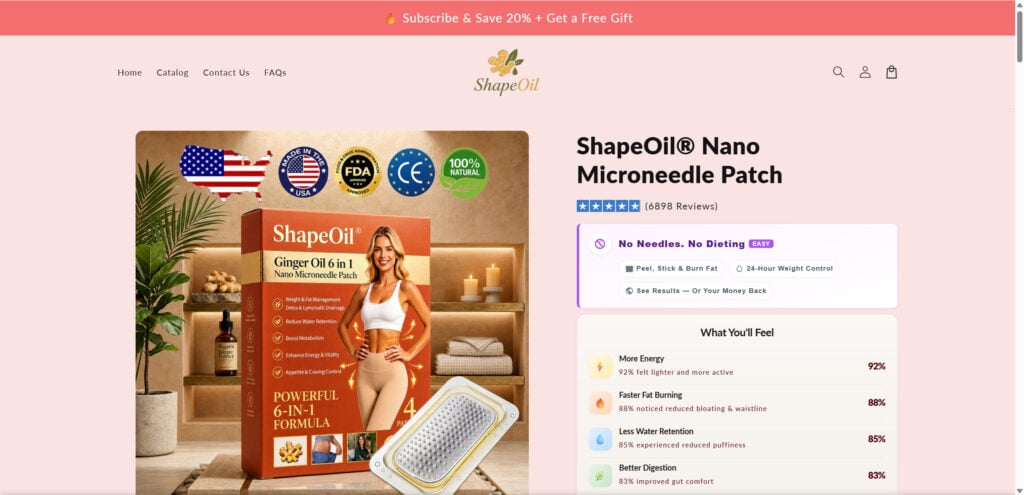
ShapeOil is sold as the “ShapeOil® Nano Microneedle Patch.” The product is promoted as a simple patch that users apply daily, usually before sleep, and remove in the morning.
The sales page claims the patch can support:
- fat burning
- weight control
- reduced bloating
- reduced water retention
- better digestion
- firmer skin
- appetite control
- blood sugar balance
- metabolic activation
- waistline reduction
- body shaping
- skin tightening
The site also describes it as a “Berberine 6-in-1 Nano Microneedle Patch” and claims it uses dissolvable microneedle technology for direct and controlled delivery through the skin.
The product may look modern and scientific, but the claims are extremely broad. A small adhesive patch should not be treated as a proven solution for fat loss, metabolism, appetite control, blood sugar balance, bloating, digestion, and skin tightening.
The Main Issue: This Looks Like a Generic Weight Loss Patch Funnel
ShapeOil appears to follow the same pattern as many social media “fat-burning patch” offers.
The formula is familiar:
- A generic patch product is sourced cheaply.
- The product is given a premium brand name.
- Ads use dramatic body-shaping claims.
- AI-style images, fake testimonials, or exaggerated before-and-after visuals create trust.
- The page pushes bundles such as 4, 6, or 10 boxes.
- A Subscribe & Save option creates recurring monthly billing.
- The refund promise sounds generous, but the real process may be difficult.
This does not mean every buyer receives nothing. ShapeOil may ship a real patch. The concern is that the product appears to be marketed far beyond what a generic wellness patch can realistically do.
Why ShapeOil Raises Red Flags
1. The fat-burning claims are unrealistic
ShapeOil uses phrases like “Peel, Stick & Burn Fat,” “Faster Fat Burning,” “Burn stored fat faster — even at rest,” and “24-Hour Weight Control.”
That is classic weight-loss ad language.
Real fat loss requires a calorie deficit over time. A patch cannot selectively melt belly fat, thigh fat, arm fat, or waist fat. It also cannot replace diet, exercise, medication, or medical care.
A patch may contain ingredients that create warmth, tingling, scent, or temporary skin sensation. But that is not the same as burning stored body fat.
2. “No dieting” messaging is a warning sign
The page says “No Needles. No Dieting Easy” and says no strict dieting or intense workouts are required.
That type of claim is common in weight-loss scams. It appeals to people who want results without lifestyle changes.
The FTC has long warned consumers to be skeptical of products promising easy or rapid weight loss without sensible diet and exercise. Any product that suggests effortless fat loss should be treated with caution.
3. The “microneedle” wording makes the product sound more advanced
ShapeOil uses “nano microneedle” and “micro-delivery” language to make the patch sound medically advanced.
Microneedle technology can be legitimate in medical and dermatology contexts. But that does not automatically prove that a consumer patch can deliver meaningful fat loss, blood sugar balance, appetite control, or body shaping.
A product can borrow scientific terminology without being clinically proven.
Buyers should ask:
- Is this exact patch clinically tested?
- What ingredients are inside each patch?
- What are the dosages?
- Are the microneedles sterile?
- Who manufactures the patch?
- Where is it made?
- Is there third-party testing?
- Was weight loss measured in a controlled human trial?
- Are before-and-after claims independently verified?
If the answers are missing, the science language should be treated as marketing.
4. The product category is flooded with cheap China-made patches
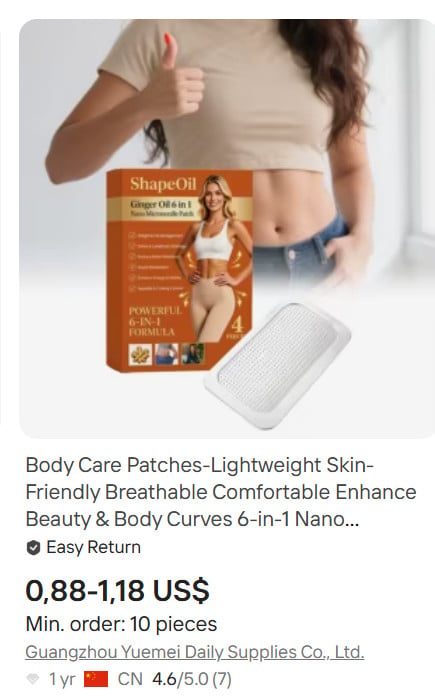
Very similar nano microneedle slimming patches, berberine patches, moringa patches, body-shaping patches, and weight-control stickers are sold by Chinese suppliers and wholesale platforms.
Some supplier listings advertise nearly the same concepts:
- nano microneedle patch
- berberine patch
- slimming patch
- weight control patch
- body shaping patch
- fat burning patch
- skin firming patch
- appetite support patch
- metabolism support patch
Many are available at very low unit prices and can be customized or private-labeled.
That is a major dropshipping red flag. A seller can buy a cheap patch, rebrand it as ShapeOil, build a polished Shopify page, run aggressive social media ads, and sell it at a markup.
The product may be real, but the perceived value may be inflated.
5. ShapeOil pushes large bundle orders
The product page offers multiple box options:
- 1 box
- 2 boxes
- 4 boxes
- 6 boxes
- 10 boxes
The larger packages are framed as better value, and one option is labeled “Best Value.”
This creates a clear buyer risk. Someone may order multiple boxes before knowing whether the patch works, causes irritation, or is refundable.
With this type of funnel, multiple-unit problems can happen through:
- preselected bundles
- “most popular” package emphasis
- best-value buttons
- post-purchase upsells
- one-click extra offers
- accidental quantity changes
- confusing mobile checkout pages
- subscription discounts applied automatically
If you only want to test the product, do not buy 4, 6, or 10 boxes.
6. There is a real subscription risk
ShapeOil’s product page includes a “Subscribe & Save” option offering 20% off and delivery every 30 days.
That means buyers must inspect the checkout carefully. If the subscription option is selected, the customer may be billed repeatedly and receive new boxes every month.
This is one of the biggest risks with these offers. Many people think they are placing a one-time order, then later discover recurring charges.
Before paying, look for:
- Subscribe & Save
- delivered every 30 days
- recurring billing
- monthly shipment
- auto-renewal
- auto-refill
- free gift with subscription
- cancel anytime wording
- membership or VIP discount
If you only want one order, make sure the purchase is clearly set to one-time.
7. The refund promise is inconsistent
ShapeOil’s product page says it offers a 90-day money-back guarantee and says buyers can request a full refund with “no questions asked.”
But the separate return policy says standard returns are within 30 days of receipt. It also says shipping charges are not refunded and that return terms may vary during promotional periods.
That inconsistency matters.
A buyer seeing “90-day guarantee” may assume they can test the patches for weeks and still get every penny back. But the formal policy appears narrower and less detailed than the sales-page promise.
This is a common problem in dropshipping funnels: the product page makes the guarantee sound simple, while the policy page leaves room for delays, conditions, or denial.
8. “Try it risk-free” may not mean easy refunds
A patch can only be evaluated after opening and using it. But many personal-care and wellness products become difficult to return once opened.
Even when a site says returns are possible, customers may face problems such as:
- slow support replies
- requests for photos or proof
- partial refund offers
- return labels not provided
- shipping costs not refunded
- promotional-period exclusions
- refusal after product is opened
- unclear return address
- delays until the return window expires
The user-reported pattern for this type of operation is “no returns” in practice. That does not necessarily mean the website has no written return policy. It means the refund process may be so restrictive or frustrating that buyers effectively cannot recover their money.
9. The shipping page points to manufacturer dispatch
ShapeOil’s shipping policy says orders are usually sent to the manufacturer for dispatch within 72 hours after payment. It also says shipping can take 2–4 weeks to the United States, Canada, Australia, New Zealand, the UK, and Europe, and 2–5 weeks for other countries.
That is consistent with international fulfillment or dropshipping-style logistics.
Long shipping times are not automatically a scam. But when long fulfillment is combined with generic supplier products, aggressive ads, and refund friction, the risk increases.
10. The business transparency is weak
ShapeOil’s About page describes the company as a “new international B2C team” offering various products for the United States. It says the company works directly with manufacturers and has warehouses.
That language does not provide much transparency.
For a product making weight-loss, blood sugar, metabolism, digestion, and microneedle delivery claims, buyers should expect clearer information, such as:
- company registration
- physical business address
- manufacturer name
- country of origin
- ingredient label
- safety testing
- clinical study details
- medical disclaimers
- subscription terms
- return address
- third-party lab testing
A vague “international B2C team” description is not reassuring for a health-related product.
11. AI-style social media ads are a major concern
The user flagged ShapeOil as being promoted through fake AI social media ads. This fits a broader pattern seen with weight-loss patches and supplement funnels.
These ads often use:
- AI-generated doctors
- AI-generated influencers
- fake customer stories
- synthetic before-and-after images
- stolen creator footage
- exaggerated body transformation clips
- fake news-style videos
- fake comment sections
- fake “medical breakthrough” narratives
- fake scarcity warnings
The goal is to make a generic product appear like a new scientific discovery.
Buyers should not trust an ad just because it shows a confident doctor, a dramatic transformation, or a polished video. Social media weight-loss ads are frequently built to sell emotion, not evidence.
12. The page uses percentage claims without real proof
ShapeOil claims that:
- 92% felt lighter and more active
- 88% noticed reduced bloating and waistline
- 85% experienced reduced puffiness
- 83% improved gut comfort
- 80% saw improved elasticity
These numbers look scientific, but the page does not clearly show a proper clinical study.
Buyers should ask:
- How many people were tested?
- Was there a placebo group?
- Who conducted the study?
- Was weight measured objectively?
- Was waistline measured by researchers?
- Were users dieting at the same time?
- Was the study published?
- Was the exact ShapeOil patch tested?
Without those details, the percentages are marketing claims.
How the ShapeOil Funnel Appears to Work
Step 1: The ad targets weight-loss frustration
The promotion likely reaches people who are tired of diets, bloating, belly fat, cravings, or slow metabolism.
The pitch is simple: apply a patch and let the product work while you sleep.
Step 2: Science-style language creates credibility
Terms like nano microneedle, dissolvable technology, time-based delivery, berberine, metabolism, and blood sugar balance make the product sound advanced.
This helps distract from the basic question: where is the clinical evidence that this exact patch causes meaningful weight loss?
Step 3: AI-style videos create authority
Fake or AI-generated social ads can make the product look more legitimate than it is.
A fake doctor, fake health expert, or AI-generated user testimonial can make a cheap patch look like a medical breakthrough.
Step 4: Bundles increase the order value
Instead of selling one box first, the page encourages 2, 4, 6, or 10 boxes. This increases the amount charged before the buyer can test the product.
Step 5: Subscription billing adds recurring revenue
The Subscribe & Save option offers a discount and delivery every 30 days. If selected, buyers may face monthly shipments and charges.
Step 6: Refund friction appears later
If the buyer is disappointed, the 90-day claim may collide with the formal 30-day return policy, non-refundable shipping, support delays, or promotional-period exclusions.
That is the core risk.
Main Red Flags
- Marketed with “Peel, Stick & Burn Fat” language.
- Claims weight control without strict dieting or intense workouts.
- Claims fat burning, bloating reduction, digestion support, appetite control, blood sugar balance, and skin tightening.
- Uses nano microneedle technology wording without clear proof that this exact product causes weight loss.
- Uses percentage claims without visible clinical-study details.
- Pushes 1, 2, 4, 6, and 10-box bundles.
- Includes Subscribe & Save with delivery every 30 days.
- Product page says 90-day guarantee.
- Formal return policy says 30-day returns.
- Shipping charges are not refunded.
- Return terms may vary during promotional periods.
- Shipping can take 2–5 weeks depending on location.
- Orders are sent to the manufacturer for dispatch.
- Similar berberine/nano microneedle slimming patches are sold cheaply by Chinese suppliers.
- The About page describes ShapeOil as a generic international B2C team.
- User-reported social ads use fake AI-style marketing.
- Buyers risk multiple boxes, recurring charges, and difficult refunds.
Is ShapeOil a Scam?
ShapeOil may ship a real patch, so this may not be a simple “pay and receive nothing” scam.
The problem is the marketing and billing structure.
A fair conclusion is this: ShapeOil appears to be a high-risk dropshipping-style weight-loss patch offer because it combines exaggerated fat-burning claims, generic China-product similarities, AI-style social media ads, bundle pressure, subscription billing, long international shipping windows, and inconsistent refund language.
The patch may create a sensation on the skin. It may feel like a wellness product. It may contain ingredients often used in weight-loss supplements. But buyers should not expect it to burn fat, reshape the body, reduce waist size, control appetite, balance blood sugar, or replace proven weight-loss methods.
What ShapeOil May Actually Do
ShapeOil may provide:
- a placebo effect
- a skin sensation
- a routine reminder
- mild temporary tightening from adhesive contact
- temporary perception of bloating reduction
- a cosmetic “body care” experience
ShapeOil is unlikely to reliably:
- burn stored fat
- reduce belly fat
- shrink thighs or arms
- replace diet or exercise
- balance blood sugar
- improve digestion in a clinically meaningful way
- prevent weight regain
- produce major waistline changes
- tighten loose skin
- work while you sleep without lifestyle changes
If a patch could reliably burn fat without diet or exercise, it would be a major medical product, not a low-cost Shopify wellness item sold through social media ads.
Safety Concerns Buyers Should Consider
Microneedle-style patches are applied to the skin and may create tiny contact points. Even if shallow, they can still irritate sensitive skin.
Possible risks include:
- redness
- itching
- rash
- burning
- swelling
- peeling
- allergic reaction
- skin irritation
- infection if used on broken skin
- pigment changes
- discomfort
- reaction to adhesives
- reaction to botanical extracts
Do not use the patch on:
- broken skin
- infected skin
- rashes
- open wounds
- eczema
- psoriasis
- sunburn
- areas recently shaved
- irritated skin
- moles or suspicious lesions
Stop using it if you experience burning, swelling, blistering, pain, pus, bleeding, worsening rash, or strong irritation.
Also be cautious if you have diabetes, circulation problems, skin sensitivity, immune suppression, pregnancy, breastfeeding, or are taking medications that affect blood sugar.
What To Do Before Buying
1. Treat it as a cosmetic/wellness patch, not a weight-loss treatment
Do not buy it expecting fat loss. If you still want to test it, treat it as an unproven wellness product.
2. Avoid bundles
Do not buy 4, 6, or 10 boxes before trying one. Extra boxes increase the loss if the product does not work or causes irritation.
3. Avoid Subscribe & Save unless you want recurring billing
Make sure the checkout says one-time purchase. Do not select delivery every 30 days unless you clearly want monthly charges.
4. Screenshot everything
Before paying, save screenshots of:
- selected package
- quantity
- subscription checkbox
- final price
- shipping cost
- guarantee wording
- return policy
- delivery estimate
- support email
- checkout page
- any upsell page
This is important if you later need to dispute the charge.
5. Compare similar products
Search for:
- berberine nano microneedle patch
- nano microneedle weight loss patch
- body slimming patch
- weight control microneedle patch
- Moringa Berberine patch
- private label slimming patch
- Alibaba berberine patch
- ShapeOil alternative
If similar products appear for a fraction of the price, slow down.
6. Use a protected payment method
Use a credit card or PayPal when possible. Avoid payment methods that make disputes difficult.
What To Do If You Already Ordered
1. Check your confirmation email immediately
Look for:
- number of boxes ordered
- total charge
- selected package
- subscription status
- delivery every 30 days wording
- next billing date
- support email
- order number
- shipping method
2. Cancel any subscription immediately
If you see Subscribe & Save, auto-refill, or recurring billing, email support right away.
Use clear wording:
“I am canceling all subscriptions, auto-refills, recurring billing, memberships, and future shipments connected to this order. Please confirm in writing that no future charges will occur.”
3. Monitor your card
Watch for:
- repeat charges
- monthly charges
- duplicate charges
- charges under a different merchant descriptor
- additional shipping charges
- upsell charges
4. Do not open every box
If you received multiple boxes, keep extras sealed until the refund issue is resolved.
5. Document the product
Take photos of:
- package
- shipping label
- box
- ingredient label
- inserts
- patches
- any manufacturing information
- country-of-origin label
- damaged items
6. Request a refund quickly
Use direct wording:
“The product does not match the advertised fat-burning and weight-control claims. I am requesting a refund under the money-back guarantee shown on the product page.”
7. Do not accept delay tactics
If support delays, offers only a small partial refund, asks repetitive questions, or refuses the advertised guarantee, escalate quickly.
8. Dispute if necessary
Contact your bank, credit card issuer, or PayPal if:
- you were charged for more boxes than ordered
- you were enrolled in a subscription without clear consent
- you were charged again after canceling
- the product never arrives
- the item is not as advertised
- support refuses the advertised refund
- the return policy contradicts the product page
- the refund process is unreasonable
Use clear dispute wording such as:
- “item not as described”
- “misleading weight-loss claims”
- “unauthorized recurring charge”
- “subscription not clearly disclosed”
- “unauthorized quantity charged”
- “merchant refuses advertised refund”
- “refund policy contradicts sales page”
FAQ
What is ShapeOil?
ShapeOil is a nano microneedle patch marketed for weight control, fat burning, bloating, appetite support, metabolism, and skin firmness.
Is ShapeOil a scam?
ShapeOil may ship a real patch, but the offer has major red flags: exaggerated fat-burning claims, generic China-product similarities, AI-style social ads, bundle pressure, subscription billing, and inconsistent refund terms.
Does ShapeOil really burn fat?
There is no clear evidence on the product page proving that this exact patch burns stored body fat or causes meaningful weight loss.
Is ShapeOil made in China?
The exact manufacturer is not clearly disclosed on the product page. However, very similar nano microneedle slimming and berberine patches are widely sold by China-based suppliers, which supports the generic-product concern.
Can ShapeOil reduce belly fat?
Be skeptical. A patch cannot selectively melt belly fat. Spot reduction claims are a classic red flag in weight-loss advertising.
Is there a subscription risk?
Yes. The product page includes a Subscribe & Save option with delivery every 30 days. Buyers should make sure they are selecting a one-time purchase if they do not want recurring charges.
Can buyers receive multiple boxes?
Yes. ShapeOil heavily promotes 2, 4, 6, and 10-box bundles. Buyers should check the final quantity before paying.
Are refunds easy?
Not necessarily. The product page promotes a 90-day guarantee, but the return policy refers to 30-day returns, non-refundable shipping, and promotional-period conditions.
Is ShapeOil safe?
Microneedle-style patches can cause skin irritation, rash, redness, burning, infection risk, pigment changes, or allergic reactions. Do not apply them to broken or irritated skin.
Should I buy ShapeOil?
Be cautious. Do not buy bundles, avoid Subscribe & Save unless wanted, screenshot the checkout, and do not treat the patch as a proven weight-loss product.
The Bottom Line
ShapeOil is marketed as an easy nano microneedle patch for fat burning, bloating, appetite control, metabolism, blood sugar balance, digestion, and skin firmness. The product may ship, but the marketing raises serious concerns.
The biggest warning signs are the exaggerated weight-loss claims, AI-style social media ads, generic China-product similarities, multi-box bundles, Subscribe & Save billing, long shipping windows, and inconsistent refund language.
ShapeOil should be treated as an unproven wellness patch, not a real fat-loss solution. If you already ordered, check for recurring billing, save all screenshots, keep extra boxes sealed, and contact your bank or PayPal if the seller refuses the advertised refund.
10 SEO Titles
- ShapeOil Nano Microneedle Patch Review: Scam or Legit?
- ShapeOil Scam Warning: Fake AI Ads and Weight Loss Patch Claims
- ShapeOil Exposed: Cheap China Patch Sold With Fat-Burning Claims?
- Is ShapeOil Legit or Another Dropshipping Weight Loss Patch Scam?
- ShapeOil Nano Patch Review: Claims, Subscriptions, and Refund Risks
- ShapeOil Weight Loss Patch Scam? Read This Before Buying
- ShapeOil Subscribe & Save Warning: Multiple Boxes and Recurring Charges
- ShapeOil Microneedle Patch Exposed: Fat Loss Claims vs Reality
- ShapeOil Refund Problems: 90-Day Guarantee vs 30-Day Return Policy
- ShapeOil Review: Generic Slimming Patch or Real Breakthrough?








