

Halcove is marketed as a plant-based rodent repellent tablet that claims to make mice and rats leave your home without traps, poison, dead rodents, or exterminator visits.
The product may be real, but the marketing raises several concerns: very strong “mice leave and don’t come back” claims, huge review numbers, dramatic testimonials, percentage-based results without visible independent testing, subscription/cancellation language, upsells, long shipping times, and a refund policy that appears more restrictive than the sales-page guarantee.
What Is Halcove?
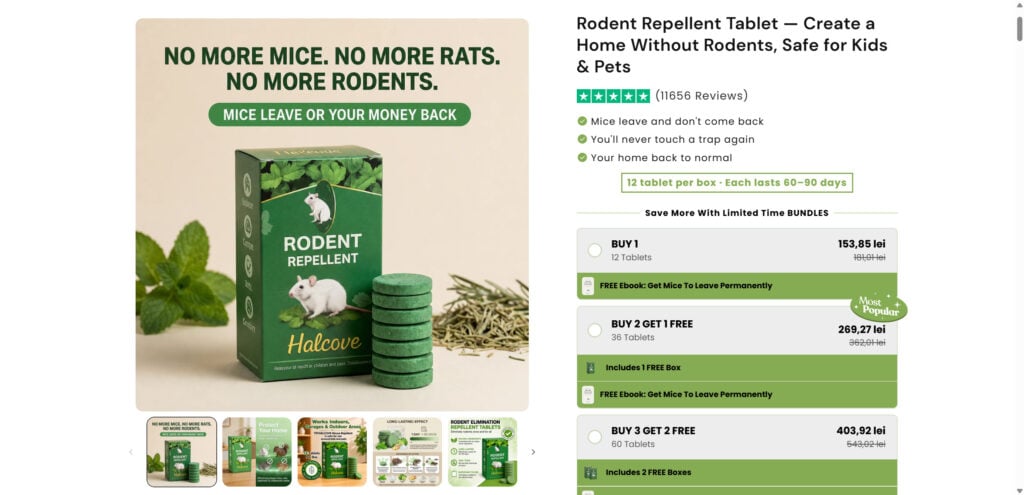
Halcove is sold through TryHalcove.com as a “Rodent Repellent Tablet” for homes, garages, attics, basements, vehicles, sheds, RVs, and other spaces where mice or rats may appear.
The product page says:
- one box costs $39.99
- each box contains 12 tablets
- each tablet lasts 60-90 days
- the tablets are 100% plant-based
- the product is safe for kids and pets
- mice leave and do not come back
- users will never need to touch traps again
- the product creates a scent barrier
- it works on mice, rats, squirrels, chipmunks, and voles
- most homes become mouse-free in 3-4 weeks
- the product includes a 60-day money-back guarantee
The listed formula includes:
- menthol
- camphor
- bergamot oil
- ginger root oil
- kaolin clay
- cellulose gum
The basic idea is simple: place tablets around problem areas, allow the scent to build, and replace the tablets every 60-90 days.
The Main Problem: The Claims Are Too Strong
Scent-based rodent repellents can be useful in some situations, especially as part of a broader prevention plan. But they are not magic barriers.
A serious rodent problem usually requires:
- sealing entry points
- removing food sources
- removing water sources
- cleaning droppings safely
- reducing clutter
- storing food in sealed containers
- checking walls, attics, garages, and crawl spaces
- using traps or professional control when needed
- monitoring for new activity
Halcove’s page makes the product sound like it can replace most of that.
That is the concern.
A scent tablet may make an area less attractive to rodents. But it cannot seal holes, remove nests, stop reproduction, repair structural gaps, clean contamination, or guarantee that rodents will not return.
Why Halcove Raises Red Flags
1. “Mice leave and don’t come back” is a very strong claim
The product page says mice leave and do not come back.
That is a bold promise.
Rodents do not enter homes only because they like a smell. They enter because homes provide warmth, food, shelter, nesting areas, and access points.
If those conditions remain, rodents may return when the scent fades, when the tablet is moved, when new rodents enter, or when food remains accessible.
A repellent tablet should not be treated as a permanent fix.
2. The product is framed as better than traps, poison, and exterminators
The page says traps only kill one mouse, poison causes smell in the walls, and exterminators can cost hundreds of dollars per visit. It then presents Halcove as the easier alternative.
That is persuasive marketing, but it oversimplifies rodent control.
Traps, exclusion, sanitation, and professional pest control all have different roles. A repellent may help in some cases, but it should not replace entry-point sealing or proper infestation management.
3. The site uses dramatic customer stories
The cart and product page include testimonials claiming:
- 8 months mouse-free after years of failed attempts
- $1,200 spent on exterminators before Halcove worked
- scratching stopped in 2 weeks
- kitchen drawers no longer caused fear
- one $40 box did what an exterminator could not
These stories are emotionally strong.
The problem is that seller-controlled testimonials are not the same as verified proof. A buyer should ask whether these are independently verified, whether negative reviews are visible, and whether the same product was tested under controlled conditions.
4. The review numbers look inflated
The product page shows 11,656 reviews. The homepage also claims 12,000+ relieved customers, and the product page says 45,976+ homes protected.
Those are large numbers for a niche rodent-repellent tablet.
Large review counts are not automatically fake, but buyers should be cautious when a Shopify-style product page displays huge numbers without a transparent independent review system.
Questions to ask:
- Where are all 11,656 reviews shown?
- Can reviews be sorted by newest, lowest rating, and verified purchase?
- Are reviews hosted by a third-party platform?
- Are customer photos real and traceable?
- Are negative reviews visible?
- Were reviews imported from another product?
- Were reviews generated or edited by the seller?
If the answer is unclear, the review count should be treated as marketing.
5. The percentages are not backed by visible study details
Halcove claims:
- 98% of customers report zero droppings within 3 months
- 95% say scratching stopped by week 2
- 92% have not called an exterminator since switching
These numbers look scientific, but the page does not clearly show a formal study.
A serious claim should answer:
- How many customers were surveyed?
- Were they verified buyers?
- Were homes inspected before and after?
- Was there a control group?
- Were entry points sealed at the same time?
- Were traps used at the same time?
- Were users also cleaning, blocking holes, or hiring pest control?
- Who collected the data?
- Can the raw results be reviewed?
Without those details, the percentages should be treated as sales claims.
6. “Safe for kids and pets” is too broad
The page says every ingredient is plant-based and completely non-toxic. It even says that if a toddler picks up a tablet or a dog chews on one, nothing harmful happens.
That is a very broad safety claim.
Plant-based does not automatically mean risk-free. Menthol, camphor, essential oils, and strong scent compounds can irritate some people and animals. Pets may also react differently depending on species, size, age, health, and amount ingested.
The safer wording would be: keep the tablets away from children and pets, avoid ingestion, and contact a veterinarian or poison control if exposure occurs.
7. The formula uses strong scent ingredients
Halcove lists menthol, camphor, bergamot oil, and ginger root oil as scent-based active ingredients.
Those ingredients can create a strong odor environment. That may be unpleasant or irritating for some users.
Possible issues include:
- headaches
- nausea
- throat irritation
- eye irritation
- asthma symptoms
- pet sensitivity
- skin irritation if handled
- strong smell in enclosed areas
- contamination of food storage spaces if placed carelessly
A product can be “natural” and still cause discomfort.
8. The page has inconsistent ingredient messaging
The page describes Halcove as a six-ingredient formula in several places. But in one section, it says the “four-ingredient formula” overwhelms a mouse’s nose.
That may be a simple editing mistake, but it is still a quality red flag.
If the seller is making technical claims about olfactory receptors, biological fear responses, and multi-compound formulas, the ingredient language should be consistent.
9. The guarantee language is inconsistent
The product page promotes a 60-day money-back guarantee.
But the site header, cart area, refund policy, FAQ, and terms layout repeatedly mention a 30-day money-back guarantee or 30-day return policy.
The refund policy says customers have 30 days after receiving the item to request a return. It also says the item must be unused, with tags, and in original packaging.
That creates a major contradiction.
The product page says if Halcove does not work within 60 days, buyers get a full refund. But the formal refund policy says returns are limited to 30 days and unused/original condition.
That matters because a rodent repellent can only be tested by opening it and placing it around the home.
10. Sale items may not be returnable
The refund policy says the company cannot accept returns on sale items.
The product page shows the product at $39.99, while other cart products show sale-style pricing such as $19.99 marked down from $29.99.
If the product is treated as a sale item, a buyer may have trouble using the return policy.
This is exactly why shoppers should screenshot the guarantee, product price, cart, checkout, and refund policy before paying.
11. Shipping is much slower than the cart suggests
The cart area says the product ships within 24 hours.
But the shipping policy says orders are processed within 3-5 business days, then U.S. delivery takes 15-20 business days after dispatch, while international delivery takes 15-30 business days.
That is a long delivery window for a pest-control product.
If someone has an active rodent problem, waiting several weeks may not be practical. Mice can continue nesting, chewing, contaminating surfaces, and spreading throughout the property during that time.
12. The cart uses urgency messaging
The cart says there are only 7 boxes left and that the cart is reserved.
This type of scarcity language is common in direct-response ecommerce funnels.
It pressures shoppers to buy quickly before comparing alternatives, reading the refund policy, checking delivery time, or confirming whether the product is right for an active infestation.
13. There are upsells in the cart
The cart shows extra items such as:
- Halcove SpotShield Mice Spray
- Add 60 Extra Days of Protection
- Shipping Protection
These add-ons increase the final order value.
Shipping protection is especially worth watching. Many ecommerce stores add it as a small optional charge, but shoppers may not notice it on mobile checkout.
Before paying, check the final cart line by line.
14. There appears to be subscription risk
The product page includes a section titled “How do I cancel my subscription?” and says users can contact support to cancel.
That means buyers should inspect the checkout carefully.
Even if the main product looks like a one-time purchase, there may be subscription, refill, or recurring billing options during checkout, bundle selection, or upsell pages.
Look for:
- subscription
- auto-refill
- recurring billing
- monthly delivery
- quarterly replacement
- save and subscribe
- future shipments
- membership
- protection plan
- “cancel anytime” wording
If you only want one order, make sure the checkout clearly says one-time purchase.
15. Similar generic rodent-repellent tablets are sold elsewhere
Very similar rodent-repellent tablets, pills, balls, and scent pouches are sold on large marketplaces at much lower prices.
Some listings offer 10-12 tablets or packs of rodent repellent using “natural,” “plant-based,” “safe for pets,” “indoor/outdoor,” and “long-lasting” language.
This does not prove Halcove is the same exact product. But it does support the generic-product concern.
A seller can buy or private-label a common rodent-repellent tablet, build a polished Shopify page, add emotional testimonials and urgency, and sell it at a higher price.
How the Halcove Funnel Appears to Work
Step 1: The ad targets rodent frustration
The pitch likely reaches people who have heard scratching in walls, found droppings, seen chewed packaging, or already tried traps.
The emotional message is simple: you are tired of mice, and this product promises a clean, humane, low-effort solution.
Step 2: The page attacks common alternatives
Halcove presents traps, poison, peppermint oil, ultrasonic devices, and exterminators as flawed or expensive.
This makes the product feel like the smarter option.
Step 3: Scientific-sounding language creates authority
The page uses terms like olfactory receptors, sensory overload, biological fear response, trigeminal nerve, pheromone trails, and multi-compound formula.
This makes a scent tablet sound more advanced.
But scientific language does not prove that this exact product reliably clears rodent infestations.
Step 4: Strong reviews create confidence
The page uses large review counts, customer quotes, “verified buyer” labels, and big statistics.
This makes the offer feel proven, even though the underlying evidence is not clearly shown.
Step 5: Bundles and add-ons increase the order value
The product page recommends multiple tablets and says larger homes may need more. It also mentions a Buy 2 Get 1 Free bundle and shows add-ons in the cart.
This can lead buyers to spend more before testing whether the product works in their specific home.
Step 6: Refund friction may appear later
If the tablets do not work, the buyer may point to the 60-day guarantee.
But the formal refund policy says 30 days, unused condition, original packaging, and no returns on sale items.
That is where the risk appears.
Main Red Flags
- Claims mice leave and do not come back.
- Claims users will never touch traps again.
- Claims the product works on mice, rats, squirrels, chipmunks, and voles.
- Claims most users become mouse-free in 3-4 weeks.
- Shows 11,656 reviews and 45,976+ homes protected.
- Uses 98%, 95%, and 92% result claims without visible study details.
- Uses dramatic testimonials comparing Halcove to exterminators.
- Says the product is completely non-toxic and safe if handled by toddlers or chewed by dogs.
- Uses strong scent ingredients such as menthol, camphor, bergamot oil, and ginger root oil.
- Product page says 60-day guarantee.
- Refund policy says 30-day return policy.
- Refund policy requires unused/original packaging condition.
- Refund policy says sale items cannot be returned.
- Shipping policy says U.S. delivery may take 15-20 business days after dispatch.
- Cart says ships within 24 hours, creating a different impression.
- Cart includes scarcity messaging.
- Cart includes upsells.
- Product page includes subscription cancellation language.
- Similar generic rodent-repellent tablets are sold elsewhere.
Is Halcove a Scam?
Halcove may ship a real rodent-repellent product, so this may not be a simple “pay and receive nothing” scam.
The concern is the marketing and refund structure.
A fair conclusion is this: Halcove appears to be a high-risk Shopify-style rodent-repellent offer because it combines strong pest-control promises, large review claims, unverified percentage results, emotional testimonials, urgency messaging, add-ons, possible subscription/refill risk, slow shipping, and conflicting refund language.
The product may help reduce rodent activity in some situations. But buyers should not expect it to solve a serious infestation by itself.
What Halcove May Actually Do
Halcove may:
- create a strong scent in treated areas
- make some spaces less attractive to rodents
- help as a temporary deterrent
- work better in small, enclosed, low-activity areas
- help protect vehicles, sheds, storage closets, or cabinets
- provide a humane option for mild prevention
- reduce activity when combined with sealing and cleaning
Halcove is unlikely to reliably:
- remove a full infestation by itself
- stop rodents if entry holes remain open
- eliminate nests inside walls
- prevent rodents from accessing food
- replace sanitation and exclusion
- guarantee no return
- work equally well outdoors
- protect an entire home with one box in every case
- replace professional pest control when the problem is severe
What To Do Before Buying
1. Check for entry points first
Look around the home for:
- gaps under doors
- holes around pipes
- vents without screens
- openings near utility lines
- garage door gaps
- attic openings
- crawl space access
- cracks near foundations
- gaps behind appliances
If rodents can still enter, a scent tablet is unlikely to solve the problem permanently.
2. Remove food sources
Store food in sealed containers.
Pay attention to:
- pet food
- bird seed
- rice, flour, cereal, and pasta
- snacks in pantries
- trash bins
- compost
- crumbs under appliances
- garage storage
3. Avoid buying bundles first
Do not buy multiple boxes before testing one.
If the product does not work, extra boxes increase the loss and may be harder to return.
4. Watch for upsells
Before paying, check for:
- extra protection add-ons
- shipping protection
- sprays
- ebooks
- bundles
- subscriptions
- auto-refills
Remove anything you did not intentionally choose.
5. Screenshot the checkout
Save screenshots of:
- product page claims
- 60-day guarantee
- 30-day refund policy
- final cart
- selected quantity
- shipping estimate
- subscription status
- add-ons
- total price
- confirmation email
This helps if you later need a refund or dispute.
6. Use a protected payment method
Use a credit card or PayPal when possible.
Avoid payment methods that make disputes difficult.
What To Do If You Already Ordered
1. Check your confirmation email
Look for:
- number of boxes ordered
- add-ons added
- shipping protection
- total charge
- shipping estimate
- subscription status
- next billing date
- merchant name
- support email
2. Cancel quickly if needed
The shipping policy says changes and cancellations are accepted within 24 hours of purchase.
Email support immediately if you want to cancel.
Use wording like:
“I am requesting immediate cancellation of my order. Please cancel the order before dispatch and refund my original payment method. Also cancel any subscription, refill plan, or future shipment connected to this purchase.”
3. Monitor your card
Watch for:
- repeat charges
- subscription renewals
- extra protection charges
- shipping protection charges
- duplicate orders
- charges under a different merchant name
4. Keep packaging and proof
If you receive the product, keep:
- shipping label
- packaging
- receipt
- product photos
- ingredient label
- instructions
- screenshots of claims
- email correspondence
5. Request a refund clearly
If the product does not work, write:
“I am requesting a refund under the money-back guarantee shown on the product page. The product did not repel rodents as advertised.”
6. Dispute if necessary
Contact your bank, credit card issuer, or PayPal if:
- the product never arrives
- delivery is far outside the promised window
- you were charged for add-ons you did not select
- you were enrolled in recurring billing without clear consent
- the seller refuses the advertised guarantee
- the refund policy contradicts the product page
- support does not respond
- the product is not as described
Use clear dispute wording such as:
- “item not as described”
- “merchant refuses advertised refund”
- “unauthorized add-on charge”
- “unauthorized recurring charge”
- “refund policy contradicts sales page”
- “product did not match advertised claims”
FAQ
What is Halcove?
Halcove is a rodent-repellent tablet sold as a plant-based scent product for mice, rats, squirrels, chipmunks, and voles.
Is Halcove a scam?
Halcove may ship a real product, but the offer has red flags: strong claims, huge review numbers, unverified percentages, upsells, possible subscription risk, slow shipping, and conflicting refund terms.
Does Halcove really make mice leave?
It may deter some rodents in some situations, but there is no clear public proof that it reliably clears infestations or prevents rodents from returning.
Is Halcove safe for kids and pets?
The seller claims it is plant-based and non-toxic, but buyers should still keep it away from children and pets. Natural scent ingredients can still cause irritation or reactions.
How long does Halcove last?
The product page says each tablet lasts 60-90 days.
How many tablets are in one box?
The product page says one box contains 12 tablets.
How long is shipping?
The shipping policy says orders are processed in 3-5 business days, then U.S. delivery may take 15-20 business days after dispatch. International delivery may take 15-30 business days.
Is there a subscription risk?
Yes. The product page includes subscription cancellation language, so buyers should check the checkout carefully for auto-refills or recurring billing.
Are refunds easy?
Not necessarily. The product page mentions a 60-day guarantee, but the formal refund policy says 30 days and requires unused/original packaging condition.
Should I buy Halcove?
Be cautious. If you still want to try it, buy only one box, avoid add-ons, screenshot everything, check for subscriptions, and do not rely on it as your only rodent-control method.
The Bottom Line
Halcove is marketed as a plant-based rodent-repellent tablet that can make mice and rats leave without traps, poison, dead rodents, or exterminators.
The product may be real and may help in mild cases. But the marketing is too strong for what appears to be a scent-based repellent tablet.
The biggest warning signs are the “mice leave and don’t come back” promise, huge review numbers, unverified percentage claims, dramatic testimonials, conflicting 60-day versus 30-day refund language, slow shipping, upsells, scarcity messaging, and possible subscription/refill risk.
Treat Halcove as a possible deterrent, not a guaranteed rodent-control solution. For real infestations, seal entry points, remove food sources, clean properly, monitor activity, and use proven pest-control methods when needed.








