

Zafira Recovery Foundation is marketed as a supplement for people taking GLP-1 weight-loss medications such as Ozempic, Wegovy, Zepbound, and Mounjaro.
The offer claims to help with mood crashes, brain fog, fatigue, hair shedding, nausea, digestive problems, and the “flat” or emotionally numb feeling some users describe while losing weight quickly.
The product may be a real supplement, but the marketing raises serious concerns. It leans heavily on emotional GLP-1 side-effect fears, medical-adjacent language, dramatic testimonials, “dopamine restoration” claims, subscription-style purchasing, and refund terms that are not as simple as the sales page makes them sound.
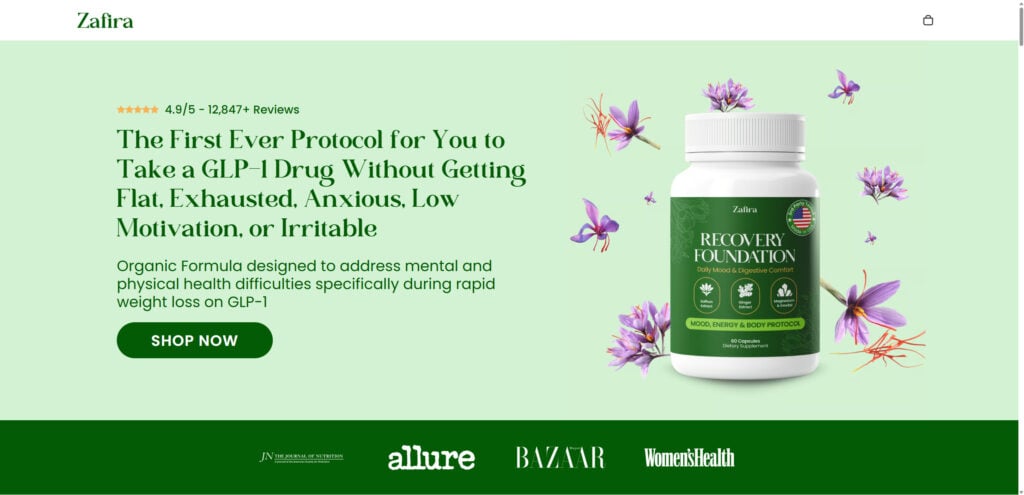
What Is Zafira Recovery Foundation?
Zafira Recovery Foundation is sold by Zafira Organics as a capsule supplement designed for people using GLP-1 drugs.
The page says each bottle contains 60 capsules, with a serving size of 2 capsules per day. That makes one bottle a 30-day supply.
The listed active ingredients include:
- Vitamin B12
- Vitamin C
- Vitamin D3
- Magnesium
- Zinc
- Copper
- Myo-inositol
- L-theanine
- Ginger extract
- Saffron extract
The product is positioned as a “Recovery Foundation” for people who feel physically and mentally depleted while taking GLP-1 medication.
The advertised claims include:
- better mood
- more energy
- less brain fog
- less nausea
- better digestion
- reduced sulfur burps
- reduced bloating
- reduced hair shedding
- improved motivation
- emotional balance
- dopamine support
- gut-brain support
- help with GLP-1-related anhedonia
- support during rapid weight loss
- safe use with all medications
- changes within days
Those are very broad claims for a dietary supplement.
The Main Problem: Zafira Claims Too Much
Zafira is not marketed like a basic multivitamin or wellness supplement. It is marketed as a specialized solution for GLP-1 side effects, emotional numbness, dopamine disruption, hair loss, nausea, fatigue, and digestive issues.
That is a serious positioning choice.
GLP-1 medications are prescription drugs. They can affect digestion, appetite, blood sugar, weight, and overall health. People using them may also have diabetes, obesity, heart-risk factors, hormonal issues, gastrointestinal problems, or other medical conditions.
A supplement should not be treated as a fix for serious medication side effects unless there is strong clinical evidence on the exact finished product.
Zafira uses ingredients that may have general wellness research behind them. Saffron, L-theanine, ginger, magnesium, B12, vitamin D, zinc, and inositol are not automatically suspicious. The issue is the way the product is marketed.
A supplement containing common nutrients is not the same as a clinically proven treatment for GLP-1-related mood changes, dopamine dysfunction, medication side effects, or rapid-weight-loss complications.
Why Zafira Recovery Foundation Raises Red Flags
1. It targets people who may already feel vulnerable
The page speaks directly to people who feel “flat,” exhausted, anxious, foggy, emotionally numb, or disconnected while taking GLP-1 medication.
That is emotionally powerful marketing.
People who are losing weight but feeling mentally unwell may be desperate for relief. A product that says it can help them feel like themselves again can be very persuasive.
That does not automatically make the product fake. But it does mean the claims must be held to a high standard.
2. The GLP-1 dopamine claims are very aggressive
Zafira’s page claims GLP-1 drugs disrupt dopamine pathways and describes the product as helping restore mood, motivation, and dopamine-related function.
It also uses language such as:
- dopamine transporter dysfunction
- receptor rebuilding
- reward system support
- GLP-1-induced anhedonia
- dopamine receptor function
- restoring emotional balance
- mood recovery within weeks
This makes the product sound more medically advanced than a normal supplement.
If Zafira is going to claim it addresses GLP-1-related dopamine dysfunction, buyers should expect clear proof that the exact formula was tested in GLP-1 users for that purpose.
Ingredient-level research is not enough.
3. “Safe to use with all medications” is too broad
The product page says it is safe to use with all medications, while also telling users to consult a doctor.
That combination is concerning.
A supplement company should be very careful with medication-safety claims, especially when targeting people taking prescription drugs for diabetes or obesity.
Some users may be taking:
- semaglutide
- tirzepatide
- insulin
- metformin
- sulfonylureas
- antidepressants
- anxiety medication
- blood pressure medication
- thyroid medication
- blood thinners
- sleep medication
- hormone therapy
A seller cannot realistically know that one supplement is safe with every medication for every customer.
4. The product implies help for serious symptoms
The testimonials and copy mention problems like emotional numbness, depression-like symptoms, nausea, vomiting, sulfur burps, constipation, fatigue, hair loss, and feeling disconnected from life.
Those are not small cosmetic complaints.
If someone has new or worsening depression, suicidal thoughts, severe vomiting, dehydration, severe constipation, abdominal pain, or major mood changes while taking a GLP-1 medication, they should talk to a licensed healthcare professional.
A supplement should not delay medical care.
5. The FDA-style messaging can mislead buyers
The page shows an “FDA-registered” style icon while also including the standard dietary supplement disclaimer saying the product is not intended to diagnose, treat, cure, or prevent disease.
This matters.
“FDA-registered” does not mean “FDA-approved.” It does not prove the FDA has reviewed the product’s effectiveness for GLP-1 side effects, depression, dopamine dysfunction, hair loss, nausea, or weight-loss recovery.
Many supplement sellers use FDA-style wording because it sounds official. Buyers should look for actual FDA approval, clinical trial data, and third-party testing documents, not just badges or icons.
6. The site claims 12,847+ verified reviews
The homepage says the product is rated 4.92/5 based on 12,847+ verified reviews.
That is a huge number for a niche GLP-1 supplement.
The page also includes many emotional testimonials with names, photos, and “verified customer” labels. Some testimonials claim major improvements in mood, hair shedding, energy, digestion, nausea, and life satisfaction.
The problem is that seller-controlled testimonials are not the same as independent evidence.
Buyers should ask:
- Where are all 12,847 reviews displayed?
- Are they hosted by an independent review platform?
- Can reviews be filtered by date and rating?
- Are negative reviews visible?
- Are the photos real customers?
- Were reviewers compensated?
- Were reviews imported from another product?
- Are the claims medically verified?
Without that transparency, the review count should be treated cautiously.
7. The testimonials make “fixed everything” style claims
Some testimonials suggest the supplement helped with several GLP-1 problems at once: mood, hair loss, constipation, nausea, fatigue, and emotional numbness.
That type of testimonial is powerful, but it can also create unrealistic expectations.
A supplement may help some people with mild nutritional gaps or digestive discomfort. But “this fixed everything” style marketing can push buyers to expect results that are not guaranteed.
8. The product recommends 5-6 months of use
The page says consistent use for 5-6 months is recommended for “complete recovery.”
That creates a clear business incentive.
If one bottle is a 30-day supply, then 5-6 months means buyers may be encouraged to buy several bottles or stay on recurring refills.
This is not automatically bad. Some supplements are meant to be taken consistently. But when a product relies on emotional health claims and recommends months of use, buyers should be careful with bundles and automatic refills.
9. The product page includes recurring-purchase language
The product page includes language saying the item may be a deferred, subscription, or recurring purchase, and that the customer authorizes future charges according to the listed frequency and dates until fulfillment or cancellation.
That is a major buyer risk.
People may think they are buying one bottle, then later discover they selected an automatic refill or subscription option.
Before ordering, buyers should check for:
- automatic refills
- subscription
- monthly delivery
- recurring billing
- “save more” refill options
- preselected subscription buttons
- one-click upsells
- post-purchase offers
- future shipment language
If you only want one bottle, the checkout must clearly say one-time purchase.
10. Bundle pricing can increase the loss
Search results and product snippets show options such as one-month, two-month, and three-month supplies, plus “buy 2” and “buy 3” offers.
This matters because Zafira’s own refund policy says the first unit may be refunded without return, but additional units may only be refundable if unopened and returned at the customer’s cost.
That means buying several bottles upfront increases your risk.
If the product does not work for you, causes side effects, or cannot be used with your medication, extra bottles may become difficult to refund.
11. The refund policy is less simple than “no risk”
Zafira promotes a 60-day money-back guarantee and says no return is required for the first purchase.
That sounds strong.
But the details matter:
- the no-return refund applies to the first order only
- one refund is allowed per customer
- multi-unit orders are treated differently
- the first unit may be refunded without return
- additional units may require return
- additional units must be unopened and in original condition
- return shipping is paid by the customer
This is not necessarily dishonest, but it is more limited than a simple “try it risk-free” message.
12. The cancellation policy adds more conditions
The cancellation/subscription policy says customers may cancel subscriptions before the next billing cycle.
It also says refunds apply within 60 days of receiving the first order, but mentions return requirements such as original condition, unused condition, original packaging, and valid proof of purchase.
It also says bulk or sale items may not be eligible for refund.
That can create confusion.
The refund page sounds generous, while the subscription/cancellation page sounds more restrictive. Buyers should screenshot both before ordering.
13. The terms say cancellations may not be possible after acceptance
Zafira’s terms say the company may be unable to accommodate cancellation requests after an order is accepted.
This matters if someone orders quickly after seeing an ad, then realizes they selected a subscription, bought too many bottles, entered the wrong address, or cannot take the supplement with current medication.
A good rule: do not order until you are fully sure.
14. The business appears built for direct-response supplement marketing
The footer identifies Fanstel Goods LLC in Sheridan, Wyoming.
Fanstel Goods’ own site describes a branded supplement line, direct-to-consumer subscription model, creative development, media scaling, customer lifetime value, and conversion-focused marketing.
That does not prove the product is a scam.
But it does show that this appears to be a serious direct-response supplement funnel, not just a small clinical wellness project. The marketing is designed to sell, scale, and retain customers.
15. There is brand confusion around Amazon
Zafira’s page says the product is only sold on its official website and that products listed on Amazon or eBay are counterfeit.
At the same time, search results show Amazon listings using the Zafira name and similar Recovery Foundation wording.
This creates buyer confusion.
If the company says Amazon listings are not genuine, buyers should be cautious about purchasing from marketplaces. But the presence of marketplace listings also raises the question of how easily this brand/product presentation can be copied, relisted, or imitated.
How the Zafira Funnel Appears to Work
Step 1: The ad targets GLP-1 side-effect fear
The pitch likely reaches people taking Ozempic, Wegovy, Zepbound, Mounjaro, or compounded GLP-1 medications.
The message is emotionally sharp: you may be losing weight, but you may also be losing your energy, joy, motivation, hair, digestion, and personality.
Step 2: Scientific language builds authority
The page uses terms like dopamine, GLP-1, anhedonia, gut-brain axis, receptor sensitivity, transporter dysfunction, and clinical dosing.
This creates a medical-science feel.
But scientific language does not prove the exact product works.
Step 3: Testimonials create emotional proof
The page includes stories from people who say they felt emotionally numb, depressed, exhausted, constipated, nauseous, or ready to quit their medication before using Zafira.
These stories are designed to make the buyer think: “That sounds exactly like me.”
Step 4: The product is framed as the missing GLP-1 support system
Instead of being presented as a normal supplement, Zafira is framed as something GLP-1 users need to protect their mental and physical health while continuing to lose weight.
That makes the product feel essential.
Step 5: Multi-month use and refills increase customer value
The page recommends 5-6 months of use, offers multi-month purchase options, and includes recurring-purchase language.
That can turn a single supplement order into a longer customer relationship.
Step 6: Refund limitations appear later
If the buyer orders multiple bottles or subscribes, the refund may not be as simple as expected.
The first bottle may be covered more generously, while extra units may need to be returned unopened.
Main Red Flags
- Marketed specifically to GLP-1 users dealing with emotional and physical side effects.
- Claims to help with mood, motivation, energy, brain fog, nausea, digestion, sulfur burps, hair loss, and weight-loss recovery.
- Uses medical-adjacent terms like dopamine dysfunction, anhedonia, receptor rebuilding, and gut-brain axis.
- Says it is safe to use with all medications, which is too broad.
- Uses FDA-style “registered” messaging while also carrying a supplement disclaimer.
- Claims 12,847+ verified reviews on the site.
- Uses dramatic testimonials that suggest the product fixed multiple serious symptoms.
- Recommends 5-6 months of consistent use.
- Product page includes subscription/recurring-purchase language.
- Multi-bottle orders may not be fully covered by the no-return guarantee.
- Additional units may need to be returned unopened at customer expense.
- Cancellation may not be possible after an order is accepted.
- Bulk or sale items may not be eligible for refund under the cancellation policy.
- Business model appears tied to direct-response supplement marketing and subscription economics.
- Marketplace listings may create confusion because the site warns that Amazon/eBay products are counterfeit.
Is Zafira Recovery Foundation a Scam?
Zafira Recovery Foundation may ship a real supplement, so this does not appear to be a simple “pay and receive nothing” scam.
The concern is the marketing.
A fair conclusion is this: Zafira Recovery Foundation appears to be a high-risk GLP-1 supplement offer because it combines emotional medication-side-effect marketing, broad medical-adjacent claims, dopamine and anhedonia language, dramatic testimonials, subscription-style purchasing, multi-month use recommendations, and refund limitations for multi-unit orders.
The product may contain real ingredients. Some users may genuinely feel better while taking it. But buyers should not treat it as a proven treatment for GLP-1 side effects, depression-like symptoms, dopamine dysfunction, hair loss, severe nausea, or digestive complications.
If you are having serious side effects from a GLP-1 drug, speak with your prescriber.
What Zafira May Actually Do
Zafira may provide:
- basic nutrient support
- a daily supplement routine
- mild digestive support from ginger
- calm/focus support from L-theanine
- general mood support from saffron
- vitamin and mineral support
- placebo effect
- perceived improvement in energy
- support for people with actual nutrient gaps
Zafira is unlikely to reliably:
- reverse GLP-1-induced anhedonia
- rebuild dopamine receptors
- treat depression
- fix severe medication side effects
- stop major hair loss caused by rapid weight loss
- replace medical monitoring
- guarantee better energy within days
- guarantee mood recovery
- safely work with every medication
- make GLP-1 weight loss faster for everyone
Safety Concerns Buyers Should Consider
Do not use Zafira as a substitute for medical advice.
Be especially careful if you:
- take diabetes medication
- take antidepressants or anxiety medication
- take blood thinners
- take blood pressure medication
- have bipolar disorder
- have severe depression
- have suicidal thoughts
- have severe nausea or vomiting
- have dehydration
- have severe constipation
- are pregnant or breastfeeding
- have liver or kidney disease
- have allergies to saffron, ginger, or supplement ingredients
Stop using the product and seek medical advice if you experience:
- rash
- swelling
- breathing difficulty
- severe stomach pain
- worsening mood
- anxiety spikes
- dizziness
- vomiting
- allergic reaction
- unusual bleeding
- medication-related symptoms
If you experience suicidal thoughts, severe depression, or a major mental health crisis, seek emergency help immediately.
What To Do Before Buying
1. Ask your doctor first
If you are taking Ozempic, Wegovy, Zepbound, Mounjaro, insulin, antidepressants, or other prescription medications, ask your doctor or pharmacist before adding Zafira.
2. Do not buy multiple bottles first
Start with one bottle if you still want to try it.
Avoid 2-month, 3-month, 5-month, or 6-month bundles until you know whether the product agrees with you.
3. Avoid automatic refills unless you clearly want them
Check the checkout carefully for recurring billing.
Make sure the order clearly says one-time purchase if you do not want future charges.
4. Screenshot everything
Before paying, save screenshots of:
- product claims
- ingredient list
- 60-day guarantee
- refund policy
- cancellation policy
- subscription terms
- selected quantity
- final price
- shipping cost
- checkout page
- confirmation page
5. Look for real proof
Before trusting the claims, look for:
- clinical trials on the exact Zafira formula
- third-party testing certificates
- batch testing
- supplement facts label
- manufacturer identity
- verified review source
- clear FDA wording
- independent medical review
- realistic benefit claims
6. Use a protected payment method
Use a credit card or PayPal when possible.
Avoid payment methods that make disputes difficult.
What To Do If You Already Ordered
1. Check your confirmation email
Look for:
- number of bottles ordered
- total charge
- subscription status
- next billing date
- shipping fee
- refund terms
- order number
- merchant name
2. Cancel recurring billing immediately
If you see automatic refill, subscription, or recurring billing, email support immediately.
Use wording like:
“I am canceling all subscriptions, automatic refills, recurring billing, memberships, and future shipments connected to this order. Please confirm in writing that no future charges will occur.”
3. Keep extra bottles sealed
If you ordered multiple bottles, do not open all of them.
The refund policy may require additional units to be unopened and in original condition.
4. Request a refund within 60 days
Use direct wording:
“I am requesting a refund under the 60-day money-back guarantee. The product did not match the advertised benefits for me. Please refund my original payment method.”
5. Monitor your card
Watch for:
- repeat charges
- monthly charges
- subscription renewals
- duplicate charges
- charges under a different merchant descriptor
6. Dispute if necessary
Contact your bank, credit card issuer, or PayPal if:
- you were charged for a subscription you did not clearly authorize
- you were charged again after canceling
- you received more bottles than expected
- support refuses the advertised guarantee
- the product never arrives
- the refund terms contradict what you saw at checkout
- the merchant does not respond
Use clear dispute wording such as:
- “unauthorized recurring charge”
- “item not as described”
- “merchant refuses advertised refund”
- “subscription not clearly disclosed”
- “refund policy contradicts sales page”
- “health claims not substantiated”
FAQ
What is Zafira Recovery Foundation?
Zafira Recovery Foundation is a dietary supplement marketed to GLP-1 users who experience mood changes, brain fog, fatigue, nausea, digestive issues, and hair shedding.
Is Zafira Recovery Foundation a scam?
It may ship a real supplement, but the offer has red flags: aggressive GLP-1 side-effect marketing, broad dopamine and mood claims, dramatic testimonials, recurring-purchase language, multi-month use recommendations, and refund limits for multi-unit orders.
Does Zafira really fix GLP-1 side effects?
There is no clear public clinical evidence on the site proving that the exact Zafira formula reliably fixes GLP-1 side effects.
Is Zafira FDA approved?
No clear FDA approval is shown. The site includes the standard supplement disclaimer saying the statements have not been evaluated by the FDA.
Is “FDA registered” the same as FDA approved?
No. FDA-registered does not mean FDA-approved and does not prove the product is effective.
Can Zafira be taken with Ozempic or Wegovy?
Do not rely only on the seller’s claim. Ask your doctor or pharmacist before combining supplements with prescription GLP-1 medication.
Is there a subscription risk?
Yes. The product page includes recurring-purchase language, and search snippets show automatic refill messaging. Check checkout carefully before paying.
Are refunds easy?
The first unit may be covered by the 60-day guarantee, but additional units may need to be returned unopened at the customer’s cost.
Should I buy Zafira?
Be cautious. If you still want to try it, ask your doctor first, buy only one bottle, avoid automatic refills, screenshot the checkout, and use a protected payment method.
The Bottom Line
Zafira Recovery Foundation is marketed as a specialized supplement for GLP-1 users dealing with mood crashes, fatigue, brain fog, hair shedding, nausea, digestive problems, and emotional numbness.
The product may be real, and some buyers may genuinely like it. But the marketing is aggressive and medical-adjacent. Claims about dopamine dysfunction, anhedonia, “safe with all medications,” fast mood recovery, and full GLP-1 side-effect support should not be accepted without strong evidence on the exact finished product.
The biggest risks are unrealistic expectations, subscription or automatic-refill billing, multi-bottle purchases, refund limitations, and delaying proper medical care for serious side effects.
Treat Zafira as an unproven supplement, not a proven GLP-1 recovery treatment.








