

The Electric Spray Air Cushion Massage Comb looks impressive in viral ads, but the offer follows a classic dropshipping playbook: a generic Chinese-made brush is rebranded, paired with dramatic or AI-assisted demonstrations, and sold at a large markup.
The brush itself may arrive, but that does not make the marketing honest. Comparable versions sell on major marketplaces for roughly $15 to $30, while viral storefronts present ordinary misting and brushing as salon technology. Buyers can then discover that returning the item overseas costs nearly as much as the product.
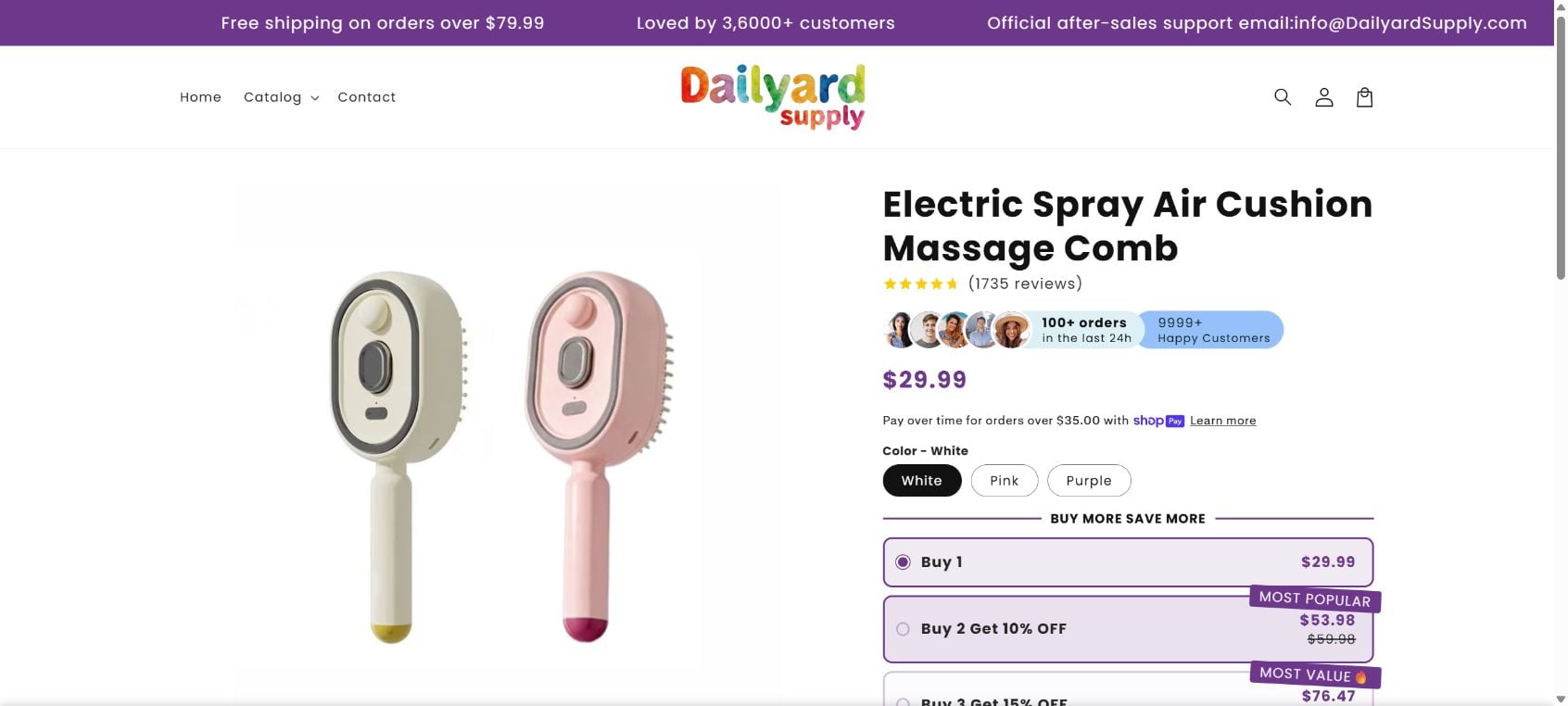
Overview
The Electric Spray Air Cushion Massage Comb is a generic rechargeable hairbrush with an air-cushioned bristle pad and a small reservoir that releases a fine mist. Depending on the listing, sellers also describe it as self-cleaning, anti-static, aromatherapy-ready, red-light, scalp-massaging, detangling, straightening, or hair-nourishing.
At its core, this is still a brush that sprays water or a diluted hair product. A light mist can make detangling easier and temporarily reduce static or flyaways. That is a reasonable cosmetic effect, but it is nowhere close to rebuilding damaged hair, reversing hair loss, permanently straightening strands, or producing the edited before-and-after results used in social ads.
The clearest warning is how widely the identical design appears. Marketplace listings describe it as an unbranded product made in China and sell versions for roughly $8 to $31. Social-media storefronts can rename the same item, place it on a polished one-product website, and charge several times more while presenting it as an exclusive invention.
This is the shopping-scam pattern buyers need to understand. The seller may ship something, so the transaction does not always end with an empty mailbox. The loss happens when a cheap mass-produced gadget arrives, performs like an ordinary misting brush, and is difficult or uneconomical to return.
What the product can realistically do
- Release a light water or product mist while brushing.
- Help loosen minor tangles when used carefully.
- Reduce temporary static when hair is lightly dampened.
- Provide a basic scalp-massage sensation through rounded bristles.
- Collect several ordinary grooming functions in one rechargeable device.
What the ads do not prove
- That the brush repairs split ends or chemically damaged hair.
- That red light from an inexpensive brush stimulates meaningful hair growth.
- That essential oils sprayed through the device treat scalp disease.
- That one pass can permanently straighten, thicken, or restore hair.
- That the people and results shown in promotional clips are genuine customers.
How the Electric Spray Comb Scam Works
Step 1: A dramatic hair transformation stops the scroll
The ad usually shows frizzy, tangled, or dull hair becoming glossy within seconds. Cuts, lighting changes, styling products, filters, and footage taken from unrelated creators can make the result look far more dramatic than anything the brush itself can deliver.
Step 2: Ordinary features are renamed as advanced technology
A water mister becomes “nano hydration.” A cushioned bristle pad becomes “scalp activation.” A colored LED becomes “red-light therapy.” Marketing language gives a simple device the appearance of a scientific breakthrough without providing meaningful test data.
Step 3: The storefront creates urgency and exclusivity
Buyers may see a countdown, low-stock warning, today-only discount, or claim that the product is available only through that page. In reality, visually identical brushes are sold by unrelated merchants across large marketplaces.
Step 4: The generic product is shipped at a large markup
The buyer may wait weeks for a parcel sent through a low-cost fulfillment chain. The item can arrive in plain packaging with minimal instructions and no recognizable manufacturer, even though the ad made it look like a premium branded system.
Step 5: The return becomes the real obstacle
To get a refund, the customer may need approval from an unresponsive support address and may be told to pay tracked international postage. When return shipping approaches the value of the order, many buyers give up. Others are offered a small partial refund while being told to keep the brush.
Red Flags in the Viral Marketing
- No stable manufacturer identity: the same physical design appears under many unrelated names.
- Impossible speed: damaged or heavily tangled hair does not become permanently repaired after a few brush strokes.
- Vague scientific terms: “ions,” “nano mist,” and “red-light care” are used without specifications or credible testing.
- Generic testimonials: first names, stock-style portraits, and perfect five-star ratings are not independent evidence.
- Permanent discount language: an inflated reference price makes an ordinary product look like an urgent bargain.
- Missing company details: a support email is not a substitute for a clearly identified seller and return address.
- Return friction: the policy may sound generous until the customer learns that return approval and international postage are their responsibility.
Is the Electric Spray Air Cushion Massage Comb Safe?
A basic misting brush is not automatically dangerous, but unbranded rechargeable devices deserve caution. The buyer may receive no useful electrical certification, battery information, warranty process, or instructions about what liquids can safely go into the reservoir.
Do not fill the device with undiluted essential oils or unknown treatments simply because an advertisement suggests it. Oils can irritate the scalp, damage the pump, or leave residue. Stop using the brush if it overheats, leaks near the charging port, smells burnt, or causes redness and discomfort.
Hair loss, scalp inflammation, persistent itching, and sudden breakage are medical or dermatological concerns. A generic brush should not delay an assessment by a qualified professional.
How to Check a Seller Before Buying
- Search the product image and compare identical marketplace listings.
- Look for a legal company name, physical return address, and working support channel.
- Read the complete return policy, including who pays postage and where the item must be sent.
- Check whether sale items, opened personal-care products, or discounted bundles are excluded.
- Ignore reviews displayed only on the seller’s own landing page.
- Pay by credit card or another method that provides a dispute process.
- Take screenshots of the ad, product claims, price, and refund promise before ordering.
What to Do If You Already Bought It
If the order has not shipped
Send a written cancellation request immediately. Save the message and any automatic response. Do not rely on a social-media comment because it can be deleted and may not create a useful paper trail.
If the brush is not as advertised
- Photograph the parcel, label, packaging, and product before using it.
- Record a short video showing the defect or the missing advertised function.
- Request a return in writing and quote the seller’s own policy.
- Ask for the exact return address and refund timeline before paying postage.
- If the seller stalls, contact your card issuer or payment provider and explain the material difference between the advertisement and the item received.
- Watch future statements for additional or recurring charges.
The Bottom Line
This is a dropshipping product, not a breakthrough hair-care device. You may receive a real brush, but it is an inexpensive generic gadget wrapped in marketing that promises far more than a misting brush can deliver. Expect something closer to the low-cost marketplace versions—not the hair-repair miracle shown in viral ads.
If you want this type of brush, compare transparent marketplace listings with buyer protection and an easy domestic return. Do not pay a premium to a one-product storefront because an edited video made an ordinary device look miraculous.








