


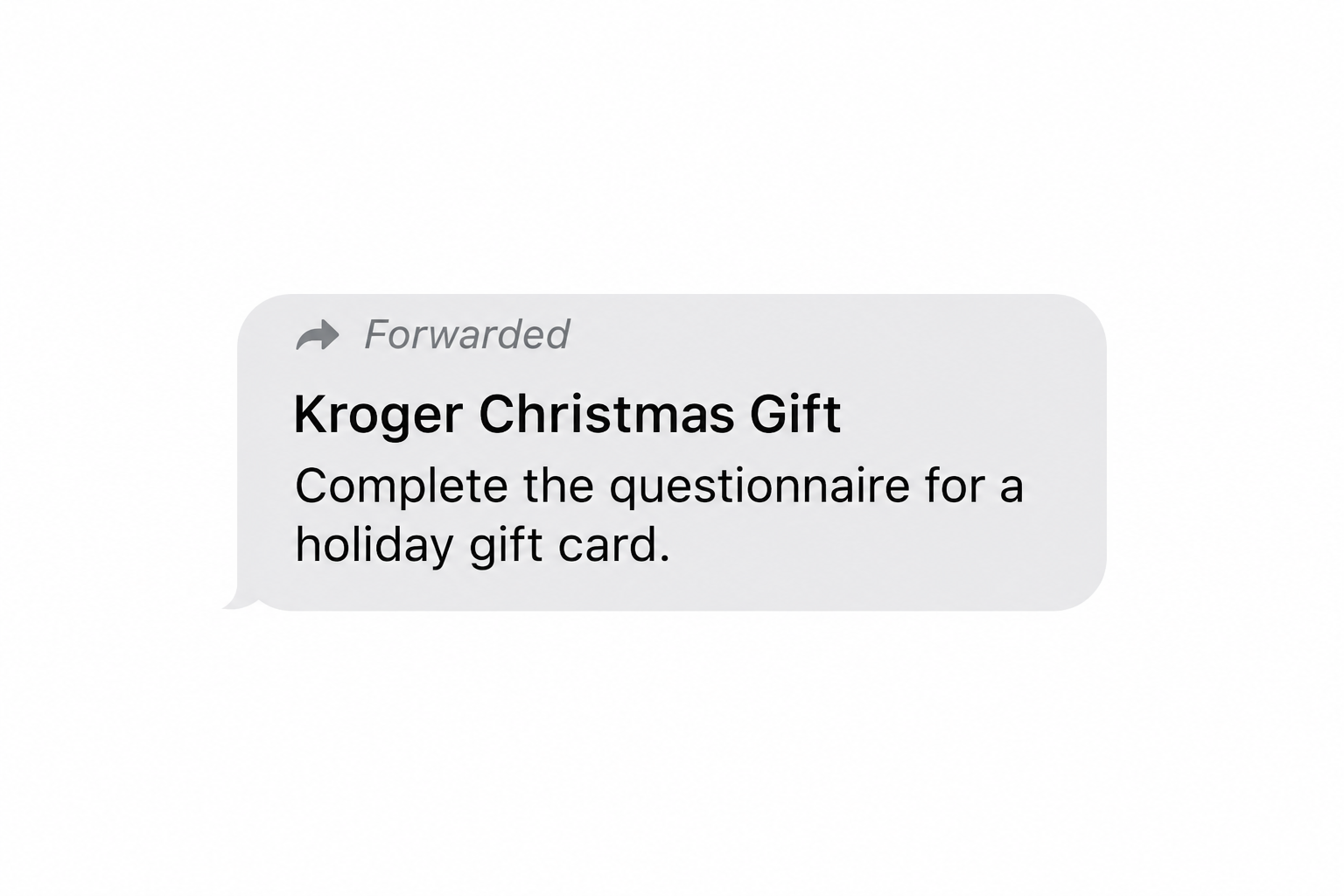
A friend forwards a Kroger Christmas questionnaire just as you’re planning the holiday grocery run. A gift card would help, and the questions sound easy.
Before you join in, look past the festive picture. The important details aren’t the recipes or shopping questions, but what happens after you answer them.
Overview
A holiday reward is being used to borrow Kroger’s credibility
The Kroger Christmas gift questionnaire scam uses a familiar supermarket name to make an unsolicited survey feel like a seasonal customer promotion.
Reported versions promise a holiday gift card, sometimes worth $100 to $500, or a chance at free groceries. They arrive through texts, social posts, or forwarded messages.
Kroger is a real retailer with genuine rewards and customer research. Those services don’t authenticate a separate page that borrows its name, colors, or logo.
The crucial question is whether the invitation connects to a promotion Kroger actually operates. A graphic saying you qualified cannot establish that connection.
The questionnaire leads toward information or payment
The reported scheme starts with ordinary-looking questions, then requests personal information or card details under a verification or delivery explanation.
Some versions also tell visitors to distribute the link before receiving anything. That turns recipients into promoters while leaving the promised reward unfulfilled.
Watch for this combination of requests:
- A forwarded message presents a valuable reward without a verifiable entry or official announcement.
- Questions about shopping lead into a form seeking information unrelated to your store visit.
- The supposed prize requires a card payment for shipping, handling, or verification.
- Sharing with friends becomes a condition for receiving the advertised gift.
- The page cannot explain who runs the promotion through independently verifiable rules.
Kroger’s real feedback page provides a useful comparison
Kroger’s Customer Satisfaction Survey page describes feedback about a store visit, requires an invitation, and advertises 50 fuel points.
It also directs visitors to survey links hosted by Qualtrics. An outside survey domain isn’t automatically fraudulent when you reached it through Kroger’s own website.
The difference is the trusted starting point. A random Christmas message should not replace the invitation, terms, and route provided by the retailer itself.
Why a Forwarded Grocery Offer Feels Convincing
You recognize the person who sent it
An unexpected promotion feels different when it comes from a sibling, neighbor, or friend. Their familiar name can distract from the unfamiliar website inside the message.
They may have forwarded it because they hoped it was useful. That doesn’t mean they checked the destination or received a gift card themselves.
Ask whether they redeemed the reward through their real Kroger account, rather than whether a page congratulated them. Those are very different kinds of confirmation.
The opening image is a simplified reconstruction of the forwarded-message hook, not a captured conversation. Actual messages, wording, and destinations can differ.
Holiday timing makes a large reward seem relevant
Christmas shopping involves real promotions, loyalty offers, and unfamiliar checkout screens. Criminals place their invitation among things people are already expecting to see.
A grocery reward also addresses an immediate expense. The offer can feel practical rather than extravagant, even when its value should prompt more scrutiny.
None of that requires the sender to know your shopping habits. A widely circulated message can reach enough grocery shoppers without knowing who uses Kroger.
The familiar brand provides the shortcut: you recognize the store, so you briefly stop asking who controls the form. The questionnaire depends on that pause.
How the Kroger Christmas Questionnaire Scam Works
Step 1: A message introduces an easy seasonal reward
The first contact presents the offer as something simple you can finish now. Answering questions appears less consequential than making a purchase or opening an account.
That framing makes opening the questionnaire feel harmless. You may want only to see the questions, without intending to share sensitive information or spend money.
At this stage, a logo and holiday artwork supply atmosphere, not authentication. Anyone can reproduce a retailer’s visual identity inside a message or webpage.
Before proceeding, leave the message and check through Kroger’s official channels. Don’t treat the sender’s own explanation as independent confirmation of the offer.
Step 2: Shopping questions make participation feel routine
Questions about favorite departments or shopping frequency resemble genuine customer research. They can give the impression that the retailer is learning something useful about customers.
The questions also create a small investment of time. Once you’ve answered them, abandoning the page may feel like wasting an opportunity you already earned.
But completion proves only that you interacted with a form. It doesn’t prove that Kroger recorded an entry, selected a winner, or allocated a reward.
If the page announces success immediately, compare that statement with the published rules. A congratulatory screen is not a substitute for a verifiable promotion.
Step 3: The reward becomes conditional on another action
Instead of providing the gift, the page introduces a requirement. The explanation may involve confirming eligibility, supplying delivery information, or completing a final verification.
Read what the new request actually collects. An address identifies where you live; a password can open an account; card details can authorize spending elsewhere.
Those consequences exist even if the form calls everything verification. The word describes the operator’s story, not a guarantee about how your information will be used.
A request for bank details is especially hard to reconcile with an unsolicited grocery gift. Don’t provide them simply because the preceding questions seemed harmless.
Step 4: A small fee changes a free offer into financial exposure
Some versions ask for payment to deliver or release the advertised prize. A small amount can feel reasonable beside the value of the promised gift card.
This is where the comparison becomes misleading. The risk isn’t limited to the fee shown on the page when the same form collects reusable card information.
The FTC warns that paying shipping or processing charges to claim a prize is a scam signal. A supposed win should not require that payment.
Don’t assume that every version creates a subscription. If a charge appears, document its merchant name and any terms shown rather than guessing what billing arrangement exists.
Step 5: Sharing spreads the invitation through trusted contacts
A forwarding requirement gives the page another benefit before delivering any reward. Your contacts receive the link with the credibility of your name attached.
The next person may not see the original sender. They see someone they know, making the same mistaken assumption you may have made earlier.
Sharing doesn’t validate the offer or create a right to a prize. It only increases the number of people exposed to the same invitation.
If you’ve already forwarded it, you can interrupt this stage immediately. Send a plain warning without the link and ask recipients not to complete the questionnaire.
How to Check the Offer Without Returning to the Trap
Start with a route you already trust
Open the Kroger app you normally use, or type the retailer’s address yourself. Look for the promotion there rather than searching for another copy of the questionnaire.
A search result repeating the same promise may belong to another promoter. Several websites using identical language aren’t necessarily several independent confirmations of a giveaway.
For receipt-based feedback, use the instructions supplied with your actual invitation. If anything differs, ask Kroger through contact details obtained independently from the questionable message.
Don’t send support your password, full card number, or a verification code. You can explain the offer and provide a redacted screenshot without exposing those details.
Compare the terms, not just the amount
A real promotion should explain who operates it, what participation involves, and how rewards are issued. Eligibility conditions should be available before you surrender sensitive information.
Look for consistency between the invitation and those rules. A survey shouldn’t change from earning fuel points into paying an unknown business for a grocery prize.
Also separate legitimate research from unrelated paid offers. A third party’s reward program isn’t automatically a Kroger promotion just because its prize can be spent there.
If the destination or conditions change, reconsider the transaction from the beginning. Time spent on the earlier questionnaire doesn’t justify accepting a different offer afterward.
Don’t make a single visual clue decide everything
A padlock means the connection is encrypted, not that Kroger owns the destination. Professional spelling and a polished layout are equally easy to imitate.
Conversely, an unfamiliar survey host isn’t sufficient proof of fraud. Kroger’s own feedback page links externally, which is why the original route matters so much.
Use the combination of provenance, published rules, and requested information. The strongest warning is a supposed free prize that depends on payment or unexplained sensitive-data collection.
What to Do if You Have Fallen Victim to This Scam
-
Stop participating and preserve the evidence you already have.
Close the questionnaire without completing another verification. Keep the original message, destination address, screenshots, and any payment confirmation somewhere private.
Record what you submitted, rather than reopening the page to investigate. Your response depends on whether you merely viewed it, entered information, paid, or shared it.
-
Contact your card issuer if you entered payment details.
Use the bank’s app or the number printed on your card. Explain that a fake Kroger reward page collected your information and describe any resulting charge.
Ask about blocking further use, replacement, and the appropriate dispute process. Report the actual transaction accurately, including whether you authorized a small payment before recognizing the deception.
-
Replace exposed passwords through the genuine account website.
If you entered a Kroger, email, Facebook, or other password, change it on that service directly. Replace matching passwords elsewhere and review unfamiliar sessions.
Enable available multifactor protection and check recovery settings. A new password won’t address an unfamiliar recovery email or a session that the service lets remain active.
-
Warn the people who received your forwarded invitation.
Explain that the reward wasn’t verified and ask them not to open the link. If someone already responded, tell them to act on their own exposure.
Remove your post where possible and report the original content through the platform. Don’t repost the clickable address as part of a public warning.
-
Prepare for follow-up messages using the information you supplied.
A name, email, and phone number can make a later approach more convincing. Someone may mention the questionnaire and pretend to help complete or refund it.
Don’t provide additional details to someone who contacts you unexpectedly. Check any claimed company through a separate route before continuing the conversation.
-
Choose identity-protection steps that match the information exposed.
If you supplied a Social Security number or identity document, use IdentityTheft.gov for U.S. recovery guidance appropriate to the disclosure.
An email address alone doesn’t justify assuming every account was stolen. Keep your response proportionate, while treating financial credentials and identification numbers as higher-priority exposures.
-
Report the impersonation and retain your complaint records.
Notify Kroger through its independently opened website and report the fraudulent post or message. American readers can also submit the incident at ReportFraud.ftc.gov.
Save complaint references and dates alongside transaction records. These details make later conversations with the bank or platform easier without requiring you to relive every step.
Keep unredacted evidence for official reporting channels. In a public warning, obscure personal information and avoid exposing a friend’s private conversation or account details.
-
Reject anyone charging to recover the missing reward.
There is no reason to pay a stranger to unlock a gift card from this questionnaire. Further fees only extend the original payment story.
If money was lost, work with the actual payment provider. The FTC’s scam-response guidance explains recovery routes without promising that every payment can be reversed.
Frequently Asked Questions
Is the Kroger Christmas questionnaire a real holiday promotion?
The forwarded questionnaire described here is an impersonation scam, not a verified Kroger promotion. Check any separate offer through the retailer’s official app, website, or support.
Does Kroger actually offer rewards for customer feedback?
Yes, its official feedback page advertises 50 fuel points and requires an invitation. That real program doesn’t validate an unrelated page promising a large Christmas gift.
Does a Qualtrics survey address mean the invitation is fake?
Not by itself, because Kroger’s own feedback page links to Qualtrics. Reach the survey from the retailer’s genuine page rather than trusting an unsolicited forwarded address.
What if the link came from someone I know?
Your friend may have forwarded it without verifying the reward. Ask whether they actually redeemed anything, and don’t treat their good intentions as proof of Kroger’s involvement.
Have I been hacked just by answering shopping questions?
Not necessarily, and the specific information matters. Assess what you disclosed, secure any exposed credentials, and don’t assume that ordinary survey answers automatically compromised your entire device.
Should I pay a small delivery fee for the gift card?
Do not pay to release this supposed prize. A shipping or verification explanation doesn’t make the questionnaire legitimate, and entering card details creates risk beyond the displayed fee.
The Bottom Line
Don’t complete or forward the Kroger Christmas gift questionnaire. A familiar grocery name and a few easy questions don’t justify payment or sensitive-information requests.
Check genuine rewards through Kroger’s own channels instead. If you already supplied card details or a password, contact the issuer or secure that account now.

Join the discussion
0 commentsShare your experience or ask a question about this article.
Community experiences
Did this happen to you?
Your experience could help someone recognize the same scam. Submit a private report for our team to review.
I experienced this tooReports are reviewed before publication. Sharing publicly is always your choice.
Discussion
Start the conversation
Have a question or something useful to share? Add the first comment.