

Velverdo CollaGum is sold with a simple promise: stronger gums, less sensitivity, and a healthier smile with a quick daily routine.
The idea is appealing. Instead of complicated dental treatments or long product routines, you get a jar of powder and a “20-second ritual” that claims to work right where problems start, along the gumline.
But products like this deserve extra scrutiny, especially when the marketing leans hard on dramatic results, steep bundle discounts, and vague proof.
In this article, we will break down what Velverdo CollaGum claims, what the ingredients can realistically do, and why the overall operation looks like a private-label dropshipping setup rather than a proven oral-care breakthrough. We will also cover what to do if you already ordered.
Overview
What Velverdo CollaGum is and what it claims to do
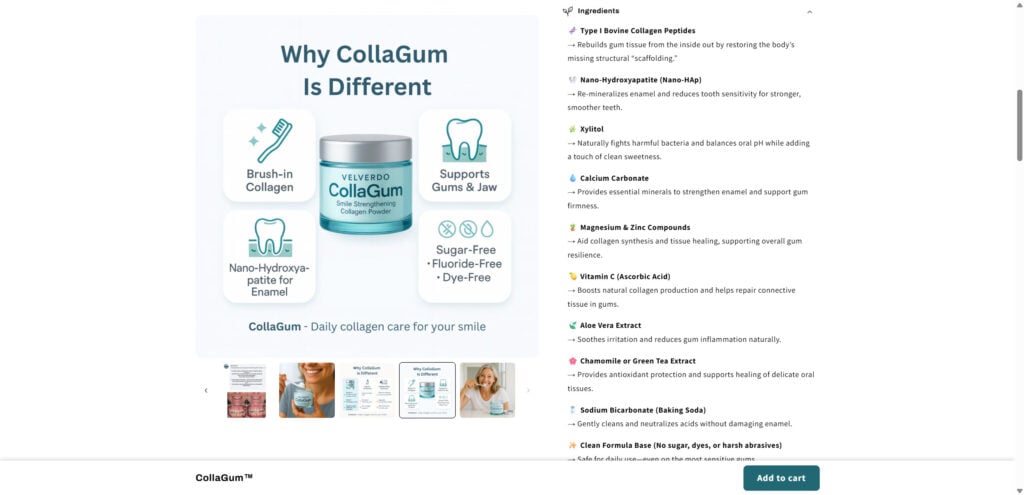
Velverdo CollaGum is marketed as a “Smile Strengthening Collagen Powder” that you brush onto your gums as part of your normal routine.
The product page highlights benefits like:
- Strengthens gums and enamel
- Soothes sensitivity “at the root”
- Fits into a simple 20-second daily habit
- Supports gums and jaw
- “Brush-in collagen” that targets the gumline directly
The positioning is clear: this is not just cosmetic whitening powder. It is framed as gum repair, gum strength, and sensitivity relief in one product.
That is a big promise.
Gum issues are not like dry skin where you can rub on moisture and feel better. Gum tenderness, inflammation, and recession typically involve plaque bacteria, irritation, grinding, brushing technique, genetics, smoking, hormonal changes, or periodontal disease.
A powder can support a routine, but it cannot replace diagnosis and treatment when a real gum problem exists.
The page structure: steep discounts, bundle pressure, and urgency
Velverdo CollaGum is presented with aggressive bundle offers and a large sale banner advertising major percentage discounts.
That structure is extremely common in direct-response funnels:
- The “Buy more, save more” bundle is positioned as the smart choice
- The discount anchor makes the regular price look inflated
- The checkout is designed to keep you moving, not researching
This does not automatically prove wrongdoing.
It does tell you what kind of business model you are dealing with: high-conversion ecommerce, not a clinical oral-care brand built on long-term credibility.
The headline claims: “25,000+ healthier smiles” and near-perfect results stats
The page claims “25,000+ Healthier Smiles” and lists very high percentages such as:
- A large majority claiming stronger, healthier gums within weeks
- A large majority reporting less sensitivity after daily use
- A large majority seeing a “fuller gumline” and smoother smile
It also notes that the stats are based on a poll of early users.
Here is the problem.
These numbers can be displayed on any webpage without independent verification. Unless you can confirm them through third-party sources, they function as marketing, not evidence.
Even when a product is helpful, real-world results for gum sensitivity and gum inflammation are rarely this uniform, especially across different ages, diets, brushing habits, and oral health conditions.
When you see near-perfect stats tied to a product that is not widely discussed outside its own site, it is rational to be cautious.
The “review count” issue: small on-page reviews vs big performance claims
The product page shows a modest review count on the site itself, while also claiming huge user adoption and dramatic results.
That mismatch matters.
If a product truly produced fast, visible gumline changes for thousands of people, you would usually see more organic discussion beyond the store page, including:
- independent reviews on Trustpilot or similar platforms
- dental forums discussing it, positively or negatively
- consistent brand presence and a traceable company identity
- clear third-party testing documentation
When the primary proof is kept inside the storefront, you are being asked to trust the seller’s own content.
What the ingredients list suggests
The product page lists a mix of familiar oral-care and supplement-style ingredients, including:
- Type I bovine collagen peptides
- Nano-hydroxyapatite (often abbreviated as Nano-HAp)
- Xylitol
- Calcium carbonate
- Magnesium and zinc compounds
- Vitamin C (ascorbic acid)
- Aloe vera extract
- Chamomile or green tea extract
- Sodium bicarbonate (baking soda)
- A “clean formula base” with claims like no sugar, no dyes, and no harsh abrasives
- “Fluoride-free” positioning
Some of these ingredients are reasonable in oral-care products.
The issue is how they are framed.
Velverdo CollaGum is not marketed as “a gentle tooth powder that supports a healthy routine.” It is marketed as a repair product that rebuilds gums and creates visible gumline improvements.
That is a much higher bar.
What ingredients like nano-hydroxyapatite can realistically do
Nano-hydroxyapatite is commonly used in certain toothpastes and oral-care products aimed at enamel remineralization and sensitivity.
In plain language:
- It can help support enamel surface repair and reduce sensitivity for some users
- It is not a miracle cure, but it can be a legitimate part of sensitivity control
If CollaGum’s formula contains a meaningful and properly manufactured form of nano-hydroxyapatite, that could support smoother enamel feel and reduced sensitivity for some people.
But you do not need a mystery brand with aggressive sales tactics to get nano-hydroxyapatite.
You can choose reputable oral-care products with clearer manufacturing standards and a long track record.
What collagen claims usually get wrong in oral-care marketing
Velverdo CollaGum’s core hook is “brush-in collagen” for gum support.
Collagen matters for the body, including connective tissues.
But the claim that brushing collagen peptides onto gums “rebuilds” tissue is where marketing often outruns reality.
Here is why:
- Collagen peptides are proteins or protein fragments. When used topically in the mouth, they are exposed to saliva, enzymes, and constant mechanical disruption.
- Gum recession is not a simple “missing collagen” problem. It often involves inflammation, plaque, mechanical trauma, or periodontal disease.
- A “fuller gumline” is not something most people get from a powder. If you truly have recession, the correct path is usually professional care, better plaque control, correcting brushing technique, and in some cases periodontal treatment.
A product might make gums feel less irritated if it reduces inflammation triggers or improves daily cleaning.
That is very different from rebuilding gum tissue.
The “fluoride-free” framing is not automatically a benefit
The product page highlights that the formula is sugar-free, fluoride-free, and dye-free.
Sugar-free and dye-free are easy wins.
Fluoride-free is more complicated.
Fluoride is one of the most evidence-supported cavity prevention tools in modern dentistry. Many dentists actively recommend fluoride toothpaste for most adults and children because it helps strengthen enamel and reduce decay risk.
A fluoride-free product is not automatically bad.
It does mean the product should not be sold as a superior enamel-strengthening solution just because it avoids fluoride.
If someone is cavity-prone, fluoride-free can be a downgrade, not an upgrade.
The before-and-after style visuals and why they deserve skepticism
Velverdo CollaGum uses teeth and gumline visuals that resemble common marketing layouts used across many dental funnels.
The biggest red flag with before-and-after style presentations is that they are easy to reuse, license, or fabricate.
A credible oral-care brand that relies on transformations typically provides:
- clear, consistent clinical photography reveals
- standardized lighting, angles, and timeframes
- strong disclaimers about typical vs exceptional results
- supporting documentation, not just image tiles
When the imagery looks generic and the claims are dramatic, assume the visuals are persuasive design, not proof.
The private-label evidence: the same product concept sold wholesale for around $1
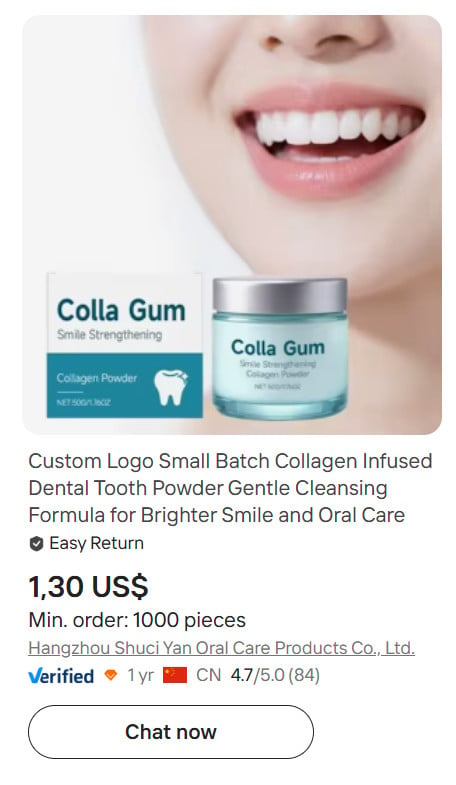
One of your screenshots shows a wholesale listing for a “Colla Gum” style product described as collagen-infused dental tooth powder with custom logo private labeling, priced around $1.30 per unit with bulk minimums.
That matters.
It strongly suggests CollaGum is not a unique invention from a specialized oral-care lab. It looks like a private-label product that can be branded and sold under many names.
Private label is not automatically a scam.
But when a private-label product is sold with:
- dramatic gum repair claims
- near-perfect results stats
- constant deep discounts
- limited independent reputation
…then it is reasonable to treat it as a high-margin marketing play, not a breakthrough treatment.
What “same type op” usually means in practice
When you see a product like this tied to a storefront brand, and then you see a similar product available as custom-labeled inventory from manufacturers, the business often works like this:
- a manufacturer produces a generic tooth powder formula
- resellers select a jar design, label, and name
- a storefront is built using a standard ecommerce template
- ads drive traffic into a conversion funnel
- bundles and discounts increase average order value
- customer service and returns are treated as a cost center, not a brand priority
This is why two people can have completely different experiences.
One customer receives a jar and feels some sensitivity relief because they improved brushing consistency.
Another customer sees no change, tries to return it, and discovers that refunds are difficult, slow, or require costly shipping.
So should you buy Velverdo CollaGum?
If you want a gentle add-on to your routine, you can likely find safer options with stronger transparency.
If you are dealing with gum bleeding, recession, swelling, pain, or ongoing sensitivity, Velverdo CollaGum is not a smart first-line solution. That is a dental health issue, not a marketing problem.
Based on the product’s claims, the funnel structure, and the private-label sourcing signal, Velverdo CollaGum looks like a relabeled commodity formula sold at a premium price through heavy persuasion tactics.
That is not where you want to place your trust when it comes to oral health.
How The Operation Works
Step 1: Ads sell fear, simplicity, and a quick fix
Operations like this usually start with social media ads that frame gum problems as a hidden threat.
The pitch is built around:
- “Your gums are mostly collagen”
- “Over time, collagen breaks down”
- “Your gumline starts pulling back”
- “This 20-second ritual supports repair”
This style of messaging is effective because it creates a single villain (collagen loss) and a single hero (a powder you brush in).
Real gum health is rarely that simple.
Step 2: A clean landing page builds instant credibility
The product page uses a polished design with:
- a professional product mockup
- star ratings near the title
- simple benefit bullets
- a “How it works” section that explains a straightforward mechanism
- short FAQs that keep the user moving toward purchase
This structure is deliberate.
It is designed to make the product feel established and clinical without providing the kinds of documentation that clinical products usually provide.
Step 3: The science is simplified into a story
Instead of focusing on plaque control, periodontal inflammation, flossing technique, and professional evaluation, the page narrows the cause down to one theme:
- collagen declines
- gums weaken
- brush collagen back in
- gums strengthen again
This is persuasive storytelling.
It is not how dentistry typically explains gum health.
Gum tissue condition is closely tied to inflammation, bacterial load, and mechanical irritation.
A powder does not bypass that reality.
Step 4: “Unique” positioning is created through comparisons
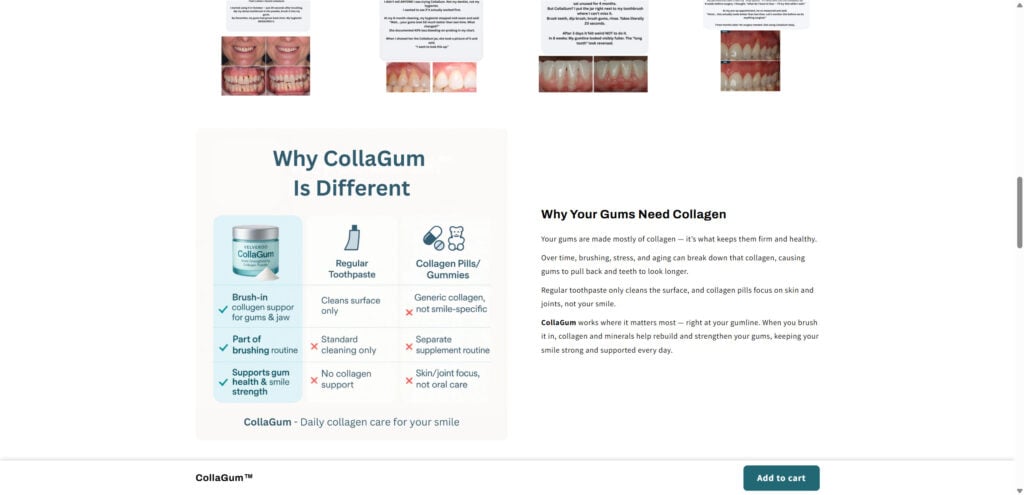
The page includes “Why CollaGum is different” style comparisons against:
- regular toothpaste
- collagen pills or gummies
The framing is usually:
- toothpaste cleans only the surface
- pills focus on skin and joints
- Velverdo CollaGum works directly at the gumline
This comparison is persuasive but misleading by omission.
A quality toothpaste with fluoride, plus good technique, plus flossing, plus professional cleanings, is a serious gum-health program.
A powder does not replace it.
Step 5: The ingredient list is used as proof by association
A long list of familiar ingredients makes the product feel advanced.
That is a classic tactic.
The presence of an ingredient is not the same as:
- the correct form of the ingredient
- the correct concentration
- stable manufacturing and storage
- batch-to-batch consistency
- independent verification of purity and contaminants
When a product claims meaningful results, you want proof beyond the ingredient names.
Step 6: Big stats provide social permission to buy
“25,000+ healthier smiles” and extremely high success percentages are used to create a sense that buying is the normal, safe choice.
This is social proof engineering.
If the stats are real, they should be backed by something verifiable.
A claim that the data comes from a poll of early users is not the same as independent evidence.
Step 7: Bundles raise the cart value
The pricing section is built to steer customers away from buying one jar.
Common bundle logic:
- Buying one feels inefficient
- Buying a bundle feels like “saving” and “planning ahead”
- A “most popular” tag nudges the buyer to select the middle option
- Free shipping is tied to higher order sizes
This is a standard ecommerce optimization tactic.
It is especially common in private-label operations because the cost per unit can be extremely low relative to the retail price.
Step 8: Fulfillment is often routed through third parties
When a product is private-label, fulfillment is frequently handled through a third party, sometimes overseas.
That can lead to:
- longer shipping times than a local brand would typically have
- tracking that updates slowly or inconsistently
- packaging that does not match the premium story
- unclear origin details
Not every order will have issues, but the overall model increases the chance of friction.
Step 9: Returns become difficult because they reduce profit
This is where many buyers feel burned.
A premium funnel needs most customers to keep the product, even if results are modest.
So the return experience can become a barrier course, such as:
- strict return windows
- “must be unopened” requirements
- slow responses
- requests for photos and forms
- return shipping costs that are not worth it
- return addresses that make the process expensive
If a return requires international shipping, many customers give up, which is exactly how these funnels protect margins.
Step 10: The brand can be replaced faster than a reputation can be built
Private-label storefronts can be launched quickly and rebranded quickly.
If one product name gets too many complaints, the same formula can be relaunched under a different name, different jar, and a slightly different story.
This is why independent reviews and a real company footprint matter so much.
A real brand invests in a reputation it cannot easily replace.
A funnel invests in ads and checkout conversion.
Step 11: Why results are hard to interpret
Even if someone reports improvement, it may not mean the product has special gum-repair powers.
Common reasons people perceive improvement:
- they started brushing more consistently because the product created motivation
- they spent more time on the gumline, improving plaque removal
- they stopped irritating their gums with aggressive brushing
- sensitivity fluctuates naturally based on diet, stress, and brushing habits
A routine change can improve gum comfort.
That does not confirm that brushing collagen into gums rebuilds tissue.
Step 12: Who is most at risk of being disappointed
Certain buyers are more likely to have a bad outcome:
- people with gum recession expecting visible reversal
- people with periodontal disease needing treatment
- people with persistent bleeding and swelling
- people with tooth mobility or deep pocketing
- people who need a dentist, not a new product
If someone has real symptoms, delaying professional care because a website promised an easy fix can be costly.
What To Do If You Have Bought This
If you already ordered Velverdo CollaGum, focus on practical steps and protect yourself financially.
- Check whether you bought a one-time order or a recurring plan.
Look at the checkout confirmation and any follow-up emails. Some stores add subscriptions or recurring “saver” options. If you see anything recurring, cancel immediately through your account page and also by email. - Save screenshots of the product page, claims, and refund policy.
Capture the key claims that influenced your purchase, including any “money back” language, return timelines, and shipping claims. This matters if you need to dispute charges. - If the order has not shipped, request cancellation in writing right away.
Keep the message short and direct:- order number
- request to cancel before shipment
- request written confirmation
- If you receive the product, inspect it before using it.
Photograph:- front and back label
- ingredient list
- any lot number or batch code
- any manufacturing country statement
- If you try it, stop immediately if you get irritation or pain.
Gum irritation can have many causes. Do not push through discomfort because a website promised results. If symptoms persist, see a dentist. - Do not treat it as a substitute for flossing or dental visits.
Even the product FAQ typically admits it does not replace standard dental care. If you have bleeding, swelling, recession, or sensitivity that is not improving, schedule a dental exam. - Keep it away from pets and small children.
Many oral-care products contain ingredients that should not be ingested in large amounts. Also note that xylitol is dangerous for dogs. Store it safely. - If customer support stalls, escalate early with your payment provider.
If you paid via PayPal, open a dispute inside the resolution center.If you paid by card, contact your bank and ask about a chargeback for misleading marketing and return friction. - Do not spend $ on expensive return shipping without a clear written agreement.
If the merchant requires you to ship returns far away, ask for:- a prepaid label
- a domestic return address
- a partial refund without return
- Watch your statements for extra charges.
Set a reminder to review your card activity for the next 30 days. If you see unexpected charges, act immediately. - Report misleading ads if you believe the claims were deceptive.
You can report ads through the platform where you saw them, including Meta and Google. If you are in the US and believe the marketing is deceptive, you can also report to Federal Trade Commission. - If you need a safer alternative, ask your dentist what fits your case.
Sensitivity can be caused by enamel wear, recession, grinding, acidic diet, or cavities. Gum inflammation can be plaque-driven. A dentist can tell you what is actually happening and what product category helps.
The Bottom Line
CollaGum is marketed as a fast, simple gum-repair shortcut, built around the idea that brushing collagen onto your gums can restore strength, reduce sensitivity, and even improve the look of your gumline.
The issue is that the claims are bigger than the proof, and the overall presentation matches a private-label ecommerce funnel: heavy discounts, bundle pressure, polished visuals, oversized success stats, and a product concept that appears available wholesale for around $1 per unit under custom branding.
If you want to improve gum health, your best return on time and money is still the fundamentals: correct brushing technique, daily flossing or interdental cleaning, evidence-based toothpaste choices, and professional evaluation when symptoms persist.
If you are choosing between Velverdo CollaGum and a more transparent oral-care option from an established brand, CollaGum is not the safer bet.

Join the discussion
0 commentsShare your experience or ask a question about this article.
Discussion
Start the conversation
Have a question or something useful to share? Add the first comment.