

PawVita Taurine Powder is marketed as a simple, daily safeguard for your dog, one scoop a day for heart health, eyesight, and overall vitality.
At first glance, the pitch sounds responsible. Taurine is a real nutrient that can matter in certain veterinary situations, and many owners want to be proactive rather than wait for a problem to show up.
The issue is that a real ingredient does not automatically mean a trustworthy product.
When you look closely at how PawVita is presented, the page relies heavily on urgency, dramatic health framing, and credibility signals that are difficult to verify. Add in signs of private-label sourcing and stock or AI-styled imagery, and it becomes reasonable to pause before buying.
In this review, we break down what PawVita claims, how this type of operation typically works behind the scenes, what the real risks are for buyers, and what to do if you already placed an order.
Overview
What PawVita Taurine Powder is being sold as
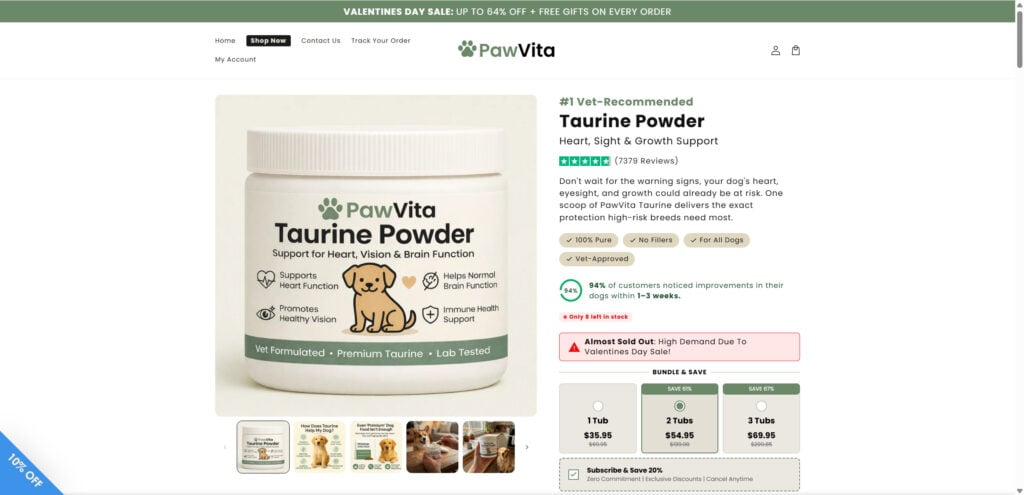
PawVita Taurine Powder is positioned as a simple daily supplement for dogs, with messaging focused on prevention and peace of mind.
The product page frames it as:
- “#1 vet-recommended” taurine powder
- Support for heart health, sight, growth, brain function, and immune function
- A “precise” daily dose using a scoop and weight-based guide
- A solution for owners who do not want to guess whether food contains “enough” taurine
The label shown on the jar leans into broad wellness positioning, not a narrow, clinical use case.
That is important, because taurine supplementation can be appropriate in certain scenarios, but it is not automatically something every dog needs.
The on-page sales signals: urgency, bundling, and perpetual discounts
The site shows a rotating promotion tied to a “Valentines Day Sale” with “up to 64% off” and “free gifts on every order.”
This kind of always-on discounting is common in direct-to-consumer funnels that rely on impulse decisions.
Instead of “Here is a product, here is the science, here is the documentation,” the structure is closer to:
- Create urgency (“Only 8 left in stock”)
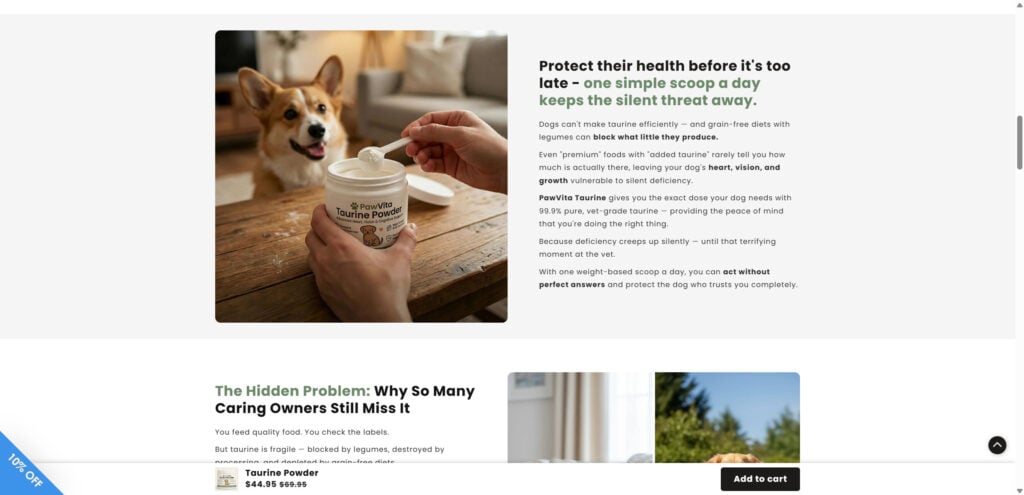
- Create fear (“silent threat,” “before it’s too late”)
- Create a simple action (“one scoop a day”)
- Increase order size with bundles
The bundles displayed are:
- 1 tub for $35.95
- 2 tubs for $54.95 (marked as a higher savings option)
- 3 tubs for $69.95
A sticky bar lower on the page shows a price of $44.95 with a crossed-out $69.95, reinforcing the discount anchor.
These numbers matter, because when you compare them to wholesale private-label pricing for similar products (more on that below), the margin can be substantial.
Big margins are not automatically bad. Plenty of legitimate brands have healthy margins.
The problem is when the margin is powered by vague sourcing, missing verification, and pressure tactics.
The subscription element: “Subscribe & Save 20%”
The product page also includes a subscription option with “Subscribe & Save 20%” and language like “Zero Commitment” and “Cancel Anytime.”
Subscriptions can be convenient when the company is reputable and customer service is responsive.
They can also become a headache when:
- cancellation is buried
- support is slow
- the return process is expensive or unclear
- the brand is built to rotate domains and storefronts
If you are buying any supplement from a site like this, it is worth slowing down and checking whether you are placing a one-time order or starting a recurring charge.
The dosage guide and why it deserves scrutiny
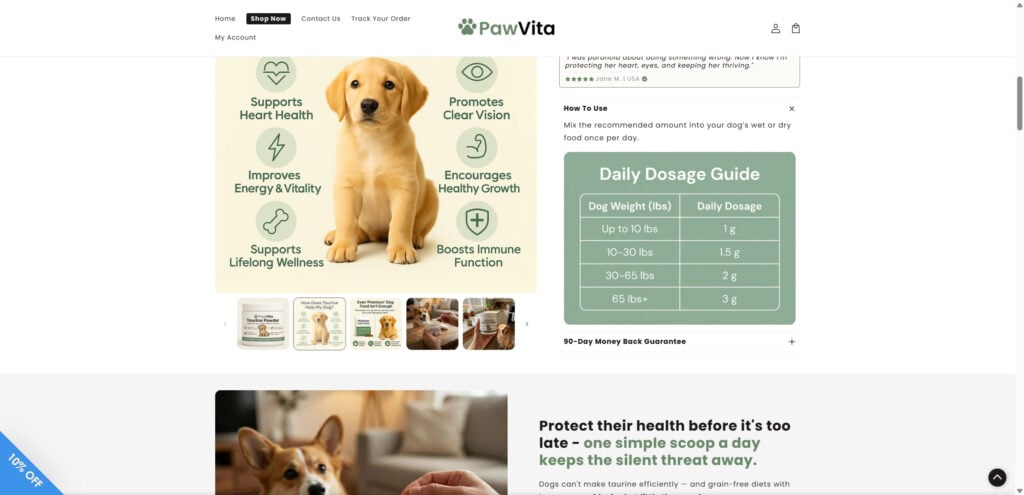
The page includes a “Daily Dosage Guide” based on dog weight:
- Up to 10 lbs: 1 g
- 10 to 30 lbs: 1.5 g
- 30 to 65 lbs: 2 g
- 65 lbs+: 3 g
A dosing chart looks reassuring. It feels precise.
But dosing alone does not answer the bigger questions:
- How many milligrams of taurine are in 1 g of this powder, in the real world, batch to batch?
- Is the powder pure taurine, or is it blended with something else?
- Is there a certificate of analysis (COA) per batch?
- Is the scoop actually calibrated, or is it a generic scoop included with private-label packaging?
- What is the actual daily taurine intake your dog is already getting from food?
This is where legitimate supplement brands usually provide deeper transparency.
They do not just show a chart. They show documentation.
Taurine: real nutrient, real use cases, but not a universal emergency
Taurine is a naturally occurring amino sulfonic acid (often discussed like an amino acid) involved in multiple biological functions.
In veterinary contexts, taurine is most commonly discussed around:
- certain diet-associated heart concerns, including some cases of dilated cardiomyopathy (DCM)
- specific breeds that may be more prone to taurine-related issues
- dogs with confirmed low taurine levels on testing
- situations where a veterinarian is managing a case and supplementing as part of a plan
Many dogs can synthesize taurine from other amino acids in the diet. That does not mean deficiency never happens.
It means “all dogs cannot make taurine efficiently” is not a clean, universal statement.
The PawVita page uses broad language that can make a normal owner feel like they are failing their dog by not adding this supplement.
That emotional framing sells products.
It does not automatically make the product appropriate.
A better way to think about taurine is:
- Taurine can be important in specific situations.
- The need should ideally be guided by a veterinarian, especially if the marketing is pushing fear.
- If you truly suspect a taurine-related issue, the best money you can spend is often on a vet visit and appropriate testing, not on a dramatic sales page.
The “vet-recommended” and “vet-approved” positioning
The product page uses phrases like “vet-recommended” and “vet-approved,” plus “vet formulated” and “lab tested” on the jar label.
These claims can be meaningful, but only if they are backed up.
What you want to see for real credibility:
- the name and credentials of the veterinarian(s) involved
- the role they played (formulation, review, advisory board, paid endorsement, etc.)
- the manufacturing facility details
- third-party lab testing results that are accessible and verifiable
In the screenshots, the marketing claims are prominent, but the proof is not.
There is also a quote attributed to a “Dr. Sarah Mitchell” about dogs developing DCM from taurine deficiency.
A quote with a name is not the same as a verifiable expert source.
When a page uses medical urgency and authority signals, the burden is on the seller to provide clear sourcing and documentation.
The “7,379 reviews” problem: on-page social proof without independent verification
The product page displays “(7379 Reviews)” along with star icons.
It also claims that 94% of customers noticed improvements in 1 to 3 weeks.
On-site reviews and statistics are easy to display and hard to verify.
That does not mean they are always fake.
It means you should treat them as marketing until you can confirm them elsewhere.
A high-trust brand typically has at least some visible footprint outside its own checkout page:
- independent reviews on well-known platforms
- discussion in real communities
- a consistent brand history
- a traceable company presence and customer support trail
If you search and find nothing beyond the brand’s own site and ads, that is a risk signal.
The product imagery: stock-like and AI-styled visuals
Your notes mention that many images appear AI-generated or reused.
Even without proving that definitively, this shows a common pattern:
- polished lifestyle photos
- clean infographic-style panels
- strong emotional storytelling
- minimal manufacturing transparency
Legitimate brands often have:
- consistent product photography across batches
- real facility or team photos
- clear labeling shots with lot numbers
- documentation links near quality claims
When images look generic, heavily stylized, or disconnected from real-world product handling, it can indicate private-label reuse across multiple storefronts.
The strongest sourcing red flag: the private-label lookalike listings
Wholesale listings for “Kriath Taurine Powder” with packaging that closely matches the PawVita jar design style, including the cartoon dog and similar layout are a big red flag.
The listings appear on a wholesale marketplace and show:
- very low unit prices in US$ (for example, roughly $1.35 to $2.15 per unit on one listing, and roughly $2.25 to $2.85 on another)
- “private label” and “OEM” style wording
- suppliers marked CN (China)
This does not prove PawVita is the exact same supplier or the exact same formulation.
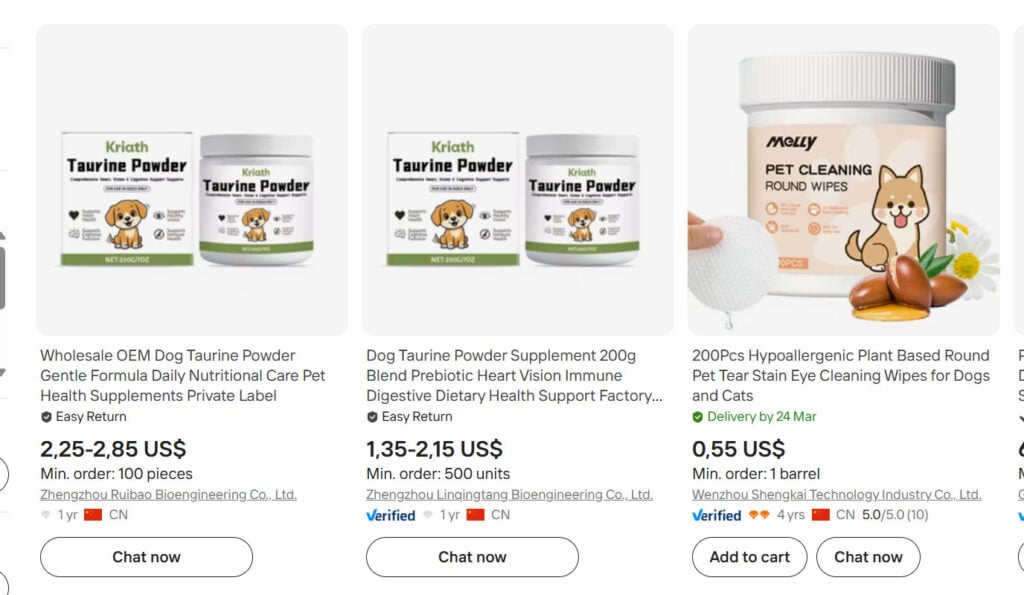
It does strongly suggest that this product category is widely offered as an off-the-shelf private-label item that can be rebranded and sold at a large markup.
Private label is not inherently a scam.
But when a product is private-label and the storefront relies on:
- fear-based health claims
- unverifiable “vet-approved” language
- on-site-only reviews
- aggressive discounting
- unclear testing documentation
…then the risk shifts toward “marketing machine first, product transparency second.”
What a high-trust taurine supplement listing usually includes
If a company wants you to give a supplement to your dog every day, the page should make it easy to verify basics.
High-trust signals include:
- a downloadable COA for recent batches
- a clearly stated manufacturing country and facility standards
- a real business address and support phone number
- transparent ingredient list (not just “taurine powder”)
- heavy metal and contaminant testing statements with lab details
- clear refund and return terms with a realistic return address
- realistic claims (support language, not dramatic disease prevention framing)
When those pieces are missing, it does not mean the powder is harmful.
It means you are being asked to buy trust instead of being shown trust.
So should you buy it?
PawVita Taurine Powder looks less like a specialized veterinary product and more like a conversion-focused funnel selling a commodity ingredient with premium storytelling.
If your dog genuinely needs taurine supplementation, you can often get it through a vet-guided plan using a product with clearer documentation and a safer return path.
If your dog does not have a specific need, buying because the page made you scared is rarely the best decision.
How The Operation Works
Step 1: A short-form video creates urgency and fear
This type of product is often sold through social media ads and short videos.
The script usually follows a predictable pattern:
- introduce a “simple” supplement
- list big benefits (heart health, vision, growth, energy)
- imply a hidden danger most owners are missing
- tease that “there are a few things you should know before buying”
- steer viewers to a single product page
This works because it blends caring and anxiety.
The owner is not being sold a powder.
They are being sold relief from worry.
Step 2: The landing page is built to convert, not to educate
Once you hit the site, the layout is designed for momentum.
The key conversion elements include:
- a large discount banner (“up to 64% off”)
- a “vet-recommended” headline near the top
- a big review count displayed immediately
- a claim that 94% of customers see improvements in 1 to 3 weeks
- low stock messaging (“Only 8 left in stock”)
- bundle pricing presented as the smart choice
- a subscription option that looks like savings
This is classic direct-response structure.
It keeps your brain in “act now” mode.
It does not encourage slow verification.
Step 3: Authority signals are layered in without hard proof
The page uses authority signals that feel medical, even if the product is marketed as a supplement:
- “vet-approved”
- “lab tested”
- “third-party tested”
- “99.9% pure”
- “vet formulated”
- a named doctor quote about DCM and taurine deficiency
When these are true, reputable sellers typically make proof easy to find.
A COA link is a common minimum.
Without it, authority signals function as persuasion, not evidence.
Step 4: Social proof is manufactured or isolated to the site
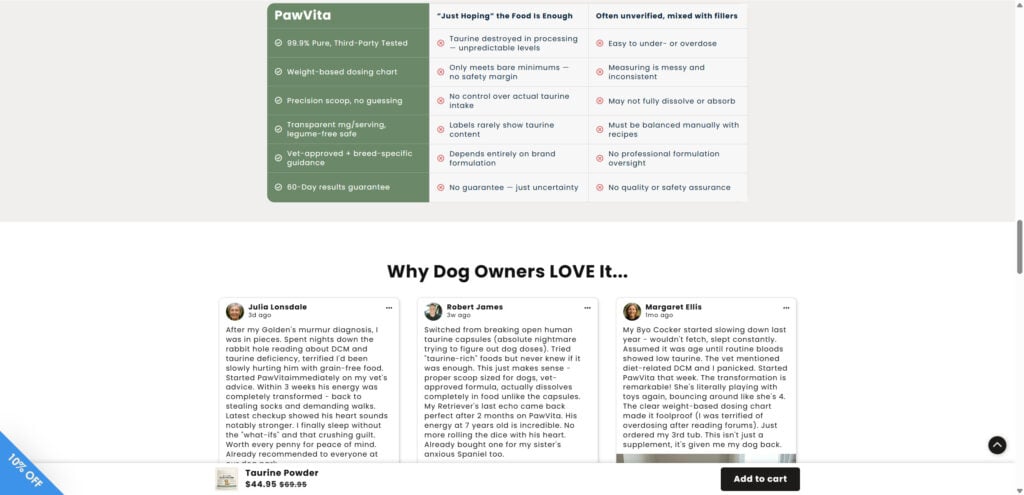
The testimonial section shows long, emotional review cards with full names like “Julia Lonsdale,” “Robert James,” and “Margaret Ellis,” plus timelines like “3d ago,” “3w ago,” and “1mo ago.”
The problem is not that testimonials exist.
The problem is that on-site testimonials are controlled by the seller.
If you cannot find a real footprint elsewhere, the testimonial block becomes part of the sales copy.
The “7379 reviews” counter has the same issue.
If those reviews are real, there should be evidence beyond the product page.
Step 5: The product is sourced through private label channels
This is where your wholesale screenshot matters.
A private-label supply chain often looks like this:
- a manufacturer produces a generic version of a supplement (taurine powder is a common commodity)
- the supplier offers “OEM” and “private label” packaging services
- sellers can choose label designs, jar sizes, and inserts
- the seller launches a storefront with a new brand name and marketing angle
In your screenshot, “Kriath Taurine Powder” appears as a wholesale listing with low per-unit pricing and CN supplier signals.
That pattern fits a relabeling model.
The key point is not “private label equals fake.”
The key point is this:
If the product is private label, the brand needs to prove quality through documentation, not through dramatic storytelling.
Step 6: Fulfillment is handled through third parties, often overseas
Many private-label storefronts do not hold inventory locally.
They route orders to a fulfillment partner, which can be overseas.
When that happens, customers often experience:
- longer shipping times than expected
- vague tracking updates
- confusing carrier handoffs
- packages that arrive with labeling that does not match the brand story
Again, this is not guaranteed in every case.
But it is common enough that you should plan for it if the company does not clearly state where it ships from.
Step 7: Customer support is minimal because the model is volume-based
Conversion funnels like this often run on paid ads.
The business goal is to acquire customers quickly, not build a long-term retail brand.
That can lead to:
- slow support response times
- scripted replies
- refund delays
- strict return conditions
- requests that make returns expensive or unrealistic
Your note about returns requiring shipping to China fits a common pattern in dropship operations: the store offers a “money back guarantee,” but the return address is overseas, and the shipping cost and customs friction discourage most people from following through.
A guarantee that is hard to use is not the same as a guarantee that protects you.
Step 8: Returns become the pressure point
Return friction is where customers often discover the difference between a brand and a storefront.
Common friction points include:
- return window starts at purchase date, not delivery date
- returns require unopened product even if the buyer needed to test it
- customer must pay return shipping
- return must go to an overseas address
- refunds are only issued after inspection, with no timeline
- “processing fees” are deducted
If PawVita’s policy requires costly international shipping, that is a serious downside.
Even if the product is harmless, you are exposed to financial hassle if it does not meet expectations.
Step 9: The marketing claims do the heavy lifting
Look at the promise stack:
- heart support
- vision support
- immune support
- brain function support
- energy and vitality
- “lifelong wellness”
- improvements in 1 to 3 weeks
That is a lot for a single-ingredient powder.
Taurine can be important, but it is not a magical, universal fix for every dog.
The more a product is positioned as a broad cure-all, the more you should demand proof.
Step 10: Why the pet niche is especially vulnerable to this model
Pet owners are emotionally motivated buyers.
That is not an insult. It is normal.
You love your dog, and the idea of missing a “silent threat” is painful.
That is why pet supplements are a magnet for aggressive marketing:
- fear converts quickly
- owners do not want to take chances
- the buyer is not the one feeling the symptoms, so changes are hard to verify
- placebo-by-proxy is real (owners perceive improvement because they want it to be true)
- “before and after” stories are compelling and difficult to challenge
A trustworthy brand counters this by being boring in the best way: transparent, documented, and realistic.
A funnel counters it by being emotional: urgent, dramatic, and vague on proof.
A simple checklist to judge whether this is a safe buy
If you are still considering buying, do this first:
- Find the company’s real business name and address (not just a contact form).
- Look for a batch-specific COA you can download.
- Check if the site explains where it ships from and where returns go.
- Confirm the subscription is not preselected.
- Search for independent reviews outside the brand site.
- Compare the product visuals and jar style to wholesale private-label listings.
- Ask your vet whether your dog actually needs taurine supplementation.
If most of those checks fail, the safer move is to skip.
What To Do If You Have Bought This
If you already placed an order, do not panic.
Most situations like this are fixable, especially if you act quickly and stay organized.
- Do not start (or continue) giving it to your dog if you feel unsure.
If your dog has a diagnosed condition and you bought this for that reason, call your veterinarian and ask what they want you to do next. If your dog is healthy and you bought it due to fear-based marketing, it is reasonable to pause until you have more clarity. - If your dog has any unusual symptoms, treat it like a normal health issue, not a customer service issue.
Vomiting, diarrhea, loss of appetite, lethargy, itching, or behavior changes should be discussed with a veterinarian. Save the product jar and packaging in case your vet wants details. - Find your order confirmation and check exactly what you purchased.
Look for:- quantity ordered (1, 2, or 3 tubs)
- whether you selected a subscription or “subscribe and save”
- the total charged, including shipping and any add-ons
- Take screenshots of the product page claims and the guarantee language.
Capture the parts that influenced your purchase:- “90-day money back guarantee”
- “third-party tested” or “99.9% pure” claims
- pricing and discount claims
- subscription terms
- Email customer support immediately and keep everything in writing.
Be polite and direct. Ask for one of these outcomes:- cancel the order if it has not shipped
- refund the order if it has shipped but you want to return it
- confirm in writing that you are not enrolled in a subscription (if applicable)
- If they offer a return, demand the return address and total cost before agreeing.
If the return address is overseas, ask whether they can provide:- a domestic return address
- a prepaid return label
- a partial refund without return (some merchants will offer this)
- If you used a card and support is unresponsive, start the dispute process early.
Card networks and banks have time limits.Tell your bank you have:- attempted to resolve with the merchant
- concerns about misleading marketing claims and return barriers
- supporting screenshots and emails
- Watch for additional charges over the next 30 days.
If a subscription was involved, or if the checkout used confusing defaults, you want to catch any repeat billing quickly.Set a calendar reminder to review your statement weekly for a month. - If you suspect your card details are at risk, take a conservative approach.
That can include:- requesting a new card number
- turning on transaction alerts
- using a virtual card number for future online purchases
- If the package arrives, photograph the label clearly.
Take pictures of:
- front label
- back label
- ingredient list
- any lot number or batch code
- country of origin statements (if present)
Missing lot numbers and vague labeling are additional quality risk signals.
- Ask the seller for a certificate of analysis for your batch.
A serious supplement seller should be able to provide testing documentation.
If they cannot, that tells you a lot about what you are paying for.
- Report misleading advertising if you believe the marketing was deceptive.
In the United States, you can report deceptive advertising to Federal Trade Commission.
If you believe the transaction involves fraud patterns, you can also report to FBI Internet Crime Complaint Center.
If you are outside the US, your country’s consumer protection agency is usually the right destination.
- Talk to your vet about safer options if taurine is truly relevant for your dog.
If taurine supplementation is actually needed, your veterinarian can point you toward:
- a product with strong documentation
- a dosing plan tailored to your dog’s diet and health
- follow-up testing if appropriate
The Bottom Line
PawVita Taurine Powder is marketed like a high-trust veterinary solution, but the page structure and evidence look more consistent with a private-label, dropship-style funnel.
The biggest concerns are not that taurine is “fake.” Taurine is real.
The concerns are the surrounding signals: heavy pressure tactics, dramatic health framing, on-site-only social proof, and missing verification for claims like “third-party tested” and “99.9% pure.” The presence of near-identical private-label taurine powder listings from CN suppliers strengthens the case that this is likely a relabeled commodity product sold at a premium.
If your dog truly needs taurine, the safer path is vet-guided supplementation using a product with transparent testing and a straightforward return policy.
If you are being pushed to buy because the page made you scared, that is usually a sign to step back, verify, and skip.









Excellent information!
Thanks Rosemary, glad it helped.