

PHOFAY promises a spray-on answer to razor cuts, sticky creams, painful waxing, and the awkwardness of reaching sensitive body areas.
The product page makes the process look almost effortless. Its guarantee and safety details become much less simple when the policy pages are opened.
Overview
What PHOFAY Hair Removal Mousse Claims
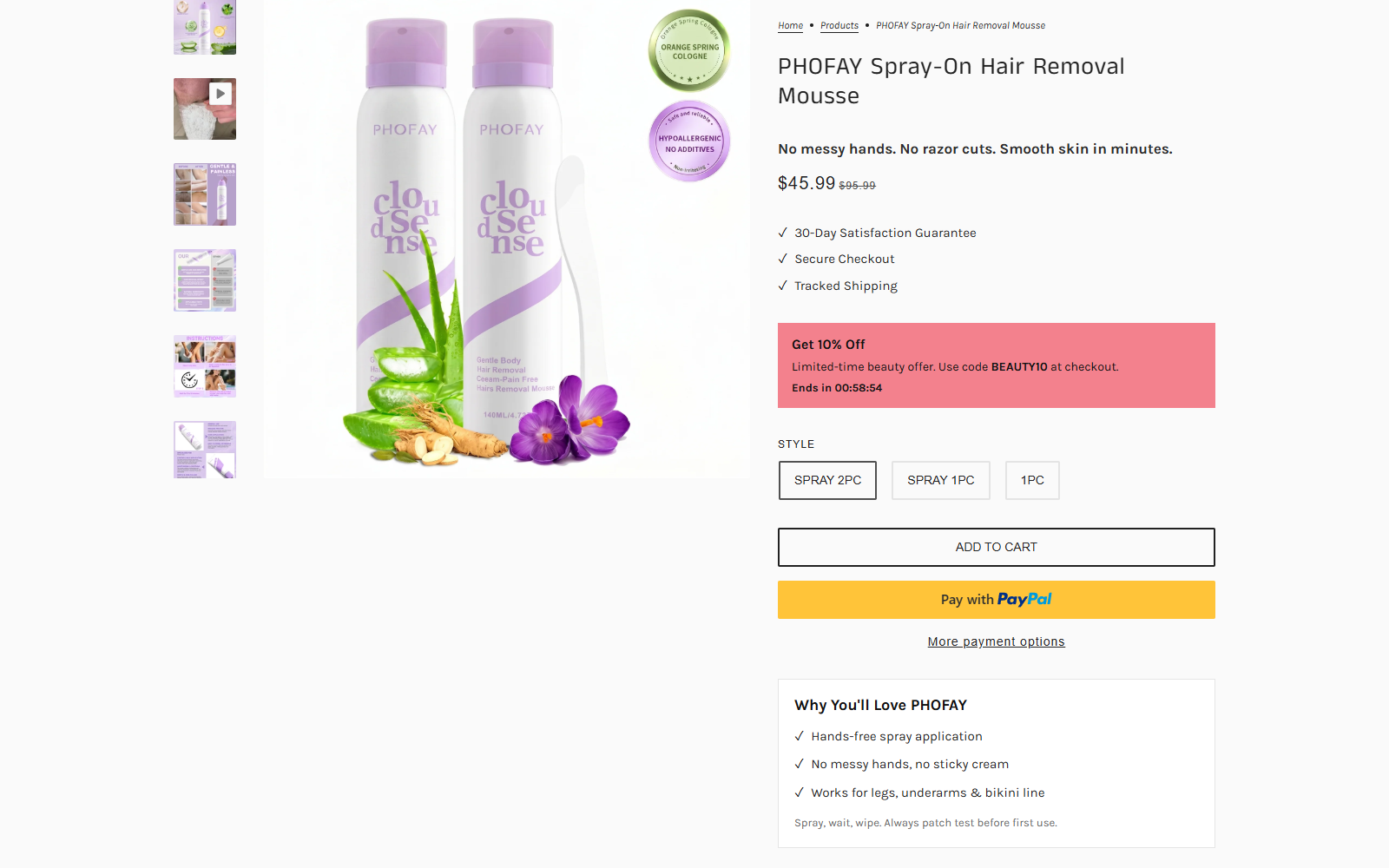
PHOFAY sells a spray-on depilatory mousse for legs, underarms, the bikini line, and other body areas.
The page says users can spray, wait, and wipe away unwanted hair without blades, messy hands, razor cuts, or painful pulling.
It describes the formula as suitable for sensitive skin and says calcium thioglycolate softens and dissolves hair without burning or redness.
The product is advertised at $45.99 against a crossed-out $95.99 price, with an additional 10% checkout code and countdown timer.
The Sales Page and Refund Policy Conflict
The main product panel advertises a 30-day satisfaction guarantee.
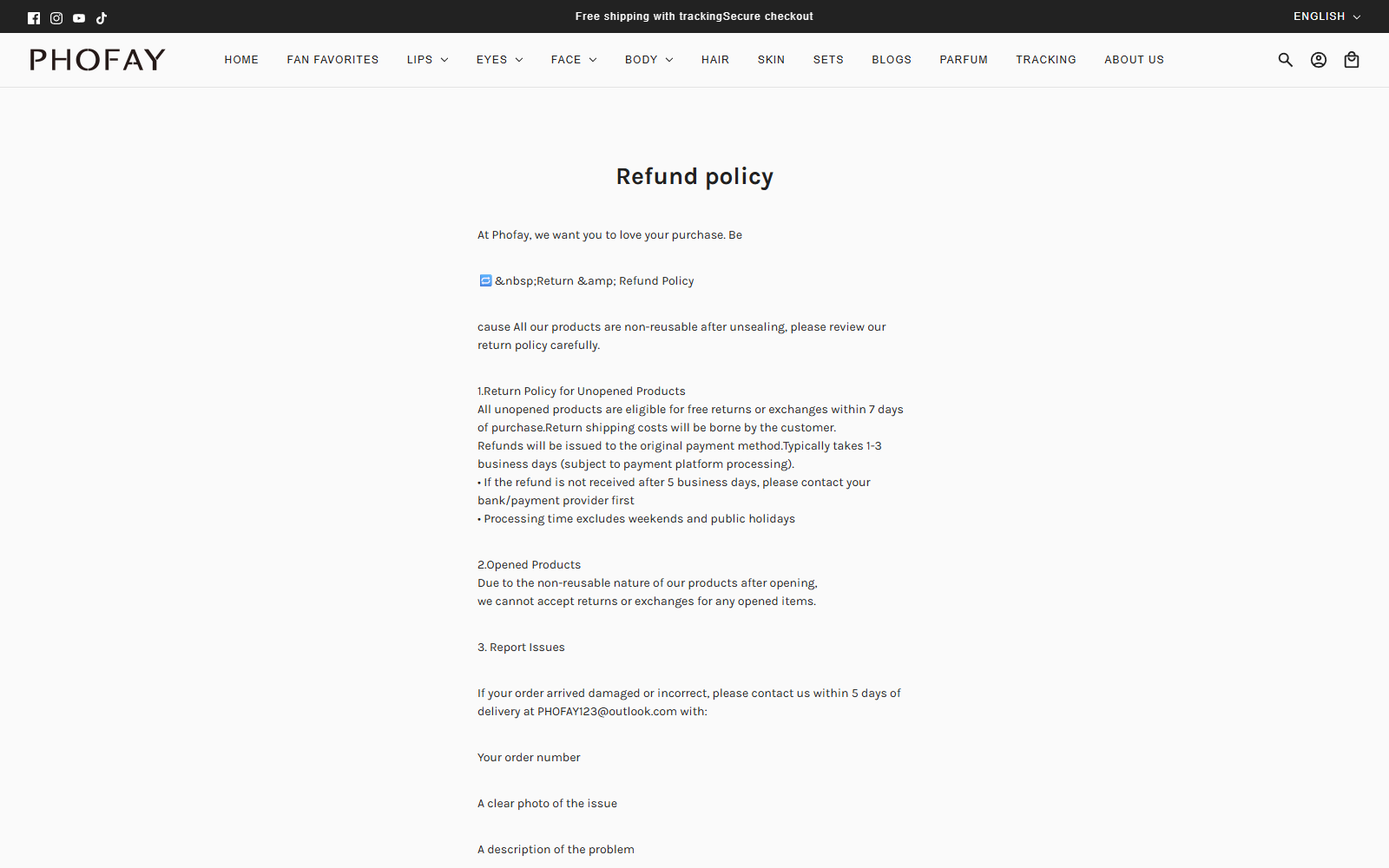
The actual refund policy allows returns or exchanges for unopened products only, within seven days of purchase.
It says opened products cannot be returned because they are non-reusable. The customer also pays return shipping.
A beauty product cannot realistically be tested without opening it, so the written policy undermines the impression of a 30-day trial.
This Is a Buyer-Warning Investigation
PHOFAY appears to sell an actual depilatory product. We are not claiming that every order is fraudulent or every can is unsafe.
The concerns are the extreme reference price, default two-can selection, chemical-safety language, contradictory guarantee, and limited return rights.
Before buying, verify these points:
- The active style is one can or two cans.
- The total charge matches the selected quantity.
- A complete ingredient list appears on the delivered label.
- The product has instructions for exposure time and safe body areas.
- The 30-day guarantee applies after the package is opened.
- The return destination and shipping cost are disclosed.
- The seller’s company name appears on the receipt and card statement.
How Chemical Hair Removal Actually Works
Depilatory products break chemical bonds in hair so the strand weakens and can be wiped from the skin.
Calcium thioglycolate is a known depilatory ingredient. Its presence does not automatically make a product fraudulent or dangerous.
However, a formula strong enough to break down hair can also irritate skin when used too long, applied incorrectly, or placed on sensitive tissue.
Risk varies with concentration, pH, exposure time, skin condition, previous reactions, and the accuracy of the instructions.
The phrase pain-free describes a hoped-for experience, not a universal medical guarantee.
Even PHOFAY’s own testimonial section includes a five-star account mentioning irritation and a lingering burning sensation around sensitive skin.
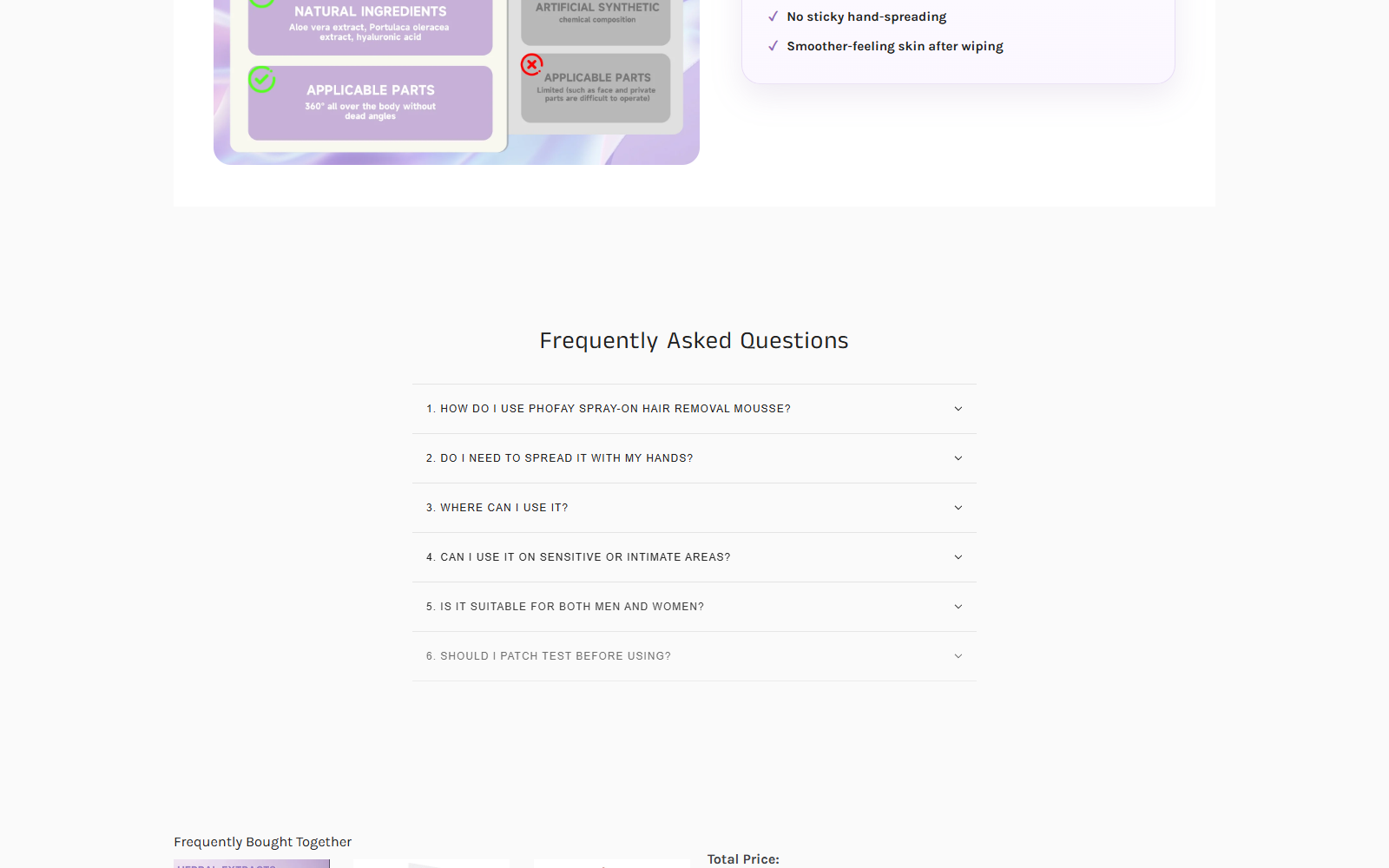
The page does tell shoppers to perform a patch test before first use. That instruction should be treated as essential, not optional fine print.
Do not use the product on broken, sunburned, recently shaved, inflamed, or already irritated skin.
Keep it away from eyes and internal genital tissue. Follow the label’s maximum exposure time and remove it immediately if burning begins.
After any unexpected reaction, stop use and retain the can, packaging, lot number, ingredient list, and photographs.
Cosmetics Are Not FDA-Approved Products
Hair removal creams are generally regulated in the United States as cosmetics.
The FDA explains that cosmetic products and ingredients do not receive premarket approval, except for certain color additives.
Therefore, language suggesting that an ordinary cosmetic is FDA certified or FDA approved should be examined carefully.
Registration, regulatory compliance, or a factory certificate is not the same as FDA approval of the finished product’s safety and effectiveness.
The responsible company must ensure that a cosmetic is safe when used as directed and that its labeling is not misleading.
The FDA advises consumers to stop using a cosmetic after a reaction, contact a healthcare provider, and report serious problems.
How the PHOFAY Hair Removal Offer Works
Step 1: The Page Starts With Familiar Frustrations
Shaving can produce cuts, stubble, and awkward angles. Waxing can be painful, expensive, and inconvenient.
PHOFAY positions the spray can as the clean middle ground: no blade, no hand-spreading, and no salon appointment.
That convenience is the strongest part of the pitch because it addresses problems the buyer has already experienced.
Step 2: A Large Discount Makes Testing Feel Cheap
The displayed price falls from $95.99 to $45.99, while a separate code promises another 10% off.
A countdown resets attention toward immediate purchase. The page does not explain the basis for the much higher comparison price.
Judge value by ingredients, volume, seller support, and comparable depilatories, not by the crossed-out number alone.
Step 3: Two Cans Appear as the Active Style
The product area presents spray 2PC, spray 1PC, and 1PC choices.
During our review, the two-can spray option appeared selected. Shoppers expecting one container could overlook that active choice.
Read the quantity, variant name, cart contents, and final total before authorizing payment.
Step 4: Testimonials Normalize Sensitive-Area Use
On-site reviews discuss bikini areas, intimate grooming, bodybuilding, chest hair, and longer exposure for thick hair.
Those stories can encourage experimentation beyond the clearest label directions.
A testimonial is not a safety instruction. Never extend exposure time or apply to delicate tissue because another reviewer says it worked.
Step 5: The Product Page Reassures, Then the Policy Narrows
A 30-day satisfaction guarantee appears close to the purchase button.
The refund page instead gives unopened products seven days from purchase, excludes anything opened, and makes the buyer pay shipping.
The gap matters because opening is required to discover irritation, smell, spray failure, or disappointing hair removal.
Step 6: Support Controls the Remedy
Damaged or incorrect orders must be reported within five days, with the order number, photographs, and a description.
The seller then decides whether a resend or refund is available.
Document the parcel before opening, especially when multiple containers, broken seals, leakage, or the wrong variant are involved.
Company, Address, and Fulfillment Checks
The Legal Seller Is a Hong Kong Company
PHOFAY’s contact information names HONGKONG XINBO TRADING CO., LIMITED.
That company name should match the transaction documents or be explained clearly if a different payment descriptor appears.
A registered company does not validate every performance claim, but it gives buyers an identity to compare across policies, receipts, and disputes.
The Address Is a Shared Commercial Building
The listed address is Room 1603, 16/F, Tung Ning Building, 125-126 Connaught Road Central, Sheung Wan, Hong Kong.
That is a commercial registration address, not proof of a cosmetics factory, testing laboratory, or customer-return warehouse.
Ask for the actual return destination and manufacturer shown on the product label.
Support Relies on an Outlook Address
The contact page lists PHOFAY123@outlook.com and says replies should arrive within 24 to 48 business hours.
A free email provider is not proof of misconduct. It does provide less visible organizational continuity than a staffed address on the seller’s domain.
Send a pre-sale question about opened returns and keep the complete response.
The Product Label Must Carry the Supply Chain
The website does not substitute for the label. The can should identify responsible parties, net contents, ingredient declaration, warnings, directions, and batch information.
If that information is missing, blurred, covered, or materially different from the online page, do not use the product.
Photograph the label before the first application. The image may be essential if irritation occurs or the seller changes its website.
The Guarantee Is Not a Usable Trial
The main page invites buyers to rely on 30-day satisfaction protection.
The detailed policy says unopened items qualify for returns or exchanges only within seven days of purchase.
It refuses opened-product returns entirely and places return postage on the customer.
This is not a minor wording difference. A satisfaction guarantee implies the customer can try the product and evaluate it.
An unopened-only rule protects delivery decisions, not satisfaction after use.
The seven days begin at purchase, according to the page, rather than delivery. Shipping time could consume much of that period.
Ask the seller to explain the contradiction in writing. If the reply avoids the question, treat the 30-day claim as unreliable.
Safety Steps Before Using Any Depilatory
- Read the full label and confirm that every ingredient and warning is legible.
- Patch test exactly as directed and wait the stated observation period.
- Use only on body areas expressly permitted by the label.
- Never apply over cuts, rashes, sunburn, irritation, or recently shaved skin.
- Set a timer and never exceed the maximum exposure.
- Remove immediately if burning, severe stinging, swelling, or pain begins.
- Rinse thoroughly according to the directions.
- Seek urgent care for eye exposure, blistering, serious burns, or breathing difficulty.
Do not assume a plant picture makes the entire formula gentle. The hair-removal action comes from chemical ingredients, not decorative botanicals.
People with eczema, allergies, highly reactive skin, or a history of chemical burns should ask a clinician before experimenting.
What the Product Label Must Tell You
The website can change overnight. The container should carry the instructions and warnings needed to use the product safely after delivery.
Look for ingredients, responsible company, country of origin, net contents, batch code, expiration guidance, application time, and emergency directions.
Directions must state where the mousse may be used. “Body” does not automatically include the face, genitals, nipples, broken skin, or mucous membranes.
If the delivered label differs from the website, follow the more cautious limitation and photograph both versions before contacting the seller.
Do not transfer the mousse into an unmarked container. Keep its packaging if a clinician or poison center needs ingredient information.
How to Handle a Skin Reaction
Remove the product immediately and rinse with plenty of cool or lukewarm water. Do not scrub irritated skin or apply another active cosmetic.
Avoid acids, retinoids, fragrances, exfoliants, and deodorants on the affected area until it has recovered.
Seek urgent help for severe pain, blistering, facial swelling, breathing difficulty, eye exposure, extensive burns, or symptoms continuing after rinsing.
Keep photographs showing the reaction over time. Save the can, ingredient panel, batch code, order record, and conversation with support.
Report a serious cosmetic reaction to the appropriate health regulator. United States consumers can use the FDA cosmetic reporting channels.
Why Quantity Selection Deserves Attention
Product pages often use preselected variants. A shopper may focus on the unit price while the active option represents two or more cans.
Read the style selector, cart quantity, subtotal, shipping charge, tax, and final confirmation before authorizing payment.
Take a screenshot after every selection. If delivered quantity exceeds the confirmed order, keep extra units unopened while requesting correction.
Check whether a discount code added an item or changed the bundle. Savings language should never replace a clear description of what will ship.
Consider a credit card or protected payment service. Avoid bank transfer, cryptocurrency, gift cards, and payment links sent through private messages.
Questions to Ask Before Ordering
- May an opened can be returned after a patch test?
- Which body areas are specifically approved on the delivered label?
- Who manufactured the batch, and where was it produced?
- Does the order contain one can or the selected multi-can style?
- Who pays international return postage and import charges?
- Will the seller provide a prepaid label for a defective product?
What to Do if You Have Fallen Victim to This Scam
- Stop using the mousse after a reaction. Rinse as directed and seek medical help for blistering, intense pain, eye contact, swelling, or persistent injury.
- Preserve product evidence. Keep the can, lot number, ingredient list, packaging, order record, photographs, and exact exposure time.
- Contact the seller immediately. Describe whether the issue is damage, wrong quantity, leakage, misleading guarantee, or a health reaction. Request a written remedy.
- Challenge a bundle error quickly. If two cans were charged when one was expected, save the cart display and ask for correction before shipment.
- Escalate an unhonored guarantee. Give the card issuer the product-page promise, seven-day policy, support messages, and return tracking.
- Report a cosmetic reaction. Consumers in the United States can report it to the FDA. Other countries have comparable cosmetics or consumer regulators.
- Check the purchasing device. Malwarebytes can scan for unwanted software. AdGuard can reduce deceptive advertising and risky redirect chains.
- Avoid recovery fraud. Do not give remote access or upfront fees to anyone promising a guaranteed refund.
Frequently Asked Questions
Is PHOFAY Hair Removal Mousse a confirmed scam?
No. It appears to be a real depilatory product. The strongest concerns involve guarantee conflicts, bundle selection, seller transparency, and safe-use expectations.
Does the product contain a chemical depilatory?
The seller says calcium thioglycolate dissolves hair. Botanical images do not change the product’s chemical hair-removal mechanism.
Can PHOFAY be used on intimate areas?
Follow only the can’s exact directions. Bikini-line use does not mean internal genital tissue is safe, and testimonials are not medical instructions.
Is the return period 30 days?
The product panel says 30 days, but the refund policy limits unopened returns to seven days from purchase and excludes opened products.
Why is a patch test necessary?
Skin may react to depilatory chemicals or other ingredients. A patch test can reveal irritation before a larger body area is exposed.
What if the mousse causes a burn?
Remove it, rinse as directed, seek appropriate medical care, and preserve the product details. Report serious cosmetic reactions to the relevant regulator.
The Bottom Line
PHOFAY may remove hair, but the page’s effortless language should not hide the chemical action, patch-testing requirement, or sensitive-area risks.
The 30-day promise conflicts directly with a seven-day unopened-only policy. Confirm quantity, ingredients, safe-use directions, and return eligibility before paying.

Join the discussion
0 commentsShare your experience or ask a question about this article.
Discussion
Start the conversation
Have a question or something useful to share? Add the first comment.