

Aveya Hair Growth Spray arrives with an appealing promise: a few daily sprays could help thinning hair look fuller, stronger, and healthier.
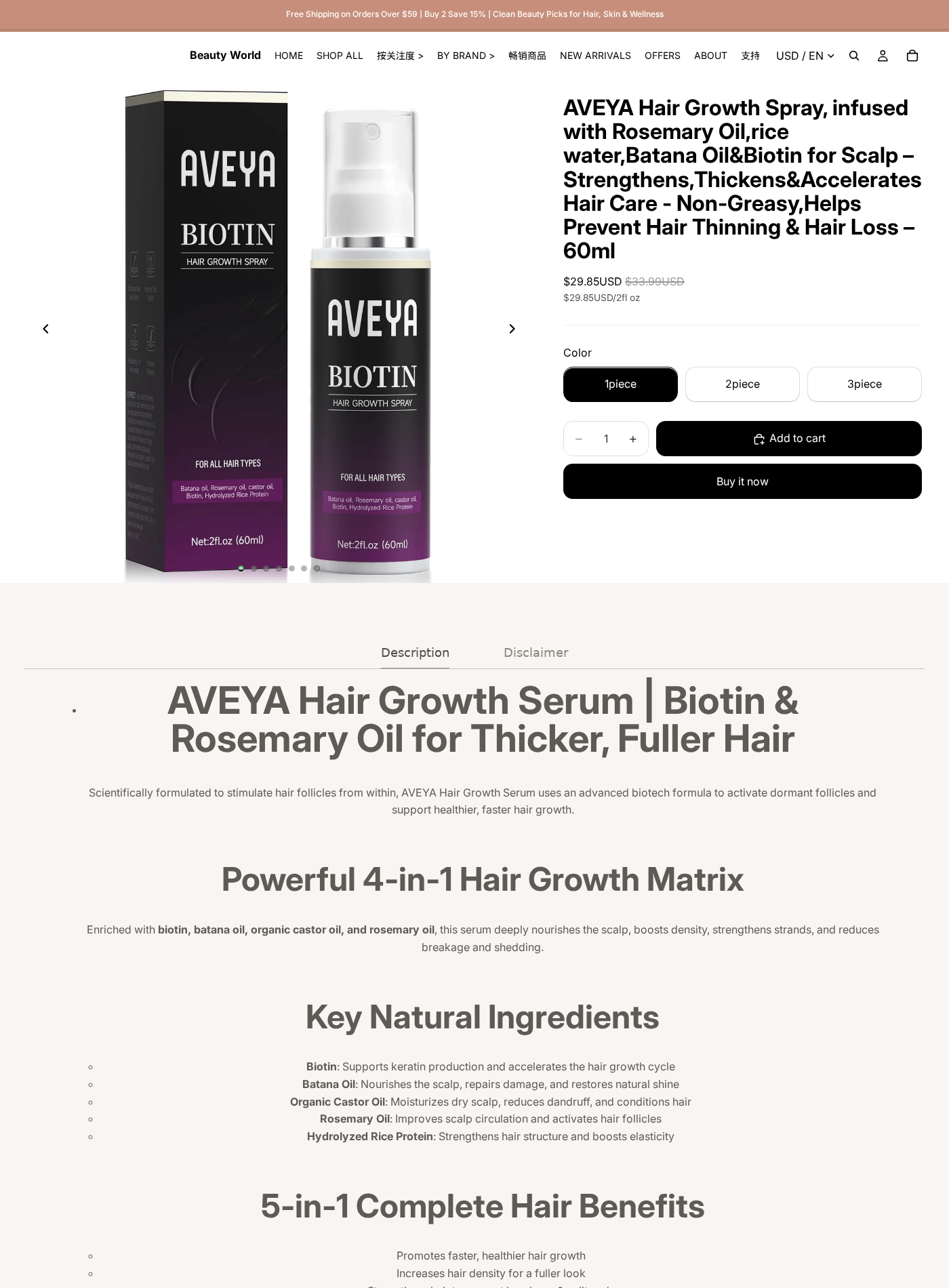
The bottle is sold across several storefronts, yet the story changes depending on where you look. That makes the details worth examining carefully.
Overview
Aveya is a real labeled cosmetic product, not an imaginary bottle
A genuine product called Aveya Biotin Hair Growth appears in the National Library of Medicine’s DailyMed label database.
The listing identifies it as a topical liquid in a 60 ml bottle and names Guangdong Aimu Biological Technology Co., Ltd. as labeler.
That evidence distinguishes Aveya from promotions using a digitally invented bottle that never existed outside an advertisement.
However, DailyMed publishes submitted labeling information. Inclusion does not mean the FDA tested, approved, or confirmed the advertised hair-growth results.
The useful question is therefore not whether a bottle exists. It is whether marketing, price, seller identity, and expectations match the documented product.
The label shows modest ingredient amounts behind dramatic advertising
The official product table lists biotin at 1 mg per 100 ml, while water accounts for 97.65% of the formula.
It also lists panthenol, batana oil, rosemary oil, castor oil, hydrolyzed rice protein, preservatives, fragrance ingredients, and solubilizers.
Some sales pages describe follicle stimulation, dormant follicle activation, reduced shedding, and visible thickness within 28 days.
Those are meaningful biological promises, yet the reviewed pages did not provide a linked clinical trial testing this finished Aveya formula.
Ingredient popularity cannot establish that this concentration, delivery method, and treatment period will regrow hair for a particular customer.
Different sellers attach very different prices and policies to the same spray
Aveya appeared around $29.85 on one storefront and above $76 on another, despite photographs showing the same recognizable packaging.
One reseller excludes opened or used beauty items from returns, which can make a satisfaction promise practically useless after testing.
The domain previously associated with Aveya hair promotions now displays an unrelated uric-acid supplement and recurring purchase options.
A changing storefront does not alter the bottle’s existence, but it complicates support, refunds, warranty questions, and attribution of older advertisements.
Customers should identify the exact merchant charging the card instead of assuming every Aveya listing belongs to one official manufacturer-operated store.
- Aveya Biotin Hair Growth Spray has a real DailyMed label and a named Chinese manufacturer.
- DailyMed publication is not FDA approval and does not verify regrowth claims.
- The official label lists water as 97.65% of the formulation.
- Reviewed sellers displayed sharply different prices for apparently identical bottles.
- Some marketing promises visible improvement within 28 days without linking a finished-product clinical study.
- Return rights may disappear once a personal-care product is opened or tested.
- The former promotional domain now markets an unrelated supplement, showing why buyers must preserve the exact seller details.
How the Aveya Hair Growth Marketing Funnel Works
Step 1: A short video turns ordinary hair concerns into urgency
The promotion often begins with thinning edges, wider parts, breakage, shedding, or a brush filled with loose hair.
These images feel personal because many viewers have already tried oils, vitamins, shampoos, or expensive salon treatments without clear improvement.
Before-and-after sequences can compress months into seconds and rarely show lighting, styling, hair fibers, extensions, medication, or concurrent treatments.
A viewer is encouraged to recognize herself in the problem before asking whether the pictured results came from the advertised bottle.
Save the complete video and caption. Later versions may change the timetable, ingredients, discount, endorsements, or supposed reason for scarcity.
Step 2: Familiar ingredients make the scientific story sound settled
Biotin, rosemary, castor oil, batana oil, and panthenol already appear throughout beauty content, so the formula feels intuitively credible.
The advertisement may move from an ingredient’s general reputation to a specific claim that Aveya awakens dormant follicles or reverses shedding.
That leap requires evidence from a controlled test of the finished product, not isolated studies involving another concentration or preparation.
Hair loss also has many causes, including genetics, hormones, illness, nutritional deficiency, medication, inflammation, traction, and damaging styling practices.
A topical cosmetic cannot be assumed to address every cause merely because several fashionable ingredients appear on its label.
Step 3: The landing page supplies certainty that the evidence page does not
A typical product page presents the bottle beside phrases such as scientifically formulated, clinically inspired, or tested by experts.
Countdowns, stock notices, recent-sale messages, crossed-out prices, and bulk discounts move attention toward checkout rather than documentation.
Customers may see percentages or timelines without finding the study design, participant count, control group, measurements, conflicts, or complete results.
A seller’s own product test can be useful, but shoppers need enough information to distinguish research from a satisfaction survey or marketing graphic.
If a claim cannot be traced to a report, treat it as advertising language until independent evidence supports it.

Step 4: A reseller controls the transaction even when the bottle is genuine
The same product can pass through several websites, marketplaces, affiliates, importers, and fulfillment companies before reaching the customer.
Each seller may choose a different price, shipping estimate, return address, refund rule, bundle, or recurring-order setting.
A real manufacturer name on the label does not automatically make an unrelated online reseller authorized, responsive, or financially accountable.
Record the domain, legal seller, card descriptor, support email, phone number, delivery origin, and return country before placing an order.
Those transaction details matter more during a dispute than the brand name printed on the front of the bottle.
Step 5: The customer must open the product before learning whether it suits her
Hair products cannot be meaningfully assessed while sealed, yet personal-care return exclusions often begin the moment the seal is broken.
The spray may irritate the scalp, feel greasy, smell unpleasant, leave residue, or simply produce no visible improvement.
By that stage, the merchant may classify it as used merchandise that cannot be resold for hygiene reasons.
A satisfaction guarantee should explain whether opened bottles qualify, who pays postage, where returns travel, and whether original shipping is refundable.
If the policy avoids those questions, the advertised guarantee provides less protection than its prominent badge suggests.
Step 6: The brand name can move while support becomes harder to trace
The domain associated with earlier Aveya promotions currently presents a different supplement category rather than the hair spray reviewed here.
That change may reflect ordinary business experimentation, an affiliate pivot, new ownership, or a temporary campaign ending.
Whatever the explanation, old customers should not assume today’s site policies or contact details governed yesterday’s transaction.
Use the order email and card statement to identify the merchant actually paid, then preserve any archived invoice or checkout page.
Brand rotation is precisely why a buyer should collect evidence before a website, offer, or support address changes.
What the Official Aveya Label Actually Tells Us
The named manufacturer is based in Guangdong, China
DailyMed identifies Guangdong Aimu Biological Technology Co., Ltd. in Guangdong, China as the labeler for Aveya Biotin Hair Growth liquid.
This provides more traceability than an anonymous product page, but it does not tell buyers which reseller imported their individual bottle.
A United States seller should still explain who handles complaints, adverse reactions, damaged goods, authenticity questions, and product recalls.
Compare the bottle’s lot code, ingredient panel, volume, labeler, and packaging with the current official label before applying it.
Do not use a bottle with missing seals, altered labels, unexplained spelling changes, leakage, unusual odor, or no traceable batch information.
The ingredient table deserves more attention than the hero claims
The label lists purified water as the overwhelming majority of the formula and smaller quantities of conditioning, fragrance, and preservation ingredients.
Biotin appears at 1 mg per 100 ml in the product information table, an amount that deserves careful comparison with percentage language elsewhere.
Rosemary oil and batana oil each appear at 0.1%, while panthenol appears at 0.15% and hydrolyzed rice protein at 0.3%.
Those facts do not prove the spray is ineffective. They place the marketing story into a measurable formulation context.
A credible seller should answer concentration questions directly rather than relying on ingredient recognition and dramatic transformation photographs.
The label includes warnings that advertisements may minimize
The product is for external use and should not be applied to an injured, infected, or otherwise damaged scalp.
Users should avoid eye contact and stop if irritation develops, according to the published directions and warnings.
Anyone with persistent shedding, bald patches, scalp inflammation, pain, scarring, or sudden loss should seek qualified medical evaluation.
Delaying diagnosis while repeatedly buying cosmetic sprays can allow a treatable medical cause to progress unnoticed.
Pregnancy, allergies, medications, and existing skin conditions may also justify asking a clinician before testing a multi-ingredient topical product.
Claims, Pricing, and Evidence Buyers Should Compare
A 28-day transformation is a marketing claim, not a universal schedule
Human scalp hair grows slowly, and visible density changes usually require consistent photography and enough time to separate growth from styling.
Short promotional timelines can be influenced by hair fibers, volumizing products, camera angle, wetness, part placement, trimming, and temporary shedding changes.
Ask whether the seller measured hair count, shaft diameter, shedding, participant perception, or simply selected favorable photographs.
Also ask how many people completed the test and whether results were independently reviewed or published.
Without those details, a precise-looking timeline should not become a personal prediction.
The price spread shows why the bottle must be separated from the seller
One reviewed listing offered Aveya near $30, while another displayed a price exceeding $76 before taxes or shipping.
A higher price does not establish authenticity, clinical quality, faster fulfillment, or stronger consumer protection.
Likewise, the lowest offer may omit returns, ship internationally, bundle unwanted units, or provide weaker support.
Compare the final checkout total, quantity, bottle size, recurring terms, delivery origin, duties, and return destination rather than the headline discount.
Screenshot the cart before payment because upsells and quantity selectors can change the order total quickly.
FDA language is frequently misunderstood in cosmetic advertising
DailyMed is an official government-hosted database, but its presence alone does not convert a cosmetic into an FDA-approved hair-loss treatment.
Registration, facility listing, label submission, or use of an NDC-style identifier does not prove effectiveness or premarket approval.
Sellers should not blur those distinctions by placing government terminology beside unsupported therapeutic promises.
Look for the exact regulatory status claimed and verify it through an official source, not a badge embedded in the sales page.
When wording remains vague, assume the database confirms labeling information rather than clinical results.
Company, Address, and Fulfillment Checks
The manufacturer is named, but the retail operator may be different
Guangdong Aimu Biological Technology Co., Ltd. appears on the official label, while retail websites can be operated by unrelated merchants or affiliates.
The company manufacturing a liquid may not control the advertisement, collect payment, store customer data, ship parcels, or approve refunds.
Buyers need the legal name of the seller accepting the order, not only the factory printed on a product database.
Compare that name with the invoice and payment statement. Unexplained differences should be resolved before any return deadline passes.
The changing domain weakens continuity for older customers
TryAveya.com now promotes an unrelated uric-acid supplement instead of the hair spray associated with earlier marketing.
A domain pivot does not prove fraud, yet it leaves previous buyers unsure which policies, contacts, and company disclosures remain applicable.
Use historic order documents rather than assuming the current storefront inherited every earlier obligation.
If support fails, contact the payment provider while the dispute window remains open and explain the site’s material change.
Return addresses can belong to fulfillment operations rather than decision makers
A warehouse may receive parcels without having authority to recognize an order, inspect complaints, or issue money back.
Some beauty retailers route products through United States logistics addresses while ownership, customer service, and manufacturing remain elsewhere.
Never send the bottle to an address copied from a label or search result without written return authorization.
Request the return country, recipient, reference number, tracking method, deadline, deductions, and refund timetable before paying postage.
Customer service should answer specific product and billing questions
Ask whether the bottle is authentic, whether opened products qualify for refunds, and whether the order renews automatically.
A competent representative should identify the seller, explain the guarantee, locate the order, and provide a complete ingredient and warning panel.
Generic replies that repeat benefits without addressing billing or returns are a poor substitute for accountable support.
Keep every email and record the date, address, representative, and promised action after any telephone conversation.
What to Do if You Have Fallen Victim to This Scam
- Stop using the spray if irritation develops. Rinse affected skin as appropriate, retain the bottle and packaging, photograph the reaction, and obtain medical advice for persistent or severe symptoms.
- Identify the exact merchant. Use the confirmation email, invoice, parcel label, and card statement to separate the retailer from the manufacturer and unrelated Aveya listings.
- Preserve the advertisement. Save claims, before-and-after images, price, quantity, guarantee, return language, ingredient statements, checkout disclosures, and any recurring-order wording.
- Request a refund in writing. State the order number, delivery date, specific problem, requested resolution, and policy language supporting your request, then save the sent message.
- Do not mail an unauthorized return. Obtain the correct recipient, address, RMA, deadline, required tracking, and confirmation that opened personal-care products qualify.
- Challenge unauthorized recurring charges quickly. Cancel through the merchant, notify the card issuer, ask whether replacement card details are needed, and monitor future statements.
- Document product authenticity concerns. Photograph seals, lot codes, labels, ingredients, bottle volume, damage, and differences from the official DailyMed presentation before disposing of anything.
- Report serious adverse events. Contact the appropriate regulator and healthcare professional with the product name, batch details, seller, symptoms, dates, and medical outcome.
- Secure the ordering device. Run Malwarebytes if the purchase involved suspicious downloads or redirects, and use AdGuard to reduce repeat exposure to deceptive beauty advertisements.
How to Shop for Hair-Loss Products More Safely
Begin with the cause, not the viral ingredient
A clinician can distinguish common pattern loss from nutritional, hormonal, inflammatory, medication-related, traction, infectious, or scarring conditions.
That diagnosis changes which treatments are reasonable and whether a cosmetic spray belongs anywhere in the plan.
Bring photographs, symptom timing, family history, medications, supplements, styling habits, and any products already tried.
A targeted evaluation can save months of spending on formulas that never addressed the underlying problem.
Demand evidence for the finished formula
Search the exact product name with clinical trial, randomized, placebo, publication, ingredients, adverse events, and manufacturer.
Read the study itself when available and check whether the tested concentrations match the purchased bottle.
Testimonials can illustrate experiences, but they cannot reveal the average result, failure rate, or contribution of other treatments.
Be especially cautious when every result photograph comes from the seller or its affiliates.
Treat checkout terms as part of the product
The formula, merchant, price, quantity, subscription status, shipping route, guarantee, and return rules together determine the real purchase.
Read the smallest text around the order button and remove preselected bundles or recurring options you do not want.
Pay with a method offering meaningful dispute rights and avoid bank transfers, gift cards, cryptocurrency, or payment through unknown intermediaries.
A screenshot taken before payment can resolve later arguments about what was selected and promised.
Frequently Asked Questions
Is Aveya Hair Growth Spray a real product?
Yes. A product with that name and recognizable packaging appears in DailyMed with a named labeler and ingredient information.
That does not verify every reseller, advertisement, bottle, or promised result.
Is Aveya Hair Growth Spray FDA approved?
A DailyMed listing does not mean FDA approved. It records submitted labeling information and should not be presented as proof of effectiveness.
Check any regulatory claim through the FDA’s own databases.
Can Aveya regrow thinning hair in 28 days?
We found marketing making rapid improvement claims, but not a linked, independent finished-product trial establishing that outcome for typical users.
Hair-loss causes and responses vary substantially.
Why does Aveya cost different amounts on different websites?
Independent resellers can set their own markups, bundles, shipping charges, policies, and promotions.
The price difference reinforces the need to verify who is selling the bottle and what protections apply.
What should I do before applying Aveya?
Compare the label and lot details with the official information, patch test when appropriate, read warnings, and avoid damaged skin.
Seek medical guidance for sudden, patchy, painful, or persistent loss.
Does this investigation prove every Aveya seller is fraudulent?
No. The product exists, and we did not test every seller or customer outcome.
Our concerns involve overstated evidence, variable pricing, restrictive returns, unclear retail accountability, and a changing promotional domain.
The Bottom Line
Aveya Hair Growth Spray is not merely an AI-generated bottle. It has a documented label, identifiable manufacturer, measurable ingredients, and real retail listings.
The larger problem is everything added around it: ambitious regrowth claims, inconsistent prices, difficult returns, reseller ambiguity, and a domain that moved to another product.
Buy the evidence and the transaction, not the transformation story. For ongoing hair loss, a proper diagnosis is more valuable than another persuasive spray advertisement.

Join the discussion
0 commentsShare your experience or ask a question about this article.
Discussion
Start the conversation
Have a question or something useful to share? Add the first comment.