

Curious about the Eloura Hair Growth Serum Roll and whether it lives up to its bold promises? You’re not alone. With flashy offers like “See results in 30 days or your money back,” “Buy 1 get 1 free,” and rapid regrowth claims, this roll‑on serum promises to solve your hair‑thinning woes fast. But are these claims backed by science, or is this just another slick sales pitch? We’re going beyond the hype to examine clinical evidence, marketing tactics, user feedback, and critical red flags, so you can decide for yourself.
Overview
In this section, let’s examine the product claims, website messaging, and the broader hair‑growth serum market for context.
What Eloura Claims
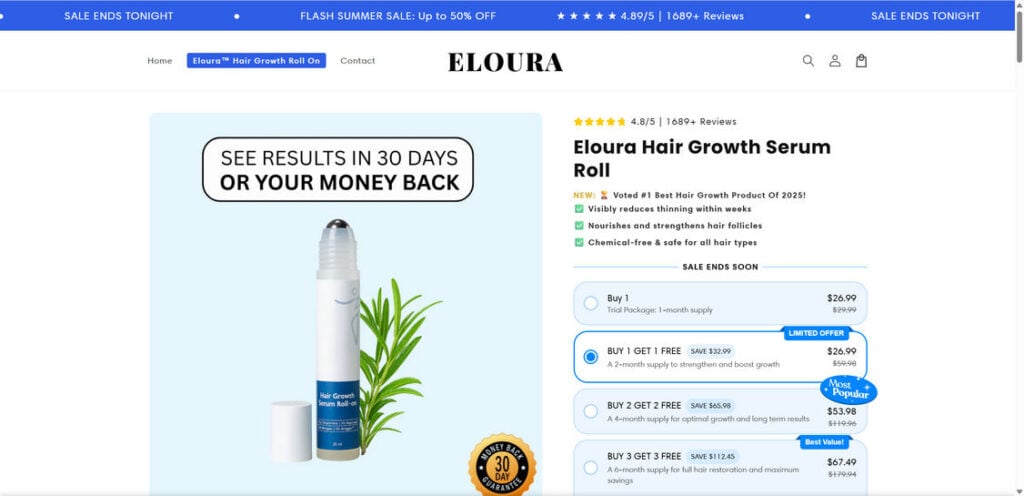
On its official site, Eloura promotes itself as a clean, simple, and effective roll‑on serum that targets hair thinning at the roots. Their headline speaks to “95% of customers reported noticeably reduced hair fall after just 14 days,” while other statements include “92% experienced visible baby hair regrowth in thinning areas in just 3 weeks” and “89% said their hair felt stronger, thicker, and healthier than before.” The formula is billed as powered by rosemary oil, copper peptides, biotin, aloe vera, and plant‑based extracts.
Marketing also highlights convenience, targeted roll‑on applicator, chemical‑free claims, and universal suitability for all hair types.
Marketing Tactics & Red Flags
The product page employs classic urgency tactics: “Sale ends tonight,” low‑stock warnings, and “Buy 1 get 1 free” deals. This pressure can push customers to act impulsively.
Further, they claim their serum is “Voted #1 Best Hair Growth Product of 2025” (no source cited) and that 95% of users saw results within two weeks. These are extraordinary claims with no visible scientific backing, a familiar hallmark of overly marketing‑heavy products.
Gap Between Claims and Science‑Backed Standards
In comparison, credible serums like minoxidil (the only FDA‑approved topical for hair growth) typically require consistent use for 3 to 6 months before visible results emerge. Even peer‑tested natural formulas show moderate improvements , and only over longer timelines.
Dermatologists highlight essential oils like rosemary and peppermint as having some supportive evidence, but emphasized with the caveat that results are modest and require consistency.
No Clinical or Dermatologist Backing
A glance across credible sources reveals no clinical trials or dermatologist endorsements for Eloura. The marketing leans fully on bold claims rather than peer‑reviewed results, medical backing, or publicly verifiable evidence.
Summary of Overview
Eloura’s messaging is polished, urgent, and emotionally compelling. But flashy design and bold numbers cannot replace scientific validation. Delivery claims and product positioning align closely with marketing tactics, pushing urgency and benefit extremes without third‑party proof.
How the Operation Works
Here we break down how the brand’s business model and operations likely function, based on the available information.
1. Crafting an Attractive Promise
- The brand begins with eye‑catching, persuasive marketing: “30‑day money back,” “95% customer satisfaction,” “Buy 1 get 1 free.”
- This creates buyer’s excitement before evidence is even presented.
2. Creating Limited‑Time Offers and Scarcity
- Flash sales (“Sale ends tonight”) and low‑stock notifications instill urgency and fear of missing out.
- This tactic nudges consumers toward impulse decisions rather than thoughtful shopping.
3. Leveraging Select Ingredients
- The formula reads like a checklist: rosemary oil, copper peptides, biotin, aloe vera. Each of these has some scientific mention, but not necessarily in the context or concentration used in such a product.
- Emphasis is placed on “clean ingredients,” “chemical‑free,” and that the formula suits all hair types, buzzword‑rich messaging designed to reassure and appeal widely.
4. Displaying “Results” Metrics Without Verification
- The website states specific percentages: 95% noticed less hair fall in 14 days, 92% saw baby hairs in 3 weeks, etc.
- But no methodology, sample size, or independent audit is referenced.
5. Managing Customer Experience
- On‑site reviews all glowingly positive. Common testimonials mention faster growth, improved thickness, barbers noticing results, and no greasiness, all reinforcing the product narrative.
- There’s no visible negative feedback or neutral reviews, a red flag suggesting curated or staged feedback.
6. No Third‑Party Validation
- Unlike clinically‑backed serums or dermatologist‑recommended products, Eloura presents zero independent studies, no medical expert endorsements, and no consumer research.
- Their own Disclaimer notes that the claims haven’t been evaluated by the FDA.
7. Redirecting to Social Proof
- Tiktok, Facebook, and other social platforms show users praising the rolling applicator or cool sensation, but such content isn’t clinically reviewed or sourced.
- Videos may amplify appeal without verifying effectiveness.
8. Encouraging Repeat or Subscription Purchases
- The website offers automatic refills, zero commitment cancellation, and subscription models, designed to lock consumers into repeat buying even with unverified results.
What to Do If You’ve Been Affected
If you purchased the Eloura Hair Growth Serum Roll and feel misled or want to protect yourself, here are practical steps you can take:
- Contact the seller for a refund or return.
- Check their refund policy, reach out to customer service, and start the return if you’re within their stated window.
- Dispute charges through your credit card or payment service.
- If you can’t get a refund or suspect misleading practices, filing a dispute may be effective, especially if you were pressured by false urgency or claims.
- Stop using the product immediately.
- Without clear ingredient transparency or safety studies, discontinuing use is the safest route to avoid potential scalp irritation or adverse reactions.
- Track and document any adverse reactions.
- If you experience irritation, increased shedding, or allergic responses, note the symptoms. Consult a medical professional if needed.
- Share a balanced review.
- Post your own feedback on platforms like Trustpilot, Reddit, or product forums. Genuine experiences help other consumers make informed choices.
- Explore clinically backed alternatives.
- Consider proven products such as minoxidil (OTC), Nutrafol, Vegamour, or peptide formulas like The Ordinary. These have dermatologist support and documented outcomes.
- Consult a dermatologist or trichologist.
- Before using topical treatments, get a professional assessment about the root causes of thinning hair, stress, DHT, nutritional deficits, or underlying health conditions.
- Focus on holistic hair health.
- Support scalp health with lifestyle steps: balanced diet, stress management, gentle scalp massage, and avoiding harsh styling practices.
The Bottom Line
Eloura Hair Growth Serum Roll shines in the marketing department, with bold claims, slick visuals, and emotional triggers. But the lack of clinical evidence, absence of independent validation, and manipulative urgency tactics cast serious doubt on its legitimacy. While ingredients listed (like rosemary oil or copper peptides) have some supportive research in general hair‑health contexts, the remarkably fast results touted, achieved in just 14 or 21 days, are implausible compared to evidence‑based hair‑growth timelines of several months.
If you’re seeking real regrowth, safer options include FDA‑approved treatments, dermatologist‑recommended serums, or well‑researched natural formulas used over time. And if you’ve already bought Eloura and feel misled, take action, whether that’s to stop use, request a refund, or switch to proven alternatives.
Approach too‑good‑to‑be‑true hair‑growth claims with caution. Real results take time, and credible products take evidence.

Join the discussion
2 commentsShare your experience or ask a question about this article.
Discussion
I can’t stop the repurchase of this product it’s takes from my account and I’ve tried every which way to stop. The bank says contact them !? Who as there is no trail .. anyone help
In reply to mr b
mr b, that sounds like a subscription or recurring billing issue. If there’s no clear cancellation trail, don’t keep fighting the merchant directly.
Do this:
Call your bank and request a stop-payment / block for that merchant descriptor and dispute the most recent charges as unauthorized recurring billing.
If the charges keep coming, ask about replacing the card number (new card) to break the billing token.
Save the order email/receipt and any cancellation attempts as evidence for the dispute.