

BarkGuard is marketed as a handheld ultrasonic dog training device that claims to stop leash pulling, barking, lunging, anxiety-driven behavior, and other unwanted habits with the press of a button.
The product may be a real ultrasonic trainer, but the way it is advertised raises serious concerns. The sales page uses exaggerated behavior-change promises, fake-looking authority signals, AI-style images and videos, huge review numbers, urgent stock warnings, bundle pressure, and a very broad 180-day guarantee that buyers should verify carefully before ordering.
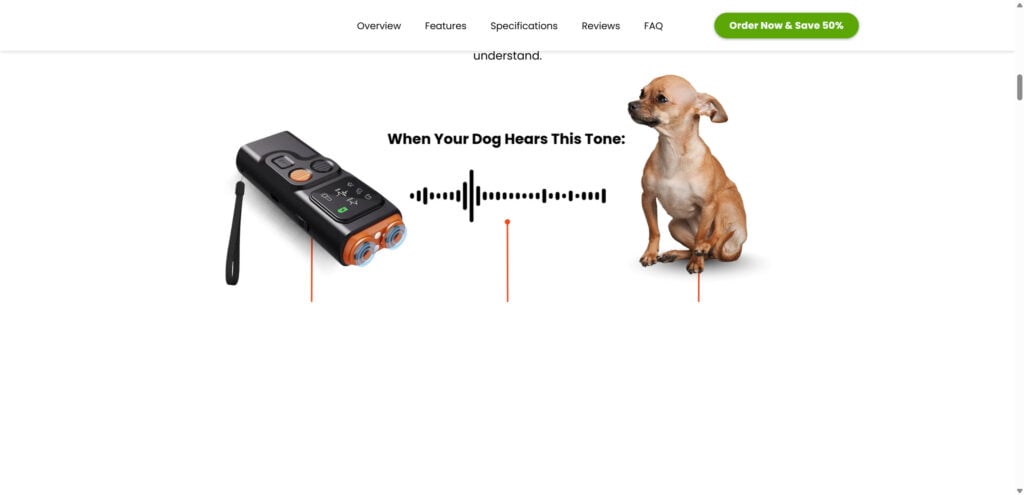
What Is BarkGuard?
BarkGuard is sold through Pawcify landing pages as a portable dog training device using what the page calls “SilentSync Technology.” It is promoted as a humane alternative to shock collars, prong collars, sprays, and professional dog trainers.
The page claims BarkGuard can:
- stop leash pulling instantly
- work in under 3 seconds
- erase the “Pull Reflex Loop” after 2 weeks
- retrain dog behavior permanently
- work on all breeds and sizes
- work on reactive dogs
- work on rescue dogs
- work on “untrainable” dogs
- stop neighbor dogs from approaching
- work from up to 50 feet away
- sometimes work up to 70 feet away
- reduce anxiety and pulling
- correct bad behavior indoors and outdoors
- help with jumping, lunging, leash aggression, and barking
- produce calm walking without the device after 30 days
The product is described as rechargeable, portable, smaller than a smartphone, equipped with a flashlight, and able to charge in 30 minutes.
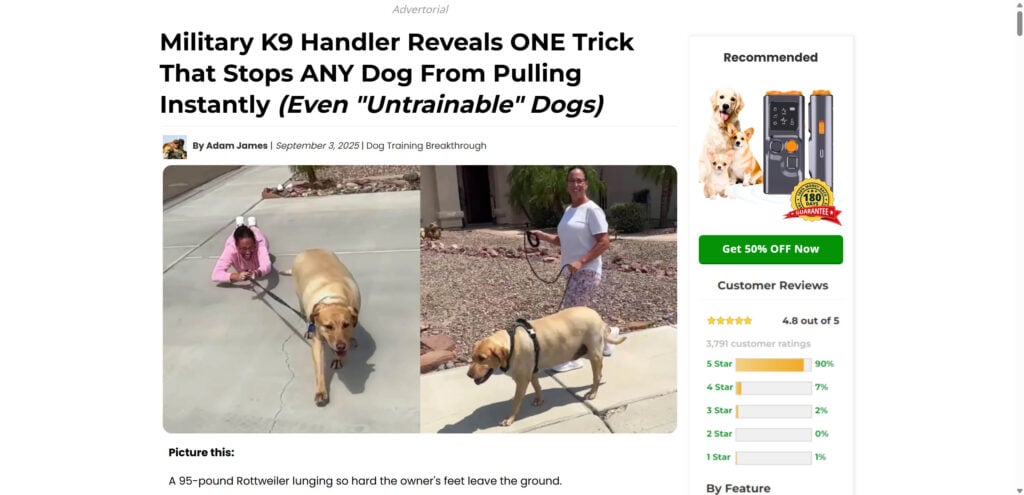
At first glance, this sounds like a miracle training tool. The issue is that real dog behavior does not usually change permanently because of a single button-press device.
The Main Problem: BarkGuard Promises Too Much
A handheld ultrasonic device can make a sound. That sound may interrupt some dogs in some situations. But interruption is not the same as training.
Training a dog not to pull on the leash usually requires:
- consistency
- timing
- reinforcement
- teaching an alternative behavior
- reducing triggers
- building focus
- working in low-distraction environments first
- gradually increasing difficulty
- understanding the dog’s motivation
- rewarding calm walking
- managing distance from triggers
- repetition over time
BarkGuard is marketed as if it can skip that process.
The page claims the device breaks a neurological “Pull Reflex Loop,” reprograms behavior, and creates permanent change in 14 days. That is an extremely strong claim for a generic-looking ultrasonic trainer.
A device may interrupt behavior in the moment. It does not automatically teach a dog what to do instead.
Why BarkGuard Raises Red Flags
1. The “Pull Reflex Loop” sounds invented for marketing
The BarkGuard page repeatedly uses the phrase “Pull Reflex Loop.”
It describes this as a hidden neurological pattern that makes dogs pull more and more every time the owner resists. The page says BarkGuard breaks this loop at the source.
This sounds scientific, but the page does not provide a clear veterinary behavior study, peer-reviewed training paper, or clinical evidence proving that this named “Pull Reflex Loop” exists in the way the advertisement describes it.
It appears to be a sales concept designed to make normal leash-pulling behavior sound like a special neurological problem only BarkGuard can fix.
2. “Stops pulling in under 3 seconds” is unrealistic for many dogs
The page claims BarkGuard can stop pulling instantly when the button is pressed.
Some dogs may pause when they hear an unexpected ultrasonic sound. That does not mean they are trained.
A dog may stop briefly, look around, become confused, or react to the sound. But the same dog may pull again seconds later if the trigger remains exciting, frightening, or rewarding.
Instant interruption is not the same as long-term behavior change.
3. The “permanent change in 14 days” claim is too strong
BarkGuard claims the pulling reflex loop can be completely erased after 14 days and that by day 30 the dog can walk perfectly without the device.
That is not realistic for many dogs.
Leash pulling can be caused by:
- high excitement
- fear
- reactivity
- lack of leash skills
- breed tendencies
- frustration
- poor impulse control
- chasing instincts
- anxiety
- lack of exercise
- overstimulation
- poor equipment fit
- inconsistent training history
A single ultrasonic device cannot guarantee permanent change across all of those causes.
4. “Works on all dogs” is a red flag
The page says BarkGuard works on all breeds and sizes, from tiny dogs to large breeds. It also says reactive, rescue, stubborn, and “untrainable” dogs respond immediately.
That is one of the biggest warning signs.
No responsible dog trainer should guarantee that one device works on every dog. Dogs vary widely in hearing, temperament, fear responses, motivation, training history, age, breed, sensitivity, and medical status.
Some dogs may ignore ultrasonic sound. Some may become startled. Some may become more anxious. Some may associate the unpleasant sound with other dogs, people, children, bikes, or the environment around them.
5. Ultrasonic does not automatically mean humane
The BarkGuard page says the product is 100% safe and humane because it uses ultrasonic soundwaves rather than shock, prongs, or choking.
That sounds reassuring, but it is too simple.
An ultrasonic sound may be painless, but it can still be aversive if the dog finds it unpleasant, startling, or stressful. The whole point of using the sound is to interrupt or stop behavior. If the dog stops because the sound is annoying or uncomfortable, then the device is still using an aversive stimulus.
That does not make every ultrasonic device cruel, but it does mean “no shock” does not automatically equal “force-free” or “stress-free.”
6. It may create confusion instead of teaching
If a dog pulls because it wants to reach another dog, sniff a tree, chase a squirrel, or escape something scary, pressing a sound button may interrupt the behavior.
But what does the dog learn?
Without proper training, the dog may only learn that walks become unpredictable. The dog may not understand that the desired behavior is walking on a loose leash near the owner.
Training should teach the replacement behavior. A sound interruption alone does not do that.
7. The page attacks other training tools too broadly
The sales page says harnesses do not stop pulling, treats do not work when dogs are over threshold, prong collars suppress without teaching, and only BarkGuard breaks the problem at the source.
That is a classic funnel tactic.
It makes everything else sound useless so the promoted product feels like the only real solution.
In reality, many dogs improve with reward-based loose-leash training, better management, distance from triggers, properly fitted equipment, and help from a qualified trainer or veterinary behavior professional when needed.
8. The “Navy SEAL K9 trainer” claim needs proof
The page says BarkGuard was developed by a Navy SEAL K9 trainer and is professionally designed. It also claims it is recommended by a Navy SEAL K9 trainer.
That is a strong authority claim, but the page does not clearly provide:
- the trainer’s full verifiable identity
- military credentials
- professional certification
- dog training business record
- published method
- independent interview
- testing documentation
- proof of involvement in product design
If a product relies on military or expert authority, the identity should be easy to verify.
9. The “Featured in Modern Dog Magazine” and professional association claims need verification
The page says BarkGuard is featured in Modern Dog Magazine and recommended by the International Association of Canine Professionals.
Claims like this should be clickable and independently verifiable.
A real feature or endorsement should link to the actual article, issue, review, or professional statement. If a sales page only displays the claim without clear proof, buyers should treat it as marketing.
10. The review number is extremely high
The page claims BarkGuard is rated 4.8 by 47,836 verified dog owners.
That is a massive review count.
For a niche handheld dog training gadget sold through a single landing page, such a large number should be examined carefully.
Buyers should ask:
- Where are all 47,836 reviews displayed?
- Can negative reviews be sorted and read?
- Are reviews hosted by an independent platform?
- Are reviewers verified buyers?
- Are photos real customers?
- Were reviews imported from another product?
- Are reviews generated or filtered?
- Does the site publish low-star reviews?
A large review count on a seller-controlled page is not proof by itself.
11. The testimonials are not enough to prove the claims
The page includes customer-style testimonials and repeatedly says dog owners are “raving” about the product.
Testimonials can be persuasive, but they are not clinical proof. This is especially important when a page claims permanent behavior change, reduced anxiety, and effectiveness on reactive dogs.
Behavior problems are complex. A few stories on a sales page do not prove that the product works for most dogs.
12. AI-style images and videos are a major concern
The user flagged BarkGuard as being sold through AI videos and images. This fits a broader pattern seen in viral pet-product funnels.
These ads often use:
- AI-generated dogs
- AI-generated owners
- staged leash-pulling clips
- fake before-and-after behavior scenes
- synthetic voiceovers
- fake trainer-style videos
- unrealistic instant transformation clips
- emotional owner testimonials
- fake expert visuals
- stock footage edited into a product demo
AI media can make a cheap gadget look like a breakthrough device. It can also show behavior changes that were not actually produced by the product.
13. It appears similar to generic ultrasonic dog trainers
BarkGuard appears to be a small handheld ultrasonic training device with a rechargeable battery, button operation, and flashlight.
That product category is widely available online under many brand names. Similar generic ultrasonic dog trainers are commonly sold through marketplaces and supplier sites, often at much lower prices than branded funnel products.
That does not prove BarkGuard’s exact manufacturer. But it does support the concern that BarkGuard may be a private-label or dropshipping-style version of a generic product sold with much stronger claims.
14. The “patented SilentSync” wording is unclear
The page refers to “patented SilentSync soundwaves.”
That sounds official. But the page does not provide a patent number, patent holder, filing jurisdiction, patent title, or link to a patent database.
Without those details, buyers should not assume there is a meaningful patent covering the device or method.
15. The countdown and low-stock pressure are aggressive
The sales page repeats urgency claims many times:
- Sale live for 24 hours
- Stock: Only 7 units left
- Claim your BarkGuard now
- Risk paying full price tomorrow
- 50% discount for first-time buyers
- Special limited-time offer
- Free shipping for bundle orders
This is pressure marketing.
A legitimate training product should stand on clear specifications, realistic claims, transparent reviews, and a normal return policy. It should not need constant countdown pressure.
16. Bundle discounts increase the risk of receiving multiple units
The page promotes extra discounts when ordering more than one and free shipping for bundle orders.
That creates a risk for buyers.
Some customers may think they are ordering one device, but checkout flows can push bundles, extra units, add-ons, or post-purchase upsells. This is a common risk in direct-response ecommerce funnels.
Buyers should check the final cart carefully before submitting payment.
17. The 180-day “risk-free” guarantee sounds too broad
The page says buyers can use BarkGuard for 180 days and get a full refund, no questions asked, if they are not blown away by how much calmer and better-behaved their dog becomes.
That sounds very generous.
But the full Pawcify refund policy could not be retrieved during review. Buyers should not rely only on the guarantee displayed in the sales copy.
Important questions:
- Can a used device be returned after 180 days?
- Who pays return shipping?
- Is there a restocking fee?
- Are bundle orders fully refundable?
- Are extra units refundable?
- Are ebooks or bonuses excluded?
- Does the guarantee apply if the dog ignores the device?
- Does the guarantee apply if the dog becomes more anxious?
- Is the refund processed before or after return inspection?
- Is original packaging required?
A guarantee is only useful if the written refund policy clearly supports it.
18. The contact page gives limited support information
Pawcify’s public contact page lists support by email and says the company aims to respond within 24-48 business hours. That is useful, but it does not replace a clear refund policy, physical return address, product-origin details, or warranty terms.
For a product sold with a 180-day guarantee, customers should be able to easily find complete return instructions before buying.
How The BarkGuard Funnel Appears To Work
Step 1: The ad targets frustrated dog owners
The funnel likely begins with a social media ad showing a dog pulling, barking, lunging, jumping, or ignoring its owner.
This is a strong emotional hook.
Many dog owners feel embarrassed, tired, or guilty when walks become stressful. The ad speaks directly to that pain.
Step 2: The problem is reframed as a hidden neurological loop
Instead of saying “your dog needs loose-leash training,” the page introduces the “Pull Reflex Loop.”
This makes the problem feel more serious and more technical.
The buyer is led to believe that normal training tools fail because they do not address this hidden loop.
Step 3: Existing solutions are dismissed
The page then says harnesses, treats, prong collars, sprays, and trainers do not solve the real problem.
This makes the owner feel like they have not failed. The tools failed.
That emotional shift is powerful because it reduces shame and makes the new product feel like hope.
Step 4: BarkGuard is presented as the breakthrough
The product is introduced as the next-generation solution using SilentSync soundwaves.
The page says it interrupts the pulling cycle, calms the dog, and retrains behavior without pain or stress.
This turns a handheld ultrasonic gadget into something that sounds like behavioral science.
Step 5: The page uses authority signals
The funnel adds credibility with claims about:
- Navy SEAL K9 trainer involvement
- professional design
- magazine features
- professional association recommendations
- 47,836 verified dog owners
- 180-day risk-free trial
These signals make the product feel trusted, even when the proof is not clearly shown.
Step 6: The timeline creates expectation
The page gives a specific success timeline:
- 1-3 seconds: dog stops pulling
- Day 1-3: dramatic reduction
- Day 7: walking calmly 80% of the time
- Day 14: permanent change
- Day 30: walks perfectly without device
This is designed to make the results feel predictable.
Real dog training is rarely that linear.
Step 7: Urgency pushes the purchase
The page repeats the 24-hour sale, low stock warning, and first-time buyer discount.
This reduces comparison shopping and pushes the customer to checkout before researching generic ultrasonic trainers, training advice, or refund details.
Step 8: Bundles and bonuses increase order value
The page offers free bonuses, bundle shipping, and extra discounts for buying more than one.
This can lead buyers to spend more before testing one device.
Step 9: The customer may receive a basic ultrasonic trainer
If the product arrives, it may work as a sound-emitting training device. Some dogs may react to it.
But if the buyer expected permanent leash training, calm behavior, reduced anxiety, and perfect walks in 30 days, the product may disappoint.
Step 10: Refund friction may appear later
If the buyer wants a refund, the advertised 180-day guarantee sounds simple. But without a clearly visible refund policy at checkout, buyers may later face requirements such as return authorization, original packaging, customer-paid shipping, bundle exclusions, or slow support.
This is why screenshots matter.
Main Red Flags
- Claims to stop leash pulling instantly.
- Claims to work in under 3 seconds.
- Claims to erase a “Pull Reflex Loop” permanently after 2 weeks.
- Claims dogs may walk perfectly without the device by day 30.
- Claims to work on all dogs, including reactive, rescue, and “untrainable” breeds.
- Claims to work on neighbor dogs up to 70 feet away.
- Uses “Navy SEAL K9 trainer” authority language without clear verification.
- Claims magazine and association recommendations without visible proof.
- Claims 47,836 verified dog owners.
- Uses urgency pressure: 24-hour sale and only 7 units left.
- Promotes bundles and extra discounts when ordering more than one.
- Uses AI-style images and videos in ads, according to the user’s report.
- Appears similar to generic ultrasonic dog training devices.
- Uses broad “100% safe and humane” language.
- Says veterinarians approve the method without naming sources.
- Promotes a very broad 180-day guarantee, but full refund terms should be verified.
- Risk of receiving or being charged for multiple units if checkout bundles are confusing.
Is BarkGuard A Scam?
BarkGuard may ship a real ultrasonic device, so this may not be a simple “pay and receive nothing” scam.
The concern is the marketing.
A fair conclusion is this: BarkGuard appears to be a high-risk pet-product funnel because it combines exaggerated dog-training claims, fake-looking authority signals, AI-style promotional content, large unverified review numbers, countdown urgency, bundle pressure, generic-product signals, and a broad refund promise that buyers should verify before ordering.
The device may interrupt some dogs in some situations.
But buyers should not expect it to permanently fix leash pulling, reactivity, barking, anxiety, or lunging across all breeds in 14 days.
What BarkGuard May Actually Do
BarkGuard may help with:
- briefly interrupting a dog’s attention
- getting some dogs to pause
- redirecting focus in low-distraction situations
- supporting training when used carefully
- serving as a sound cue for some dogs
- working better with reward-based follow-up
- giving owners a sense of control in mild cases
BarkGuard is unlikely to reliably:
- erase pulling permanently
- fix reactivity in 14 days
- work on every dog
- replace a qualified trainer
- replace veterinary behavior support
- fix anxiety-based behavior
- stop lunging at the root cause
- teach loose-leash walking by itself
- work equally outdoors, indoors, and around high-value triggers
- guarantee calm walks without consistent training
Safety Concerns For Dogs
Ultrasonic devices should be used carefully.
Possible issues include:
- startling sensitive dogs
- increasing anxiety in fearful dogs
- creating confusion
- making dogs associate discomfort with other dogs or people
- not teaching an alternative behavior
- making reactive dogs more vigilant
- affecting other pets nearby
- being overused by frustrated owners
- being used instead of proper training
Stop using the device if your dog shows:
- cowering
- shaking
- hiding
- tail tucked
- frantic escape attempts
- barking more intensely
- aggression
- refusal to walk
- fear of the leash
- fear of the owner’s hand or pocket
- increased reactivity around triggers
A calmer dog is not always a trained dog. Sometimes a dog has simply become inhibited, confused, or stressed.
What To Do Before Buying
1. Treat it as an interruption tool, not a complete training system
Do not buy BarkGuard expecting instant permanent behavior change.
At most, think of it as a cue or interruption device that would still require training.
2. Compare generic alternatives
Search for:
- ultrasonic dog trainer
- ultrasonic anti bark device
- rechargeable ultrasonic dog training device
- handheld dog whistle trainer
- dog training device with flashlight
- BarkGuard alternative
If similar devices are available for far less under other names, slow down.
3. Ask whether your dog’s issue needs a trainer
If your dog is reactive, aggressive, fearful, panicked, or dangerous to walk, a gadget is not the safest first step.
Work with a qualified force-free trainer or veterinary behavior professional.
4. Avoid bundle pressure
Buy one device only if you decide to try it.
Do not buy multiple units before knowing whether your dog responds well.
5. Screenshot everything
Save screenshots of:
- product claims
- 180-day guarantee
- review count
- authority claims
- bundle options
- selected quantity
- checkout total
- shipping terms
- refund terms
- order confirmation
6. Check the final cart carefully
Before paying, confirm:
- quantity
- total price
- currency
- shipping cost
- add-ons
- bonuses
- insurance
- recurring charges
- bundle selections
7. Use a protected payment method
Use a credit card or PayPal if possible.
Avoid payment methods that make disputes difficult.
What To Do If You Already Ordered
1. Check your confirmation email
Confirm:
- number of units ordered
- final price
- discounts
- shipping cost
- order number
- seller name
- support email
- any add-ons or bonuses
2. Cancel quickly if the order is wrong
Use direct wording:
“I ordered one unit only. I did not authorize extra units, bundle upgrades, or additional charges. Please cancel the extra items immediately and refund the difference to my original payment method.”
3. Keep extra units sealed
If more than one BarkGuard arrives, keep extra units unopened.
This may help if the seller requires unused condition for returns.
4. Document the package
Take photos of:
- shipping label
- box
- device
- manual
- charging cable
- country-of-origin label
- all units received
- any damage
5. Watch your dog’s reaction
Use caution. Do not repeatedly press the device if your dog becomes fearful, confused, or more reactive.
6. Request a refund in writing
Use clear wording:
“The product does not match the advertised claims. It did not stop pulling, retrain behavior, or produce the results promised on the sales page. I am requesting a refund under the advertised 180-day money-back guarantee.”
7. Dispute if necessary
Contact your bank, credit card issuer, or PayPal if:
- the product never arrives
- support does not respond
- you receive more units than ordered
- you are charged more than expected
- the refund guarantee is refused
- the product is not as advertised
- the return process is unreasonable
- the seller delays until the window expires
Use dispute wording such as:
- “item not as described”
- “misleading product claims”
- “unauthorized quantity charged”
- “merchant refuses advertised refund”
- “product sold as permanent dog training solution but received generic ultrasonic device”
FAQ
What is BarkGuard?
BarkGuard is a handheld ultrasonic dog training device marketed for stopping leash pulling, barking, lunging, and other unwanted behavior.
Is BarkGuard a scam?
BarkGuard may ship a real device, but the marketing has major red flags. The strongest concerns are exaggerated behavior claims, fake-looking authority signals, huge review numbers, bundle pressure, AI-style ads, and a broad guarantee that buyers should verify.
Does BarkGuard really stop pulling in 3 seconds?
Some dogs may pause when they hear an ultrasonic sound. That does not mean the dog is trained or that pulling is permanently fixed.
Can BarkGuard permanently train a dog in 14 days?
Be skeptical. Real behavior change usually requires consistent training, reinforcement, management, and repetition.
Is BarkGuard safe for dogs?
The seller says it is safe and humane. However, ultrasonic sound can still be aversive or stressful for some dogs, especially fearful or reactive dogs.
Will BarkGuard work on all dogs?
No product can honestly guarantee that it works on every dog. Dogs vary widely in sensitivity, hearing, temperament, and training history.
Is BarkGuard made in China?
The accessible product page does not clearly disclose the manufacturer. However, the product appears similar to generic ultrasonic dog trainer devices commonly sold online under many names.
Can I receive more units than I ordered?
There is a risk if the checkout includes bundles, extra discounts, or post-purchase offers. Always check the final order summary before paying.
Are returns easy?
The page promotes a 180-day money-back guarantee, but buyers should verify the full written refund policy before ordering.
Should I buy BarkGuard?
Only consider it as a possible interruption tool, not as a complete dog training solution. Avoid bundles, screenshot the checkout, and use reward-based training methods.
The Bottom Line
BarkGuard may be a real ultrasonic dog training device, but the marketing is highly aggressive.
The sales page claims it can stop pulling in seconds, erase a neurological “Pull Reflex Loop,” permanently retrain behavior in 14 days, work on all breeds, and even affect neighbor dogs from a distance. It also uses large review numbers, authority claims, countdown urgency, bundle pressure, AI-style promotional content, and a broad 180-day guarantee.
The safest interpretation is simple: BarkGuard is likely a basic ultrasonic interruption device sold with exaggerated training claims.
It may interrupt some dogs. It is not a substitute for consistent training, proper leash work, behavior modification, or professional help for serious reactivity.
If you buy it, buy only one, verify the refund policy, document the order, and watch your dog’s stress signals carefully.
10 SEO Titles
- BarkGuard Review: Scam or Legit Dog Training Device?
- BarkGuard Scam Warning: Ultrasonic Dog Trainer Claims Exposed
- Is BarkGuard Legit? What Dog Owners Should Know Before Buying
- BarkGuard Review: Does It Really Stop Leash Pulling?
- BarkGuard Exposed: AI Ads, Fake Claims, and Refund Risks
- BarkGuard Dog Trainer Review: Real Solution or Overhyped Gadget?
- BarkGuard Ultrasonic Device: Scam, Dropshipping Product, or Legit Tool?
- BarkGuard Warning: Multiple Units, No Returns, and Exaggerated Claims
- BarkGuard Pull Reflex Loop Claims: What Buyers Should Know
- BarkGuard Pawcify Review: The Red Flags Behind This Dog Gadget








