

VetiFlow is marketed as a dog water fountain that claims to prevent biofilm, increase hydration, reduce UTIs, protect kidney health, and give dog owners peace of mind.
The product may be a real pet fountain, but the sales funnel raises serious concerns. It uses fear-based kidney disease messaging, dramatic veterinary-style storytelling, unverified medical claims, “as featured on” media-style logos, urgent stock pressure, large review numbers, and a very broad 180-day guarantee claim that buyers should verify before ordering.
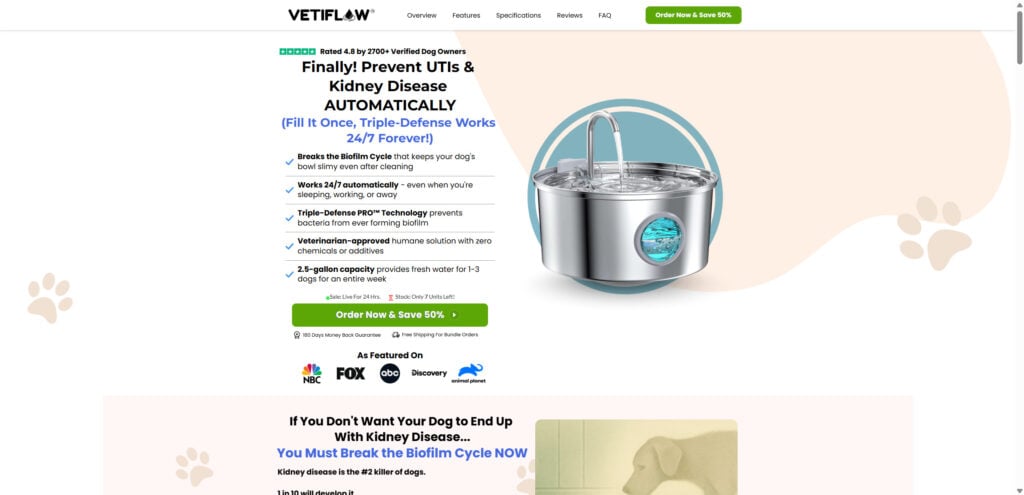
What Is VetiFlow?
VetiFlow is sold through Pawcify landing pages as a dog water fountain with “Triple-Defense PRO Technology.” The product is promoted as a next-generation fountain that keeps water moving, filters it continuously, and prevents biofilm from forming.
The sales page claims VetiFlow offers:
- 24/7 water circulation
- 3-stage filtration
- biofilm prevention
- cleaner water
- better hydration
- fewer slimy bowls
- reduced UTI risk
- kidney health protection
- BPA-free materials
- antimicrobial surfaces
- quiet operation under 40dB
- 3.2-liter capacity
- dishwasher-safe parts
- 5-year pump warranty
- 180-day money-back guarantee
The page lists the price as $99.98, with a crossed-out $199.00 retail price, and promotes a 50% discount for first-time buyers.
On the surface, this looks like a useful product. Pet fountains can encourage some pets to drink more water, and flowing water may be more appealing than still water for some dogs and cats.
The problem is not the idea of a pet fountain.
The problem is the way VetiFlow is advertised.
The Main Problem: VetiFlow Is Marketed Like A Medical Device
VetiFlow is not just marketed as a convenient water fountain. It is marketed as something that can help prevent UTIs, protect dogs from kidney disease, eliminate biofilm, and save owners from expensive vet bills.
That is a much stronger claim.
A water fountain can help keep water circulating. It can filter hair and debris. It can make water more attractive to some pets. But it should not be presented as a guaranteed way to prevent kidney disease or urinary infections.
Kidney disease and UTIs in dogs are real medical issues. They can involve age, genetics, infections, stones, immune problems, dehydration, diet, endocrine disease, and many other factors.
A fountain may support better hydration, but it cannot replace veterinary care, diagnosis, treatment, urinalysis, bloodwork, antibiotics when needed, prescription diets, kidney monitoring, or medical management.
Why VetiFlow Raises Red Flags
1. The advertorial opens with a fear-based emergency vet story
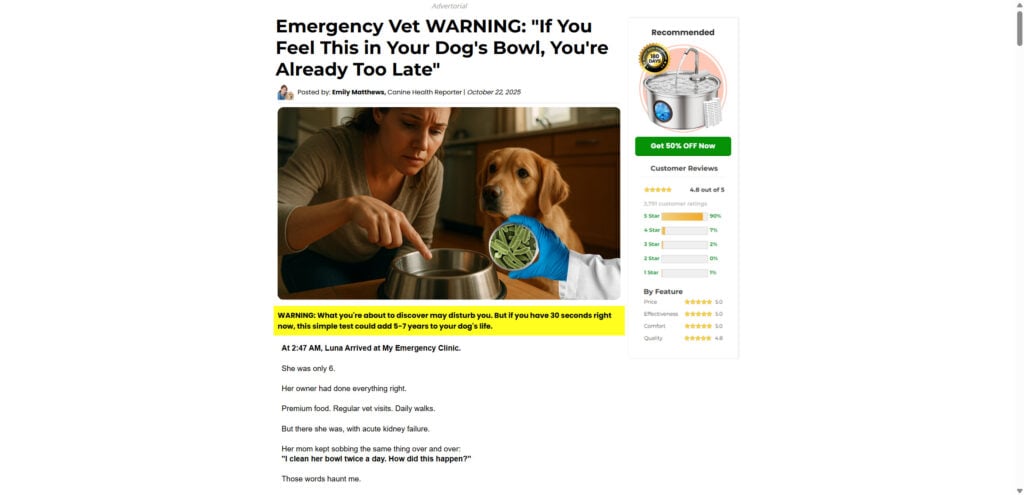
The VetiFlow advertorial begins with an “Emergency Vet WARNING” and tells a dramatic story about a 6-year-old dog arriving at a clinic at 2:47 AM with acute kidney failure.
The story is designed to create fear immediately.
It tells the reader that the dog’s owner did everything right, cleaned the bowl twice a day, and still ended up facing a kidney crisis. Then it implies that hidden biofilm in a “clean” water bowl may be the silent cause.
That is powerful copywriting, but it is also concerning.
Pet owners love their dogs. A story about kidney failure, guilt, and missed warning signs can make someone panic and buy quickly.
Health-related pet marketing should be careful, especially when it suggests that a household product can prevent serious disease.
2. The page claims a simple bowl test could add 5-7 years to a dog’s life
The advertorial says a 30-second bowl test could add 5-7 years to a dog’s life.
That is a very serious claim.
Adding years to a pet’s life is not a small product benefit. It implies disease prevention, health extension, and possibly life-saving effects.
If a product makes that kind of claim, it should provide strong clinical evidence, transparent trial data, and veterinary review from clearly identified experts.
The VetiFlow page does not show enough evidence to support such a dramatic promise.
3. The biofilm claim is exaggerated
Biofilm is real. Pet bowls can become slimy, and bowls should be cleaned regularly. Bacteria, saliva, food residue, minerals, and organic matter can build up if bowls or fountains are neglected.
But VetiFlow’s marketing goes much further.
The page claims:
- 96 out of 100 clean bowls were contaminated
- soap cannot remove biofilm
- scrubbing cannot remove it
- biofilm rebuilds within 8 hours
- biofilm concentrates toxins
- dogs are drinking “concentrated contamination”
- biofilm is slowly poisoning the dog
- every moment of delay means the dog’s kidneys are under attack
This is not balanced pet care advice. It is fear-based marketing.
A clean bowl routine is important, but owners should not be made to feel that they are poisoning their pets because they use a normal bowl.
4. The page attacks regular bowls and other fountains
The advertorial claims stainless steel bowls develop biofilm in 8 hours, ceramic bowls are worse because of microscopic cracks, bleaching makes the problem worse, and other pet-store fountains failed.
This framing makes every normal alternative feel dangerous or useless.
That is a common sales tactic:
- Create fear around the existing solution.
- Say everything else fails.
- Introduce one “breakthrough” product.
- Add urgency before the buyer can research.
In reality, many pet water fountains can be useful if cleaned properly. Bowls can also be safe if washed regularly. The key is hygiene, maintenance, and veterinary care when health symptoms appear.
5. The “hospital ICU technology” claim is vague
The advertorial claims VetiFlow uses hospital ICU technology and the same Triple-Defense PRO system used in veterinary hospitals.
That sounds impressive, but the page does not provide clear proof.
A serious claim like this should answer:
- Which hospitals use this system?
- Is Triple-Defense PRO a patented medical technology?
- What patent number supports the claim?
- What exact veterinary hospital systems is it based on?
- Has VetiFlow been tested by an independent laboratory?
- What materials are considered medical grade?
- Are antimicrobial surfaces certified or independently verified?
- Are the filters tested against specific bacteria?
Without those details, “hospital technology” is mainly a trust-building phrase.
6. The “Johns Hopkins microbiologist” story is not verified
The advertorial says VetiFlow was developed by “Dr. Sarah Mitchell,” described as a Johns Hopkins microbiologist whose own Golden Retriever developed kidney disease.
This creates authority and emotional credibility.
However, the sales page does not provide a direct professional profile, publication history, institutional page, patent filing, clinical trial registration, or transparent evidence that this person developed the product.
That does not automatically prove the story is fake. But if a product depends on a named scientist’s credibility, the page should make that identity easy to verify.
7. The clinical trial claims are extremely strong
The advertorial says a 60-day trial with 20 dogs produced these results:
- 19 out of 20 showed improved kidney values
- 100% increased water intake by at least 30%
- zero UTIs during the trial period
- average water consumption increased by 47%
These claims are serious.
Improved kidney values and zero UTIs are medical-style outcomes. If true, they would require careful context:
- Which kidney markers improved?
- Were BUN, creatinine, SDMA, phosphorus, urine specific gravity, and protein levels measured?
- Were veterinarians blinded?
- Was there a control group?
- Were dogs also treated medically?
- Were diets changed?
- Were medications changed?
- Were infections confirmed by urine culture?
- Was the study published?
- Who funded it?
- Was it peer reviewed?
Without those details, the claims should be treated as marketing, not clinical proof.
8. The page uses major university names without direct proof
The sales page references Cornell University and Johns Hopkins-style microbiology research. It also lists “Cornell University Study (2024)” and claims dogs with biofilm bowls had higher UTI rates, higher kidney disease risk, and lower water consumption.
Those are dramatic claims.
But the page does not provide a direct link to the study, study title, journal, authors, or DOI.
That is a major red flag. If a product uses university names to sell a pet health device, the evidence should be easy to verify.
9. The kidney disease messaging is too aggressive
The page claims VetiFlow can stop the “#2 killer of dogs,” protect from kidney disease, prevent UTIs and kidney disease naturally, save thousands in vet bills, and give dogs more healthy years of life.
That is not normal fountain marketing.
A pet fountain can support hydration. Hydration matters. But kidney disease in dogs is complex and should be managed by a veterinarian.
A product should not imply that buying one fountain can prevent kidney failure.
10. It may delay veterinary care
This is the most important safety concern.
If a dog has symptoms such as increased thirst, frequent urination, accidents in the house, lethargy, vomiting, poor appetite, weight loss, bad breath, or signs of pain while urinating, the answer is not simply buying a fountain.
The answer is a veterinary appointment.
A fountain may be part of home care, but it should not delay diagnosis. Kidney disease and urinary issues require proper testing.
11. “Biofilm never forms again” is unrealistic
The VetiFlow page repeatedly suggests biofilm never forms again or is permanently eliminated.
That is a very strong claim for any water device.
Pet fountains still require cleaning. Pumps, tubing, filters, bowls, spouts, and reservoirs can collect saliva, hair, minerals, food debris, and bacteria.
Even good fountains need regular disassembly, filter changes, and cleaning.
Any product that says “no more biofilm ever” should be treated cautiously.
12. The FAQ says weekly cleaning is enough
The page says users only need a quick 2-minute rinse once a week and that all parts are dishwasher-safe.
That may sound convenient, but pet fountains can get dirty. Filters need replacement. Pumps can collect mineral deposits. Tubes and corners can harbor residue. A quick rinse may not be enough for every home, especially if the dog drools heavily, eats wet food, drinks after meals, sheds a lot, or the water is hard.
Owners should follow the manufacturer’s full cleaning instructions, but they should also inspect the fountain regularly and clean more often when needed.
13. The product uses “As Featured On” media logos
The sales page includes an “As Featured On” section with media-style logos.
This creates the impression that VetiFlow has been covered or endorsed by recognizable outlets.
But a real media feature should be clickable and verifiable. If a page shows logos without linking to actual articles, tests, or interviews, the logos should be treated as marketing decoration.
14. The stock warnings are repetitive and aggressive
The page repeatedly says:
- Sale live for 24 hours
- Only 7 units left
- Page expires in 24 hours
- Current inventory: 127 units
- Orders in last hour: 43
- Estimated sell-out: 2-3 hours
- Risk paying full price tomorrow
These scarcity claims appear throughout the page.
Urgency can be legitimate if inventory is genuinely limited. But when the same page repeatedly uses countdown-style pressure, buyers should slow down.
A pet health product should not be sold through panic and countdown tactics.
15. The capacity claims appear inconsistent
One section says the fountain has a 3.2-liter capacity for 1-3 dogs for an entire week. Another repeated section says 2.5-gallon capacity.
Those are very different capacities.
A 3.2-liter fountain is about 0.85 gallons. A 2.5-gallon fountain is much larger.
This inconsistency matters because water capacity is a basic product specification. If the page cannot keep that detail consistent, buyers should be cautious about other technical claims.
16. The guarantee sounds broad but needs verification
The sales page promotes a 180-day money-back guarantee, “no questions asked,” and says buyers get a refund if VetiFlow does not eliminate biofilm and protect the dog.
That sounds generous.
But the full refund policy was not accessible through the fetcher during review. Buyers should not rely only on sales-page language. They should open the site’s terms, refund policy, warranty policy, and checkout conditions before ordering.
Important questions:
- Can a used fountain be returned after 180 days?
- Who pays return shipping?
- Are filters, accessories, and bundles refundable?
- Is the original shipping fee refunded?
- Is there a restocking fee?
- Does the guarantee require proof of use?
- Does it apply to multiple units?
- Does it apply if the dog refuses to use it?
- Does it apply if the fountain becomes slimy?
- Does it cover pump failure?
- Is the 5-year warranty only for the pump?
A guarantee is only useful if the written policy matches the sales pitch.
17. Multi-unit bundle pressure increases buyer risk
The page promotes free shipping for bundle orders and extra discounts when ordering more than one.
This may encourage buyers to purchase multiple units before testing one.
That creates risk. If the fountain is lower quality than expected, if the dog refuses to use it, if cleaning is harder than promised, or if the refund is restricted, extra units may become difficult to return.
First-time buyers should avoid large bundles.
How The VetiFlow Funnel Appears To Work
Step 1: The ad targets pet-owner guilt
The funnel starts with fear and responsibility.
The message is not just “your dog needs clean water.” It is “your dog may be silently developing kidney disease because of the bowl you think is clean.”
That is emotionally powerful because dog owners want to protect their pets.
Step 2: The advertorial creates a crisis
The page tells a late-night emergency vet story, describes kidney failure, and connects that fear to a normal household water bowl.
The reader is pushed to feel that the danger is already happening at home.
Step 3: Normal solutions are dismissed
The page says stainless steel bowls, ceramic bowls, scrubbing, bleach, and other fountains do not solve the problem.
This makes the buyer feel trapped.
If everything else fails, the promoted product becomes the only answer.
Step 4: Authority names are introduced
The page introduces an emergency vet, a Johns Hopkins microbiologist, veterinary hospital systems, Cornell research, and clinical trial language.
These references create a scientific atmosphere.
But without direct links to real studies, author profiles, published trials, or patent records, the authority signals are weak.
Step 5: The product is framed as life-saving
VetiFlow is then introduced not as a fountain, but as a device that can break the biofilm cycle, protect the kidneys, prevent UTIs, and save thousands in vet bills.
That positioning makes the purchase feel urgent and medically necessary.
Step 6: Testimonials reinforce the fear
The page includes testimonials from owners who claim VetiFlow improved kidney values, stopped chronic UTIs, eliminated slime, and impressed veterinarians.
This makes the product feel proven through real-life stories.
But testimonials on a seller-controlled page are not a substitute for independent evidence.
Step 7: Scarcity pushes immediate checkout
After the health scare, the page repeatedly says stock is low, the sale ends soon, and the price may increase tomorrow.
The emotional sequence is clear:
Fear first. Authority second. Product solution third. Urgency last.
That structure is designed to convert readers quickly.
Is VetiFlow A Scam?
VetiFlow may ship a real dog water fountain, so this may not be a simple “pay and receive nothing” scam.
The concern is the marketing.
A fair conclusion is this: VetiFlow appears to be a high-risk pet product funnel because it uses aggressive disease-prevention claims, fear-based kidney failure messaging, unverified clinical results, vague university and hospital references, strong urgency tactics, media-style logos, large review claims, and broad refund promises that buyers should verify before ordering.
A fountain may help some dogs drink more water. It may keep water moving. It may reduce visible debris. It may be convenient for some homes.
But buyers should not treat VetiFlow as a proven way to prevent kidney disease or UTIs.
What VetiFlow May Actually Do
VetiFlow may help with:
- keeping water moving
- filtering hair and debris
- making water more appealing to some dogs
- reducing still-water stagnation
- encouraging some pets to drink more
- giving owners a larger water reservoir
- reducing how often a bowl needs refilling
- improving convenience
VetiFlow is unlikely to reliably:
- prevent kidney disease
- prevent all UTIs
- permanently eliminate biofilm
- replace daily or regular cleaning
- replace veterinary care
- reverse kidney values
- guarantee increased water intake
- work for every dog
- eliminate all bacterial contamination
- prove that regular bowls are dangerous
What To Do Before Buying
1. Treat it as a fountain, not a medical device
Buy it only if you want a pet fountain. Do not buy it as a kidney disease prevention treatment.
2. Ask your veterinarian about symptoms
If your dog has urinary symptoms, kidney concerns, repeated UTIs, increased thirst, vomiting, lethargy, appetite loss, or abnormal bloodwork, talk to your vet.
3. Verify the refund policy
Find the full refund policy before paying. Confirm whether used fountains can actually be returned under the 180-day guarantee.
4. Avoid bundles first
Buy one unit only if you decide to try it. Do not buy multiple fountains before testing the product.
5. Screenshot everything
Save screenshots of:
- the 180-day guarantee
- kidney disease claims
- UTI prevention claims
- clinical trial claims
- product specifications
- price
- quantity
- shipping terms
- warranty terms
- checkout page
- order confirmation
6. Compare with established pet fountains
Look at known pet fountain brands with transparent reviews, replacement filters, pump availability, cleaning instructions, and clear return policies.
7. Check replacement filter costs
A fountain is not a one-time purchase if it uses filters. Make sure replacement filters are available and affordable.
What To Do If You Already Ordered
1. Check your confirmation email
Confirm:
- number of units ordered
- total price
- shipping charge
- bundle quantity
- warranty or add-ons
- support email
- merchant name
2. Cancel quickly if needed
If you ordered too many or changed your mind, contact support immediately.
Use wording like:
“I am requesting immediate cancellation of my order before shipment. Please cancel all units, add-ons, subscriptions, and future charges connected to this purchase.”
3. Keep extra units sealed
If multiple units arrive, do not open every box. Keep extras sealed in case return eligibility depends on unused condition.
4. Document the product
Take photos of:
- shipping label
- box
- product
- manual
- filter
- pump
- warranty card
- country-of-origin label
- any damage
5. Monitor your dog, but do not skip veterinary care
If your dog has health symptoms, schedule a vet visit. Do not rely on the fountain to fix urinary or kidney problems.
6. Request a refund clearly
If the product does not match the claims, use direct wording:
“The product does not match the advertised claims that it prevents biofilm, UTIs, and kidney disease. I am requesting a refund under the advertised 180-day guarantee.”
7. Dispute if necessary
Contact your bank, credit card issuer, or PayPal if:
- the product never arrives
- you receive more units than ordered
- support refuses the advertised refund
- the product is not as described
- the pump fails and warranty is not honored
- the seller ignores you
- the refund terms contradict the sales page
Use dispute wording such as:
- “item not as described”
- “misleading medical claims”
- “merchant refuses advertised refund”
- “unauthorized quantity charged”
- “refund guarantee not honored”
- “product sold as disease-prevention device but received a basic fountain”
FAQ
What is VetiFlow?
VetiFlow is a dog water fountain marketed as a filtration and circulation device that claims to prevent biofilm, increase hydration, and protect against UTIs and kidney disease.
Is VetiFlow a scam?
VetiFlow may ship a real fountain, but the marketing has major red flags. The biggest concerns are unverified disease-prevention claims, fear-based kidney failure messaging, urgency tactics, and broad guarantee language.
Can VetiFlow prevent kidney disease?
There is no clear public proof on the sales page that VetiFlow prevents kidney disease. Kidney disease in dogs requires veterinary diagnosis and treatment.
Can VetiFlow prevent UTIs?
A cleaner water source may support general hygiene, but no fountain should be treated as a guaranteed UTI prevention device.
Is biofilm in pet bowls real?
Yes. Biofilm and slime can build up in pet bowls and fountains. That is why cleaning is important.
Do pet fountains still need cleaning?
Yes. Pet fountains still need regular cleaning, filter changes, and pump maintenance.
Is VetiFlow really developed by a Johns Hopkins microbiologist?
The sales page makes that claim, but it does not provide a direct verifiable professional profile or published study supporting it.
Is the Cornell University study real?
The page references a Cornell study but does not provide a study title, authors, journal, or direct link. Buyers should treat that claim cautiously.
Should I buy VetiFlow?
Only consider it as a pet fountain, not as a medical solution. Compare alternatives and verify the refund policy before ordering.
The Bottom Line
VetiFlow may be a real dog water fountain, and some pets may drink more from moving water. That part is plausible.
The problem is the marketing. The sales pages push VetiFlow as a way to prevent UTIs, kidney disease, biofilm, vet bills, and guilt. They use emergency-vet stories, dramatic clinical claims, university references, media-style logos, countdown urgency, and large guarantee promises.
A fountain can be helpful, but it is not a substitute for veterinary care.
If you are interested in VetiFlow, treat it as a water fountain only. Buy one, not a bundle. Check the full return policy. Keep screenshots. Clean it regularly. And if your dog shows urinary or kidney symptoms, call your vet.
10 SEO Titles
- VetiFlow Dog Water Fountain Review: Scam or Legit?
- VetiFlow Review: Dog Fountain Claims, Kidney Disease Warnings, and Red Flags
- Is VetiFlow Legit? What Dog Owners Should Know Before Buying
- VetiFlow Scam Warning: Biofilm, UTI, and Kidney Disease Claims Explained
- VetiFlow Dog Fountain Exposed: Fear Marketing or Real Pet Product?
- VetiFlow Review: Can It Really Prevent UTIs and Kidney Disease?
- VetiFlow Dog Water Fountain: Real Solution or Overhyped Funnel?
- VetiFlow 180-Day Guarantee Warning: Read This Before Ordering
- VetiFlow Pawcify Review: The Red Flags Behind This Dog Fountain
- VetiFlow Biofilm Claims: What Pet Owners Need To Know








