

Polar Breeze Portable AC is promoted as a small cooling device for people who want quick relief from hot rooms, high energy bills, and expensive air conditioning.
The product may ship as a real mini fan or personal evaporative cooler, but buyers should be careful. The “portable AC” category is full of cheap generic products sold through aggressive landing pages, fake-looking reviews, AI-style ads, exaggerated cooling claims, and return policies that can be difficult to use once the product has been opened.
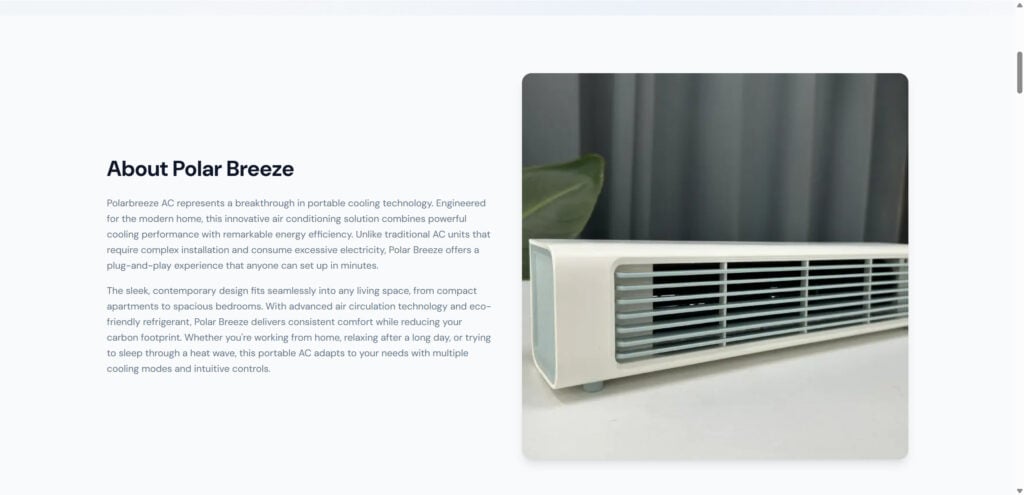
What Is Polar Breeze Portable AC?
Polar Breeze Portable AC is marketed through Polar-Breeze.com as a portable cooling product. The live page could not be fully parsed during review, but the page title identifies it as “Polar Breeze Portable AC” and uses a “Shocking Truth” style headline.
That type of page title already fits the pattern seen with many viral cooling-product funnels. These funnels usually position a small plastic fan or evaporative cooler as a breakthrough air-conditioning alternative.
The product is likely promoted to people who want:
- quick cooling
- lower AC bills
- a portable desk cooler
- bedroom comfort
- office cooling
- dorm-room cooling
- quiet operation
- easy setup
- personal airflow
- a cheaper alternative to real AC
The problem is not that a small fan cannot be useful. A fan can help one person feel cooler when air moves across the skin. An evaporative cooler can also provide some cooling in dry conditions.
The problem is the word “AC.”
Most consumers hear “portable AC” and think real air conditioning. That means they expect room cooling, temperature reduction, and meaningful relief during summer heat. A small personal cooler usually cannot deliver that.
The Main Problem: A Small Fan Is Not A Real Air Conditioner
A real air conditioner removes heat from a room. It uses a compressor, refrigerant, coils, and a system that moves heat away from the indoor space.
That is why real portable air conditioners are usually large. They have BTU ratings, exhaust hoses, filters, drainage systems, and enough power draw to perform actual cooling.
A small Polar Breeze-style gadget does not appear to be in that category.
If it is a mini fan or evaporative cooler, it may blow air toward your face or body. If it uses water, it may make the air directly in front of it feel cooler. But that does not mean it can cool a whole room.
This distinction is critical.
A personal fan creates comfort near the device.
A real AC changes the room temperature.
Those are not the same thing.
Why Polar Breeze Portable AC Raises Red Flags
1. “Portable AC” can mislead buyers
The phrase “portable AC” is the biggest warning sign.
Many viral mini coolers are not air conditioners at all. They are fans, misting fans, or evaporative coolers. They may be useful in a small area, but they do not replace a window AC, central AC, mini-split, or real portable AC.
If Polar Breeze has no visible BTU rating, compressor, refrigerant, exhaust hose, or room-size cooling test, it should not be treated as a true air conditioner.
2. The category is packed with cheap generic China products
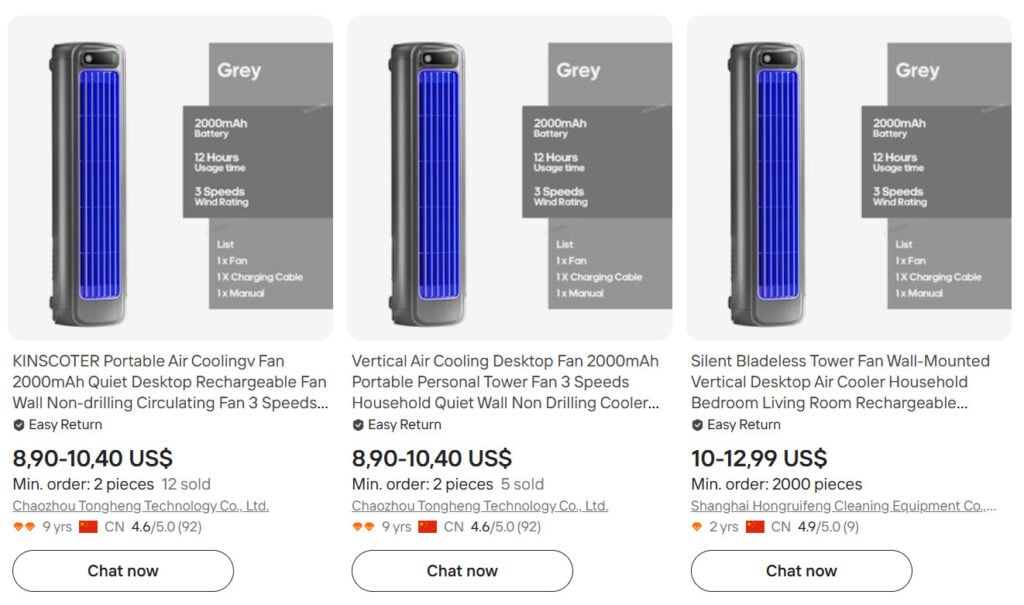
Small “portable AC” gadgets are widely sold under many names. They often appear as generic mini air coolers, USB fans, desk coolers, rechargeable cooling fans, evaporative coolers, and personal air conditioners.
This is a common dropshipping model.
A seller can source a cheap plastic fan from an overseas supplier, rename it Polar Breeze, create a polished landing page, add dramatic summer claims, and run social media ads.
The product may be real, but the branding can make it look more exclusive and more powerful than it is.
3. The cooling claims are often exaggerated
Portable-AC funnels commonly claim that small devices can:
- cool a room in minutes
- lower energy bills dramatically
- replace expensive AC units
- work in extreme heat
- cool bedrooms, offices, garages, and RVs
- provide ice-cold air
- work quietly all night
- use very little electricity
- make traditional AC unnecessary
Those claims should be treated cautiously.
A small fan may feel refreshing. But it does not remove heat from the room. If the air is already hot, the fan mostly moves hot air.
If the product is evaporative, it can work better in dry climates, but it becomes less effective in humidity and can make the room more humid.
4. Evaporative cooling has real limits
Many mini coolers use a water tank, sponge, cooling cartridge, or wet filter. This is often marketed as “advanced cooling technology.”
In reality, it is usually evaporative cooling.
Evaporative cooling can reduce air temperature in dry climates, but it needs airflow, water, maintenance, and low humidity to work well. In humid climates, the effect drops sharply.
A small portable evaporative cooler may provide only slight cooling and is limited by indoor humidity. That makes “cool any room” or “replace AC” claims risky.
5. Real room air conditioners are rated differently
Real room air conditioners are rated by cooling capacity, usually in BTU per hour. The required BTU depends on room size, and normal room AC units often range from thousands of BTU per hour.
That is not how most mini “portable AC” gadgets are sold.
If a product page talks about “rapid cooling” but does not disclose BTU, wattage, cooling capacity, or exhaust design, the claim is incomplete.
6. Fake media logos may be used to create trust
Many products in this category use “as seen on” logos, fake news-style layouts, review badges, “America’s #1” claims, and made-up award graphics.
The goal is simple: make a generic product feel validated by trusted media.
A real media feature should be clickable and verifiable. If the page only shows logos without linking to genuine articles or independent reviews, those logos should be treated as decorative marketing.
7. AI-style images and videos are common in this niche
The portable-AC niche is full of AI videos, AI product scenes, edited demonstrations, fake review clips, and exaggerated before-and-after visuals.
These ads may show:
- icy mist pouring from a tiny device
- a whole room supposedly cooling in seconds
- fake temperature readings
- people sleeping comfortably during heatwaves
- unrealistic airflow animations
- tiny coolers replacing wall AC units
- fake expert demonstrations
- synthetic review videos
The visual effect can be persuasive, but it is not proof.
Cooling performance should be proven with real measurements, not ad effects.
8. Fake or filtered reviews are a major risk
Polar Breeze-style pages often show large review counts, perfect ratings, and many enthusiastic testimonials.
Buyers should be careful with seller-controlled reviews.
Ask:
- Are the reviews hosted by an independent platform?
- Can negative reviews be sorted and read?
- Are reviews tied to verified purchases?
- Are reviewer photos real?
- Does the site publish 1-star and 2-star reviews?
- Are the names and comments reused across other products?
- Are the reviews generated, edited, or filtered?
The FTC has warned that fake, false, and otherwise deceptive reviews pollute the marketplace and mislead consumers.
9. “No returns” may happen in practice
Many of these product pages advertise a 30-day money-back guarantee, but the real return terms may be restrictive.
A typical funnel may require:
- contacting support first
- getting return approval
- keeping original packaging
- returning the product unused
- paying return shipping
- shipping to an overseas address
- providing tracking
- waiting for inspection
- accepting partial refunds
- losing original shipping fees
- being denied if the item was discounted
That is why buyers often describe these products as “no returns” in practice.
If you must open and test the device to see whether it cools as advertised, but the return policy requires it to be unused, the guarantee becomes weak.
10. Multiple units may be added through checkout funnels
Another common problem with direct-response cooling products is accidental multiple-unit ordering.
This can happen through:
- “Buy 2, get 1” bundles
- preselected quantity buttons
- “best value” packages
- one-click post-purchase upsells
- extra warranty offers
- shipping protection add-ons
- duplicate order pages
- mobile checkout confusion
A buyer may think they ordered one Polar Breeze but later receive two, three, or four units.
That matters because returning multiple cheap devices can be harder and more expensive than expected.
11. The page title itself feels like a review funnel
The accessible page title says “Polar Breeze Portable AC – Does it Works? Shocking Truth.”
That phrasing looks more like a search-engine or advertorial page than a straightforward product page. It also contains awkward grammar.
This does not prove a scam, but it does suggest the site may be built as a promotional funnel rather than a normal transparent ecommerce store.
A real product page usually focuses on specifications, pricing, warranty, support, and return terms. A “shocking truth” headline is more typical of click-driven advertorial marketing.
How The Polar Breeze Funnel Appears To Work
Step 1: The ad targets summer discomfort
The funnel likely begins with a social media ad, native ad, or search result aimed at people who are hot and frustrated.
The message is simple:
Your room is too hot. AC is too expensive. This small device can fix it.
This is effective because heat creates urgency. People are more likely to buy quickly when they are uncomfortable.
Step 2: The product is positioned as a breakthrough
Instead of saying “small fan,” the sales pitch may use words like:
- portable AC
- personal air conditioner
- rapid cooling
- advanced cooling technology
- mini climate control
- cool air in seconds
- energy-saving cooling
- summer survival device
These phrases make the product sound more powerful than a regular fan.
Step 3: The page builds trust with social proof
The funnel may use customer reviews, star ratings, “verified buyer” labels, media logos, expert quotes, and before-and-after claims.
This is meant to remove doubt.
A buyer who sees many happy reviews may stop asking technical questions such as:
- Does it have a compressor?
- Does it have a BTU rating?
- Does it remove heat from the room?
- Does it work in humid climates?
- Who is the manufacturer?
- Where does it ship from?
- Can I return it after testing it?
Step 4: The discount creates pressure
Most mini AC funnels use big discounts. The product may be shown as 50%, 60%, or 70% off, often with stock warnings or countdown timers.
The purpose is to make the buyer feel they must act now.
But if a product is truly useful and fairly priced, it should still make sense after you compare it with similar items.
Step 5: The checkout may push bundles
Once the buyer enters the checkout, the site may offer multi-unit packages.
The buyer may see:
- 1 unit
- 2 units
- 3 units
- family pack
- best seller
- most popular
- limited bundle
- free shipping bundle
- extended protection
- package insurance
This is where accidental extra units can happen.
Always read the final cart total before submitting payment.
Step 6: The product may ship as a generic fan
If the order is fulfilled, the buyer may receive a small plastic fan or evaporative cooler.
It may work. It may blow air. It may even feel cooler nearby.
But if the buyer expected a real room-cooling AC, disappointment is likely.
Step 7: Refund friction appears
If the customer wants a refund, the seller may point to policy conditions.
The buyer may be told that the product must be unused, returned in original packaging, sent to a specific address, or shipped at the buyer’s expense.
This is why screenshots and payment protection matter.
Main Red Flags
- Marketed as a portable AC, but likely closer to a small fan or evaporative cooler.
- Official page title uses “Does it Works? Shocking Truth” style wording.
- No clear evidence of compressor-based AC technology.
- No visible BTU rating from the accessible page metadata.
- No visible exhaust hose, refrigerant, or true room AC specifications.
- Portable-AC funnels often rely on fake media logos and AI-style ads.
- Seller-controlled reviews can be filtered or misleading.
- Similar generic mini coolers are commonly sold under many names.
- Return terms may be difficult to use once the product is opened.
- Multiple-unit checkout funnels may lead to unwanted extra orders.
- Claims about cooling a room should be treated skeptically unless measured proof is shown.
Is Polar Breeze Portable AC A Scam?
Polar Breeze Portable AC may ship a real product, so this may not be a simple “pay and receive nothing” scam.
The concern is misleading marketing.
A fair conclusion is this: Polar Breeze Portable AC appears to be a high-risk portable cooling offer because it uses “AC” positioning in a product category commonly filled with small fans, evaporative coolers, cheap generic devices, fake-looking ads, filtered reviews, bundle pressure, and hard-to-use return processes.
If it arrives, it may work as a personal fan.
But buyers should not expect it to cool a room like a real air conditioner.
What Polar Breeze May Actually Do
Polar Breeze may help with:
- direct airflow
- desk cooling
- bedside airflow
- personal cooling while sitting nearby
- mild evaporative cooling in dry air
- white-noise fan comfort
- short-term relief in a small area
Polar Breeze is unlikely to reliably:
- cool an entire room
- replace a window AC
- replace central air conditioning
- reduce room temperature dramatically
- remove humidity
- work well in humid climates if evaporative
- justify buying multiple units before testing one
- perform like a real BTU-rated AC unit
What To Do Before Buying
1. Treat it as a fan, not an AC
Do not buy Polar Breeze expecting real air conditioning.
At most, consider it a small personal cooling device.
2. Look for real specifications
Before ordering, check for:
- BTU rating
- wattage
- compressor details
- refrigerant type
- exhaust hose
- tank size
- airflow rating
- noise rating
- room-size test data
- manufacturer name
- country of origin
- full return address
If those details are missing, be careful.
3. Compare generic alternatives
Search for:
- mini portable air cooler
- personal evaporative cooler
- USB desktop cooling fan
- rechargeable air cooler
- small water tank air cooler
- Polar Breeze alternative
If a similar product is available elsewhere for far less, slow down.
4. Check the return policy
Do not rely only on a “money-back guarantee” badge.
Confirm whether used products can be returned after testing.
5. Avoid bundles
Buy one unit only if you decide to test it.
Do not buy multiple units before knowing whether it works.
6. Screenshot everything
Save screenshots of:
- product claims
- price
- discount
- reviews
- media logos
- checkout quantity
- final total
- refund policy
- shipping policy
- order confirmation
7. Use a protected payment method
Use a credit card or PayPal if possible. Avoid payment methods that make disputes difficult.
What To Do If You Already Ordered
1. Check the order confirmation
Look for:
- number of units
- total charge
- shipping fee
- merchant name
- support email
- order number
- tracking details
- any add-ons or warranties
2. Act quickly if you ordered too many
Use clear wording:
“I ordered one unit only. I did not authorize extra units, bundle upgrades, warranties, or add-ons. Please cancel the extra items and refund the difference immediately.”
3. Save the ad and product page
Take screenshots of any claims saying it cools a room, replaces AC, saves major energy costs, or works like an air conditioner.
4. Keep extra units sealed
If multiple devices arrive, do not open every box. Keep extra units sealed in original packaging.
5. Test one unit carefully
Document whether it actually lowers room temperature or only blows air nearby.
Use a thermometer if possible.
6. Request a refund in writing
Use direct wording:
“The product was advertised as a portable AC, but it performs as a small personal fan or evaporative cooler and does not match the advertised cooling claims. I am requesting a refund.”
7. Dispute if necessary
Contact your bank, credit card issuer, or PayPal if:
- the product never arrives
- the tracking is fake or stalled
- you received more units than ordered
- you were charged more than expected
- the seller refuses the advertised refund
- the product is not as described
- the return process is unreasonable
- support does not respond
Use dispute wording such as:
- “item not as described”
- “misleading portable AC claims”
- “sold as AC but received a small fan”
- “unauthorized quantity charged”
- “merchant refuses advertised refund”
- “product does not perform as advertised”
FAQ
What is Polar Breeze Portable AC?
Polar Breeze Portable AC is marketed as a portable cooling product. Based on the product category and available page metadata, it appears to be a mini cooling device rather than a clearly documented real air conditioner.
Is Polar Breeze a real air conditioner?
There is no clear public evidence from the accessible page metadata that it is a true compressor-based AC. A real room AC should provide specifications such as BTU rating, power draw, and cooling capacity.
Can Polar Breeze cool a whole room?
Be skeptical. Small fans and mini evaporative coolers usually provide personal cooling, not full-room air conditioning.
Is Polar Breeze a scam?
It may ship a real product, but it has red flags common to dropshipping-style portable AC offers, including “AC” positioning, likely generic-product similarities, possible AI-style ads, review risk, and refund concerns.
Why are portable AC ads often misleading?
Many ads use the word “AC” for small fans or evaporative coolers. That can make buyers expect true room cooling when the device only provides close-range airflow.
Are fake reviews a concern?
Yes. Fake and deceptive reviews are a known problem in online product marketing. Seller-controlled reviews should not be treated as independent proof.
Can I accidentally receive multiple units?
Yes, that can happen in funnel-style checkouts with bundles, quantity discounts, or post-purchase upsells. Always check the final cart before paying.
Are returns easy?
Not always. Many similar offers advertise guarantees but require unused condition, original packaging, return approval, and customer-paid return shipping.
Should I buy Polar Breeze?
Only consider it if you want a small personal fan or mini evaporative cooler. Do not buy it expecting a real AC.
The Bottom Line
Polar Breeze Portable AC should be treated with caution.
The product may exist and may provide personal airflow, but the “portable AC” positioning is the main concern. A small fan or evaporative cooler cannot perform like a real air conditioner unless it has the proper technology, cooling capacity, and specifications to prove it.
The safest assumption is simple: Polar Breeze is likely a personal cooling gadget, not a true room-cooling AC.
Before buying, compare cheaper alternatives, avoid bundles, verify the return policy, screenshot the checkout, and use a protected payment method.








