

Artic Air Portable AC is being promoted through advertorial-style pages and social media ads as a small cooling device that can supposedly deliver fast, powerful relief from summer heat.
The product may ship as a real mini fan or evaporative cooler, but the marketing raises serious red flags. It appears to follow the same dropshipping-style portable AC pattern: cheap generic product from China, exaggerated cooling claims, AI marketing raises serious red flags. It appears to follow the-style videos and images, fake-looking reviews, limited or difficult returns, and checkout funnels that may cause buyers to receive more units than they intended to order.
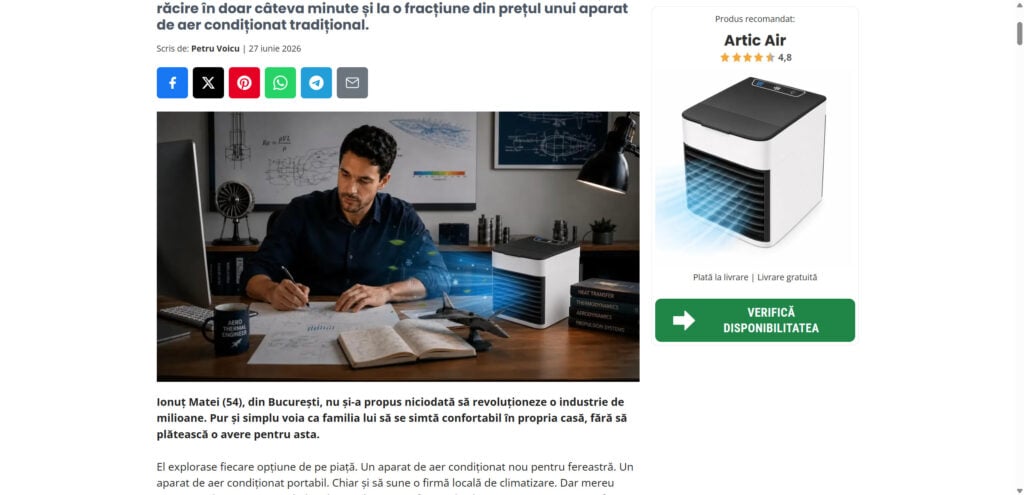
What Is Artic Air Portable AC?
Artic Air Portable AC is advertised as a compact cooling device for people who want relief from hot rooms, high electricity bills, poor airflow, and expensive air conditioning.
The offer is promoted through an article-style landing page rather than a normal retail product page. This kind of page usually looks like a consumer article, local news story, viral recommendation, or “shocking truth” review. But the real goal is to push the reader into a checkout funnel.
The product is likely positioned with claims such as:
- portable cooling
- quick relief from heat
- low energy use
- simple plug-in or USB operation
- personal cooling for bedrooms, desks, kitchens, offices, and dorm rooms
- cheaper than traditional air conditioning
- no installation required
- quiet operation
- easy setup
- limited-time discount
- money-back guarantee
On the surface, that sounds useful. A small personal fan can help one person feel cooler if it is close enough. A small evaporative cooler can also provide mild cooling in dry air if it uses water and airflow.
The problem is the “portable AC” claim.
Most people hear “AC” and think of real air conditioning. They expect a device that lowers room temperature, removes heat, and works during summer heat. A small fan or mini water cooler does not do that in the same way.
A real air conditioner removes heat from a room. A small fan moves air. An evaporative cooler may add moisture and provide a slight cooling effect under the right conditions. Those are very different products.
The Main Problem: It Will Not Work Like A Real Air Conditioner
The biggest issue with Artic Air Portable AC is expectation.
If the product is a small desk cooler, mini fan, or evaporative device, it may blow air directly toward you. It may feel pleasant if you sit close to it. It may help at a desk, bedside table, or small workspace.
But it should not be expected to cool an entire bedroom, office, living room, apartment, garage, or RV like a real air conditioner.
Real room air conditioners use measurable cooling capacity, usually shown in BTU per hour. They also require enough power to remove heat from the air. Portable AC units usually need an exhaust hose because the heat has to go somewhere.
A small plastic device with a fan, water tank, cooling pad, or USB cable cannot perform the same job.
That is why these viral “portable AC” ads are often misleading. They sell the feeling of air conditioning, but the buyer may receive something closer to a personal fan.
Why Artic Air Portable AC Raises Red Flags
1. The product appears to be a cheap generic China-made cooler
Products like Artic Air Portable AC are commonly sourced from overseas suppliers, especially China-based manufacturers that sell small USB cooling fans, personal evaporative coolers, mini desktop coolers, and rechargeable fans in bulk.
These products can be rebranded easily.
A seller can take a generic mini cooler, rename it Artic Air, create a polished landing page, add dramatic ad videos, claim a big discount, and sell it as a breakthrough cooling solution.
The product may still arrive. The problem is that it may not be worth the advertised price, and it may not perform like the ad suggests.
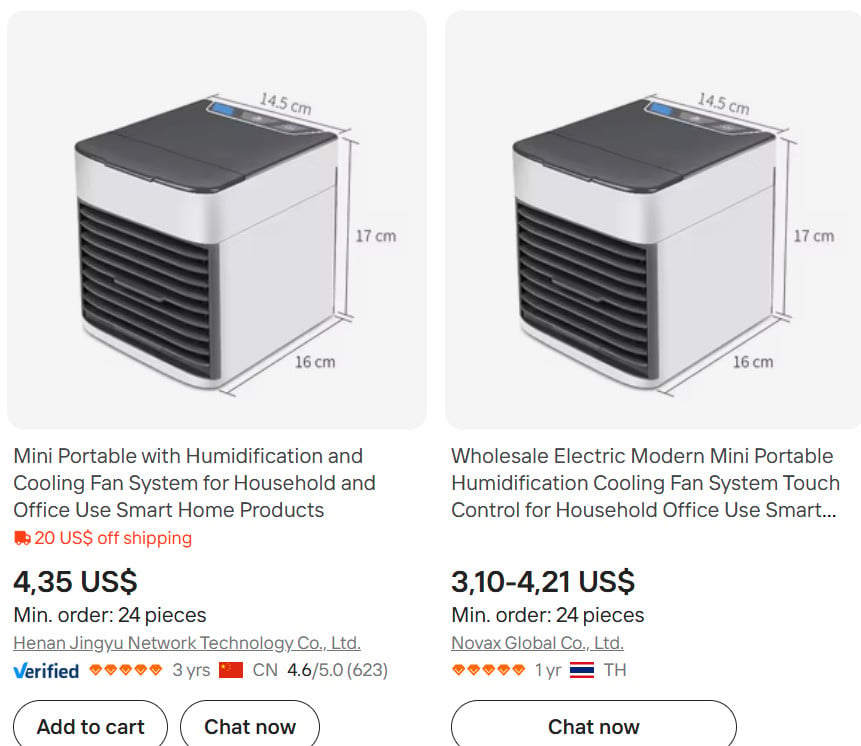
2. “Portable AC” is misleading if it is only a fan
The word “AC” is doing most of the selling.
A fan can make your skin feel cooler by moving air. It does not lower the temperature of the room. An evaporative cooler may cool air slightly by evaporating water, but it works best in dry climates and becomes weaker in humid areas.
A real air conditioner is different. It uses refrigeration technology to remove heat from indoor air.
If Artic Air has no clear BTU rating, compressor, refrigerant system, exhaust hose, or verified room-cooling test, buyers should treat it as a small fan or personal cooler, not a true air conditioner.
3. The ads likely exaggerate the cooling effect
Portable AC scam-style ads often show:
- icy mist coming from a tiny device
- a hot room cooling in seconds
- fake thermometer drops
- people sleeping comfortably during heatwaves
- cars, bedrooms, and offices being cooled instantly
- dramatic “before and after” heat scenes
- claims that a small unit replaces expensive AC
- claims of huge electricity savings
These visuals are persuasive, but they often do not match real-world performance.
A small fan can feel refreshing up close. It cannot cool a full room in seconds.
4. AI videos and images make the product look better than it is
The user flagged Artic Air as being promoted with AI-style videos and images. This fits the pattern seen across many viral gadget funnels.
AI and edited ads can make a basic product look premium. They can create perfect bedroom scenes, fake airflow animations, synthetic users, fake news clips, fake review videos, and unrealistic demonstrations.
This matters because many buyers trust what they see in a video. If a video shows a tiny cooler producing “ice-cold air,” people may assume the product really performs that way.
But an ad video is not proof.
Real proof would include measured temperature tests, room size, starting temperature, humidity, runtime, wattage, and comparison against normal fans.
5. Fake media-style advertorials create false trust
The page you shared is hosted on a news-style domain and uses an article route. That is a common pattern in direct-response marketing.
These pages often look like:
- local news articles
- consumer reports
- viral product reviews
- expert recommendations
- “shocking truth” stories
- investigative product tests
- sponsored lifestyle articles
The goal is to make the ad feel like independent journalism.
But the page is usually just part of a sales funnel. It may be written to make the product look discovered, tested, recommended, or “going viral.”
A real independent review should disclose who tested the product, how it was tested, what competitors were compared, and what limitations were found.
6. Fake or filtered reviews are a major concern
These funnels often show hundreds or thousands of perfect reviews. The reviews usually say the product:
- cooled a room fast
- saved money on electricity
- worked better than expected
- helped during a heatwave
- replaced expensive air conditioning
- was perfect for seniors, pets, kids, offices, or dorms
But seller-controlled reviews are weak evidence.
Buyers should ask:
- Are negative reviews visible?
- Can reviews be sorted by lowest rating?
- Are reviews tied to verified purchases?
- Are reviewer photos real?
- Are reviews hosted by a neutral platform?
- Are the same names or photos used on other sites?
- Were reviews generated by AI?
- Does the page publish 1-star reviews?
If the review system is controlled by the seller, it can be filtered, edited, imported, or fabricated.
7. “No returns” may happen in practice
Many of these pages promote a money-back guarantee, but the actual return process can be much harder.
Customers may later find that:
- returns require approval first
- opened products are not accepted
- used products are not refundable
- original packaging is required
- return shipping is paid by the customer
- refunds exclude shipping and handling
- discounted items are excluded
- return addresses are overseas
- support delays the process
- partial refunds are offered instead of full refunds
- the window expires before the issue is resolved
That creates a practical “no returns” situation.
If you must open the product to test whether it cools as advertised, but the policy says opened or used products cannot be returned, the guarantee is almost worthless.
8. Multiple units may be sent instead of what you ordered
This is another common problem with portable AC funnels.
A buyer may think they ordered one unit, but the checkout can push:
- buy 2, get 1 bundles
- family packs
- “best value” quantity options
- preselected multi-unit packages
- one-click post-purchase upsells
- warranty add-ons
- shipping protection
- duplicate order pages
- hidden extra items
Sometimes the buyer only notices after receiving the confirmation email or package.
If multiple units are shipped, returning them can be difficult. Extra units may need to stay sealed, and return shipping may cost more than expected.
9. It may not be the same as known retail cooling products
The name “Artic Air” is close to “Arctic Air,” a name that has appeared on various consumer cooling products over the years.
This can create confusion.
Some shoppers may think they are buying a known product from a normal retailer, when they are actually buying from a separate advertorial funnel using a similar name or spelling.
Always check the exact seller, domain, checkout page, return address, and merchant name before paying.
10. The discount pressure is usually part of the funnel
Portable AC funnels often use:
- 50% off
- 60% off
- 70% off
- “today only”
- “last chance”
- “limited stock”
- “selling out fast”
- countdown timers
- claims that the device is banned, hidden, or hard to find
These tactics push buyers to act before thinking.
If the product is truly good, it should still be worth buying after you compare prices, read the return policy, and check independent reviews.
How The Artic Air Portable AC Operation Appears To Work
Step 1: The ad targets people who are hot and frustrated
The funnel likely begins with a social media ad, Google ad, or native ad. The message is simple: summer is hot, air conditioning is expensive, and this small gadget can solve the problem.
That message works because heat makes people impatient. When someone is uncomfortable, a quick cooling solution feels urgent.
Step 2: The landing page looks like an article
Instead of sending buyers directly to a normal store, the ad sends them to an advertorial page.
This creates trust. A person may feel they are reading a helpful article instead of an ad.
The page may use a story format:
- people are shocked by the product
- stores are selling out
- energy companies hate it
- experts recommend it
- customers are amazed
- the product is available only today
- readers can claim a discount through the link
That format is designed to warm up the buyer before checkout.
Step 3: The product is framed as a breakthrough
The page likely uses phrases like portable AC, instant cooling, energy saver, advanced cooling, ice-cold air, or room cooling.
This makes a small fan sound like an air conditioner.
The buyer is not encouraged to ask for technical details such as BTU, refrigerant, compressor, exhaust hose, wattage, or room-size rating.
Step 4: Social proof removes doubt
The funnel then adds reviews, ratings, comments, testimonials, fake media logos, or social media screenshots.
The buyer sees people saying it worked for bedrooms, offices, RVs, kitchens, hot apartments, and summer nights.
That creates a feeling of safety, even if the reviews are not independently verified.
Step 5: The checkout pushes quantity
Once the buyer clicks through, the checkout may present quantity options.
One unit may look expensive, while multi-unit bundles appear to offer better value. The “most popular” option may be two, three, or four units.
This increases the order value and raises the risk of receiving more than intended.
Step 6: The buyer may receive a basic mini cooler
If the product arrives, it may be a small plastic fan, mini evaporative cooler, or USB-powered device.
It may blow air.
It may feel cooler up close.
It may work as a personal fan.
But it is unlikely to cool a whole room as the ads suggest.
Step 7: Refund problems appear after delivery
If the buyer asks for a refund, support may point to conditions.
The customer may need to return the product unused, pay shipping, provide photos, get approval, or ship to an address that is expensive or inconvenient.
This is why buyers should document everything from the beginning.
Main Red Flags
- Promoted through an advertorial-style article page.
- Marketed as a portable AC even though it appears to be a small fan or evaporative cooler.
- Cheap generic China-sourced product risk.
- AI-style images and videos may exaggerate performance.
- Fake or exaggerated social media ads.
- Fake-looking reviews and social proof.
- Claims may suggest room cooling even if the product only provides close-range airflow.
- Likely no meaningful BTU rating, compressor, refrigerant, or exhaust system.
- May not work as advertised in hot or humid rooms.
- Return process may be difficult or practically unavailable.
- Multiple units may be added through bundles or upsells.
- Discount and scarcity pressure may push rushed purchases.
- Similar names may create confusion with other cooling products.
Is Artic Air Portable AC A Scam?
Artic Air Portable AC may ship a real product, so it may not be a simple “pay and receive nothing” scam.
The concern is misleading marketing.
A fair conclusion is this: Artic Air Portable AC appears to be a high-risk dropshipping-style portable cooling offer because it uses “AC” positioning for what appears to be a small personal cooler, relies on exaggerated or fake claims, may use AI-style promotional media, and may create refund and multiple-unit risks through its checkout funnel.
The product may work as a small fan.
It should not be expected to work like a real air conditioner.
What Artic Air May Actually Do
Artic Air may help with:
- personal airflow
- desk cooling
- bedside airflow
- short-range comfort
- mild evaporative cooling in dry air
- temporary relief when sitting close
- white-noise fan effect
- small-space airflow
Artic Air is unlikely to reliably:
- cool a whole room
- replace a window AC
- replace central AC
- replace a real portable AC
- remove humidity
- cool a room in seconds
- perform well in humid climates
- justify buying several units before testing one
- match dramatic social media ad videos
What To Do Before Buying
1. Treat it as a fan, not an AC
Do not buy Artic Air expecting room air conditioning.
If you buy it, assume it is a small personal fan or mini evaporative cooler.
2. Look for real specifications
Before paying, check for:
- BTU rating
- wattage
- compressor
- refrigerant
- exhaust hose
- room-size test
- water tank size
- runtime
- noise level
- manufacturer name
- country of origin
- return address
If those details are missing, be cautious.
3. Compare generic alternatives
Search for:
- mini portable air cooler
- USB evaporative cooler
- personal cooling fan
- desktop air cooler
- portable water fan
- Arctic Air alternative
- Artic Air alternative
- mini AC fan from China
If a similar item appears much cheaper, slow down.
4. Avoid multi-unit bundles
Buy one unit only if you decide to try it.
Do not buy family packs or “best value” bundles before testing the product.
5. Screenshot the entire process
Save screenshots of:
- ad claims
- product page
- fake or real media logos
- cooling claims
- review claims
- price
- discount
- quantity selected
- final total
- refund policy
- order confirmation
6. Use a protected payment method
Use a credit card or PayPal if possible. Avoid payment methods that make disputes difficult.
What To Do If You Already Ordered
1. Check the confirmation email immediately
Look for:
- product name
- number of units
- final price
- shipping fee
- order number
- seller name
- support email
- payment descriptor
- add-ons or warranties
2. Act fast if extra units were added
If you see more units than expected, contact support immediately.
Use wording like:
“I ordered one unit only. I did not authorize extra units, bundles, warranties, or add-ons. Please cancel the extra items and refund the difference immediately.”
3. Save the ad and landing page
Take screenshots of any claims saying it cools a room, replaces AC, saves money, or creates cold air.
These screenshots may help with a refund or chargeback.
4. Keep extra units sealed
If multiple units arrive, do not open every box.
Keep extra units sealed in original packaging to support a return or dispute.
5. Test one unit carefully
If you open one unit, document whether it actually cools the room or only blows air nearby.
Use a thermometer if possible.
6. Request a refund clearly
Use direct wording:
“The product was advertised as a portable AC, but it performs as a small personal fan or evaporative cooler and does not match the advertised cooling claims. I am requesting a full refund.”
7. Dispute if necessary
Contact your bank, credit card issuer, or PayPal if:
- the product never arrives
- tracking is fake or stalled
- you received more units than ordered
- you were charged more than expected
- the seller refuses the advertised refund
- the product is not as described
- support ignores you
- the return process is unreasonable
- the product works only as a fan despite being sold as AC
Use dispute wording such as:
- “item not as described”
- “misleading portable AC claims”
- “sold as air conditioner but received small fan”
- “unauthorized quantity charged”
- “merchant refuses advertised refund”
- “product does not match social media advertisement”
FAQ
What is Artic Air Portable AC?
Artic Air Portable AC is marketed as a portable cooling device, but it appears to fit the category of small personal fans or evaporative coolers sold through advertorial-style funnels.
Is Artic Air a real air conditioner?
There is no clear evidence from the provided sales funnel that it is a true compressor-based air conditioner. A real AC should have cooling capacity, usually listed in BTU per hour, and a way to remove heat from the room.
Can Artic Air cool a whole room?
Be skeptical. A small fan or evaporative cooler may cool the air directly in front of it, but it is unlikely to cool a full room like a real AC.
Is Artic Air a scam?
It may ship a real product, but the offer has major red flags, including cheap generic product signals, exaggerated cooling claims, AI-style promotional media, possible fake reviews, no-return risk, and multiple-unit checkout risk.
Why are the ads misleading?
They may make a small fan look like a real air conditioner by showing cold mist, dramatic cooling, fake temperature drops, or claims that it replaces AC.
Is it made in China?
The exact manufacturer may not be clear from the funnel, but this type of product is commonly sold as a generic China-made mini cooler or fan under many names.
Are returns easy?
Be careful. Many similar funnels advertise guarantees but later require unused condition, original packaging, return approval, and customer-paid shipping. That can make returns difficult in practice.
Can I receive more units than I ordered?
Yes, that is a risk with checkout funnels that use bundles, preselected quantities, post-purchase upsells, or confusing mobile layouts.
Should I buy Artic Air Portable AC?
Only consider it if you want a small personal fan and understand that it is not a real air conditioner. Compare cheaper alternatives first and avoid bundles.
The Bottom Line
Artic Air Portable AC should be treated with caution.
The product may ship and may work as a small fan or personal cooler. But the advertising appears to push expectations far beyond what a mini device can reasonably do. It is unlikely to cool a room like a real air conditioner, and buyers should be alert for AI-style ads, fake-looking reviews, exaggerated claims, difficult returns, and multiple-unit checkout issues.
If you need real cooling, buy a real portable AC with BTU ratings, an exhaust hose, verified specifications, and a clear return policy.
If you only want a personal desk fan, compare cheaper generic alternatives before ordering.








