

InstaCool Pro is being promoted as a compact cooling and heating device that can make rooms comfortable without the cost or installation of a real air conditioner.
But the product itself deserves a closer look.
Based on its design, appearance, and similar low-cost versions sold under other names, InstaCool Pro appears to be less of a real AC and more of a generic small fan-heater being marketed with exaggerated cooling claims.
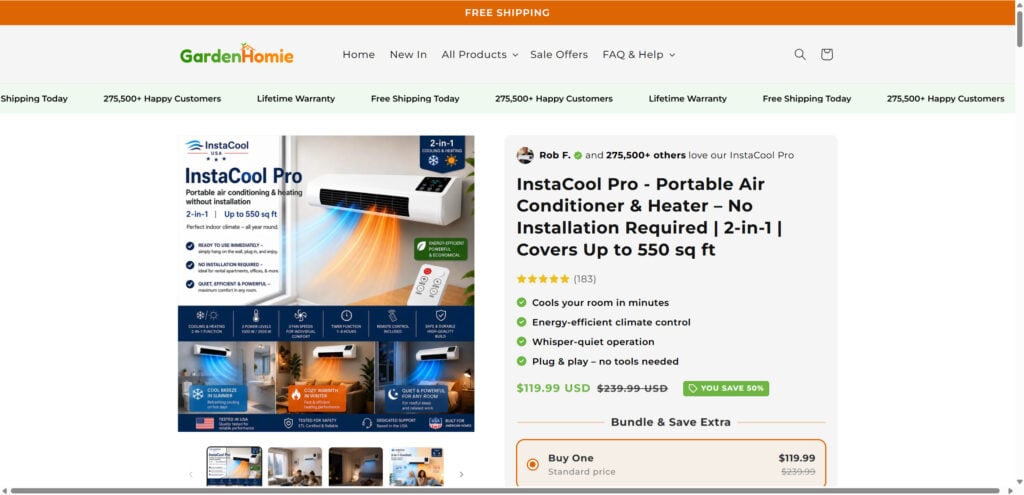
Overview
InstaCool Pro is advertised as a portable air conditioner and heater for bedrooms, offices, apartments, dorm rooms, garages, and small living spaces.
The idea sounds practical.
You plug it in, mount it or place it near you, choose cooling or heating mode, and enjoy quick comfort without a window unit, exhaust hose, outdoor compressor, or professional installation.
That is the promise.
The reality appears much less impressive.
The product shown under the InstaCool Pro name looks extremely similar to generic wall-mounted fan and heater units sold through Chinese wholesale suppliers. Similar-looking devices are often listed for around $5 to $15 per unit, depending on supplier, quantity, and configuration.
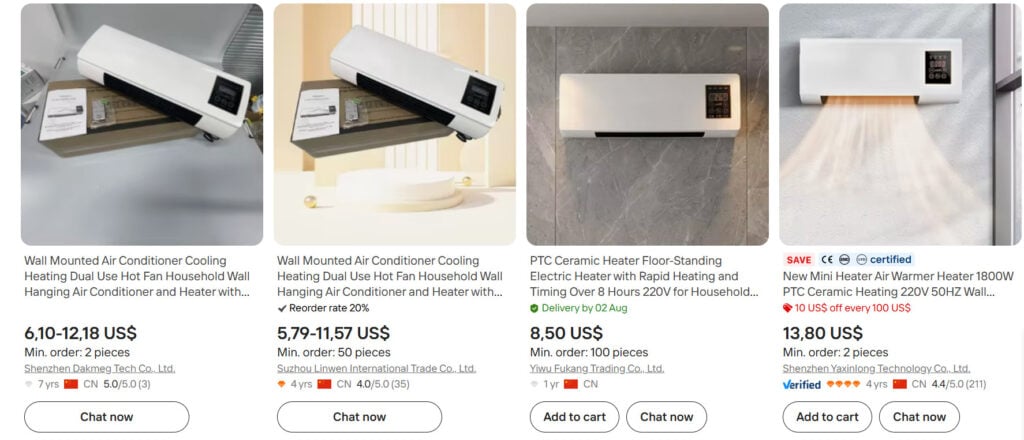
These units are usually described with broad terms such as “wall-mounted air conditioner,” “cooling and heating fan,” “PTC ceramic heater,” “hot air fan,” or “household electric heater.”
That wording can be misleading.
A small fan-heater is not the same as a real air conditioner.
A real AC removes heat from a room. It uses a refrigeration cycle, compressor, refrigerant, evaporator coil, condenser coil, and a system for moving heat outside. That is why real portable AC units usually need an exhaust hose or window kit.
InstaCool Pro does not appear to be that type of appliance.
It looks more like a compact plastic fan with a heating element. It may blow air. It may produce warm air if the heater function is active. But blowing air is not the same as cooling a room.
This is the most important point for buyers to understand.
A fan can make you feel cooler when it blows directly on your skin. Moving air helps sweat evaporate, which can create a temporary cooling sensation. But the fan does not remove heat from the room.
If the room is 90°F, a basic fan is still moving 90°F air around.
That may feel better than still air, but it is not air conditioning.
This is why products like InstaCool Pro can disappoint people. The ads may make the device look like a mini AC that can cool bedrooms, living rooms, or workspaces. But the product itself appears to have the physical limits of a small fan or fan-heater.
If it has a PTC ceramic heating element, the heating side may be more realistic than the cooling side. PTC heaters are common in compact electric heaters. They can produce warm air fairly quickly in a small area.
But that does not make the cooling claim stronger.
Heating air is simple. Cooling air properly is harder.
To cool a room, heat has to go somewhere. If a device has no exhaust hose, no outdoor condenser, no water tank with evaporative cooling, and no real refrigeration system, it cannot magically remove heat from the space.
That is why many of these “portable AC” products rely on language that sounds impressive but stays vague.
They may say:
- Rapid cooling
- Instant comfort
- Room cooling
- Personal climate control
- Cool air in seconds
- Powerful airflow
- Energy-saving AC alternative
These phrases sound useful, but they do not prove true room cooling.
A small fan can start blowing air in seconds. That does not mean it cools the room in seconds.
A heater can warm the air coming out of the vent. That does not mean the whole room changes temperature instantly.
A device can feel refreshing when placed close to you. That does not mean it is a real air conditioner.
This difference matters because buyers are often paying premium prices for what appears to be a cheap generic product.
The image you provided shows nearly identical-looking units sold on wholesale platforms for very low prices. Some listings show the same shape, same wall-mounted style, same front vent, same side control panel, and similar product descriptions.
That suggests the product is not a unique cooling breakthrough.
It appears to be a generic fan-heater that can be branded and resold under many names.
This is a common viral gadget pattern.
The same physical product may appear as InstaCool Pro on one site, Cool Cove AC on another, WellaCooler on another, and under more names elsewhere. Each brand may claim to be original, advanced, improved, or specially designed.
But the product itself may still be the same basic low-cost device.
This is why the “different name, same product” issue is so important.
When buyers search for InstaCool Pro reviews, they may not find many complaints at first because the name may be new. But if they search the product image, they may find similar versions sold much cheaper.
That is often the giveaway.
The product is not being sold mainly because of proven performance. It is being sold because the marketing makes it feel more powerful, more exclusive, and more valuable than it likely is.
The design also raises practical questions.
A wall-mounted mini fan-heater may be useful in a very limited way. It can move air in one direction. It may provide localized airflow. It may warm a small area if used carefully. But it is not a strong substitute for a window AC, split AC, proper portable AC, or even a high-quality tower fan.
Its size alone tells part of the story.
A device this compact has limited airflow, limited power, limited heat exchange, and limited coverage. It may be fine for a desk, bedside area, or small personal zone. But claims about cooling large rooms should be treated with caution.
Buyers should also consider build quality.
Many low-cost generic fan-heaters use lightweight plastic, basic motors, simple heating elements, and low-cost electronics. That does not automatically mean they are dangerous, but it does mean shoppers should be careful.
With any plug-in heater, safety matters.
A small heating device should have clear safety certifications, overheating protection, tip-over protection if floor-standing, proper plug design, correct voltage, and clear instructions. If the product is imported cheaply and sold through a temporary-looking brand, those details become even more important.
The cooling side is less about danger and more about disappointment.
The product may technically work. It may turn on. The fan may spin. The heater may blow warm air. The display may light up. The remote may function.
But “it turns on” is not the same as “it works as advertised.”
That is the difference buyers often discover too late.
A product can be real and still be misleadingly marketed.
InstaCool Pro appears to fall into that risky category.
It may be a real physical gadget, but the way it is positioned as a portable AC creates expectations that the product likely cannot meet.
If someone buys it expecting a small fan, they may not be shocked.
If someone buys it expecting real room cooling, they may feel misled.
How The Operation Works
1. The Product Starts as a Cheap Generic Fan-Heater
The operation usually begins with a mass-produced device.
This type of product is not rare. Similar units can be found from wholesale suppliers, often at very low prices when ordered in bulk.
The design is simple.
It usually has:
- A plastic wall-mounted body
- A front air outlet
- A small fan inside
- A heating element, often PTC ceramic
- A basic control panel
- A remote control
- Timer settings
- Heat mode
- Fan mode
- Sometimes a display screen
The device may be described as a cooling and heating fan, mini heater, or wall-mounted air conditioner.
But the “air conditioner” wording is the problem.
Many generic suppliers use product names that are broad, keyword-heavy, and not technically precise. They may call a fan an air conditioner because it improves search visibility and makes the product sound more useful.
That language then gets copied by resellers.
By the time the product reaches a consumer-facing website, the wording becomes even more polished.
A basic fan-heater becomes a “portable AC.”
A small airflow gadget becomes a “room cooling system.”
A cheap plastic unit becomes a “premium climate control device.”
The product did not become more powerful.
The marketing became more persuasive.
2. The Same Product Gets a New Brand Name
Once a seller chooses the product, the next step is branding.
A generic product needs a name that sounds modern and memorable.
That is where names like InstaCool Pro come in.
The name creates a feeling of speed and performance. “Insta” suggests instant results. “Cool” suggests air conditioning. “Pro” suggests a higher-quality product.
This makes the device feel more advanced than a basic fan.
The same physical product can be rebranded many times.
One seller may call it InstaCool Pro. Another may call it Cool Cove AC. Another may call it WellaCooler. Another may invent a completely different name.
The product photos may be slightly edited. The logo may change. The background may change. The sales story may change.
But the device can still look nearly identical.
This is why shoppers should never judge these products only by the brand name.
The brand may be new.
The product may not be.
3. Product Photos Make It Look More Premium
The next step is presentation.
The product is placed in clean lifestyle images. It may be shown on a wall, near a bed, in a modern bathroom, in an office, or in a bright apartment.
The photos may show smooth airflow effects, glowing displays, happy users, or comfortable rooms.
Some images may be edited. Some may be AI-generated. Some may use the same product image placed into different backgrounds.
This is common with viral gadgets.
The goal is to make the product feel like a premium home appliance, even if the actual unit is a low-cost import.
Good visuals create trust.
A cheap fan sitting on a warehouse shelf does not look exciting.
The same fan placed in a clean modern room with soft lighting suddenly looks like a clever home upgrade.
This is why the product image can be more persuasive than the product itself.
4. The Cooling Claim Is Built Around Confusion
The biggest selling point is cooling.
But the product appears to rely on confusion between three different things:
- Blowing air
- Feeling cooler
- Actually cooling a room
These are not the same.
A fan blows air.
That airflow can feel cooler on your skin.
But the room temperature does not drop like it would with a real AC.
The marketing often blends those ideas together. It may say the device cools fast, delivers refreshing air, or makes rooms comfortable in seconds.
A buyer may interpret that as real air conditioning.
In reality, the device may only provide airflow.
This is how the product can be technically functional but still disappointing.
The fan may work.
The claim may still be exaggerated.
5. Heating Is Used to Make the Product Seem More Valuable
Many versions of this device include a heating function.
This gives the product a stronger sales angle.
Instead of being just a summer gadget, it becomes a year-round device. The seller can call it a 2-in-1 cooler and heater.
That sounds useful.
But the two functions are not equal.
Heating with electricity is straightforward. A heating element gets hot, and a fan blows air across it.
Cooling is much more complex. A real cooling system must remove heat from the room and release it somewhere else.
So the product may be more believable as a small heater than as an air conditioner.
But even as a heater, buyers should be cautious.
Cheap plug-in heaters can use significant power. They should not be used near curtains, bedding, water, or flammable materials. They should not be left running unattended unless the product has clear safety features and certifications.
A low-cost imported heater should be treated carefully.
6. The Product Is Sold at a Huge Markup
This is where the business model becomes clear.
A similar product may cost $5 to $15 from a wholesale supplier.
A branded website may sell it for $79, $99, $119, or more.
The markup is not just paying for the product. It is paying for the marketing funnel.
That includes:
- Ads
- Website design
- Product copy
- Review sections
- Discount timers
- Payment processing
- Customer service
- Shipping
- Affiliate commissions
- Profit margin
The product’s perceived value is created by the sales page.
The actual manufacturing cost may be much lower.
This does not automatically make the sale illegal. Many products are marked up in retail.
The problem is when the markup is supported by exaggerated claims that make buyers believe they are getting advanced cooling technology.
If the product is really just a small fan-heater, the premium price becomes harder to justify.
7. Social Media Ads Create Fast Demand
Products like InstaCool Pro spread through social media because they are easy to understand in a short video.
The ad does not need to explain HVAC technology.
It only needs to show discomfort and relief.
A typical ad may show:
- A hot room
- Someone sweating
- A small device being turned on
- Airflow effects
- A happy person relaxing
- A claim about fast cooling
- A limited-time discount
This format works because it speaks to a simple need.
People want comfort now.
They do not want to read about BTUs, refrigerant, compressors, or heat transfer.
The ad gives them a simple answer.
Buy this small device.
Problem solved.
But that simplicity is part of the risk.
The product’s real limitations are not shown clearly.
8. Fake-Looking Reviews Support the Illusion
Reviews are often used to make the product feel proven.
A page may show many happy customers saying the device cooled their room, lowered bills, helped them sleep, or replaced a bulky AC.
These reviews may look convincing at first.
But buyers should ask where the reviews come from.
Are they from an independent platform?
Can you verify the customer profiles?
Are there negative reviews?
Are there real photos from buyers?
Do the reviews mention limitations?
Do the reviews sound natural, or do they sound like sales copy?
Seller-controlled reviews are not reliable proof.
A company can choose which reviews to show. It can hide negative reviews. It can use generic testimonials. It can import reviews from unrelated products. In some cases, reviews may be fabricated.
The safest approach is to treat reviews on the product page as advertising.
They may be useful, but they are not independent evidence.
9. Multiple Names Make Complaints Harder to Track
One of the smartest parts of this model is name rotation.
When the same product is sold under many names, complaints become scattered.
A buyer searching “InstaCool Pro scam” may not find much if the name is new.
But the same product may already have complaints under another name.
This makes the product seem newer and cleaner than it really is.
The names change, but the pattern remains.
Same product style.
Same cooling claims.
Same big discount.
Same glowing reviews.
Same social media ads.
Same disappointment when the device cannot cool a room.
This is why image search is so useful.
If you find the same product sold on wholesale sites for a few dollars, that tells you more than the brand name does.
10. Checkout Funnels Push More Units
Another common tactic is selling bundles.
Instead of encouraging buyers to purchase one unit, the page may push multi-pack offers.
For example:
- Buy 1
- Buy 2 and save more
- Buy 3 for the best deal
- Buy 4 for the whole family
This increases the seller’s profit.
It also creates risk for buyers.
Some people may accidentally select a larger bundle. Others may think they are getting a discount but end up spending much more than planned.
In worse cases, checkout pages may use confusing upsells after payment details are entered.
That is how some buyers end up receiving multiple units instead of the one they intended to order.
Before buying any product like InstaCool Pro, always check the final quantity and final total.
Do not rush through checkout.
11. The Product Arrives and Feels Different From the Ad
The moment of truth comes when the package arrives.
Many buyers may expect a serious cooling appliance.
Instead, they may receive a lightweight plastic gadget that looks like a small heater or fan.
The airflow may feel weak.
The cooling mode may simply blow room-temperature air.
The product may only help when placed very close.
The manual may be generic.
The packaging may not match the premium branding.
The product may look like something available much cheaper elsewhere.
This is where disappointment sets in.
The buyer realizes they did not receive a true portable AC.
They received a small fan-heater marketed as something more powerful.
12. Returns May Be Difficult Because the Product “Works”
Refunds can be hard with these products because the seller may say the unit is not defective.
If the fan turns on, the display works, and the heater blows warm air, the seller may argue that the product functions properly.
But the buyer’s complaint is different.
The complaint is that the product does not cool a room as advertised.
That can be harder to prove.
The seller may say results vary by room size, weather, humidity, placement, or usage.
This makes refunds difficult.
The product may be poor, but not technically broken.
That is why buyers should save screenshots of the original claims before the website changes.
The claim matters.
If the product was sold as a room-cooling AC, and it only works like a small fan, that is the issue to document.
What To Do If You Have Fallen Victim
- Save screenshots of the product claims
Start by collecting evidence.
Take screenshots of the page where the product was advertised as a portable AC, room cooler, or fast cooling device.
Save anything that mentions:
- Cooling rooms
- Fast temperature changes
- Large room coverage
- Energy savings
- AC replacement claims
- Customer reviews
- Refund promises
- Bundle offers
- Final checkout total
Do this quickly. Sales pages can change.
- Photograph the product you received
Take clear photos of the actual item.
Include:
- The front of the unit
- Control panel
- Power label
- Plug
- Packaging
- Manual
- Shipping label
- Any brand name or model number
These photos help show whether the product is a generic fan-heater rather than a real AC.
- Compare it with wholesale listings
Use reverse image search.
Look for the same product on wholesale platforms or other websites.
If you find identical-looking units for $5 to $15, save screenshots.
This can support your argument that the product was heavily marked up and misleadingly presented.
- Check your payment statement
Look at the final charge.
Confirm whether you were charged for the correct number of units.
Watch for:
- Extra units
- Duplicate charges
- Add-ons
- Shipping insurance
- Priority processing
- Foreign transaction fees
- Subscription charges
If anything looks wrong, document it immediately.
- Contact the seller in writing
Send a clear refund request.
Do not write a long emotional message.
State the facts.
Example:
“I purchased InstaCool Pro because it was advertised as a portable AC that could cool a room. The product received appears to be a small fan-heater and does not cool the room as advertised. I am requesting a full refund.”
Ask for return instructions in writing.
- Do not accept vague answers
If the seller responds with generic advice, ask again.
For example, they may tell you to place it closer, use it in a smaller room, wait longer, or adjust settings.
If the product still does not cool the room, repeat your refund request.
Keep all messages.
- Be careful with partial refunds
Some sellers may offer a small refund and tell you to keep the product.
This may be acceptable if you only want to recover part of your money.
But if the product was seriously misrepresented, you may want to dispute the full charge instead.
Think before accepting.
Once you accept a partial refund, your payment provider may treat the issue as resolved.
- Contact your bank or card provider
If the seller refuses to refund you, contact your bank, credit card company, PayPal, or payment provider.
Explain that the item was not as advertised.
Provide:
- Product page screenshots
- Photos of the item received
- Seller emails
- Wholesale comparison screenshots
- Proof of charge
- Proof of refund request
Ask about opening a dispute or chargeback.
- Watch for more charges
Monitor your account for several weeks.
Some buyers of viral products report unexpected extra charges or multiple-unit charges.
If you see anything suspicious, contact your bank immediately.
Ask them to block future charges from the merchant.
- Report the ad
If you saw the product on Facebook, Instagram, TikTok, YouTube, Google, or another platform, report the ad.
Choose options such as misleading product, scam, false claims, or counterfeit-style listing if available.
This can help reduce the spread of similar ads.
The Bottom Line
InstaCool Pro appears to be another version of a generic small fan-heater being sold under different names as a “portable AC.”
The product may blow air. It may produce heat. It may offer limited comfort if used close to your body.
But it should not be confused with a real air conditioner.
A real AC removes heat from a room. A small no-hose fan-heater does not.
The biggest issue is the product’s marketing. It appears to be sold as a powerful cooling solution, while the physical device looks like a cheap generic unit available from Chinese suppliers for a fraction of the advertised price.
That does not mean every unit is completely useless.
It means buyers should have realistic expectations.
If you need real cooling, buy a proper air conditioner with clear BTU specifications, verified safety certifications, and a real return policy.
If you only need personal airflow, a normal fan from a trusted brand will likely be cheaper, safer, and more honest.








