

Noralife Ceylon Cinnamon is promoted as a high-strength cinnamon supplement with MCT oil, marketed for blood sugar balance, steady energy, metabolism, heart support, and liver health.
The product may be real. Buyers may receive softgels. But the sales page raises several red flags: strong blood sugar claims, large review numbers, low-stock pressure, subscription billing, confusing refund terms, and signs that the product may be part of the same private-label supplement pattern seen across many similar Shopify-style health funnels.
Overview
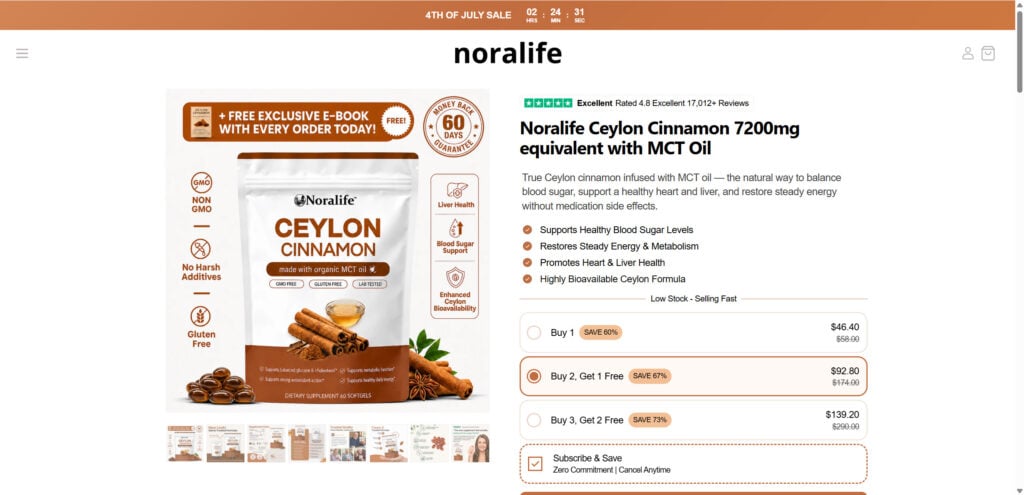
Noralife sells Ceylon Cinnamon 7200mg equivalent with MCT Oil. The page claims the product uses true Ceylon cinnamon infused with MCT oil to “balance blood sugar,” support heart and liver health, and restore steady energy “without medication side effects.” It also claims a 4.8 rating from 17,012+ reviews, a 60-day guarantee, and low stock warnings saying the product “sold out 12 times last year.”
That is a familiar supplement-funnel setup.
The offer is built around a serious health concern — blood sugar — then adds urgency, testimonials, “science-backed” language, and subscription messaging. The issue is not that cinnamon supplements do not exist. The issue is that Noralife appears to market an ordinary Ceylon cinnamon softgel with claims that may make buyers expect medical-level results.
What Noralife Claims
The page says Noralife can support healthy blood sugar, steady energy, metabolism, heart health, liver health, glucose metabolism, fewer sugar cravings, and more stable daily energy. It describes the formula as a 12:1 Ceylon cinnamon extract equivalent to 7,200mg of raw bark, combined with organic MCT oil for absorption.
The product page also includes a testimonial claiming a doctor noticed steadier blood sugar readings after the customer started using Noralife.
That is where the marketing becomes risky.
Blood sugar is not a cosmetic wellness issue. It is tied to diabetes, prediabetes, metabolic syndrome, medication use, diet, weight, cardiovascular risk, and long-term health. A supplement page should not create the impression that a capsule can meaningfully control glucose readings unless the company has strong product-specific evidence.
Major Red Flags
1. The blood sugar claims are too aggressive
Noralife does not simply say “supports wellness.” It directly links the product to blood sugar balance, insulin sensitivity, glucose metabolism, sugar cravings, and energy crashes. The page says cinnamon compounds have been studied for their ability to support insulin sensitivity and healthy glucose metabolism at the cellular level.
That sounds scientific, but ingredient research is not the same as proof that this exact Noralife product will improve blood sugar for typical buyers.
The National Center for Complementary and Integrative Health says research does not clearly support using cinnamon for any health condition and that it is unclear whether cinnamon supplementation helps diabetes or weight loss.
2. “Without medication side effects” is a dangerous framing
The product page says Noralife supports blood sugar and energy “without medication side effects.”
That wording is a red flag because it positions the supplement in contrast with medication. Even if the page does not directly tell people to stop medication, the implication is clear: this is being presented as a gentler alternative.
No one should use a cinnamon supplement as a replacement for diabetes medication, blood pressure medication, cholesterol medication, or medical monitoring.
3. The testimonial implies medical results
The page includes a customer story claiming that blood sugar readings became more predictable and that even a doctor commented on the improvement
Testimonials like this are persuasive because they imply real health outcomes. But testimonials are not clinical proof.
The FTC says health-related product advertising must be truthful, not misleading, and supported by competent and reliable scientific evidence. That applies to direct claims and implied claims created through testimonials.
4. Dietary supplements are not FDA-approved for effectiveness
Noralife is a dietary supplement, not an FDA-approved treatment.
The FDA states that it does not approve dietary supplements for safety and effectiveness before they are marketed, and many supplements can be marketed without even notifying the FDA.
So buyers should not confuse “lab tested,” “science-backed,” “clinically studied ingredients,” or “Ceylon formula” with FDA approval.
5. The product looks like a common private-label formula
Noralife’s formula is not unique. Similar Ceylon cinnamon 7,200mg equivalent softgels with MCT oil are sold by other brands, including Micro Ingredients, which lists the same general format: 12:1 Cinnamomum verum extract, MCT oil, 7,200mg equivalent per serving, and 300 softgels.
There are also China-based OEM/private-label listings for Ceylon cinnamon softgels 7200mg equivalent with MCT oil, with Made-in-China showing supplier pricing around US$2.20–$5.80 per bag at 100-bag minimums, and Alibaba supplier results showing similar OEM products around $1.90–$2.60/unit.
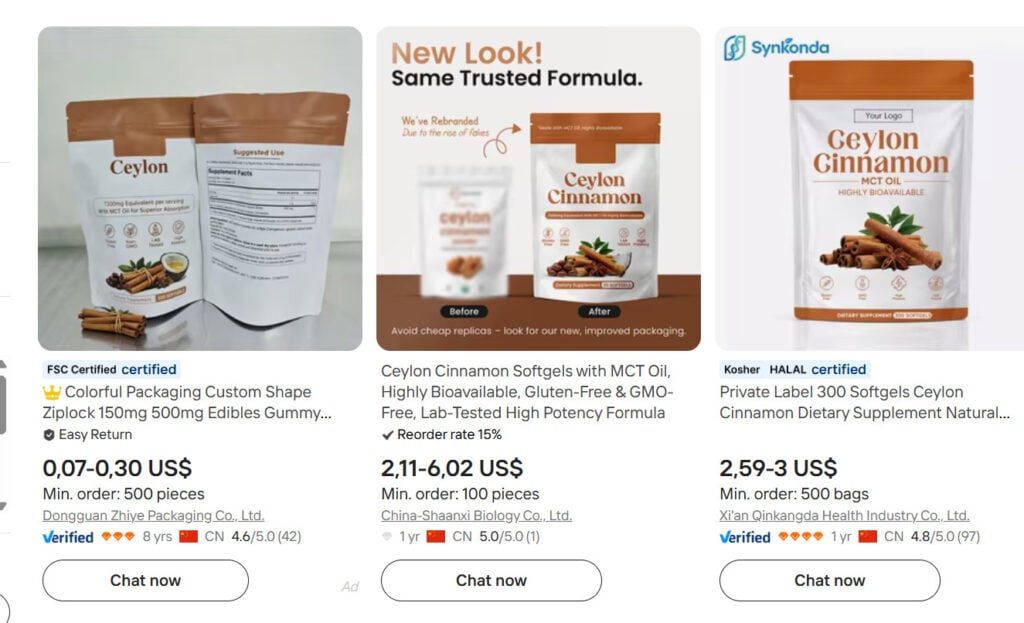
That does not prove Noralife uses a specific supplier. But it does show this formula is easy to source, relabel, and sell under different brand names.
6. The page contains a major copy-paste error
One of the strongest red flags is that the Noralife product page appears to accidentally mention Metabolae in the product copy: “Metabolae delivers a therapeutic-strength extract…”
That is a serious trust issue.
If a Noralife page contains copy from another brand, it suggests the product page may have been built from a reused template. That fits the pattern of rebranded supplement funnels where the same product concept is relaunched under different names.
7. The review count is difficult to verify
Noralife claims 17,012+ reviews and a 4.8 rating.
That sounds impressive, but the reviews appear to be controlled by the seller’s own website. There is no clear independent review platform shown where buyers can verify the review count, filter negative reviews, confirm purchase history, or check whether the testimonials are real.
Large review numbers are common in supplement funnels because they reduce buyer hesitation. They should not be treated as proof.
8. The low-stock warning is classic pressure marketing
The site says the product sold out 12 times last year and urges customers to buy now. It also says subscribing protects buyers against future stockouts
This is classic urgency marketing.
It pushes buyers to order quickly before comparing prices, checking medical evidence, reading subscription terms, or looking at the refund policy.
9. The refund promise conflicts with the actual policy
The sales page says every order has a 60-day money-back guarantee and claims customers can return packs “even if they’re empty” for a full refund.
But the refund policy says products must be in original condition, with original labels and tags, packaging undamaged, and no signs of use. It also says sealed products cannot be returned if the seal is broken, and health products are excluded from return after opening for hygiene reasons.
That is a major contradiction.
If the product can be returned “even if empty,” then opened and used bottles should qualify. But the policy says opened health products may not be returnable. Buyers should assume the stricter written policy may be used if there is a dispute.
10. Returns are not truly risk-free
The refund policy says the customer pays return shipping, must use tracking, and bears the risk if the return is lost. It also says refused deliveries are not eligible for refund and customs or return costs may be deducted.
That makes the guarantee much weaker in practice.
If the product is cheap to manufacture but expensive to return, many buyers may simply give up.
11. Order cancellation terms are inconsistent
The refund policy says order cancellation is “unfortunately not possible” because orders are immediately put into processing.
But the shipping policy says orders can be changed or canceled within 2 hours of placing them.
This kind of inconsistency matters. If a customer accidentally buys too many bottles or selects a subscription, it may be unclear which rule support will enforce.
12. Subscription risk is real
Noralife’s refund policy includes a subscription section. It says subscriptions have a minimum commitment period, recurring monthly deliveries, and a minimum of one billing cycle before cancellation. It also says subscription payments already processed are non-refundable and that all subscriptions automatically renew unless canceled.
The Terms of Service repeats that subscriptions are billed monthly, auto-renew, require cancellation at least 48 hours before the next scheduled renewal, and processed subscription payments are non-refundable.
That is a real recurring-billing risk.
Before buying, check the checkout page carefully for:
- subscribe and save
- monthly delivery
- recurring billing
- auto-renewal
- next billing date
- minimum commitment
- cancellation deadline
13. Contact and site details are inconsistent
The product page footer gives support@trynoralife.com, while the contact page says support@noralife.com and lists a UK phone number.
The shipping and terms pages say Noralife is operated by Ecom Pasa, LLC at a Wyoming address.
The site header also includes social links pointing to huel.com, which appears unrelated to Noralife.
None of this alone proves fraud. But together, these details suggest a hastily assembled or template-based storefront.
What Noralife Probably Is
Noralife appears to be a Ceylon cinnamon + MCT oil softgel supplement sold through a direct-response ecommerce funnel.
The product may contain real cinnamon extract. It may ship. Some people may like it as a general supplement.
But the marketing makes it look like a powerful metabolic support product that can help blood sugar, energy, cravings, and glucose stability. That is a much stronger claim than the evidence shown on the page can support.
What It May Realistically Do
A cinnamon supplement may provide:
- a daily cinnamon extract serving
- mild antioxidant support
- a simple supplement routine
- possible subjective energy or craving changes for some users
But buyers should not assume it will:
- control blood sugar
- reverse insulin resistance
- replace diabetes medication
- prevent glucose spikes
- lower A1C
- treat diabetes or prediabetes
- restore metabolism
- produce doctor-noticed changes
Is Noralife Ceylon Cinnamon a Scam?
Noralife is not clearly a “nothing ships” scam. Buyers may receive softgels.
The concern is the sales model.
Noralife appears to sell a common Ceylon cinnamon + MCT oil formula through aggressive blood sugar marketing, large review claims, low-stock pressure, subscription mechanics, and refund language that conflicts with the actual return policy.
The most accurate verdict is:
Noralife Ceylon Cinnamon looks like a high-risk private-label supplement funnel promoted with exaggerated metabolic and blood sugar claims.
Should You Buy Noralife?
For most buyers, caution is warranted.
Reasons to be careful:
- Cinnamon is not a proven treatment for diabetes or blood sugar problems.
- The product page uses strong blood sugar language.
- The testimonial implies medical results.
- Similar 7200mg Ceylon cinnamon + MCT oil products are widely available.
- The page contains a copy-paste brand error referencing Metabolae.
- The review count is not independently verified.
- The refund promise conflicts with the return policy.
- Subscriptions auto-renew and processed subscription payments are non-refundable.
Do not use Noralife as a substitute for medical care, glucose monitoring, diabetes medication, blood pressure medication, cholesterol medication, or dietary changes recommended by a clinician.
What To Do If You Already Ordered
1. Check whether you selected a subscription
Look for words like subscription, auto-renew, monthly delivery, recurring charge, next billing date, or subscribe and save.
If you did not intend recurring billing, email support immediately and request written confirmation that all future charges and shipments are canceled.
2. Check your order quantity
Review the confirmation email and bank charge. Confirm whether you bought one bottle, a bundle, a subscription, or any upsell.
3. Save screenshots
Capture the product claims, review count, low-stock warning, “sold out 12 times” claim, 60-day guarantee, “even if empty” refund wording, refund policy, subscription policy, and checkout total.
4. Do not stop medication
Do not reduce or stop diabetes medication, blood pressure medication, blood thinners, cholesterol medication, or any prescribed treatment because of this supplement.
5. Request a refund in writing
Use a clear message:
I am requesting a refund for order #[number]. The product does not match the expectations created by the sales page. Please confirm refund eligibility, return requirements, return address, and refund timeline in writing.
6. Watch for repeat charges
Monitor your statement for monthly charges. If a subscription renews after you requested cancellation, contact your bank or payment provider quickly.
FAQ About Noralife Ceylon Cinnamon
Is Noralife Ceylon Cinnamon a scam?
It may not be a fake-product scam where nothing ships. The product may arrive. The concern is the marketing: blood sugar claims, large review numbers, reused copy, subscription risk, and refund contradictions.
Does cinnamon really lower blood sugar?
The evidence is mixed. NCCIH says research does not clearly support cinnamon for any health condition and that it is unclear whether cinnamon supplementation helps diabetes or weight loss.
Is Noralife FDA approved?
No dietary supplement should be assumed to be FDA approved. The FDA says it does not approve dietary supplements for safety and effectiveness before marketing.
Is there a subscription risk?
Yes. Noralife’s policies say subscriptions auto-renew monthly, must be canceled at least 48 hours before renewal, and already processed subscription payments are non-refundable.
Are refunds easy?
Not necessarily. The sales page says packs can be returned even if empty, but the refund policy says items must show no signs of use and opened health products may not be returnable.
Why is the Metabolae wording important?
Because the Noralife page appears to contain copy that says “Metabolae delivers…” on a Noralife product page. That suggests reused sales-page copy and raises doubts about how original or carefully reviewed the store is.
The Bottom Line
Noralife Ceylon Cinnamon is not clearly a “nothing arrives” scam. It may ship a real cinnamon softgel product.
But the sales operation raises multiple concerns.
The product is marketed with strong blood sugar, insulin sensitivity, metabolism, energy, heart, and liver claims. The page uses large review numbers, low-stock pressure, a doctor-style testimonial, and subscription prompts. The refund policy conflicts with the “even if empty” guarantee, and the product page appears to contain a copy-paste error from another brand.
The safest conclusion is simple:
Noralife Ceylon Cinnamon looks like a high-risk supplement funnel selling a common Ceylon cinnamon + MCT oil softgel formula through exaggerated blood sugar marketing and buyer-unfriendly subscription/refund terms.









Stop any orders. i contacted my card to stop you.
Just so you know, Henrietta, you are writing on an independent review site – we are not Noralife, we have never taken a payment from you, and there is nothing here for us to stop. Contacting your card was exactly the right move though. Ask them specifically to block future recurring payments from that merchant rather than only cancelling the card, because these charges sometimes reappear under a slightly different trading name. If money has already gone out, ask to dispute those charges at the same time.
As a type 2 diabetic, it popped on my Facebook, I was skeptical at first, but this article just confirms it. I was hopeful and thats how they target you. Who doesn’t want a cure for diabetes, am I right?
You’ve put your finger on the mechanism: they target hope, and a type 2 diagnosis makes the promise of a cure very hard to scroll past. That’s not gullibility, it’s how the advert is engineered. The tell with all of them is that no supplement can claim to treat or reverse diabetes without being an unapproved drug claim – so the moment an ad says reverse, cure or replace your medication, the legal status of the claim answers the question for you. Glad the article confirmed your instinct, and please keep any changes to your treatment between you and your own doctor rather than an advert.