

GFOUK VeinTarget is marketed as a microneedle patch for varicose veins and chronic venous insufficiency. The sales page presents it as a breakthrough home treatment that can reduce visible veins, improve circulation, relieve pain and swelling, and help users avoid costly medical procedures.
The product itself appears to be a patch-style leg-care item. The problem is the marketing. The claims are extremely aggressive, the site has serious trust issues, and similar vein microneedle patches appear to be sold as cheap generic products across wholesale and marketplace sites.
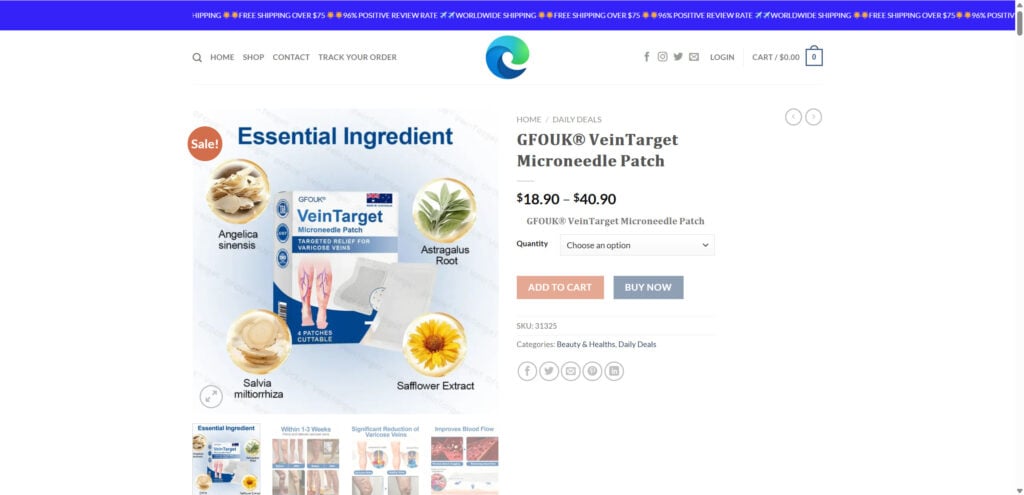
Overview
The GFOUK page sells the product for $18.90–$40.90, with options for 1, 2, or 4 pieces. The product title on the page appears strangely incomplete as just “®”, while the description calls it GFOUK VeinTarget and claims it is an “Advanced Transdermal Delivery System for Chronic Venous Insufficiency Treatment.”
The page claims GFOUK VeinTarget is a TGA-registered, GMP-certified Alpine herbal microneedle patch with a 96% success rate, a 15,000-person clinical trial, visible vein reduction in 7–14 days, and more than 150,000 satisfied customers. It also claims users “eliminated their varicose veins” and that 99% would recommend it.
Those are medical-level claims.
A patch sold on a generic ecommerce site should not be trusted as a treatment for chronic venous insufficiency, varicose veins, valve dysfunction, thrombosis risk, or circulation problems without clear regulatory proof, clinical evidence, and medical oversight.
What GFOUK Claims
According to the sales page, GFOUK VeinTarget supposedly:
- Treats chronic venous insufficiency at home
- Reduces visible varicose veins in 7–14 days
- Relieves pain, swelling, heaviness, and leg fatigue
- Penetrates 100x deeper than topical creams
- Uses microneedles to deliver botanical compounds into venous structures
- Repairs vascular function
- Restores venous valve competency
- Improves circulation
- Helps users avoid surgery or expensive procedures
- Has a 96% success rate in a 15,000-person clinical study
This is not normal cosmetic wording. The site is presenting the product like a medical treatment.
Major Red Flags
1. The claims are medically unrealistic
Varicose veins happen when vein valves do not work properly, causing blood to pool and the vein to swell or twist. The NHS explains that varicose veins are caused by valves that fail to control blood flow correctly.
GFOUK claims its patch can address venous valve dysfunction, restore valve competency, and naturally regress varicosities through botanical microneedle delivery.
That is a huge claim.
A stick-on herbal patch is not the same as a medically evaluated treatment for venous reflux, damaged valves, or chronic venous insufficiency.
2. Real varicose vein treatment usually requires medical evaluation
Mayo Clinic says diagnosis may involve a physical exam and a venous Doppler ultrasound to check blood flow through vein valves and help find blood clots. Treatment may include self-care, compression stockings, sclerotherapy, laser treatment, catheter-based procedures, or surgery depending on severity.
The NHS similarly lists specialist assessment, duplex ultrasound, endothermal ablation, foam sclerotherapy, surgery, and compression stockings as treatment options.
That does not match the idea that a low-cost online patch can “treat chronic venous insufficiency” at home in 7–14 days.
3. The “96% success rate” is not credible as presented
The page claims a clinical trial with 15,000 participants and says results included a 92% reduction in visible varicose veins and leg fatigue within 14 days, plus rapid relief from pain, swelling, and heaviness within 7 days.
A 15,000-person clinical trial would be major evidence. If real, it should be easy to verify.
The page does not clearly show:
- study title
- clinical trial registration number
- research institution
- ethics approval
- investigators
- publication
- control group
- placebo comparison
- trial duration
- ultrasound-based outcomes
- adverse event data
Without that, the “clinical trial” claim should be treated as marketing, not proof.
4. The TGA claim needs verification
The site calls the patch TGA-registered.
The TGA says the Australian Register of Therapeutic Goods is the public reference database for therapeutic goods that can be supplied in Australia, and users can search it by product name, sponsor, ingredient, or ARTG identifier.
If GFOUK VeinTarget is truly TGA-registered, the seller should clearly provide the ARTG number, sponsor name, product classification, and public register entry.
The page does not make that easy to verify.
5. The site claims thousands of happy users, but the product page says “Reviews (0)”
This is one of the biggest contradictions.
The sales copy says 150,000+ satisfied customers, 99% recommendation, and a 96% positive review rate. But the actual WooCommerce review tab on the same product page says “Reviews (0)” and “There are no reviews yet.”
That is a serious trust problem.
A page cannot credibly claim massive customer success while its own product review system shows zero reviews.
6. The contact page still contains placeholder text
The GFOUK contact page has FAQ sections filled with Lorem ipsum placeholder text. That means the page was not properly finished before being used as a live customer-facing support page. (Gfouk)
For a site selling a product with medical-style claims, this is a major red flag.
A serious health-related company should not have unfinished template text on its contact page.
7. The About page says “Bagdagul,” not GFOUK
The About page says “Welcome to Bagdagul” and repeatedly describes “Bagdagul” as an 8-year-old online shopping company. It does not clearly explain why a GFOUK site is using Bagdagul branding.
That suggests the store may be built from reused ecommerce templates or copied content.
Brand mismatch is common in low-trust dropshipping operations.
8. The product appears to be a cheap generic patch category
Similar “VeinTarget” and varicose vein microneedle patches appear across multiple marketplaces and supplier sites. Alibaba search results show “VeinTarget Microneedle Patch” products and herbal varicose vein microneedle patches with wholesale pricing around $1–$3 per unit/box depending on supplier and order quantity.
Other listings show similar vein patches sold on Amazon, Fruugo, and eBay-style marketplaces. One Amazon listing for a similar vein target microneedle patch lists the country of origin as China, while a Fruugo listing for a similar vein patch says it ships from China.
That does not prove every GFOUK patch comes from the exact same supplier. But it strongly suggests the product concept is generic, rebranded, and widely resold.
9. The same style of page appears under other store names
Search results show the same GFOUK VeinTarget-style copy appearing on another site, with nearly identical claims about “GMP-certified Alpine herbal microneedle patch,” a 96% success rate, visible vein reduction in 7–14 days, and 150,000+ users.
That is a classic rebrand pattern.
When the same “breakthrough” product appears on multiple unrelated stores with the same copy, it becomes harder to believe the product is a unique medical innovation.
10. The return policy is weak
The GFOUK footer says the site offers a 30-day return policy, but customers are responsible for return shipping fees.
That matters because many buyers may order after seeing aggressive medical claims, then realize the product is just a cheap patch. If return shipping costs more than the refund value, the guarantee becomes almost useless.
What GFOUK VeinTarget Probably Is
GFOUK VeinTarget appears to be a generic leg-care or varicose vein patch being marketed as a medical-style microneedle treatment.
It may contain botanical ingredients. It may have small projections or a patch texture. It may create a temporary cooling, warming, or soothing sensation.
But that is very different from treating chronic venous insufficiency or eliminating varicose veins.
A realistic expectation would be:
- temporary comfort
- mild skin sensation
- a feeling of leg freshness
- possible cosmetic placebo effect
- no meaningful medical correction of vein valve failure
The claims about vascular repair, valve restoration, deep venous delivery, 96% success, and visible vein reduction in 7–14 days are the problem.
Why the Medical Claims Are Dangerous
Varicose veins are not always just cosmetic. The NHS notes they can sometimes lead to complications such as bleeding, varicose eczema, venous leg ulcers, superficial thrombosis, or deep vein thrombosis.
A person with painful, swollen, worsening, or one-sided leg symptoms should not rely on a patch from a viral ad.
Warning signs that need medical advice include:
- sudden swelling in one leg
- severe leg pain
- redness or warmth
- skin ulcers
- bleeding from a vein
- hard painful veins
- shortness of breath
- chest pain
- worsening swelling or heaviness
- skin color changes around the ankle
A patch cannot rule out a clot, vascular disease, or chronic venous insufficiency.
How This Funnel Works
Step 1: Target people with visible veins and leg pain
The page speaks directly to people embarrassed by varicose veins or frustrated by pain, swelling, and heaviness.
Step 2: Present surgery as expensive and scary
The copy compares the patch to costly procedures and suggests users can avoid medical treatments by using GFOUK at home.
Step 3: Use scientific-sounding language
The page uses terms like:
- pathophysiological mechanisms
- venous valvular insufficiency
- endothelial function
- inflammatory mediators
- collagen synthesis
- hemodynamic restoration
- transdermal barrier disruption
This makes the product sound more medically advanced than a normal patch.
Step 4: Add unverifiable “clinical” proof
The page claims a 15,000-person clinical study and 96% success rate but does not provide transparent study documentation.
Step 5: Use testimonials with dramatic outcomes
The testimonials describe nurses, retirees, and teachers seeing major improvements, avoiding surgery, walking again, and wearing shorts after years of embarrassment.
These stories are emotionally persuasive, but they are not clinical evidence.
Step 6: Sell a cheap generic product at a markup
Similar vein microneedle patches appear in wholesale and marketplace listings at much lower prices, including Alibaba supplier listings and marketplace products shipped from China.
That is the typical dropshipping-style structure.
Is GFOUK VeinTarget a Scam?
GFOUK VeinTarget is not necessarily a “nothing ships” scam. Buyers may receive a physical patch.
The issue is the marketing.
The product is presented as if it can treat chronic venous insufficiency, reduce visible varicose veins in days, restore valve function, and replace costly medical procedures. The site also has unfinished template text, inconsistent branding, zero product reviews despite massive customer claims, and weak refund protection.
The most accurate verdict is:
GFOUK VeinTarget appears to be a high-risk generic vein patch sold through exaggerated medical claims and low-trust ecommerce tactics.
Should You Buy GFOUK VeinTarget?
For most people, caution is warranted.
Reasons to avoid it:
- The claims are too strong for a patch.
- Chronic venous insufficiency is a real medical condition.
- The “clinical trial” claim is not transparently verified.
- The TGA registration claim is not clearly backed with an ARTG number.
- The site has zero product reviews despite claiming 150,000+ users.
- The contact page contains placeholder text.
- The About page references another brand, Bagdagul.
- Similar patches appear as cheap generic products online.
- Return shipping is the customer’s responsibility.
If you only want a cheap leg-care patch, similar generic products appear to be available elsewhere. But do not buy GFOUK expecting it to treat varicose veins.
What To Do If You Already Ordered
1. Save screenshots immediately
Capture:
- 96% success rate claim
- TGA-registered claim
- 15,000-person clinical trial claim
- 7–14 day visible vein reduction claim
- 150,000+ satisfied customers claim
- product price
- return policy
- “Reviews (0)” section
- contact page placeholder text
- order confirmation
These may help if you need to dispute the purchase.
2. Check what actually arrives
Inspect the package for:
- country of origin
- manufacturer name
- ingredient list
- medical device registration
- ARTG number
- batch number
- expiry date
- safety warnings
- instructions
- return address
If the packaging does not match the medical claims, document it with photos.
3. Do not rely on it for symptoms
Do not use this product instead of medical care if you have pain, swelling, ulcers, bleeding veins, skin discoloration, or sudden one-sided leg swelling.
4. Request a refund in writing
Use a clear message:
I am requesting a refund for order #[number]. The product was advertised with medical-style claims that are not properly substantiated. Please provide the return address, refund requirements, and refund timeline in writing.
Keep every reply.
5. Watch the return cost
The site says customers are responsible for return shipping fees.
If return shipping is expensive or international, document that before sending anything back.
6. Dispute if necessary
Contact your bank or payment provider if:
- the product never arrives
- the item is not as advertised
- the seller refuses to honor the refund policy
- the return process is impossible
- the product lacks the claimed registration or medical documentation
- you were charged more than expected
Use evidence showing the claims, the product received, and your communication with support.
FAQ About GFOUK VeinTarget
Is GFOUK VeinTarget a scam?
It may not be a fake-product scam where nothing ships. The concern is that it appears to be a generic vein patch sold with exaggerated medical claims, weak transparency, and questionable proof.
Can GFOUK VeinTarget treat varicose veins?
There is no reliable evidence on the sales page proving that this patch can treat varicose veins or chronic venous insufficiency. Real treatments may involve compression, ultrasound evaluation, sclerotherapy, laser procedures, catheter-based procedures, or surgery
Is it really TGA registered?
The page claims it is TGA-registered, but it does not clearly provide an ARTG number or public registration record. The TGA says the ARTG is the public register used to search therapeutic goods in Australia.
Why is “Reviews (0)” important?
Because the same product page claims 150,000+ satisfied users and a 99% recommendation rate while the actual review tab says there are no reviews yet.
Is this product from China?
Similar vein microneedle patches appear in Alibaba, Amazon, Fruugo, and marketplace listings, with some comparable products showing China origin or shipping from China.
Are refunds easy?
Not necessarily. The site mentions a 30-day return policy, but customers pay return shipping.
The Bottom Line
GFOUK VeinTarget is marketed like a medical breakthrough for varicose veins and chronic venous insufficiency. The site claims TGA registration, GMP certification, a 96% success rate, a 15,000-person clinical study, and visible vein reduction in 7–14 days.
But the evidence shown on the page does not support those claims in a credible way. The site has zero product reviews despite claiming 150,000+ users, placeholder text on the contact page, an About page referring to another brand, and similar vein microneedle patches appear across cheap wholesale and marketplace listings.
GFOUK VeinTarget looks like a high-risk generic varicose vein patch sold through exaggerated medical claims. Treat it as a low-cost leg-care patch at best, not a proven treatment for varicose veins, chronic venous insufficiency, or circulation problems.

Join the discussion
0 commentsShare your experience or ask a question about this article.
Discussion
Start the conversation
Have a question or something useful to share? Add the first comment.