

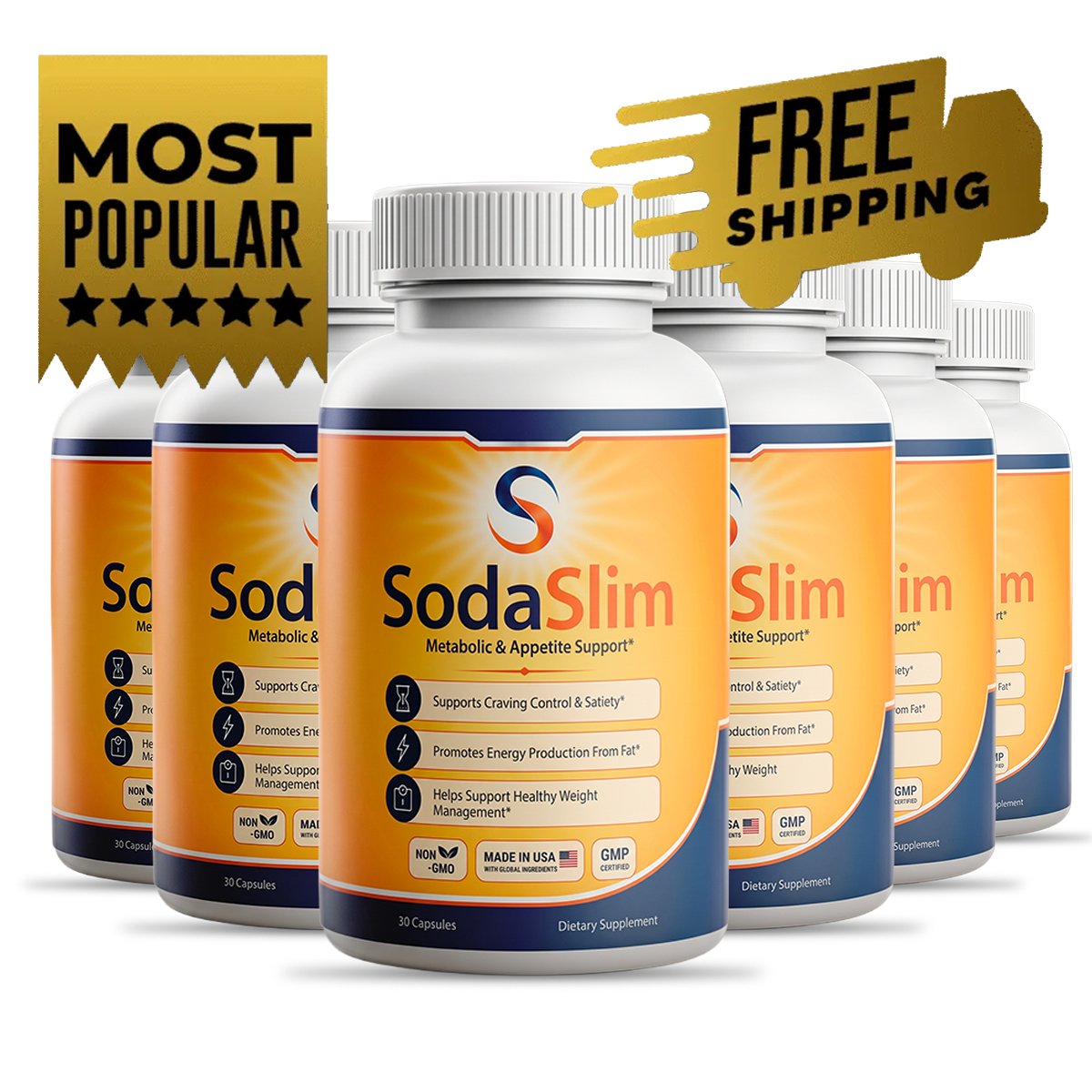
SodaSlim is promoted as a simple daily capsule that can quiet hunger, accelerate metabolism and help the body burn stubborn fat. The sales page wraps those promises in familiar weight-loss language: natural ingredients, a U.S. facility, a 60-day guarantee and a steep discount when buyers order several bottles.
The closer we looked, the less coherent the offer became. Multiple websites present themselves as the official SodaSlim source, yet their ingredient descriptions, refund conditions and even whether the formula contains stimulants do not consistently agree.
The main sales site also makes sweeping claims about gut bacteria, calorie burning and visible weight loss without presenting a rigorous clinical trial on the finished SodaSlim formula. The individual ingredients are known, but the best available evidence does not support the effortless transformation implied by the advertising.
Our verdict: avoid SodaSlim. This is a generic stimulant-based weight-loss formula sold through a maze of official-looking sites, contradictory claims and bulk-order pressure. Even if the bottles arrive, the promised fat-burning system is not proven and the inconsistent guarantee is not trustworthy enough to justify the risk.
Overview
SodaSlim is a capsule supplement marketed for metabolism, appetite control, energy and weight management. The most detailed sales pages list caffeine anhydrous, green coffee bean extract, raspberry ketone, garcinia extract and green tea extract.
Prices are structured to push volume. The current sales page offers two, three and six-bottle packages, with the largest package shown at $49 per bottle and the smallest at $79 per bottle. A countdown, “while supplies last” language and large claimed savings encourage the buyer to choose the six-bottle option.
Nothing we found explains why this familiar blend should command a premium price or produce exceptional results. The real sales engine is the funnel: a dramatic health story, an apparent deadline and a steep per-bottle discount that makes six bottles feel safer than one. That structure transfers most of the risk to the buyer before the first capsule is tried.
The core promises
- Support a faster or better-functioning metabolism.
- Reduce appetite and constant cravings.
- Convert stored fat into usable energy.
- Improve daily energy and focus.
- Promote meaningful weight loss when used consistently.
- Provide a risk-free experience through a 60-day guarantee.
Some newer pages soften the language by saying SodaSlim is not a shortcut and must be combined with diet and exercise. Other pages use much stronger statements, including that it attacks harmful bacteria, activates fat burning and produces a visible reduction in measurements.
That contradiction matters. A supplement cannot be presented as gentle “wellness support” in one place and as a direct fat-burning solution in another, then expect buyers to know which promise is real.
Why the SodaSlim Website Situation Is Confusing
We found several nearly identical domains presenting SodaSlim as an official product. These include sodaslim.com, sodaaslim.com, sodasslim.com and us-soda-slim.com. Some appear to be affiliate or promotional copies rather than the central seller, but that distinction is not clear to an ordinary shopper.
The ingredient story changes
One version openly lists caffeine anhydrous and green tea extract, both of which can contribute stimulant exposure. Another page describes the product as stimulant-free. Those statements cannot both accurately describe the same formula.
A buyer with caffeine sensitivity, anxiety, high blood pressure, sleep problems or medication concerns needs an exact label, not several sites giving conflicting summaries.
The guarantee story also changes
Across the sales material, the 60-day guarantee is described in several ways. Some language measures the window from purchase, some from delivery, and some says the buyer must use the product for at least 30 days before asking for a refund. Other passages call the guarantee unconditional or “no questions asked.”
Even the same promotional ecosystem can alternate between a generous headline and narrower conditions. That creates a predictable dispute when a customer relies on the large promise rather than the version support later decides to enforce.
The business identity is not prominent enough
The main sales page provides a generic support address at customercs.com rather than a clearly branded corporate contact. The page contains polished testimonials and manufacturing badges, but the legal seller, physical business address and party responsible for fulfillment are not given the same prominence as the marketing claims.
That imbalance does not prove the company is fake. It does make accountability harder if an order, refund or adverse reaction becomes a problem.
How the SodaSlim Sales Funnel Works
Step 1: The ad turns normal weight-loss difficulty into a hidden metabolic problem
The marketing suggests that stubborn fat, hunger or a slow metabolism is being driven by a biological obstacle that ordinary diet efforts miss. Some versions blame harmful gut bacteria and promise that SodaSlim targets the cause.
This gives the product a more exciting role than a caffeinated supplement. It also encourages buyers to believe a capsule can solve a complex issue without a proper medical or nutritional assessment.
Step 2: Familiar ingredients are described in their most optimistic form
Caffeine is connected to calorie burning, green coffee to carbohydrate absorption, raspberry ketone to fat-cell breakdown, garcinia to appetite control and green tea to thermogenesis.
Those summaries leave out the most important question: how large and reliable are the effects in real people? Ingredient studies are often small, mixed or conducted with doses and preparations that do not match a commercial blend.
Step 3: The formula is presented as stronger than the evidence
The seller combines several individually marketable ingredients and treats the bundle as a coordinated metabolic system. Yet the finished SodaSlim formula has not been shown in a transparent, independent, controlled trial to produce the advertised weight loss.
A list of researched ingredients is not a clinical trial on the bottle being sold.
Step 4: A high anchor price makes the bundle look irresistible
The site shows a supposed regular price of $119 per bottle, then reduces the per-bottle price when the customer buys more. The six-bottle package displays $420 in claimed savings.
This is a classic direct-response tactic. The buyer stops asking whether the product is worth $49 and starts thinking about how much they are “saving” compared with a $119 anchor that they may never have seriously considered paying.
Step 5: Urgency pushes the buyer past the fine print
A countdown timer, limited-supply warning, free bonuses and prominent checkout buttons create momentum. The timer can make a person feel that reading every policy risks losing the discount.
Weight-loss products should invite careful comparison, especially when they contain stimulants. Pressure is the opposite of informed consent.
Step 6: The refund depends on which terms are applied
If the customer is disappointed, the guarantee becomes the central issue. A 60-day window that also requires 30 days of use gives the buyer a relatively narrow period to evaluate the product, contact support, obtain instructions and complete any required return.
Conflicting language across pages gives the seller room to point to the stricter version while the buyer points to the larger promise shown at checkout.
What the Ingredients Can and Cannot Do
Caffeine anhydrous
Caffeine can temporarily improve alertness and may modestly increase energy expenditure. It does not selectively melt fat, and regular users can develop tolerance. It can also cause jitteriness, anxiety, rapid heartbeat or disrupted sleep, particularly when combined with coffee, energy drinks or other stimulants.
Green tea and green coffee extracts
These ingredients have been studied for weight management, but the average effects are generally small and inconsistent. Extracts can also be more concentrated than a normal beverage, so “plant based” does not mean free of side effects.
Garcinia cambogia
The National Institutes of Health consumer guidance describes garcinia as having little to no effect on weight loss. That is very different from the decisive appetite and fat-production language used by many supplement marketers.
Raspberry ketone
Raspberry ketone became popular through laboratory and animal research, but convincing human evidence for meaningful weight loss is lacking. The attractive ingredient name does more work in the sales story than it does in established clinical practice.
The combined formula
Even if one ingredient has a modest effect, the company must still establish that its specific doses, quality and combination are effective and safe. SodaSlim does not provide the level of product-specific evidence required to support its strongest claims.
“FDA-Registered Facility” Does Not Mean FDA-Approved
Supplement pages frequently display an FDA-style badge or say the product is made in an FDA-registered facility. The FDA does not approve dietary supplements for safety and effectiveness before they are sold, and it does not approve facilities simply because they are registered.
A GMP or registered-facility statement may describe a manufacturing process. It does not prove that the label is accurate, that every batch was independently tested or that the supplement causes weight loss.
For stronger assurance, buyers should look for a batch-specific certificate of analysis and credible independent verification. SodaSlim’s marketing does not make that level of documentation easy to find.
Red Flags We Found
- Several “official” domains: shoppers can easily land on different versions of the product story.
- Stimulant contradiction: some pages list caffeine while another describes the formula as stimulant-free.
- Conflicting refund terms: purchase date, delivery date, minimum-use requirements and unconditional language do not align.
- No finished-product trial: ingredient references are used in place of direct proof.
- Aggressive biological claims: some pages say the product attacks harmful bacteria and activates fat burning.
- Large price anchoring: the claimed regular price makes a six-bottle commitment look like a bargain.
- Artificial urgency: countdowns and supply warnings discourage careful review.
- Weak seller transparency: support details are more visible than a clear accountable corporate identity.
Is SodaSlim a Scam or Legit?
SodaSlim appears to be a real supplement offer, not a simple page that exists only to steal a card number. A customer may receive bottles containing the ingredients shown on the label.
That narrow form of legitimacy does not rescue the offer. The scientific case is weak, the marketing is more confident than the evidence, the refund language conflicts and the network of official-looking websites creates unnecessary confusion about what is actually being purchased.
We recommend avoiding SodaSlim. If weight management is the goal, a product with small and uncertain ingredient effects is not worth the financial, stimulant and refund risk created by this funnel.
What to Do If You Already Ordered SodaSlim
1. Save the exact page you purchased from
Record the domain, order page, guarantee wording, ingredient list and checkout total. Do not rely on another SodaSlim website because its terms may be different.
2. Identify the actual seller on the receipt
Check the card descriptor, confirmation email and fulfillment notice. Note the legal name, support address and any third-party checkout provider. These details matter if you need to dispute the transaction.
3. Ask for the refund conditions immediately
Request the deadline, return address, bottle-condition rules and refundable amount in writing. If the site required 30 days of use, confirm how that rule fits within the 60-day window.
4. Do not consume the product if the label is unclear
If your bottle’s ingredients or caffeine content differ from the page you saw, pause and ask a pharmacist or healthcare professional. Do not combine an unknown stimulant formula with other weight-loss products.
5. Document any side effect
Stop using the supplement and seek medical advice for a concerning reaction. Keep the bottle, lot number, label and receipt. Serious supplement reactions can also be reported through the FDA’s safety reporting process.
6. Escalate an unresolved billing or refund problem
If the seller does not honor the written terms, contact the payment provider promptly. Provide the sales page, guarantee, messages, tracking and any proof of return. Describe the problem accurately rather than simply calling the entire transaction fraudulent.
How to Evaluate Weight-Loss Supplements More Safely
- Compare the exact label with independent guidance on each ingredient.
- Add up caffeine from supplements, coffee, tea and energy drinks.
- Reject “effortless,” “rapid” or highly specific fat-burning promises without a finished-product trial.
- Prefer one bottle over a six-month commitment when evidence is uncertain.
- Verify the seller, physical address and return process before paying.
- Discuss weight-loss supplements with a healthcare professional if you take medication or have a medical condition.
The Bottom Line
SodaSlim combines a familiar stimulant-based formula with a polished story about metabolism, appetite and fat burning. The product’s web presence then makes a basic buying decision unnecessarily difficult by offering several official-looking sites, conflicting formula descriptions and inconsistent guarantees.
There is no convincing evidence that the finished formula delivers the dramatic results promoted by its strongest pages. The safest conclusion is not to gamble on a large bundle and hope the refund works later. Skip SodaSlim and choose an evidence-based weight-management plan whose benefits, risks and costs are clear from the beginning.








