

Navaro Collagen Peptide Lifting Ampoule is promoted as a “surgery-free facelift” that can tighten loose skin and erase years from the face. The polished ads look clinical, but the store’s evidence, company details and copied policy pages tell a very different story.
This appears to be a high-risk dropshipping-style beauty funnel: an inexpensive generic-looking serum is sold at a premium with dramatic before-and-after images, permanent discounts and claims that go far beyond what a topical collagen product can prove.
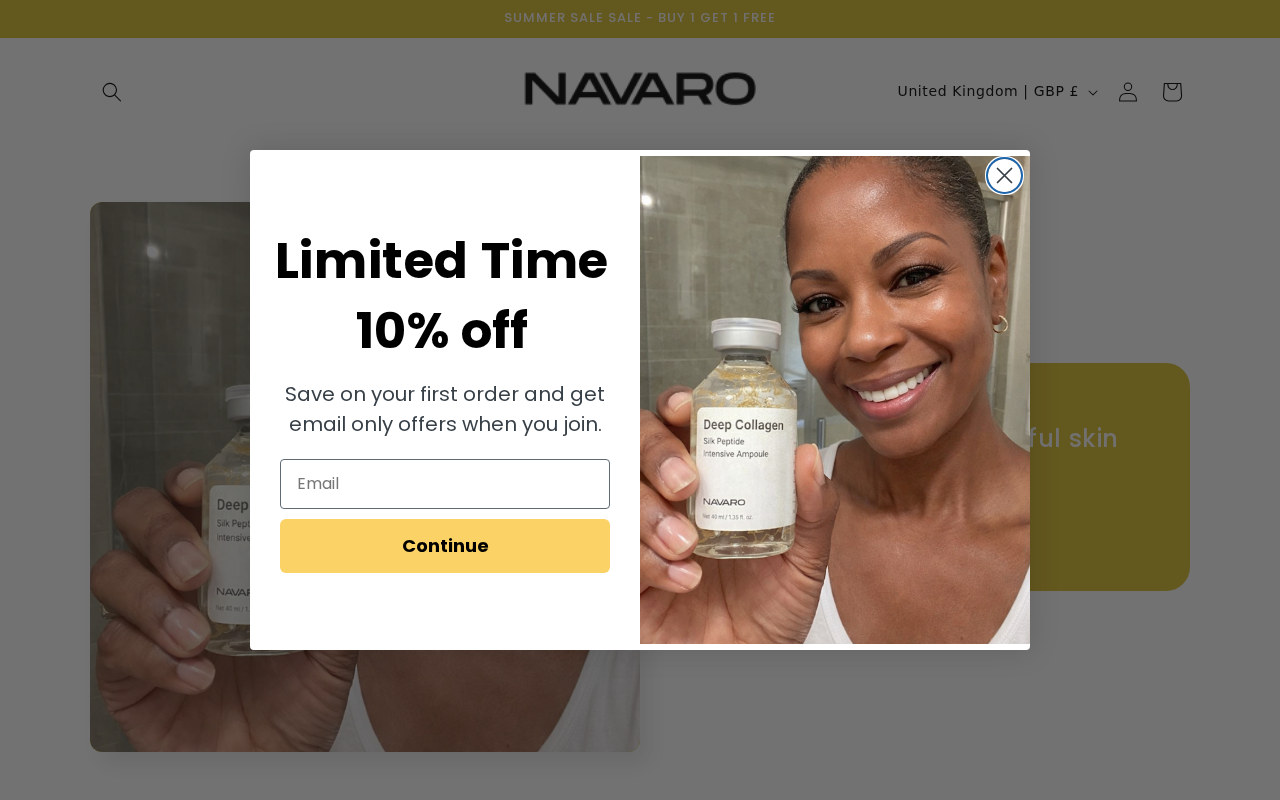
Navaro Collagen Scam Overview
Navaro sells a topical collagen and peptide ampoule through TryNavaro.com. The product page promises visible lifting, firmer skin and a younger appearance, sometimes presenting the formula as an alternative to injections or surgery.
The store may ship a bottle. That is not the same as receiving the revolutionary treatment shown in the ads. Near-identical collagen ampoules are available from wholesale suppliers for around $1, while Navaro is marketed for roughly $30–$40. Large markups are common in beauty retail, but here the premium is supported mainly by aggressive claims rather than transparent manufacturing or strong finished-product testing.
The website also contains basic credibility failures. One return page thanks customers for choosing “Vora,” not Navaro. The terms contain an unremoved Shopify instruction telling the merchant to add its return policy. Different policy pages appear to describe different remedies, and the shipping terms warn that customers may be responsible for customs duties and import taxes.
The brand promotes itself as Black-owned, while a recent U.S. trademark application for NAVARO COLLAGEN lists an individual applicant, Qian Xu, at an address in Mong Kok, Hong Kong. A trademark filing does not by itself prove who manufactures or manages every part of a brand, but the mismatch deserves a clear public explanation that the sales page does not provide.
Why we consider Navaro high risk
- The “facelift” promise is not supported by credible finished-product trials. Topical collagen can moisturize the surface; it does not replace surgery or Botox.
- Generic-looking ampoules sell for a fraction of the retail price. Customers may be paying mainly for ads, branding and fulfillment layers.
- The site contains copied and unfinished legal text. “Vora” and the Shopify merchant note are quality-control failures on pages that govern refunds.
- Policies are inconsistent. One page emphasizes replacement for defects while another promotes a 60-day return process subject to approval.
- The business identity is not transparent enough. Brand-story claims and public trademark information do not align cleanly.
- Advertorials use fear and authority tactics. Claims that plastic surgeons want the product restricted are sensational marketing, not medical evidence.
What Navaro Claims
Navaro describes its Deep Collagen Lifting Ampoule as a fast, non-invasive way to smooth wrinkles, firm sagging areas and restore youthful contours. Promotional material cites precise percentages and short timelines, including visible changes in about 21 days.
Some advertorials describe the serum as a threat to expensive cosmetic procedures and imply that professionals want to suppress it. This “secret they do not want you to know” framing is a classic sales tactic. It turns the absence of mainstream medical acceptance into supposed proof that the product is disruptive.
The Biggest Navaro Collagen Red Flags
Topical collagen cannot perform a surgical facelift
Collagen molecules applied to the skin primarily act as moisturizers and film-forming ingredients. Hydrated skin can temporarily look smoother and plumper, but that cosmetic effect is not the same as rebuilding deep structural collagen, repositioning tissue or producing a surgical lift.
Peptides and other skincare ingredients may have useful roles, but the seller must show that the complete formula, concentration and delivery system produced the advertised result in a well-designed trial. Precise percentages on an advertorial are not meaningful without a study protocol, participant data and independent publication.
The before-and-after presentation is unreliable
Beauty transformations can be created with lighting, facial expression, focal length, makeup, filters and retouching. Navaro’s own advertorial disclosure says models are used. That means the people shown should not be assumed to be verified customers demonstrating typical results.
The wholesale price gap is enormous
Online wholesale listings show similar collagen and peptide ampoules for roughly $1 per unit. We cannot confirm that every listing contains the identical formula, but the visual and marketing similarities are enough to question whether Navaro is a proprietary breakthrough or a private-label product with a very large advertising markup.
The refund pages contain copied text
A return policy that ends with “Thank you for choosing Vora” was clearly not written carefully for Navaro. The terms also retain a Shopify template instruction addressed to the merchant. These are not minor cosmetic mistakes when the same pages decide whether a customer can recover money.
The remedies do not read consistently
One policy emphasizes replacement rather than refund for defective products, while another describes a 60-day return subject to approval. Customers should not have to reconcile conflicting pages after a problem occurs. The seller should publish one clear policy covering opened products, dissatisfaction, defects and return postage.
The ownership story needs clarification
The “Black-owned” branding and Hong Kong trademark-applicant information may have an explanation, such as a business partner, filing agent or supply-chain relationship. The website does not make that structure clear. Shoppers deserve to know the legal seller, operating company, physical return location and manufacturer before purchasing a premium skincare product.
How the Navaro Collagen Funnel Works
Step 1: An ad shows an extreme facial transformation
The viewer sees loose or wrinkled skin become dramatically smoother and tighter. The change is presented as fast and ordinary, creating the impression that a dropper bottle can replace an expensive procedure.
Step 2: Medical language supplies credibility
Terms such as deep collagen, peptide lifting, clinical results and dermatologist-style analysis make the product sound like a treatment. Precise percentages create the appearance of research even when the underlying study is not available.
Step 3: An advertorial disguises the sales pitch
A page designed like a news or consumer-health article tells a story about an overlooked discovery. Claims that surgeons are “fighting” the product make skepticism feel like evidence of a cover-up.
Step 4: Permanent urgency pushes the order
Buy-one-get-one offers, countdown timers and low-stock messages tell the shopper that waiting will cost more. If the same promotion resets on a new visit, the urgency is manufactured rather than a genuine inventory event.
Step 5: The checkout maximizes the bundle
The funnel encourages several bottles by saying consistent use is required for visible change. A customer can spend far more than the manufacturing value before testing a single unit.
Step 6: A generic product is fulfilled
A bottle may arrive from a third-party warehouse or overseas supply chain. It may moisturize the skin, but that ordinary effect is unlikely to resemble the dramatic lift shown in the ad. Customs charges or long delivery times can add frustration.
Step 7: Confusing policies discourage the return
The customer encounters approval requirements, replacement-only language, inconsistent pages or an expensive return destination. When the product cost is low but international postage is high, the seller benefits even if the buyer is dissatisfied.
Is Navaro Collagen a Scam or Legit?
Navaro looks like a high-risk dropshipping-style skincare offer with misleading facelift claims. We do not see credible evidence that the ampoule can produce the surgical or Botox-like transformation implied by its marketing.
The likely danger is not that every buyer receives nothing. It is that buyers receive a low-cost serum that cannot match the advertisement, then face unclear policies when they try to return it. Copied legal pages and opaque company information make that risk harder to accept.
Our recommendation is to avoid Navaro Collagen. A moisturizer can make skin look temporarily smoother, but shoppers should not pay a premium for a generic-looking bottle on the promise of a non-surgical facelift.
What to Do If You Already Bought Navaro
Save every version of the offer
Take screenshots of the product page, advertorial, price, countdown, guarantee and policy pages—including any “Vora” reference or template text. Keep the order confirmation and the exact checkout option you selected.
Photograph the delivered product
Capture the outer parcel, return address, customs label, bottle, ingredient list, lot number and seal. If the item differs from the page or lacks required information, do not use it until you are comfortable with its origin.
Stop using it if your skin reacts
Discontinue the serum if you develop burning, swelling, rash or another concerning reaction. Rinse as appropriate and seek medical advice for significant or persistent symptoms. Keep the packaging in case a professional needs the ingredient list.
Request a refund under the most favorable written promise
Contact support before 60 days and quote the guarantee shown at purchase. Ask for a refund—not merely store credit or replacement—if that is what the saved policy promises. Demand the approved return address and authorization in writing.
Calculate return costs before mailing
If the company requires an overseas return, ask whether it will provide a prepaid label. Use tracked shipping only. A return that costs nearly as much as the order may support a complaint that the advertised guarantee was not practically usable.
Contact your payment provider if the seller will not resolve it
For non-delivery, materially different goods or an unhonored written refund promise, present your evidence to the card issuer or payment service. Act before the dispute deadline and describe facts rather than relying only on the word “scam.”
Report misleading medical-style advertising
You can report deceptive health and beauty claims to your national consumer-protection or advertising authority. Include the URL, screenshots and dates because landing pages can be changed quickly.
Frequently Asked Questions
Does Navaro Collagen really provide a facelift?
No topical serum has shown that it can reproduce a surgical facelift. Moisturizing may temporarily soften the appearance of fine lines, but it cannot reposition sagging facial tissue.
Is Navaro the same as the $1 wholesale ampoules?
We cannot confirm identical contents without supply-chain records and laboratory testing. The close resemblance and price gap are red flags that justify demanding proof of a proprietary formula.
Why does the return policy mention Vora?
It appears to be copied text left from another store or template. That mistake weakens confidence in the care taken with the policy and the brand’s legal documentation.
Is Navaro really Black-owned?
The site makes that claim, while a U.S. trademark filing lists an applicant in Hong Kong. Those facts are not automatically incompatible, but the business relationship and legal seller should be explained transparently before shoppers rely on the brand story.
Will Navaro send a product?
It may. Our concern is that the delivered serum may be inexpensive, generic and unable to match the dramatic results in the ads, while returns may be difficult.
The Bottom Line
Navaro uses medical-sounding language, advertorial fear tactics and polished transformations to sell a generic-looking skincare ampoule at a large markup. The copied policies and unclear company structure add avoidable risk.
This is not a credible alternative to Botox or surgery. Skip the funnel and choose skincare from a transparent seller that identifies the manufacturer, publishes a consistent refund policy and makes claims supported by evidence.









thank you so much for this report, for women of a certain age it is hard to find skin care that lives up to the hype. Especially for melanin rich skin which have unique care needs… and that’s all my life. So, I’m always leery when I see a product aim to women of color. My search continues!!
Thank you, Ma-Rita – and you are right that products aimed at women of colour attract a particular kind of opportunism, precisely because the need is real and so poorly served. Two things tend to separate a genuine brand from a funnel: it will sell at a normal price rather than a one-dollar trial that quietly enrols you in monthly billing, and it will publish a full ingredient list you can look up rather than a proprietary complex with no percentages. When the marketing leans on before-and-after faces and a countdown timer instead of ingredients, walk on. If it is available to you, a single consultation with a dermatologist experienced in treating skin of colour usually saves more money than it costs.