

Aurvelia MultiActive Serum has been flooding social media feeds, skincare blogs, and sponsored “magazine-style” articles that promise miracle results. Marketed as a revolutionary anti-aging serum that can smooth wrinkles, erase fine lines, lift sagging skin, and even mimic the effects of Botox without injections, Aurvelia is aggressively pitched as a breakthrough that dermatologists “don’t want you to know about.”
But behind the glossy ads and dramatic before-and-after photos, serious questions arise. Is Aurvelia MultiActive Serum truly the fountain of youth it claims to be, or is it just another cleverly packaged online scam designed to exploit consumer hopes?
This investigative article takes a deep dive into Aurvelia, analyzing the product claims, red flags, ingredient list, and customer reports. We’ll also explore how the operation behind Aurvelia works, step by step, and provide practical advice if you’ve already purchased it and suspect you’ve been misled.
If you’ve come across Aurvelia ads and wondered, “Should I buy this serum?” — keep reading. The truth may save you money, time, and even protect your skin.
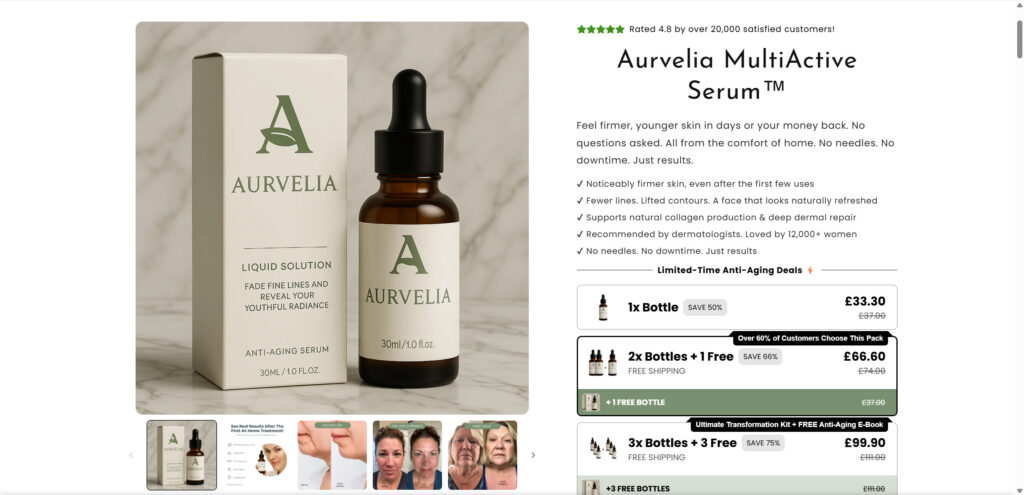
Overview of Aurvelia MultiActive Serum
Aurvelia MultiActive Serum is marketed as a luxury, dermatologist-recommended anti-aging formula. The website presents it as an all-in-one solution for visible signs of aging, including:
- Deep wrinkles and fine lines
- Sagging or crepey skin
- Dark spots, age spots, and pigmentation
- Uneven texture and redness
- Loss of volume and thinning skin
The product page claims that the serum works quickly, with visible results in days, and dramatic transformations within weeks. Some ads even suggest a 95% improvement in skin firmness, brightness, and youthfulness after three months of daily use.
The Big Claims
Aurvelia promises benefits that sound almost too good to be true. According to their promotional materials:
- “Botox in a bottle” – The serum allegedly mimics the effects of injectable Botox, smoothing expression lines without needles.
- “20 years younger in weeks” – Marketing copy suggests users can look decades younger in a short time.
- “Scientifically backed” – The website references clinical studies and dermatologist endorsements, although none are properly cited.
- “Celebrity approved” – Ads often feature photos of celebrities, though these are usually unauthorized stock photos or fabricated endorsements.
- “Money-back guarantee” – Shoppers are promised risk-free purchasing, but refund complaints tell another story.
These sweeping claims create an image of a miracle product, but let’s examine the details more carefully.
Ingredients Analysis
Aurvelia lists the following main ingredients:
- Hydrolyzed Collagen Peptides – Claimed to improve elasticity and moisture.
- Reality: Topical collagen cannot penetrate deep skin layers to rebuild collagen. It acts only as a moisturizer on the surface.
- Hyaluronic Acid – Used to plump fine lines and hydrate skin.
- Reality: This is effective for hydration, but it provides temporary smoothing, not structural anti-aging.
- Argireline (Acetyl Hexapeptide-8) – Marketed as “Botox in a bottle.”
- Reality: Argireline can relax facial tension slightly, but its effects are modest and temporary. It does not replicate Botox injections, which act directly on muscle nerves.
- Vitamin E (Tocopherol) – Antioxidant protection.
- Reality: A common skincare ingredient that helps protect against free radical damage but does not erase wrinkles.
- Cosmetic-grade Botulinum Toxin – Allegedly included in some descriptions.
- Reality: This is highly suspicious. True botulinum toxin (Botox) is a prescription-only injectable neurotoxin. It cannot be legally or effectively bottled into a serum for over-the-counter sale.
The Marketing Style
Aurvelia’s advertising follows a pattern common in online “anti-aging serum” scams:
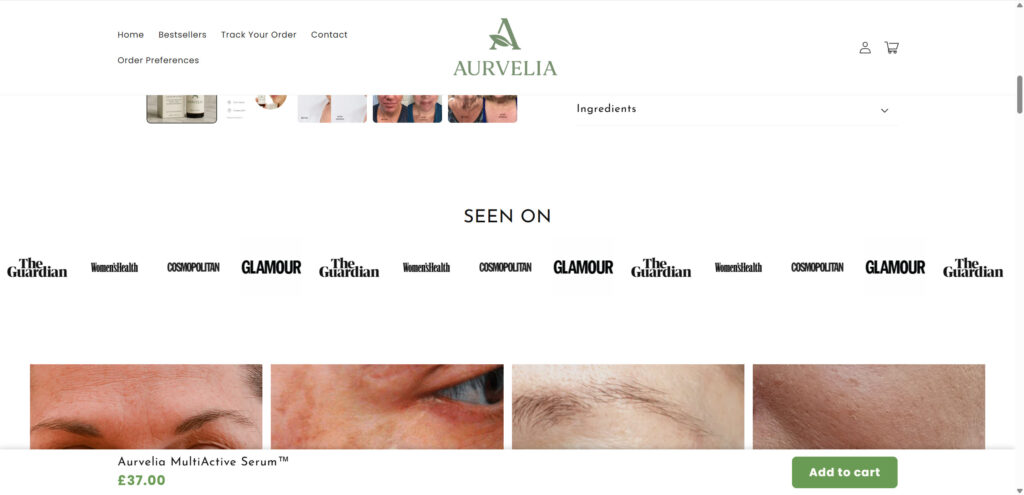
- Fake press coverage – The site displays logos of The Guardian, Cosmopolitan, Glamour, and Women’s Health as if featured in those outlets. Searches reveal no genuine coverage.
- Before-and-after photos – Many images are stock photos or recycled from unrelated skincare products. Some appear digitally altered.
- Urgency tactics – Limited-time deals, “only a few bottles left,” or slashed prices to pressure fast purchases.
- Exaggerated social proof – Claims of 20,000+ satisfied customers and 5-star reviews, but no verifiable review database exists.
This type of marketing is designed to bypass skepticism by overwhelming the consumer with emotional promises and authority cues.
Customer Complaints
Independent reviews of Aurvelia paint a much less flattering picture:
- Non-delivery – Many buyers report never receiving their orders after payment.
- Substandard product – Those who received the serum describe it as a generic moisturizer, not matching the luxury claims.
- Recurring charges – Fine print reveals hidden subscription models, billing buyers monthly even if they thought they made a one-time purchase.
- Ignored refunds – Attempts to claim the money-back guarantee often go unanswered.
- Suspicious packaging – Some customers report receiving unsealed or poorly labeled bottles, raising safety concerns.
How the Operation Works
To understand whether Aurvelia is a legitimate skincare innovation or a scam, we need to look at how the operation behind it functions.
Step 1: The Hook – Aggressive Online Ads
Aurvelia begins with targeted ads across Facebook, Instagram, TikTok, and even YouTube. These ads often feature:
- Sensational before-and-after transformations.
- Fake celebrity endorsements.
- Headlines mimicking real news outlets: “Dermatologists shocked by new serum”.
- Emotional hooks promising to reverse aging overnight.
The goal is to grab attention, create urgency, and push viewers to click through to the sales page.
Step 2: The Fake Authority
Once on the website, shoppers are presented with multiple layers of fake credibility:
- Logos of major magazines implying coverage.
- Stock images of doctors suggesting medical endorsements.
- “Clinically proven” charts with no references to actual studies.
- Customer testimonials that are generic or duplicated under different names.
This gives the illusion of legitimacy, making skeptical buyers lower their guard.
Step 3: The Scarcity and Discount Trap
Aurvelia uses psychological triggers:
- Countdown timers suggesting limited stock.
- Inflated “original prices” slashed by 50–70%.
- Bundled offers like “Buy 2, Get 1 Free” or “Buy 3, Get 3 Free.”
These are standard pressure tactics to push buyers into quick decisions without researching.
Step 4: The Subscription Model
The checkout page is the most critical stage. Many buyers think they’re making a one-time purchase, but:
- Terms often hide recurring subscriptions.
- Default checkboxes may sign users up for monthly shipments.
- Small-print “agreements” allow continuous billing unless canceled within a short window.
This creates a steady revenue stream even if customers regret the purchase.
Step 5: The Product Delivery (or Not)
Reports indicate that Aurvelia may:
- Ship a generic serum from overseas suppliers (likely China).
- Provide fake tracking numbers.
- Deliver late, incomplete, or not at all.
- Send poor-quality packaging with no ingredient safety certifications.
This shows the disconnect between marketing promises and the real product.
Step 6: The Refund Barrier
The final step is minimizing refunds:
- Customer service emails go unanswered.
- Phone numbers, if listed, are inactive.
- Refund guarantees are unenforceable due to offshore processing.
- Some customers are told to return products at their own expense to untraceable addresses.
By the time victims realize, weeks have passed, and charges may already have recurred.
What to Do if You Have Fallen Victim
If you’ve purchased Aurvelia MultiActive Serum and feel scammed, here are steps to take:
1. Stop Further Payments
- Contact your bank or credit card provider immediately.
- Cancel recurring payments or block the merchant from charging you again.
- Ask about a chargeback if the product was not delivered or was misrepresented.
2. Document Everything
- Save order confirmations, emails, and screenshots of the website.
- Keep the product packaging if you received it.
- These records strengthen your case for refunds or fraud claims.
3. Demand a Refund
- Use the company’s listed contact methods (email or phone).
- If they ignore you, escalate through your bank instead.
- File disputes promptly — many banks have a 60–120 day limit.
4. Report the Scam
- File a complaint with your country’s consumer protection agency.
- In the U.S., report to the FTC (Federal Trade Commission).
- In the U.K., report to Action Fraud.
- In the EU, report to your national consumer authority.
5. Warn Others
- Leave honest reviews on Trustpilot, Reddit, or skincare forums.
- Share your experience to prevent others from falling into the same trap.
6. Protect Your Identity
- If you entered sensitive details, monitor for suspicious activity.
- Be cautious of phishing emails pretending to be customer support.
The Bottom Line
Aurvelia MultiActive Serum presents itself as a miracle skincare solution, but the evidence suggests otherwise. From exaggerated “Botox in a bottle” claims to fake press coverage, recycled before-and-after photos, and hidden subscription traps, Aurvelia displays every hallmark of a deceptive online marketing operation.
While the ingredients themselves (hyaluronic acid, collagen, Argireline) are common in skincare, they cannot deliver the extreme results shown in the ads. More importantly, the business model behind Aurvelia raises red flags: questionable origins, poor customer support, and recurring billing complaints.
Should you buy Aurvelia MultiActive Serum? The safest answer is no. It is far wiser to invest in trusted, dermatologist-recommended products from reputable retailers or pharmacies. Real anti-aging progress comes from consistent skincare, sun protection, and medically approved treatments — not miracle serums pushed through misleading ads.
Stay cautious, protect your money, and don’t let flashy marketing override your skepticism.

Reviews & discussion
2 commentsShare a firsthand experience, or ask a question.
Community reviews
Aurvelia MultiActive Serum
Moderated reader experiences, not an editorial verdict.
I wish I had seen this sooner. I fell victim to the scam and within 2 weeks, stopped using it. To my surprise, 6n weeks later I received a refill package I hadn’t ordered and get a refund. I can’t event find the site to stop this nonsense. I will try your suggestions to block the bills from my account.
In reply to mjg
Not being able to find the site again is not you misremembering – these operations abandon a domain once complaints accumulate or the payment processor gets nervous, and reopen under a new name. The refill that arrived six weeks after you stopped using it came from the subscription that was attached to the original order, which continues regardless of whether the website still exists.
Here is the good news: you do not need to find them. Ring your card issuer instead and ask for four things in one call – dispute the refill charge as unauthorised, since you did not order it; revoke the merchant’s recurring authorisation; block the merchant; and issue you a new card number. That ends the billing whether or not the company is reachable, which is the whole point. You generally have up to 120 days per charge, so dispute the original too if it is still in range.
The refill package is legally yours to keep under the FTC’s unordered-merchandise rules – no restocking fee, no return postage – so ignore any demand about it. And if you can still find the merchant name as it appears on your statement, that is worth more than the website: your bank can identify the account from the descriptor. Then five minutes at reportfraud.ftc.gov.